Category Archives: Travel – Italy

Venice, Italy – Alfred Hitchcock’s Inspiration

Have you ever wanted to sound like the world’s biggest a-hole and  alienate multiple friends, all in one fell swoop?  If so, pay close attention and do exactly as I say.  Kind of roll your eyes a little bit in an exaggerated act of annoyance and say the following words with the smug impatience of someone who thinks they’re as classy as Ivanka Trump (but really only has as much class as her father, ‘The’ Donald).  Repeat after me:

“Ugh.  We have to go to Venice… again?!  Bleeeehh.”

Do that, and you are sure to land on the top of most people’s sh*t list!  At the risk of losing blog readers, friends and maybe even a few family members… that is exactly how we felt recently when we went back to Venice.  I can fully appreciate this is a ridiculous thought to have and even more obnoxious to share… but hey, this is a blog that delivers brutal honesty.  When we booked our cruise with Celebrity Cruises a little while back, we did it despite the fact that the ship spent two days at port in Venice.  Don’t get me wrong, Venice is a beautiful city with a unique charm found nowhere else in the world. If you’ve visited Venice before, you may reminisce about the romantic gondola rides, the charming cafes and the stunning churches.  But when you’ve faced with a visit to Venice for the fifth time, you are more likely reminded of the crowded piazzas, overprices restaurants and long lines full of pushy tourists.
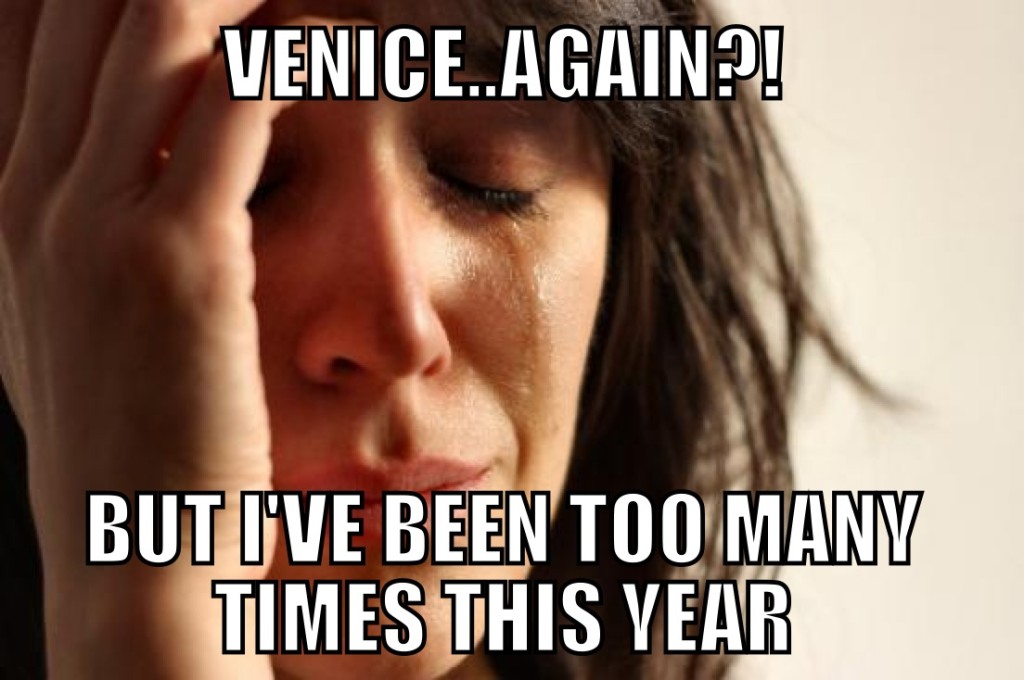
See,
See… “First World Problems Girl” gets it!

Venezia (Venice) has an alluring history that I find to be more fascinating than nearly any other city in the world.  I mean, the entire city has been floating on water for centuries, for Pete-sake!  I detail a brief explanation  of how Venice came to be in this blog post (definitely worth a quick read).

Doge's Palace with San Marco Campanile in the background
Doge’s Palace with San Marco Campanile in the background
The Lion of San Marco perches atop a tall pillar outside of the piazza

Even though we weren’t very excited at the prospect of squaring off against millions of other tourists in a space not much larger than the Mall of America, we abandoned our original plans to stay on the ship and instead ventured onto Venice’s shores.  We were sure glad that we did!  Over the next two days we rediscovered a new Venice; one with more magic and charm than we ever realized was possible.  What’s the difference, you ask?  We were walking around in the off-season.

Our cruise ship sailed in just as the sun was rising
The early morning light cast over the city of Venice is a stunning sight

The weather was cold and the droves of tourists were nowhere in sight. We were able to deftly weave betwixt the shops, restaurants, churches and museums with ease.  The horrid memory of sweating in lines and pushing through crowds became a thing of the past. Strolling down streets and visiting historical sites became pleasant and stress-free.  We fell in love with the city all over again.  It was as if we had undergone marriage counseling with Venezia and came out stronger and more in love than ever before.

Gondolas on the water
San Giorgio Maggiore Church
Doge's Palace
Doge’s Palace

In the past, we had rushed from attraction to attraction, trying to “pack it all in”.  Of course, this is impossible to do – the city boasts art and architecture in abundance.  Combined with the heat and the dense crowds of the past, we have enjoyed Venice – but haven’t been in love with the city since our magical first visit.  This time, it was completely different.  Since we didn’t feel any pressure to see the main sites – we decided to take it slowly and just be in the moment. Our second day was even better when we opted only to see the attractions on the second and third pages of most guide books.

We were lucky to have such  a beautiful day - spectacular weather
We were lucky to have such a beautiful day – spectacular weather

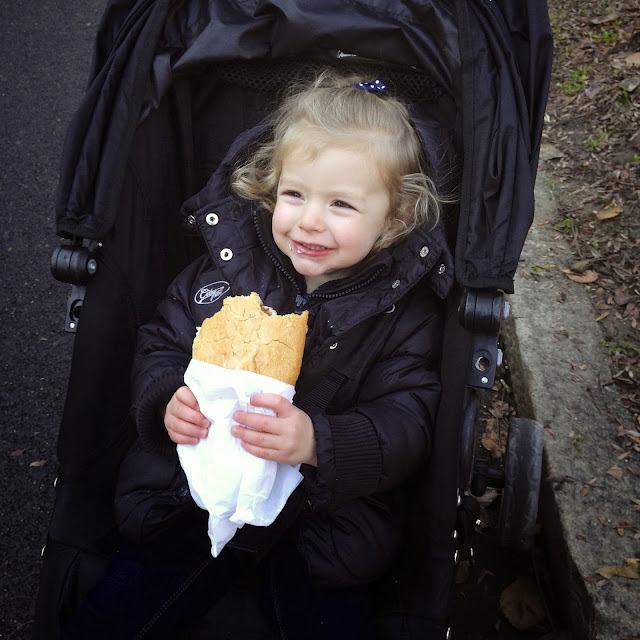
First, we spent a bit of time walking through the winding and narrow streets.  Our goal was simple – to stay away from the main square, Piazza San Marco as long as we could, fearing the worst (we still didn’t know just how “wide open” the city had become).  We stopped for a quick sandwich around 10:30am because Julia was hungry.  We found a great little wine bar, far from the main “touristy” areas.  We discovered locals coming in and enjoying glasses of wine at the bar.  I thought…“well, why not?!”  If the locals can enjoy a mid-morning wine and Julia can enjoy a mid-morning salami sandwich, why shouldn’t I join in the fun?  I ordered a nice Valpolicella Ripasso – a wonderful wine local to the region.  I got a nice big pour for €4.  “Wait, so if you don’t crowd into the main spots – food and drink are priced reasonably?!” 

A gondolier takes a break to feed his friends
His craft was parked nearby awaiting a fare
The canals are always beautiful - any time of day
The canals are always beautiful – any time of day
We started to discover just how empty the city was
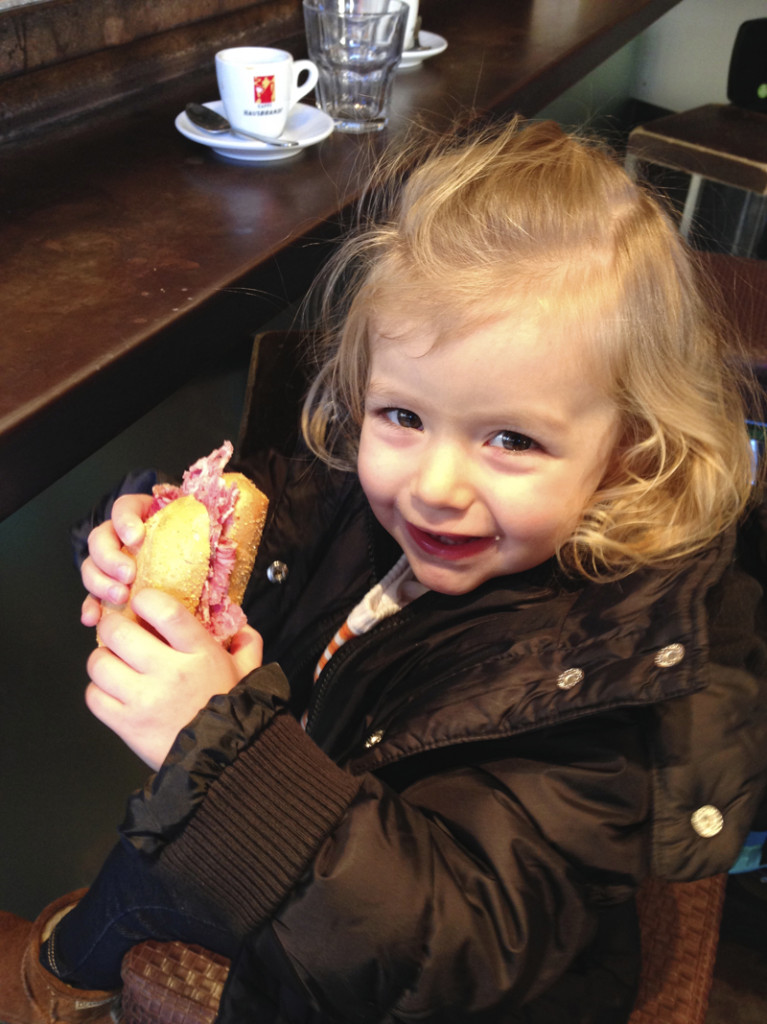
Julia insisted on stopping for a mid-morning salami sandwich
Jen and I stop for a photo on Ponte di Rialto (Rialto Bridge)
It was chilly, so we warmed up with some vin brulé

Eventually, we did wind our way into Piazza San Marco and found that our pleasant morning was a precursor to a pleasant afternoon.  I have never seen the square so wide open.  We walked right into Basilica di San Marco – something I thought was impossible without waiting for at least an hour or two!  We took in the rest of the sites, including the Procuratie VecchieCampanileLoggetta and Torre dell’Orologio.  But the absolute peak of the day was when we fed the birds.  We had a blast watching Julia get swarmed by dozens of pigeons.  A highlight of the entire cruise, for sure!  I can’t confirm any truth to the rumors that these pigeons inspired Alfred Hitchcock’s film, The Birds (mainly because I just started that rumor to suit this post’s title) – but being swarmed by dozens of these winged beggars felt like we were on the set of the movie itself.

Ponte dei Sospiri (Bridge of Sighs) is usually tougher to photograph with tourists pushing for position
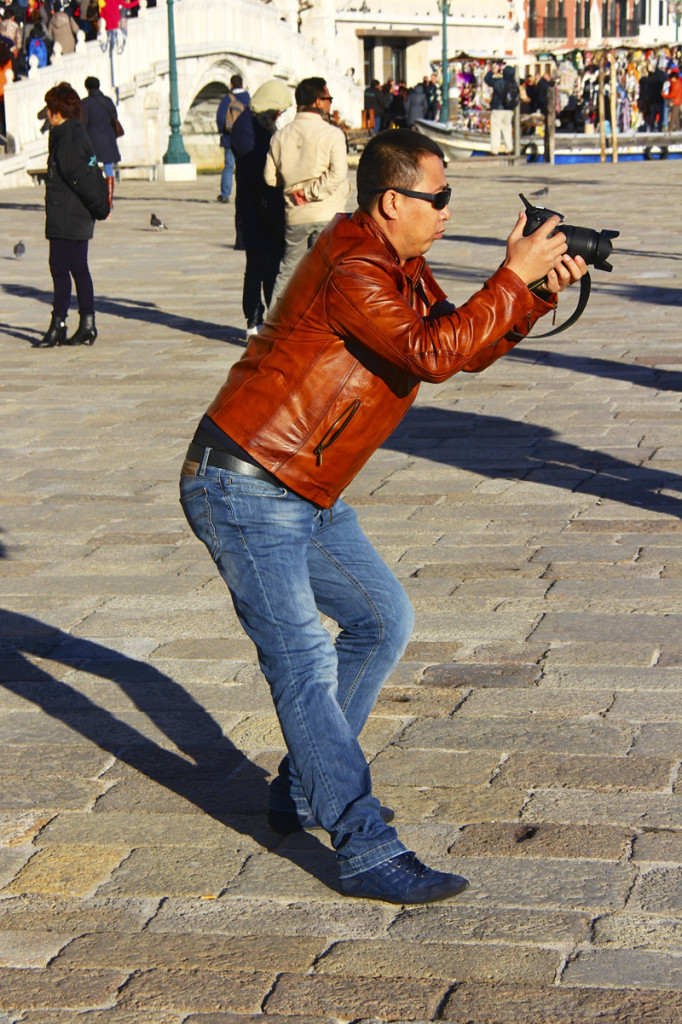
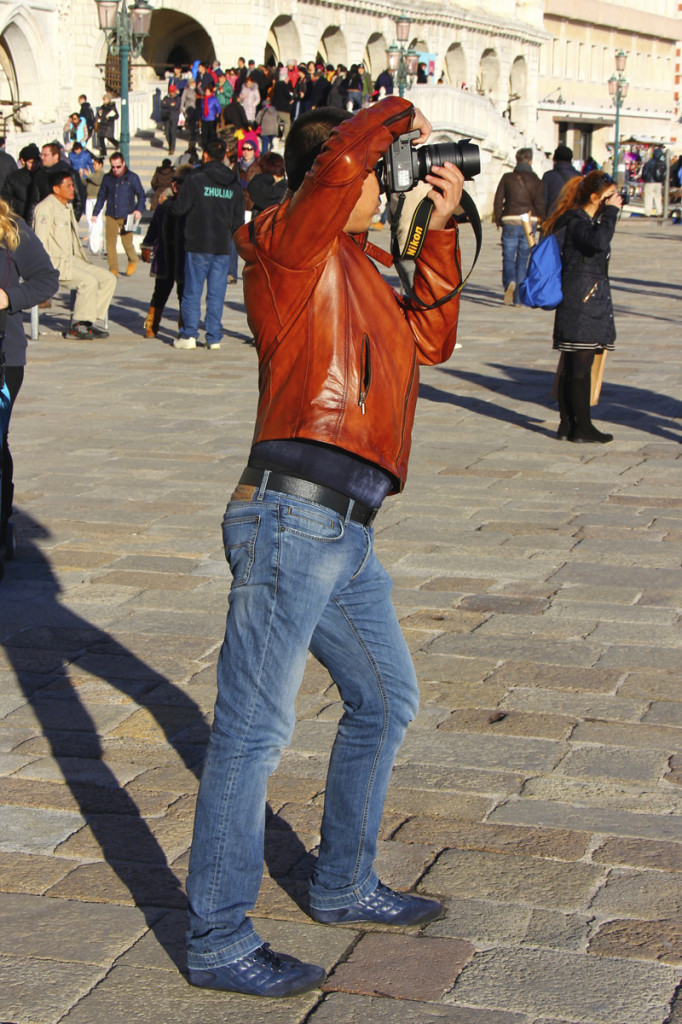
I LOVED this guys photography pose
You've got to remain in a stylish pose while you check your work
You’ve got to remain in a stylish pose while you check your work
Jen and I pose in front of the Canale Della Giudecca
We were able to stroll right in to Basilica San Marco
Julia lights a candle and says a little prayer
Jen and Julia in Piazza San Marco
Julia loved being in the wide open piazza
She took time to explore on her own
Once again, she was a hit with other tourists who wanted to take photos with her
She decided to start feeding the birds
“Whoa! Mom..Dad – I got one!”
I showed her how to get more than one bird
Which worked out better than expected... that's Julia hidden behind a wall of birds
Which worked out better than expected… that’s Julia hidden behind a wall of birds
That was about the same reaction that Julia had

Buckle up, because our next stop is our second day in Venice.  I think I’ll call it “Venice Like You’ve Never Seen Before”.  We rise early to visit the fish market as well as the islands of Murano for a glass blowing demonstration, tour the painted houses of Burano and round out our visit with the ancient church on Torcello.  Most people forget, Venice has more to share than just the main island!

An older building shows a unique beauty that only Venice can provide
We returned to our ship as a beautiful sun was setting on the Grand Canal

The City That Inspired the Renaissance

The Renaissance was a cultural movement that spanned three centuries and gave us some of the world’s most precious treasures.  It changed the way people thought, it altered politics and it had an impact on art and architecture that lasts to this day.  The exciting changes in art and philosophy reached across Europe and quite literally brought people out of the Dark Ages and into the light of a new era.  There is little debate about the birthplace of the Renaissance; nearly all scholars will agree that it is Florence, Italy.  Because of the city’s important impact on the world as we know it, as well as it’s own unique beauty – Florence is a city that everyone should see in their lifetime.  If those are not compelling enough reasons, Florence is in Tuscany – one of Italy’s most beautiful regions.

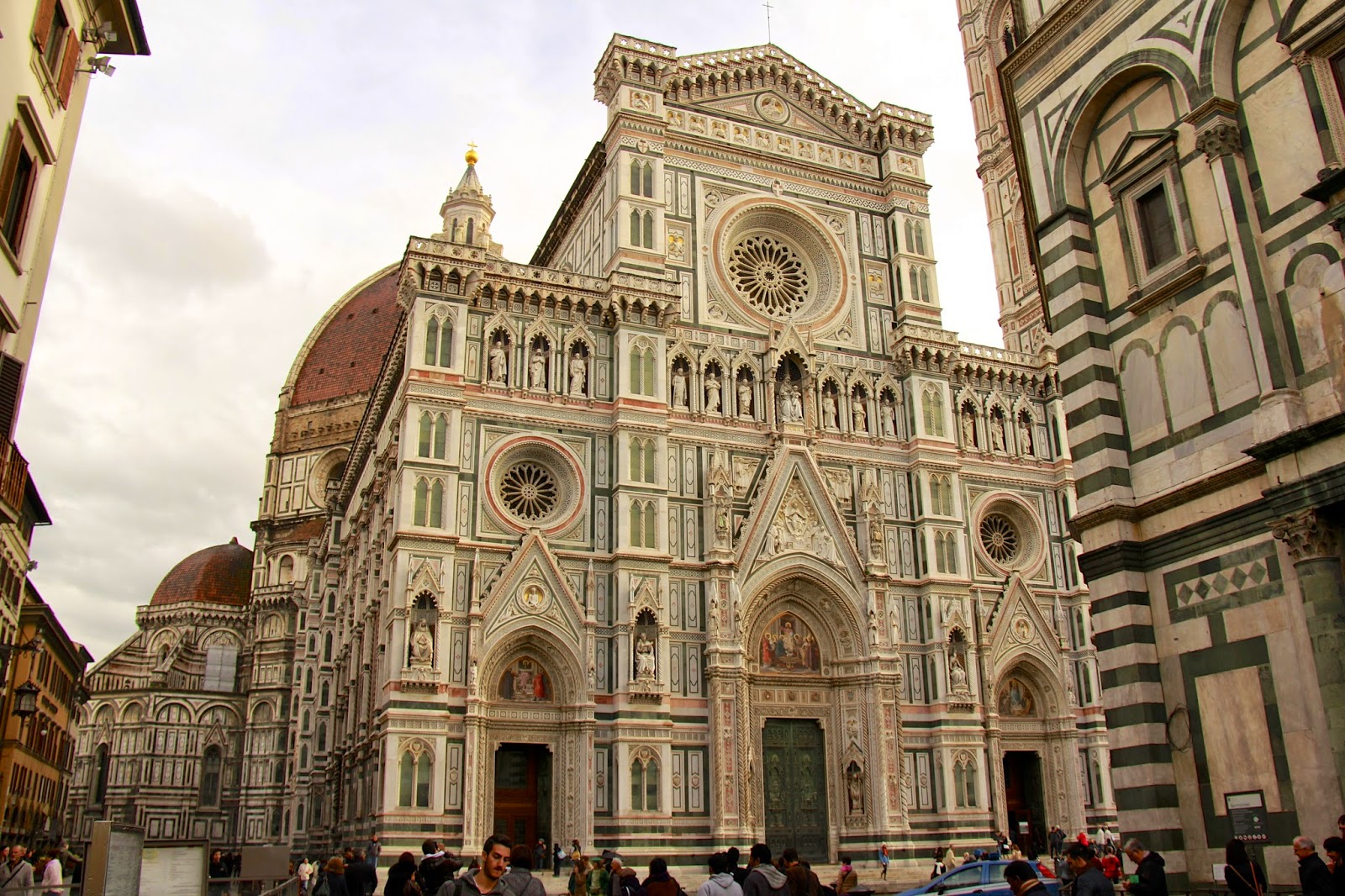
Basilica di Santa Maria del Fiore – the famous Duomo of Florence

We recently embarked on a cruise aboard Celebrity Cruises new ship, the Silhouette.  We chose this particular cruise for a variety of reasons; among the most convincing was the itinerary.  We have wanted to visit certain parts of Italy, including Florence and parts of southern Italy.  The ports of call fit in with our “Italy bucket list” perfectly.  We spent two days (HERE and HERE) in the bejeweled city of Rome before we set sail and woke up the next day in Livorno.  Livorno is a port city in Tuscany that has access to some of the region’s most renowned cities.  Cruise-goers opted to visit FlorenceSiena or Pisa or the smaller towns of Volterra and San Gimignano.  We always knew that we would venture to Florence; the only question was how we would get there.  If you read any of my previous posts from our summer cruise (HERE, HERE, HERE) – you’ll know that I am not a fan of booking daily excursions through the cruise line.  On a positive note, booking through the cruise ship is easier and they do offer some great itineraries.  But it is often five or ten times the cost of organizing the day trips on your own.  Armed with that knowledge, we bypassed the cruise’s tour buses and instead opted to visit Florence by train, given its far away proximity to the port city.

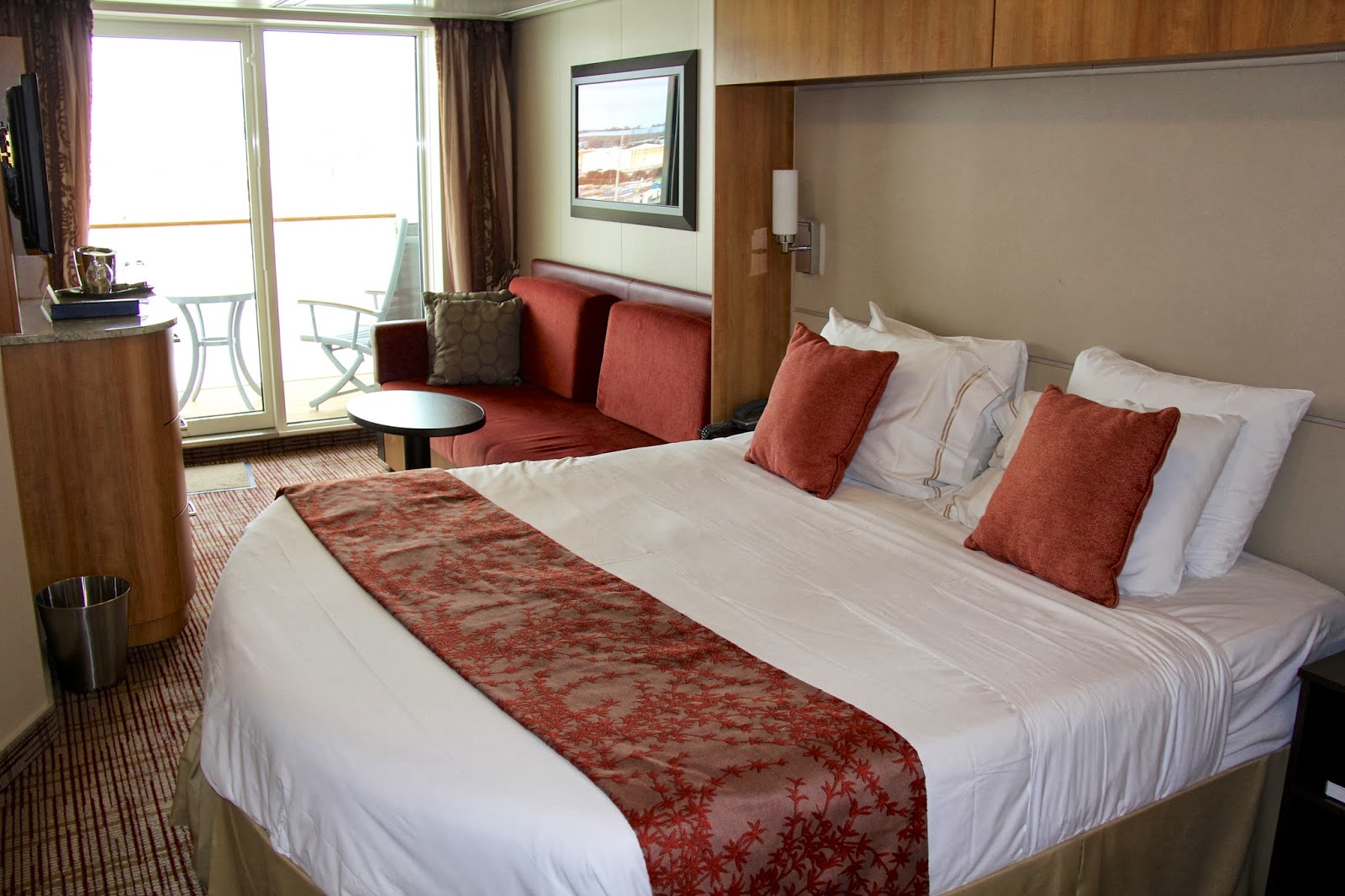
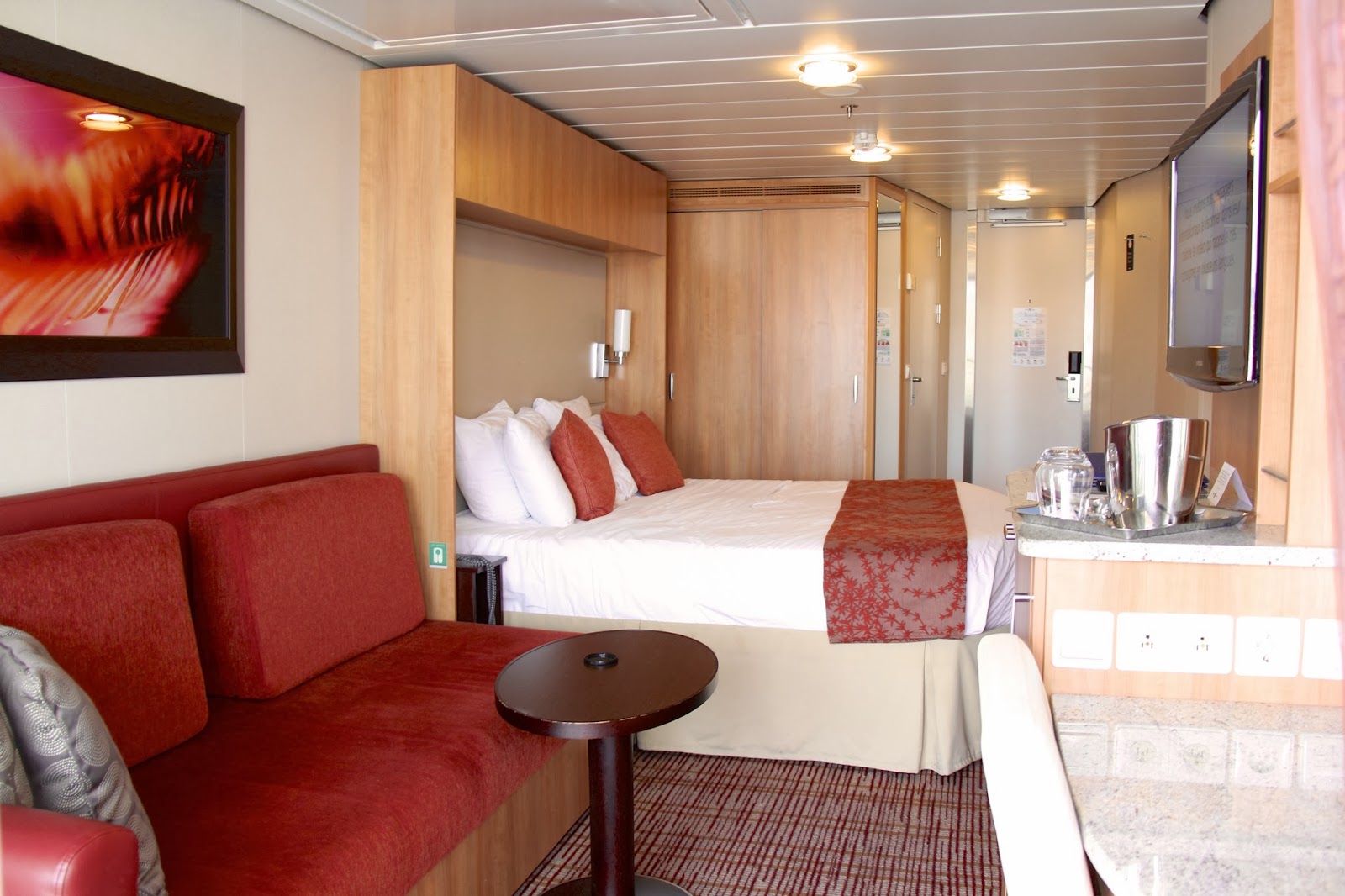
Our suite aboard Celebrity’s Silhouette
We found the room to be spacious and very pleasant for a cruise ship
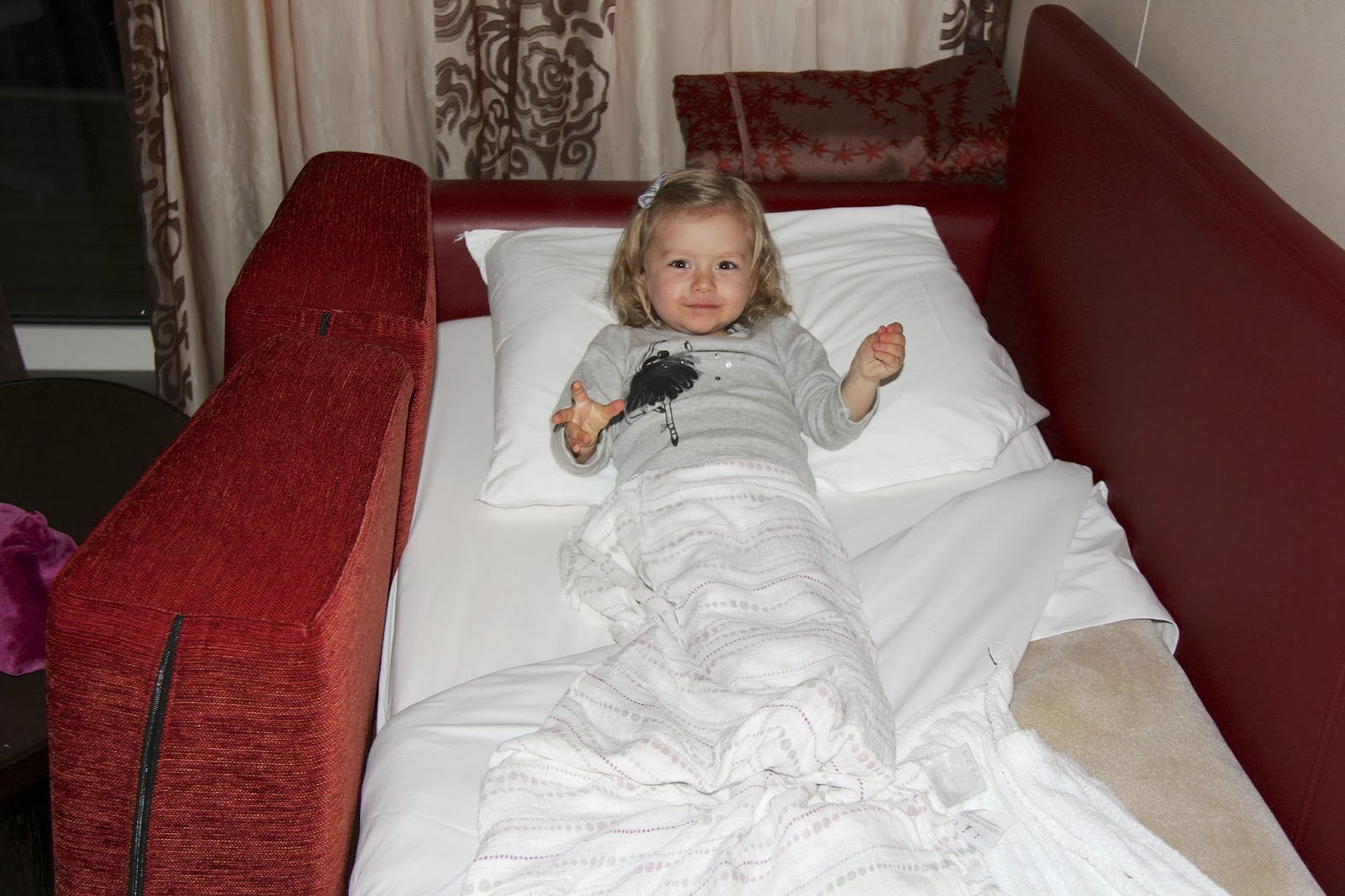
Julia got to sleep in her first “big girl” bed

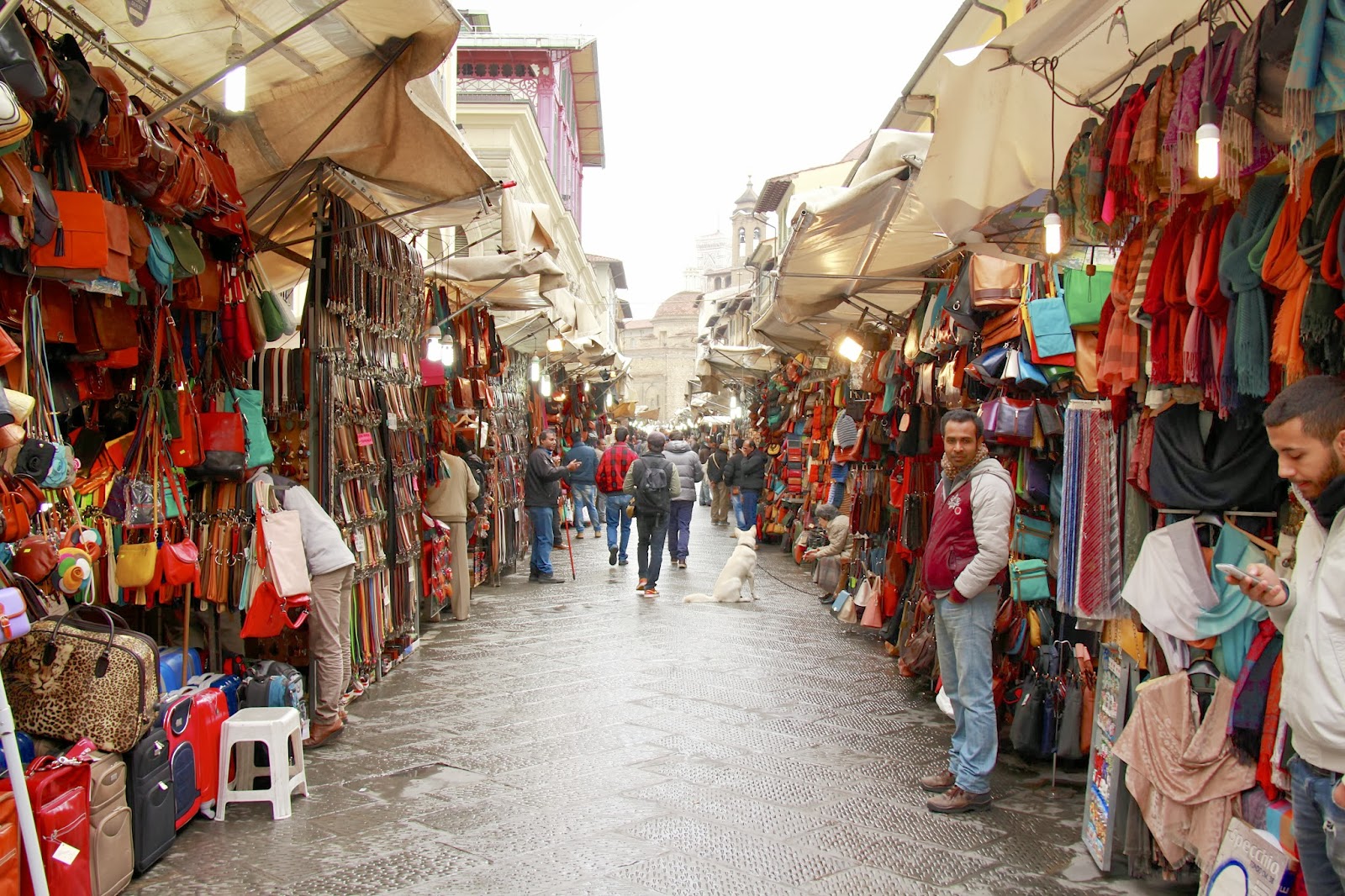
After over an hour on the train, we arrived in Florence eager to soak up the sights and the culture. My uncle had left us a great guide book on his previous visit, so we had a rough idea of how we wanted our day to evolve.  I bought a city map for a €1 from a guy selling them on the street and confirmed our route.  We first strolled through one of Florence’s main markets.  The city is well known for their leather goods and we wanted to see what they had.  As we continued our tour along the city streets, the sky decided to open up.  Our plan had been to soak up sights and sounds of Florence and instead we simply ended up getting… soaked.

Florence boasts great markets – they are renowned for their leather products

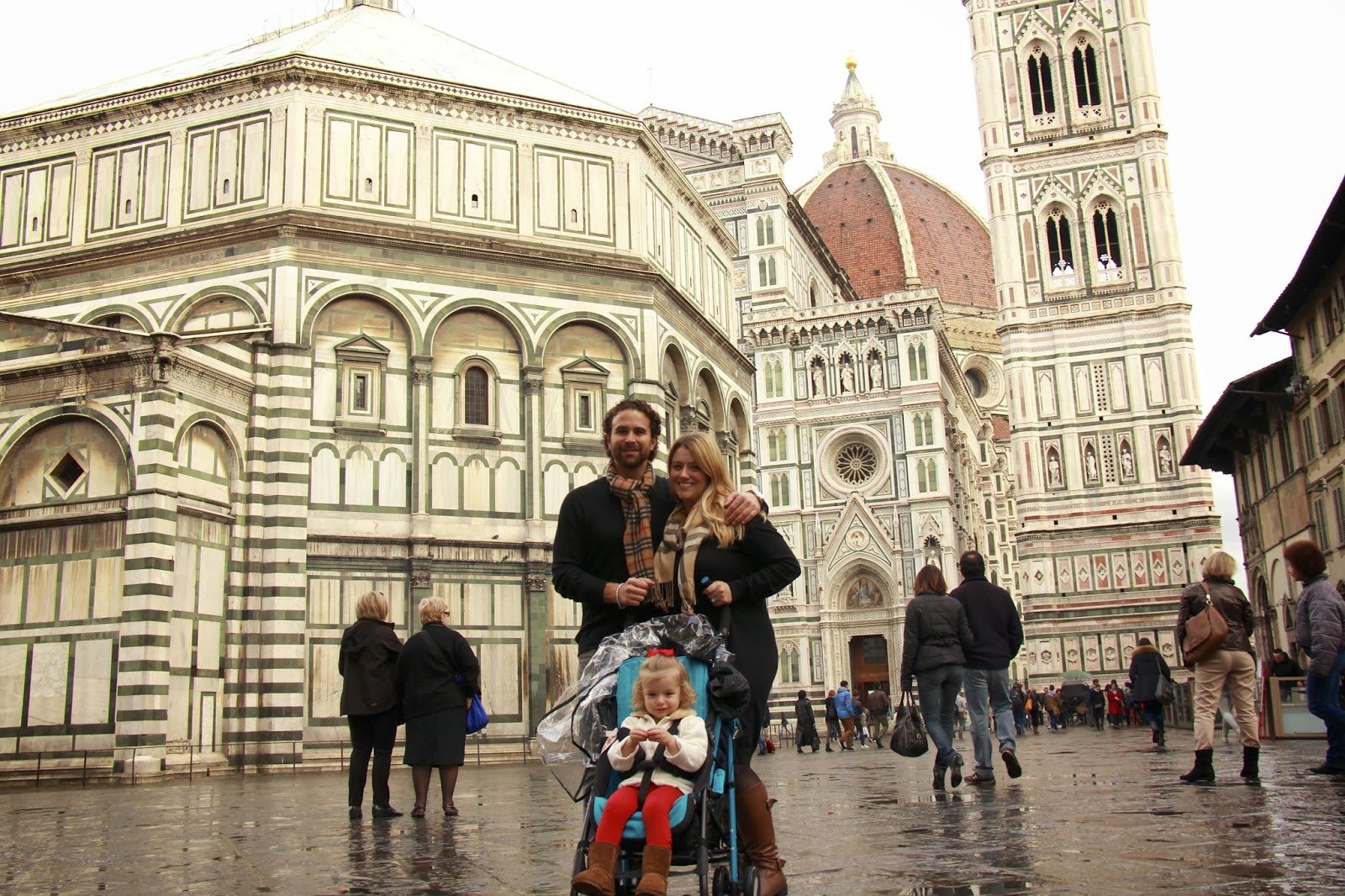
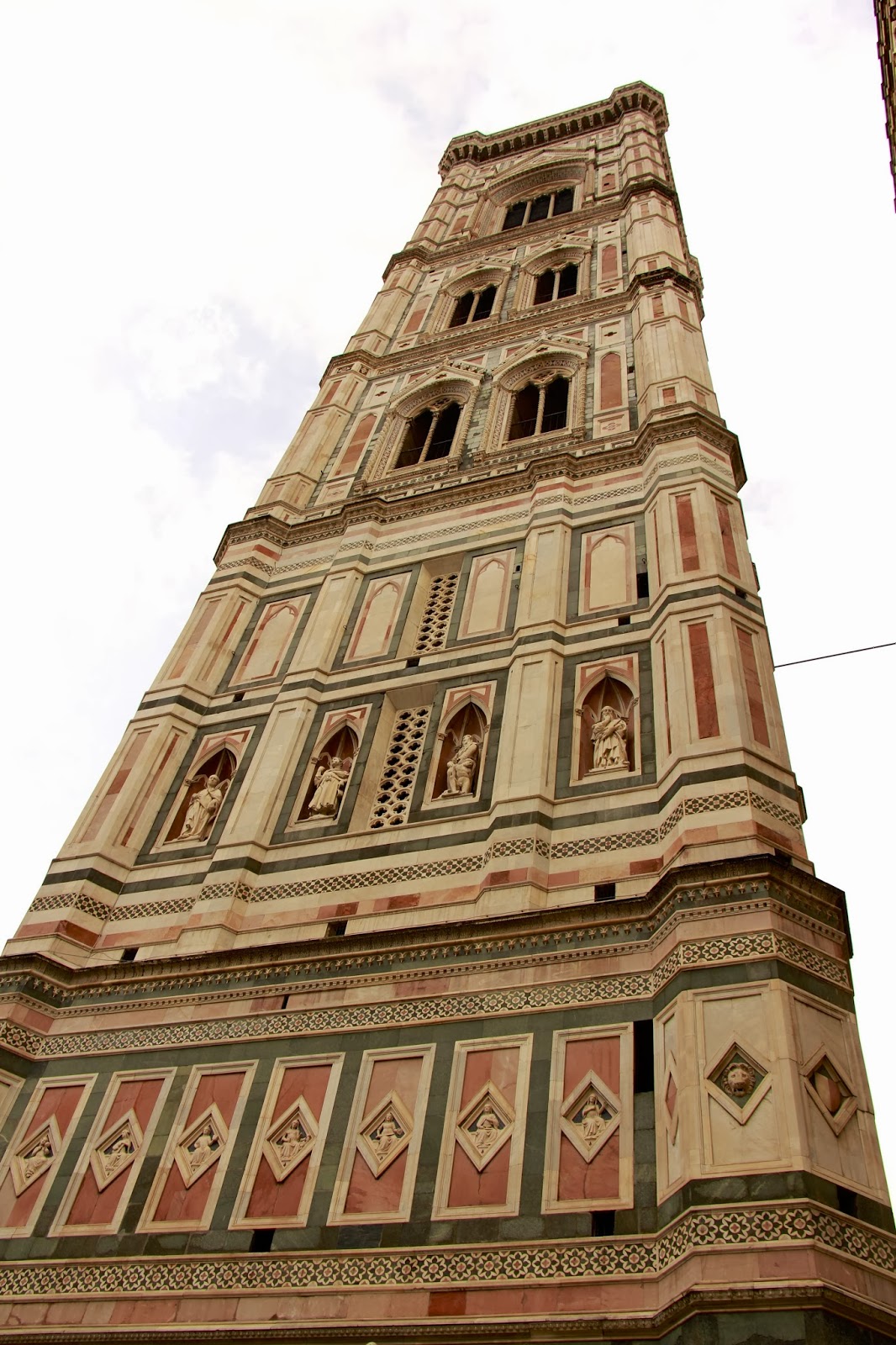
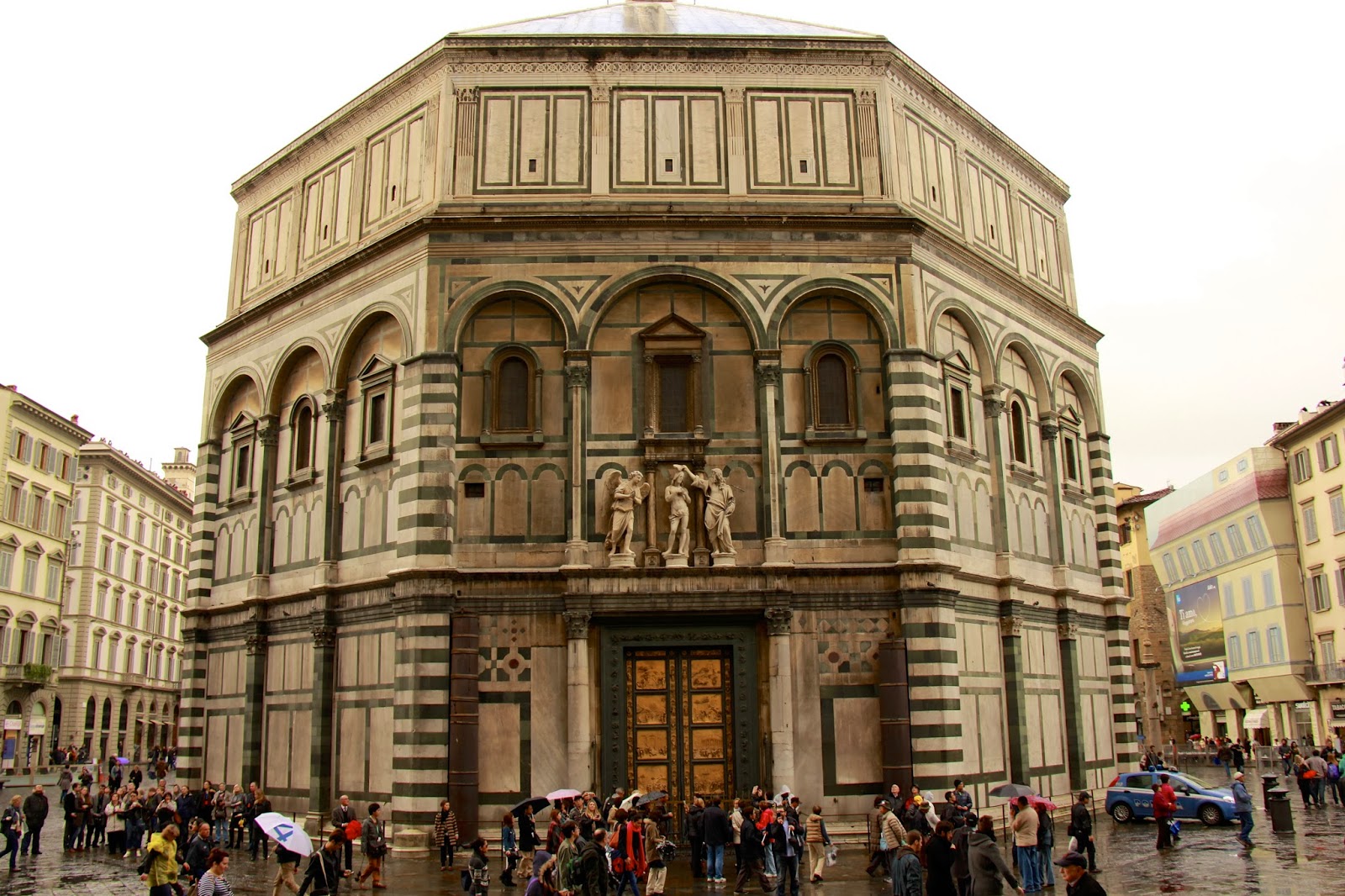
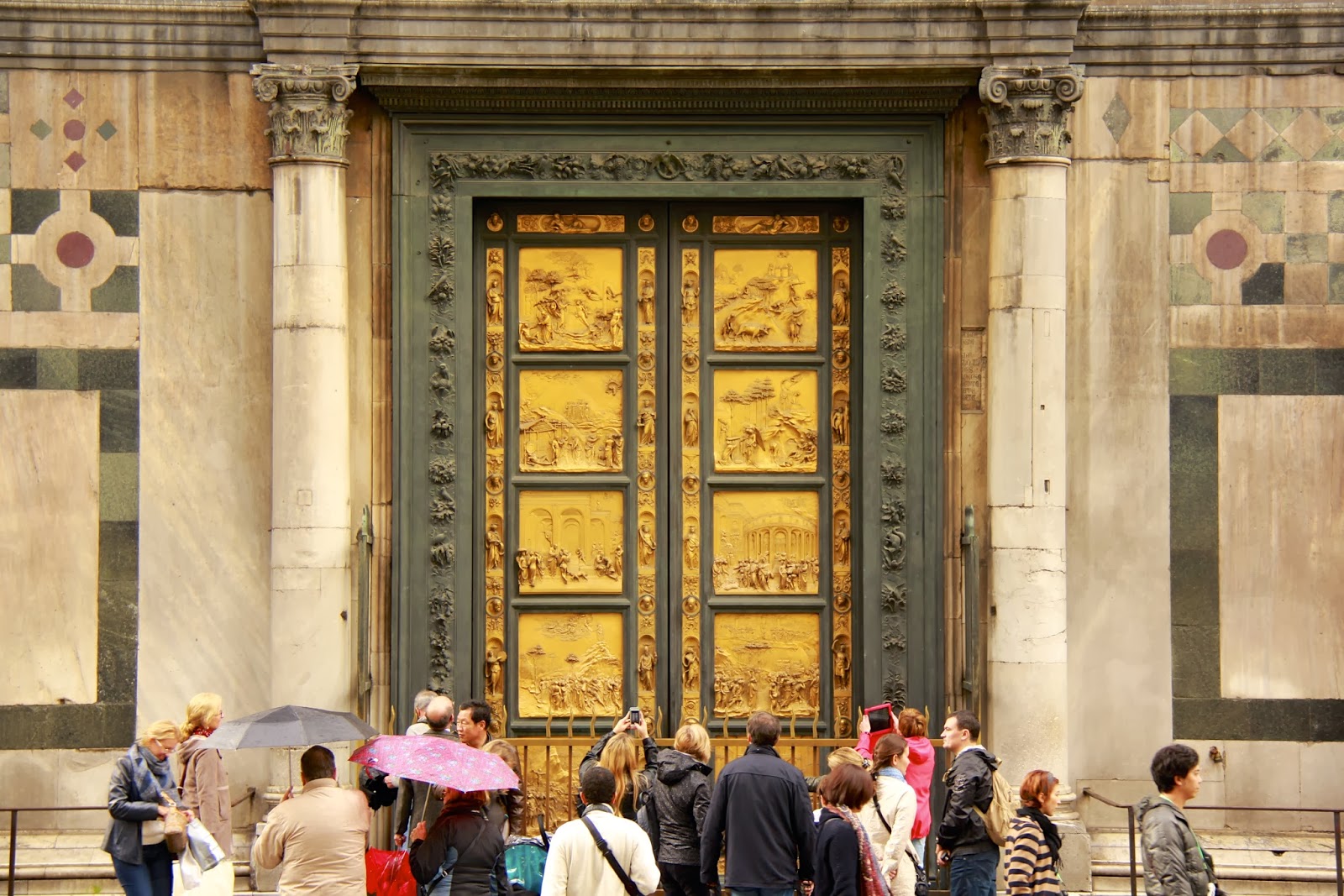
After trying in vein to stay dry under the canopy of a shoe store, we decided that pushing on was our only option.  So we walked past the Medici Chapels and Basilica of San Lorenzo.  We strolled down the puddle-filled Via Cavour and arrived in the Piazza del Duomo.  The piazza houses three very important architectural triumphs.  Giotto’s Campanile (bell tower) is a showpiece of Gothic architecture.  The Battistero di San Giovanni (Baptistery of St. John) is one of the oldest buildings in the city, constructed in the Romanesque style.  The octagonal building once served as a Roman temple constructed to honor Mars, the tutelary god of Florence.  Today, the baptistery is most famed for it’s eastern doors, known as the “Gates of Paradise”.  Constructed of gilded bronze, the doors feature ten intricate panels that depict scenes from the Old Testament.  Most people don’t realize that the doors on display are actually replicas (the originals are kept in Museo dell’Opera del Duomo).  Even though they are not the “real deal” it is still amazing to behold the work of Lorenzo Ghiberti, a project that took him twenty seven years to complete and has been described by art historian Antonio Paolucci as “the most important event in the history of Florentine art in the first quarter of the 15th century”.

We stop for a family photo in the Piazza del Duomo  
Giotto’s Campanile (bell tower) offers some of the best views of the city
The Battistero di San Giovanni is an octagonal shaped structure
The impressive bronze-gilded doors referred to as the “Gates of Paradise”

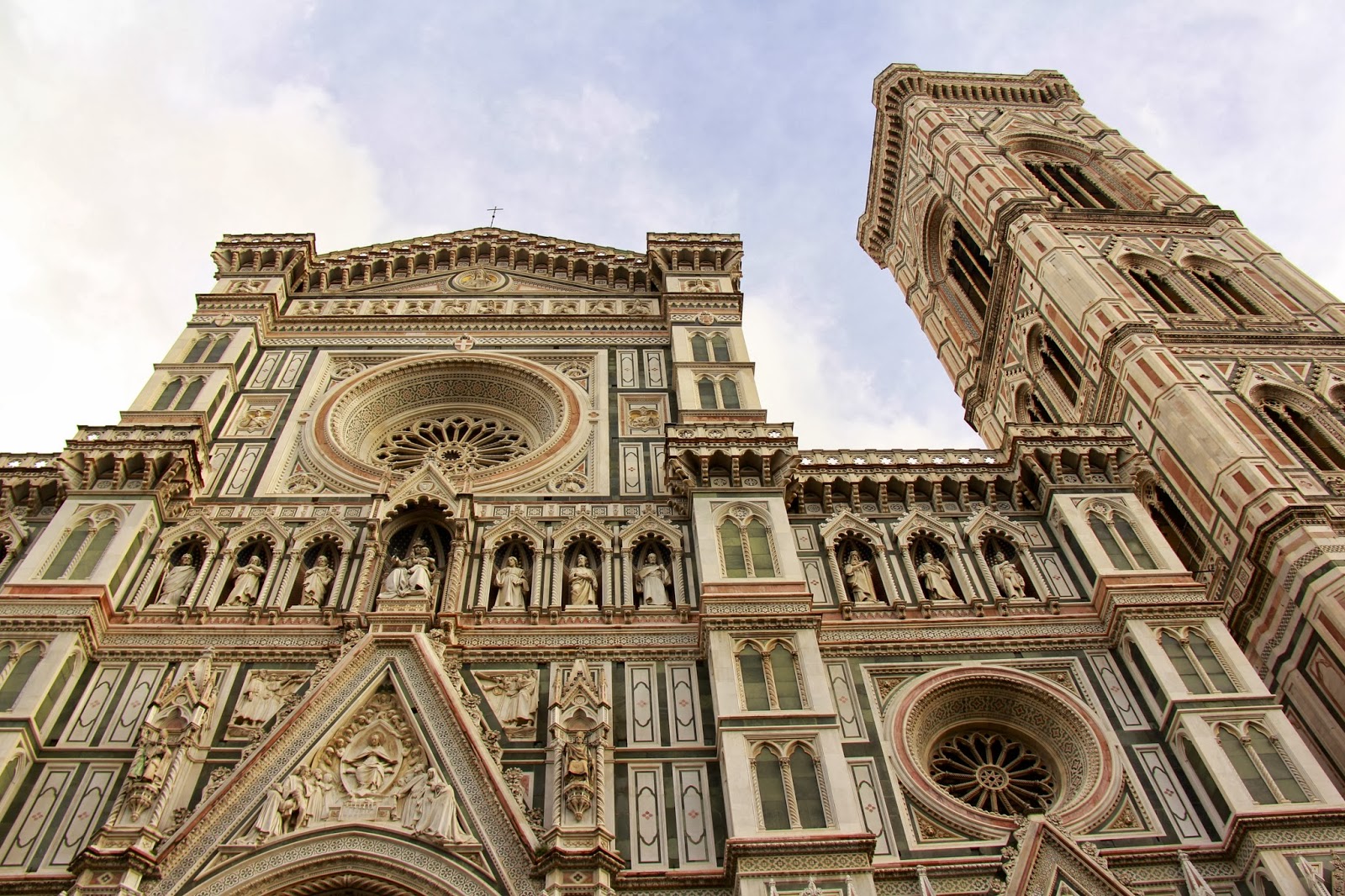
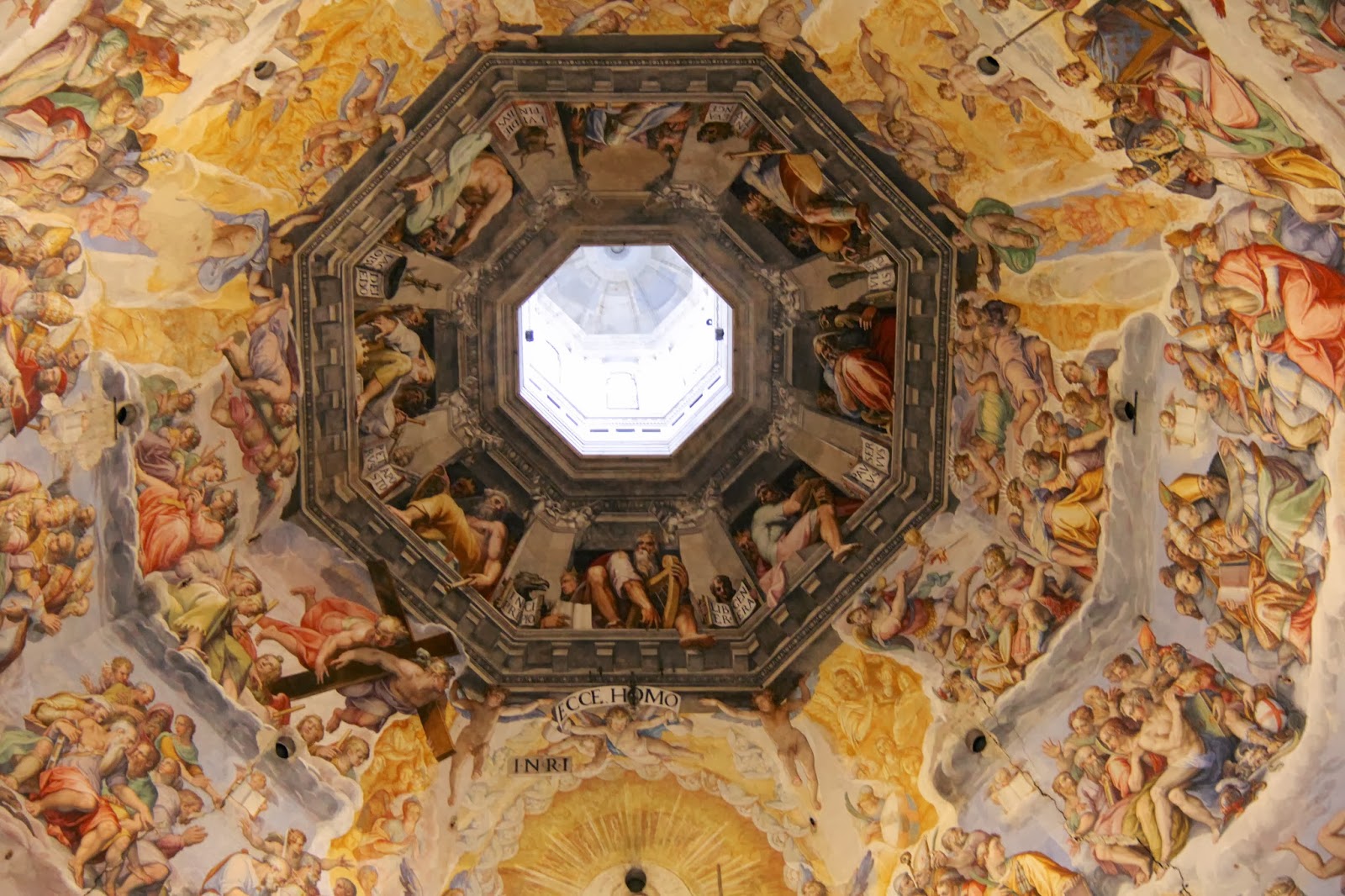
The third and most renowned attraction in the piazza is the Basilica di Santa Maria del Fiore or as it’s most commonly referred, Duomo di Firenze (Florence’s Dome).  Construction began in 1296 in the Gothic style and was finally finished in 1436 in the Gothic Revival style with the completion of the famous dome.  So much time had passed during construction that Gothic architecture had been all the rage, became “totally uncool” and then turned “retro and hip” again before the church was finished!  The construction of the dome was overseen by the famed architect and master goldsmith, Filippo Brunelleschi, spanning sixteen years (1420 – 1436).  Although, the history of the dome dates back much further – the commission was awarded to Brunelleschi in 1418 based off Arnolfo di Cambio’s original design of the dome, dating back to 1296.  In fact, the church was completed in 1380 with only the dome remaining incomplete (a period of 40 years stretched across the completion of the church and the start of the dome).  The main reason for such a long gap in time? Nothing had ever been engineered at quite this high level of intricacy and it took someone 40 years to come up with a good solution.  The end result is nothing short of an engineering marvel.  The design and construction of the dome is largely considered one of the first events marking the Italian Renaissance.  Together, the three structures in the piazza (the Duomo, the Battistero and the Campanile) are a part of UNESCO World Heritage Site, covering the historic center of Florence.
The basilica with the famous dome shown
The front façade is composed of various marble from within Tuscany
The fresco in the central dome was begun by Vasari in 1568 and finished by Zuccaro in 1579
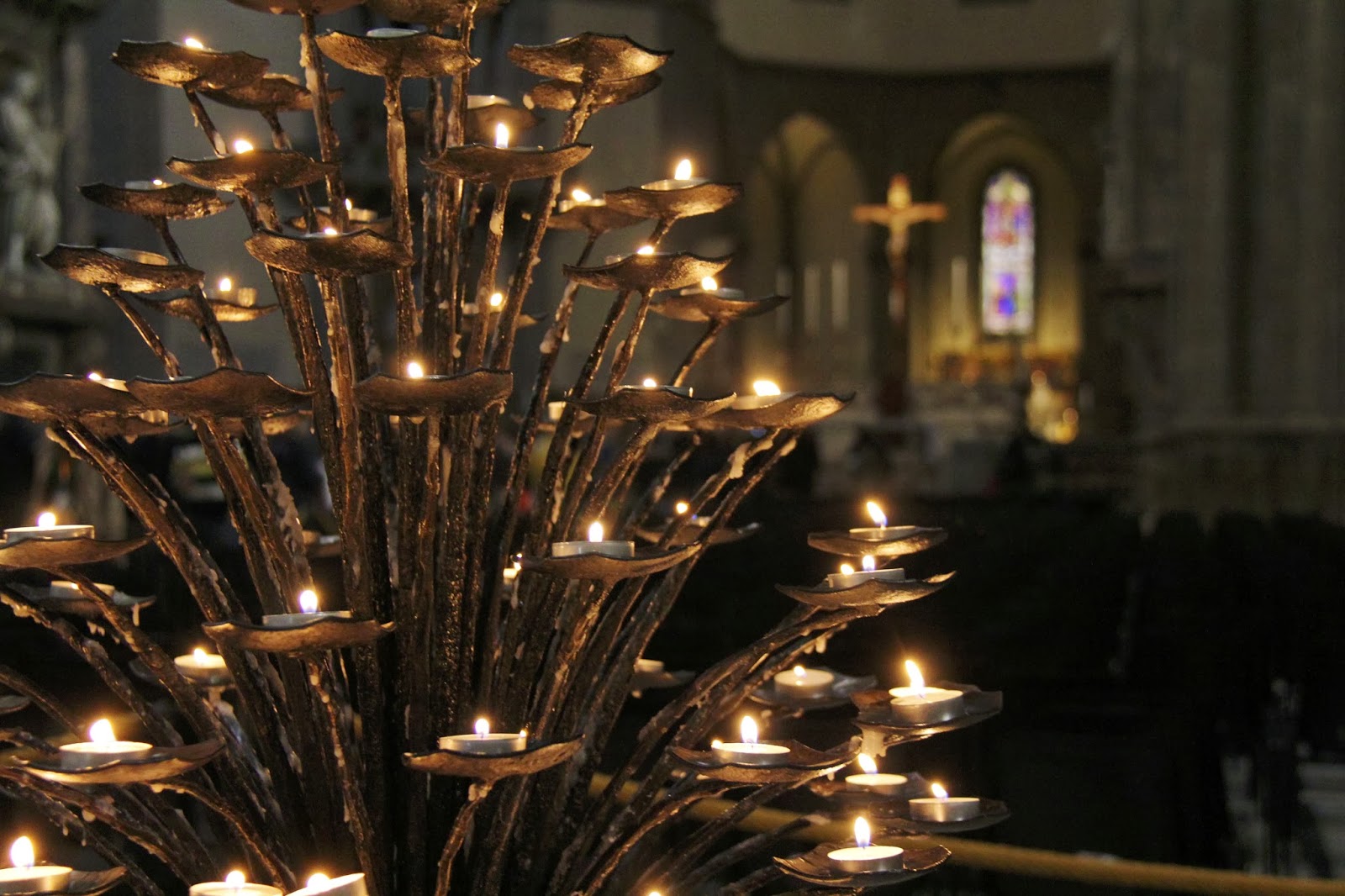
Inside the cathedral

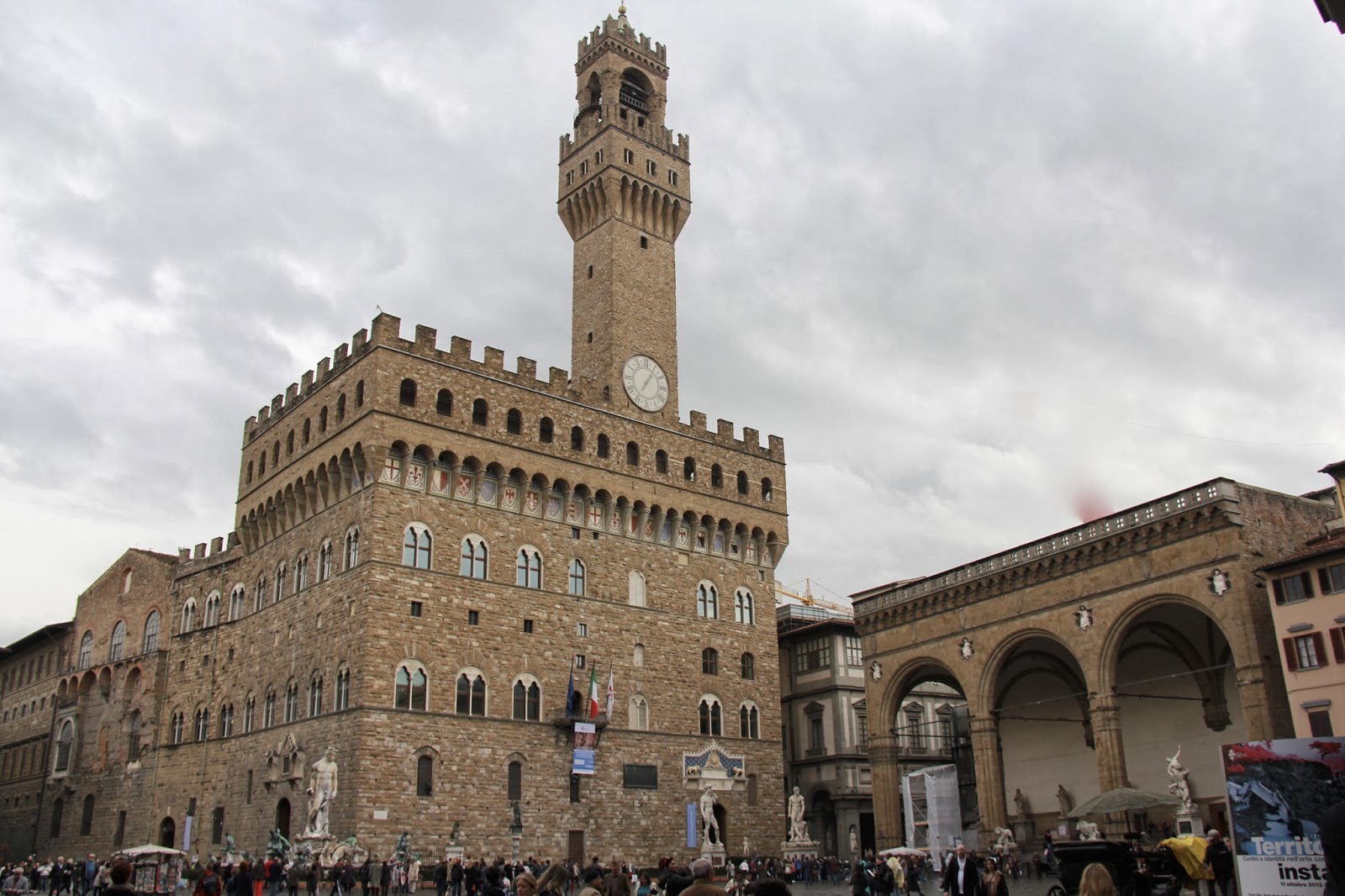
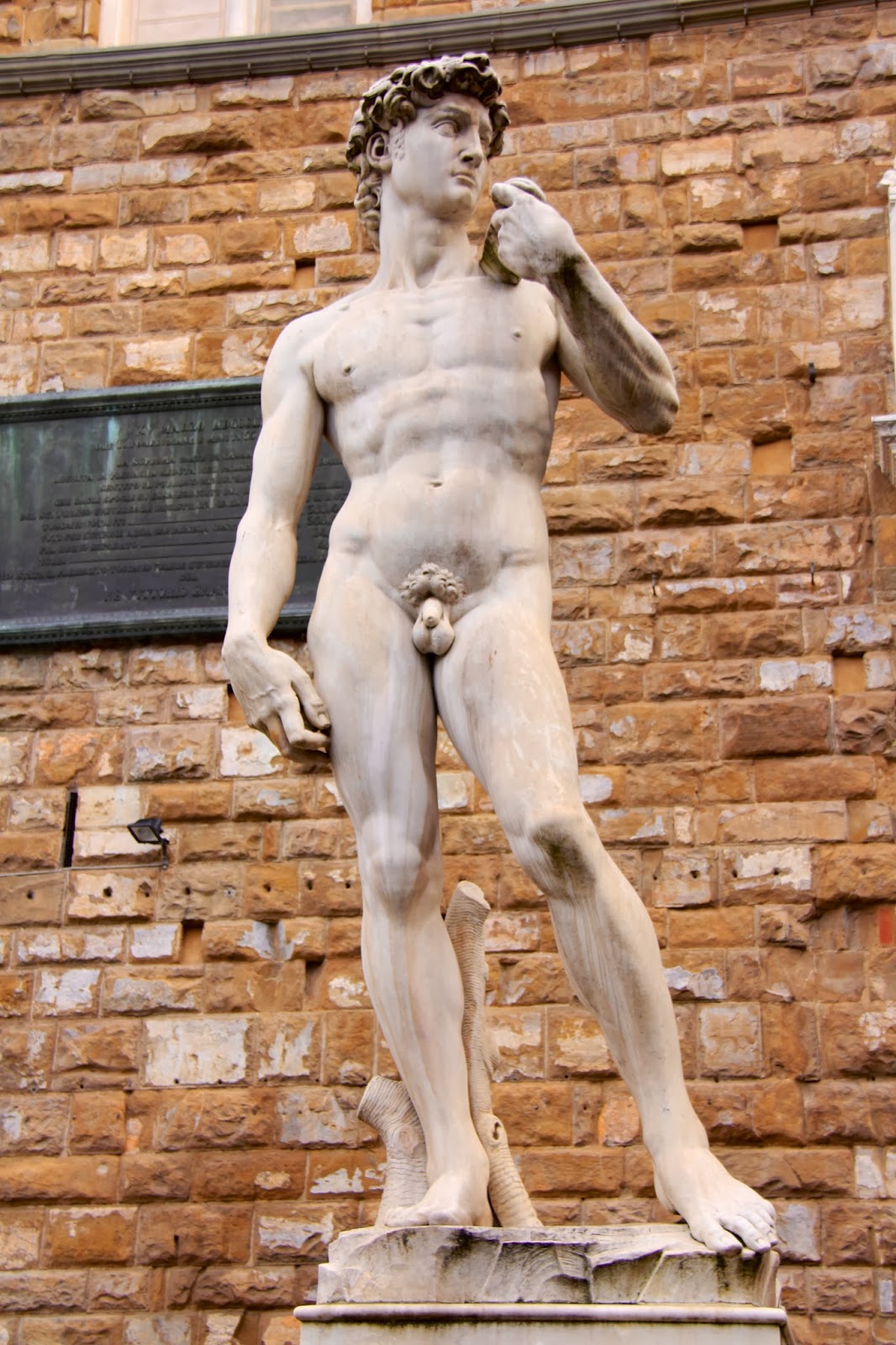
Next up was a visit to the Piazza Della Signoria and a visit to the Palazzo Vecchio (Old Palace). This impressive Romanesque fortress stands today as Florence’s town hall.  A replica of Michelangelo’s David stands at the front gates.  The original marble statue carved by the young artisan stood at the entrance from its completion in 1504 until it was moved in 1873.

The Palazza Vecchio inside Piazza Della Signoria 
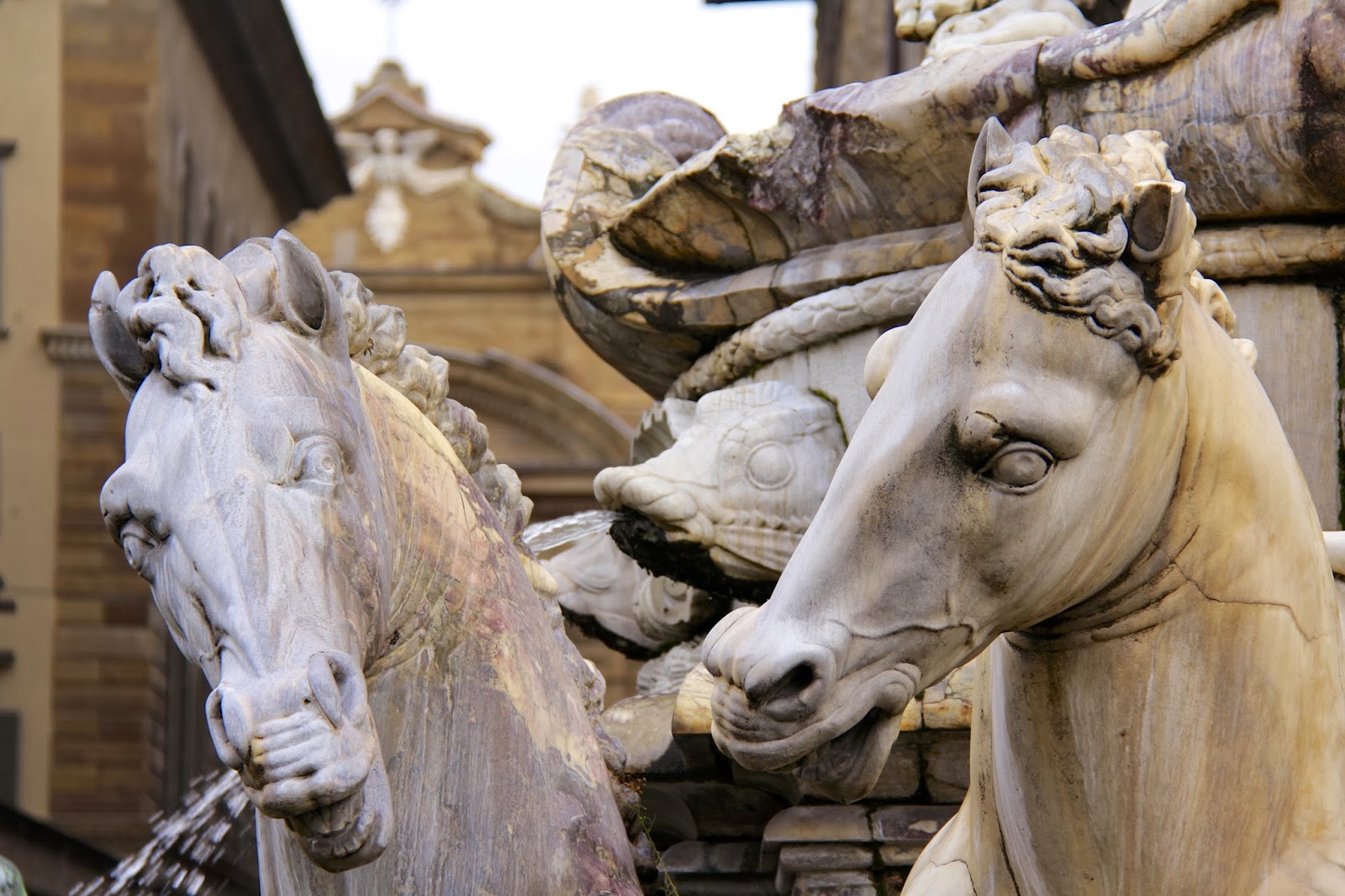
The Fountain of Neptune by Bartolomeo Ammannati commissioned in 1565
An exact replica of The David stands in the location of the original

We concluded our tour of the city by crossing over the Ponte Vecchio (Old Bridge).  To fully appreciate the bridge, you first need to learn a little bit about one of the most powerful families of all time – the Medici family.  The “House of Medici” was the preeminent Tuscan family that first attained it’s wealth and political power in Florence during the 13th century.  Their successes in banking and commerce cemented their wealth, while their philanthropic and political involvement garnered them prestige and infamy.  The family dominated politics, economics and culture in Florence for three centuries (15th to the 18th centuries) and provided the world with four Pope’s, two Queens and countless Dukes.  Through their banking empire they developed a significant improvement to the general ledger system with the development of the double-entry bookkeeping system for tracking credits and debits.  Their financial sponsorship of  arts and architecture largely funded the Renaissance itself, paving the way for advances never before seen.  The patronage of a young and inspired mind, Leonardo da Vinci gave the world some of our most prized treasures and significant cultural advancements.

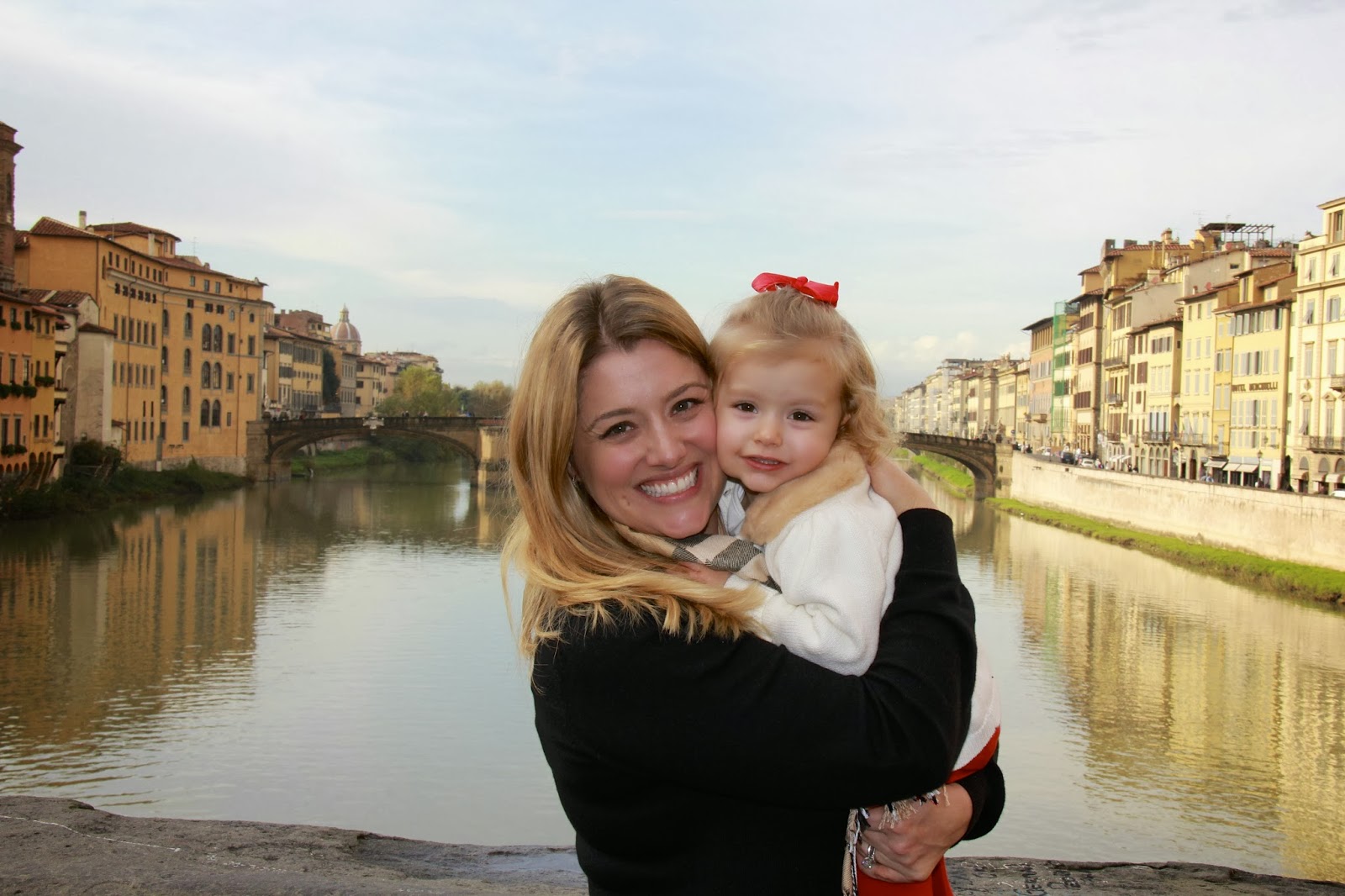
Jen and Julia on Ponte Vecchio
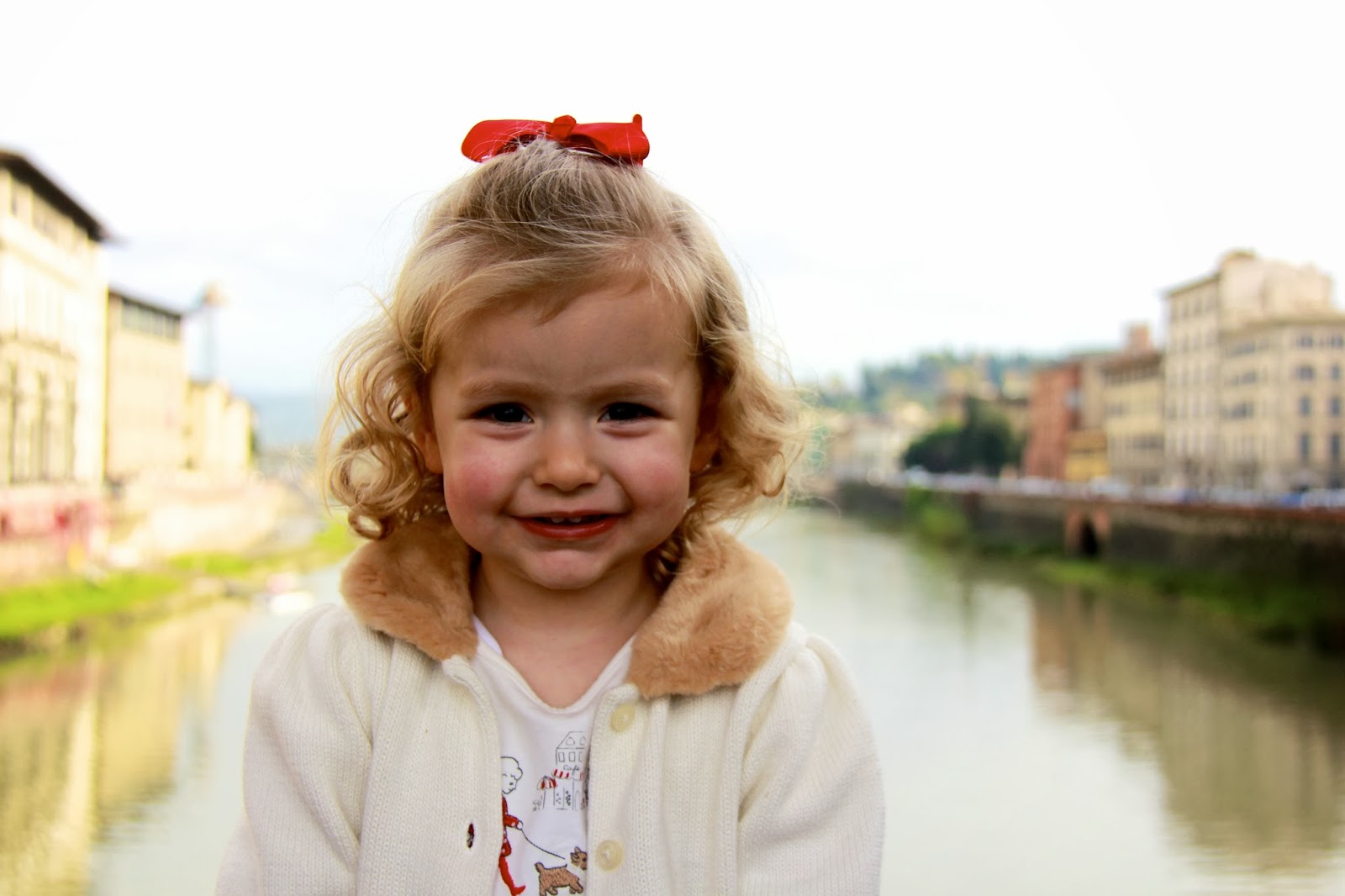
Our little Tuscan girl
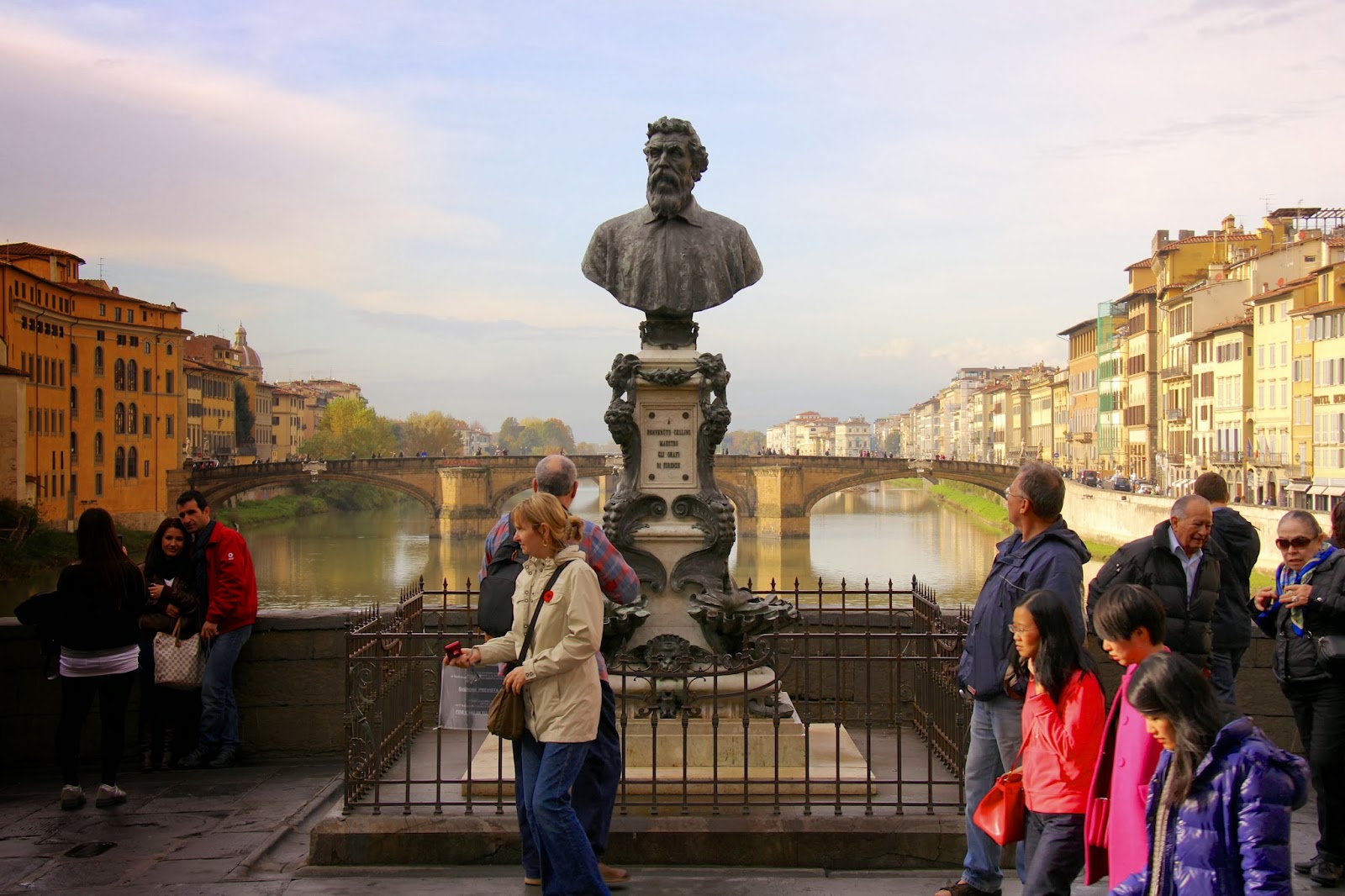
The bust of famed Florentine artist, Benvenuto Cellini

So what did the Medici’s have to do with a bridge you ask?  You may assume that they funded it (and you’d be right – the reconstruction effort of 1345) and think to yourself… “what’s the big deal, Greg – you just told me they basically bankrolled the entire Renaissance, who cares about a single bridge”?  Well, in my opinion there are two very interesting things about this particular overpass.

First, the bridge is credited as being the birthplace of bankruptcy, an action the banking family supported.  The bridge has always housed shops and merchants (as it still does to this day) and when a merchant could not pay his debts, the counter on which he sold his wares (the “banco”) was physically broken (“rotto”) by soldiers.  The practice was thus referred to as bancorotto (broken counter, or as it became known, broken bank).  Once the merchant lost his table, he was no longer able to sell anything.

The second interesting factoid about the bridge also has to do with these merchants.  Butchers dominated the shops along the bridge, nearly since it’s inception.  In 1564, Grand Duke Cosimo I de’ Medici commissioned the Vasari Corridor – an enclosed passageway elevated above the Ponte Vecchio in order to connect the Palazzo Vecchio with the Palazzo Pitti.  The Grand Duke commissioned the bridge because he wanted a private walkway when crossing between his personal residence and the government palace – he couldn’t be bothered to walk amongst the commoners.  As if this was bad-ass enough… he took it a step further. The smell of meat was not a scent that he cared to inhale, so he had all the butchers removed and oversaw the installation of gold and jewelry shops (a tradition that persists today – there are nothing but gold and jewelry shops along the bridge… with a couple souvenir places sprinkled in).  The gold merchants not only offered a less offensive odor, they extended a much more pleasant view and enhanced the prestige of the bridge.

Julia kept us on our toes with shenanigans like these our entire time at sea

We got a few souvenirs for ourselves and then hustled back to the ship for a lot more fun at sea!
When In Rome…

I suppose that I’ve sufficiently succeeded in being completely cheesy and unoriginal, using the two most obvious cliche’s to name my two posts about Rome (first post).  Oh well, this is what you can expect from me when I’m faced with the monumental task of bringing you up to speed on our many recent adventures.  So, let’s begin!
When I last left you, we had seen the Pope’s home (Vatican City), a bunch of steps (Spanish Steps) and a some running water (Trevi Fountain).  The next day, we wanted to see a pile of stones (Colosseum) and a big dome (Pantheon).  And if anyone ever describes some of the world’s most precious treasures like that again, smack them!
On our second day in Rome, we set out early to reach the Colosseum, the world’s largest ancient amphitheater and one of the most spectacular examples of Roman engineering and design. It is estimated that the colosseum could hold as many as 80,000 spectators.  If you put that into perspective, that’s as big as most NFL football stadiums – only it was built almost 2000 years ago! I’m no historian, but I don’t think they had reinforced steel, engineering software and cement-mixing trucks back then.  It’s no wonder that the Amphitheatrum Flavium (it’s Latin name) is a UNESCO World Heritage Site and one of seven wonders of the world [source].

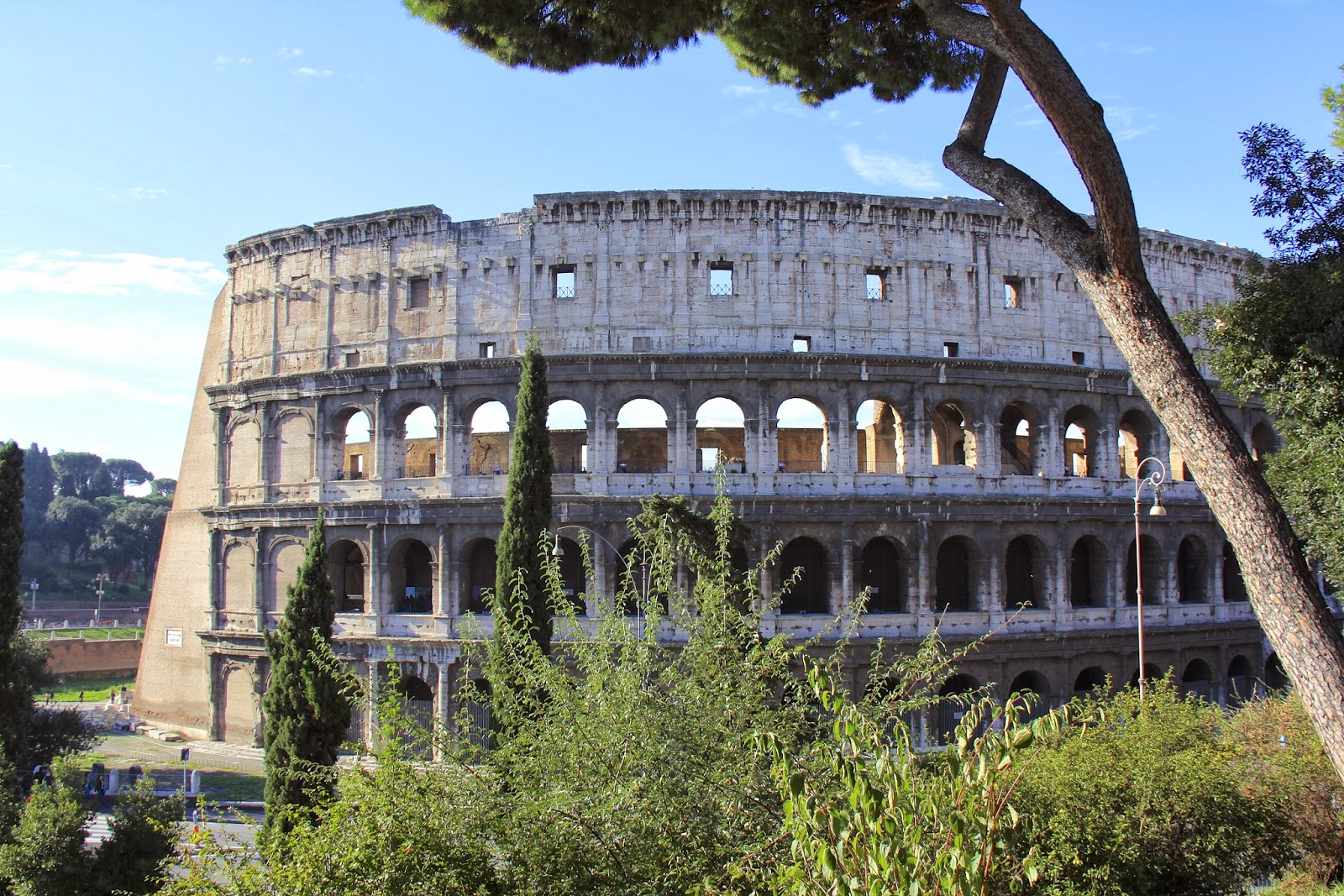
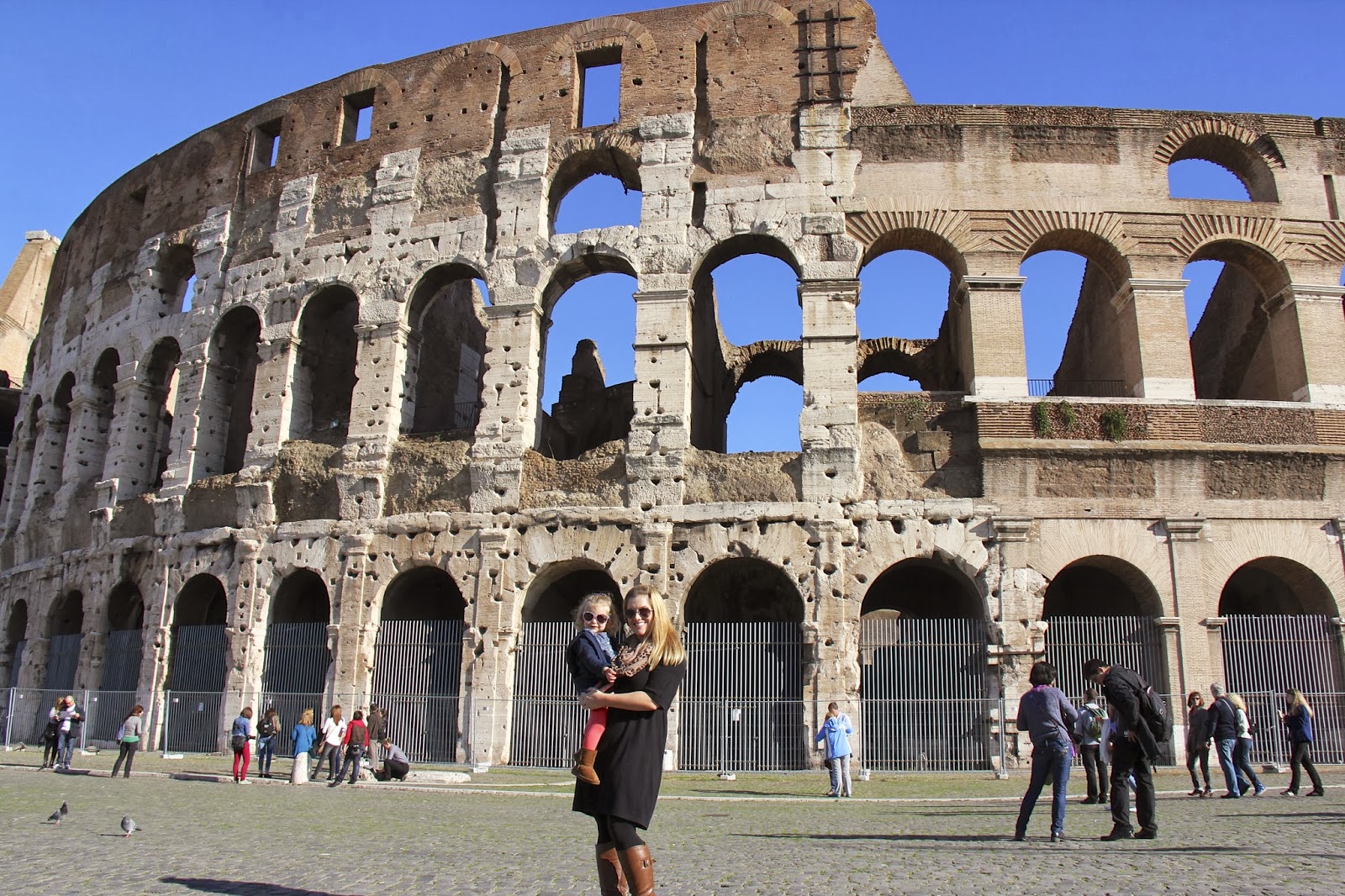
Amphitheatrum Flavium (Colosseum)
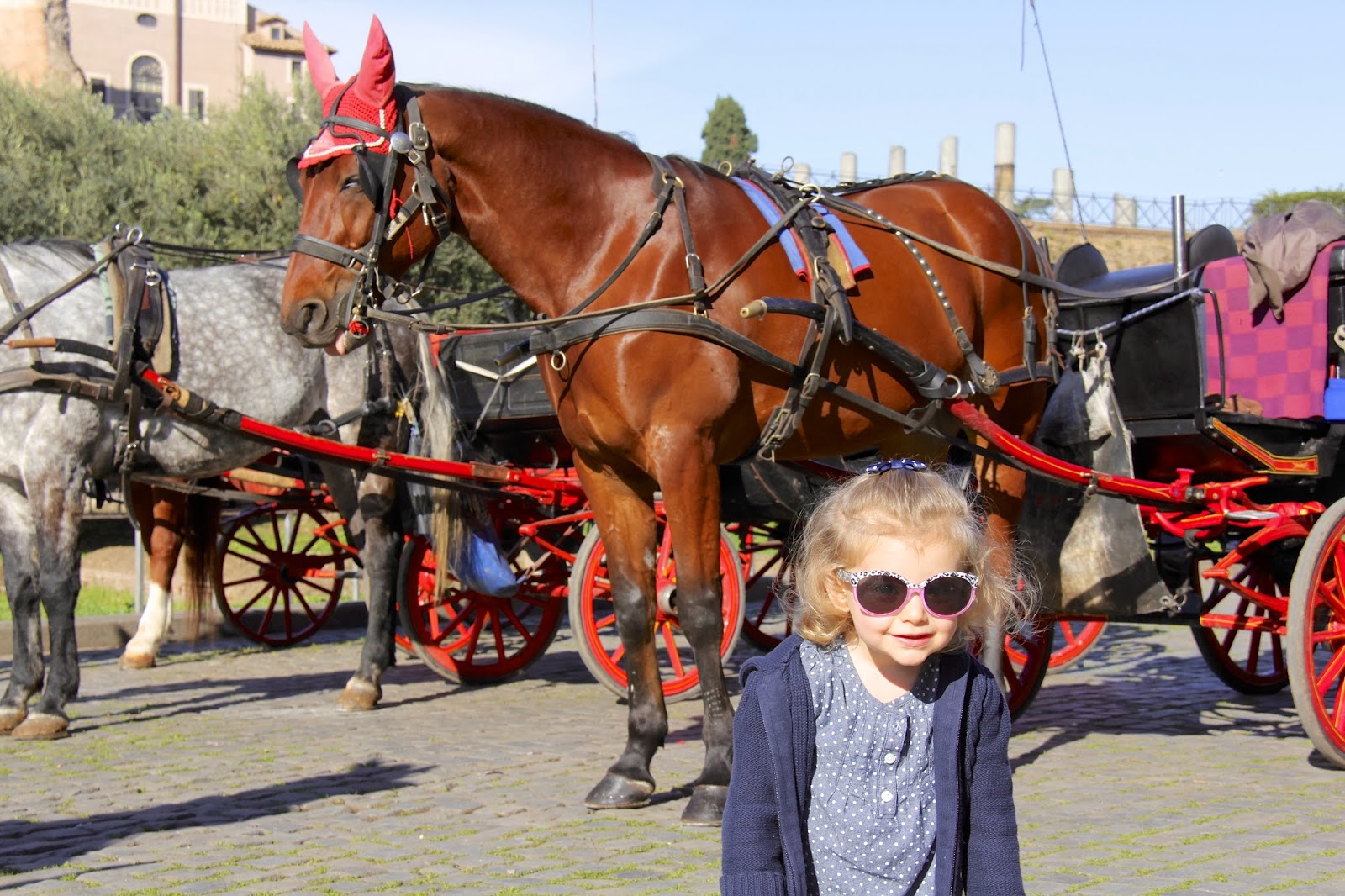
Julia found some horses that she wanted to ride
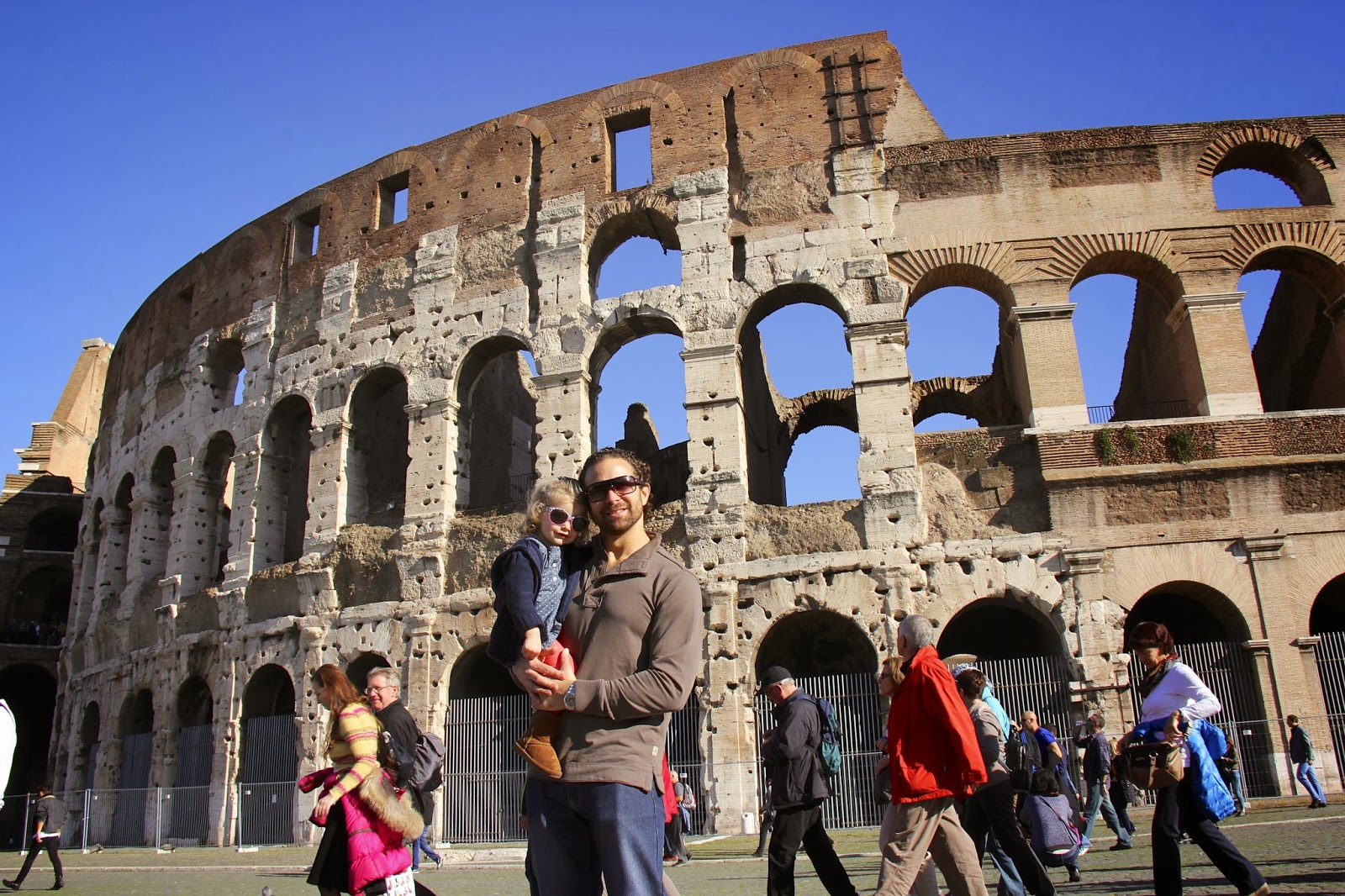
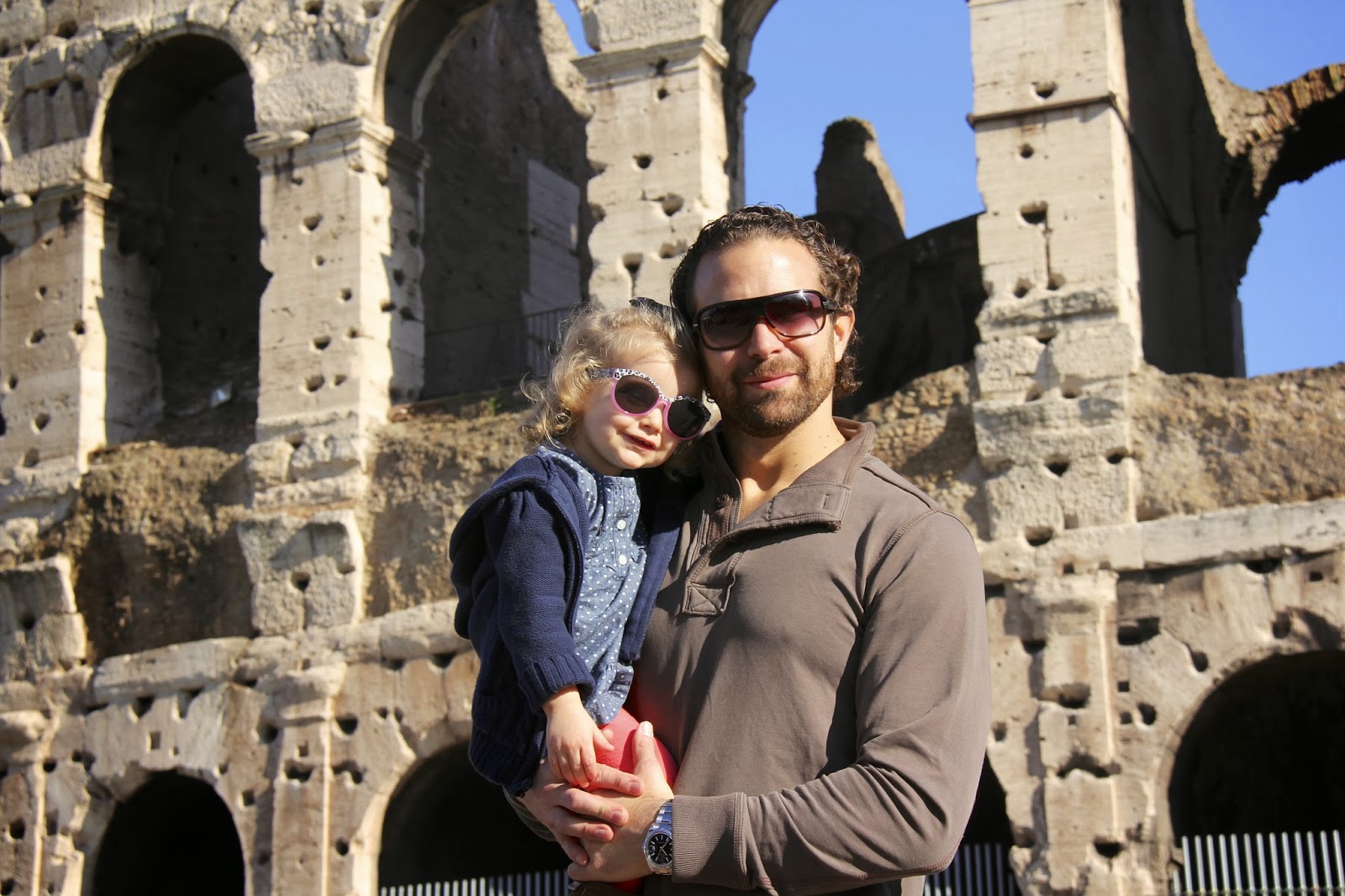
I hold Julia outside the massive stadium
Posing with Dad
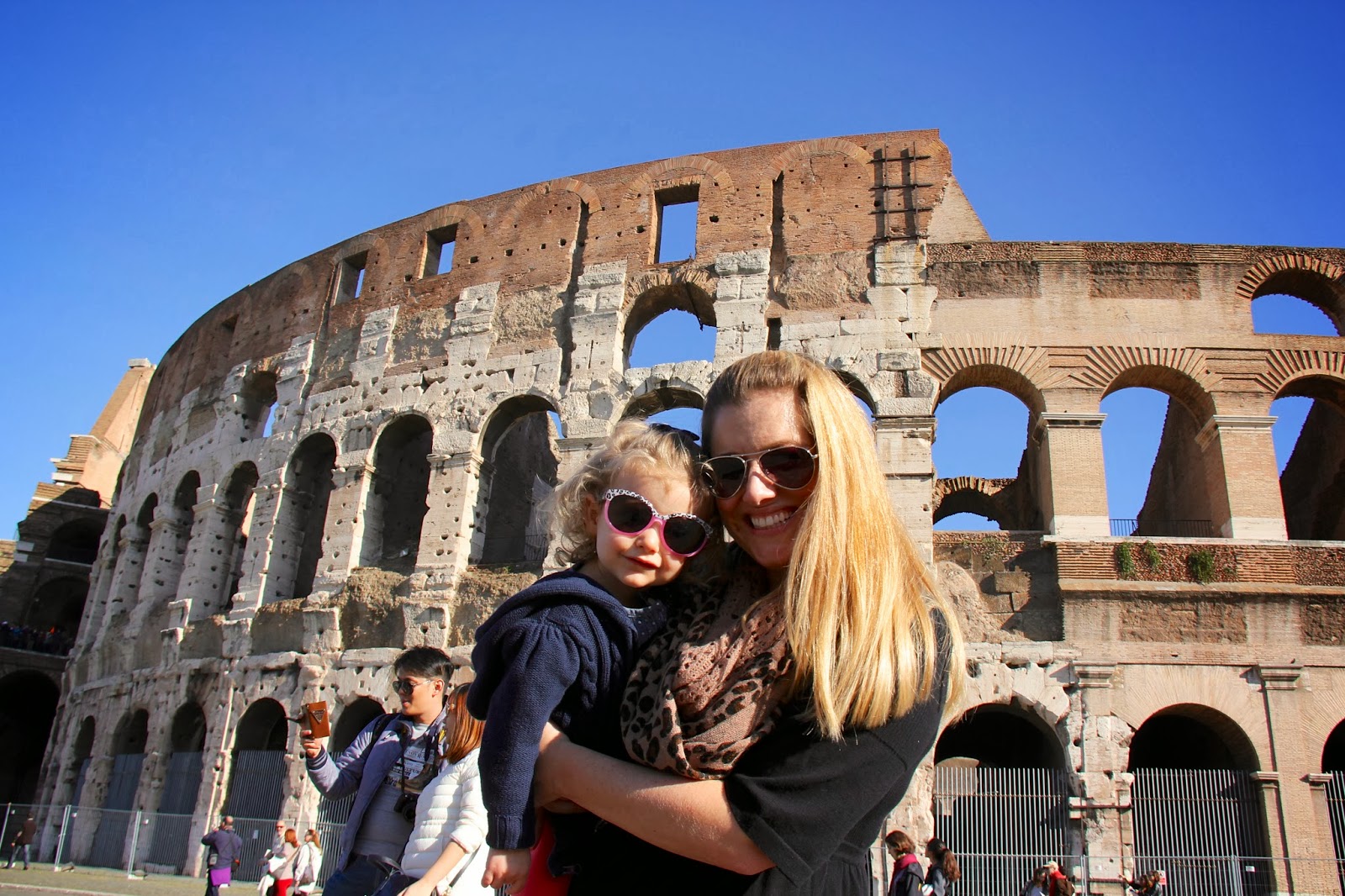
Now momma gets a photo with Julia
“Cheese!”

We didn’t get to spend too much time at the Colosseum because we had something even more important to do as we approached mid-day.  I know, you’re thinking… “Greg, I’ve been reading this blog long enough to know that your very important thing is just lunch”.  On any other day, you would be correct.  But on this particular day… lunch would have to wait.  We had a meeting with someone you may have heard of.  Oh you know… Pope Francis.

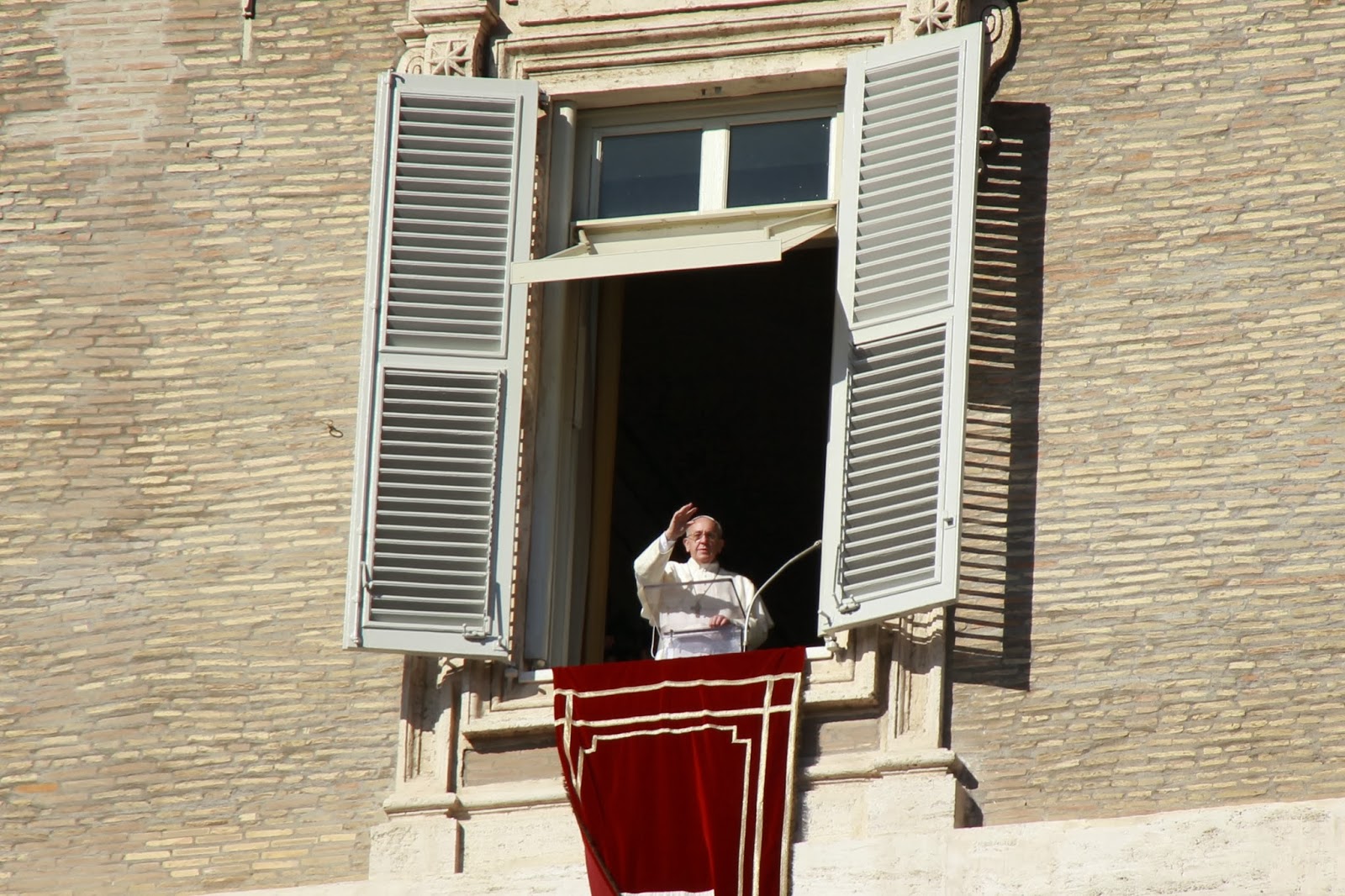
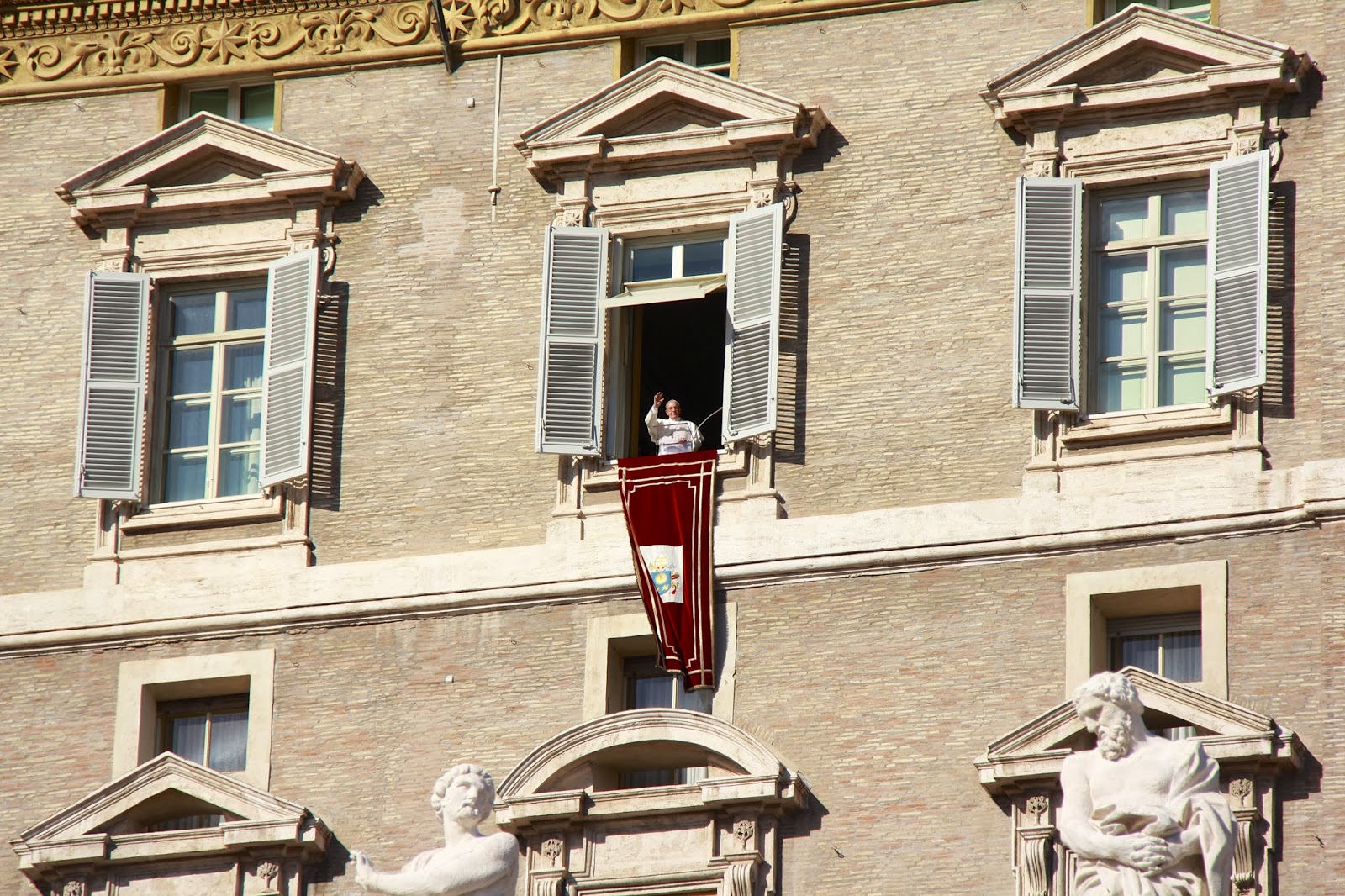
Papa Francesco greets us from a window in the Papal Residence

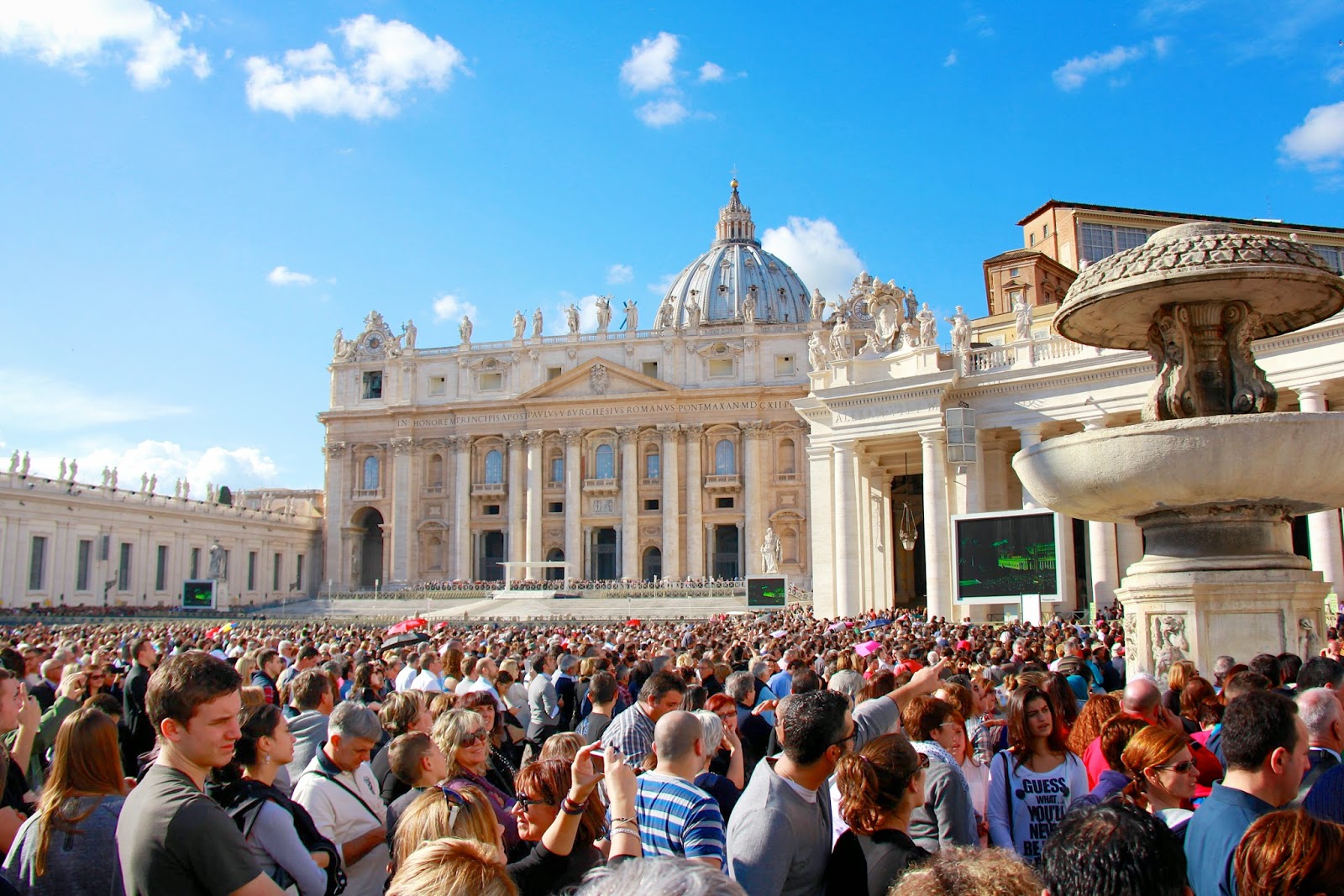
Now, when I say “meeting with the Pope” – I mean, a meeting of sorts.  A meeting that I generously shared with about 5,000 other people.  Every Sunday at noon, the Pope addresses the masses from the Papal Residence and delivers a short address to the crowd, followed by a blessing.  It was quite a tremendous thing indeed to be blessed by the Pope!

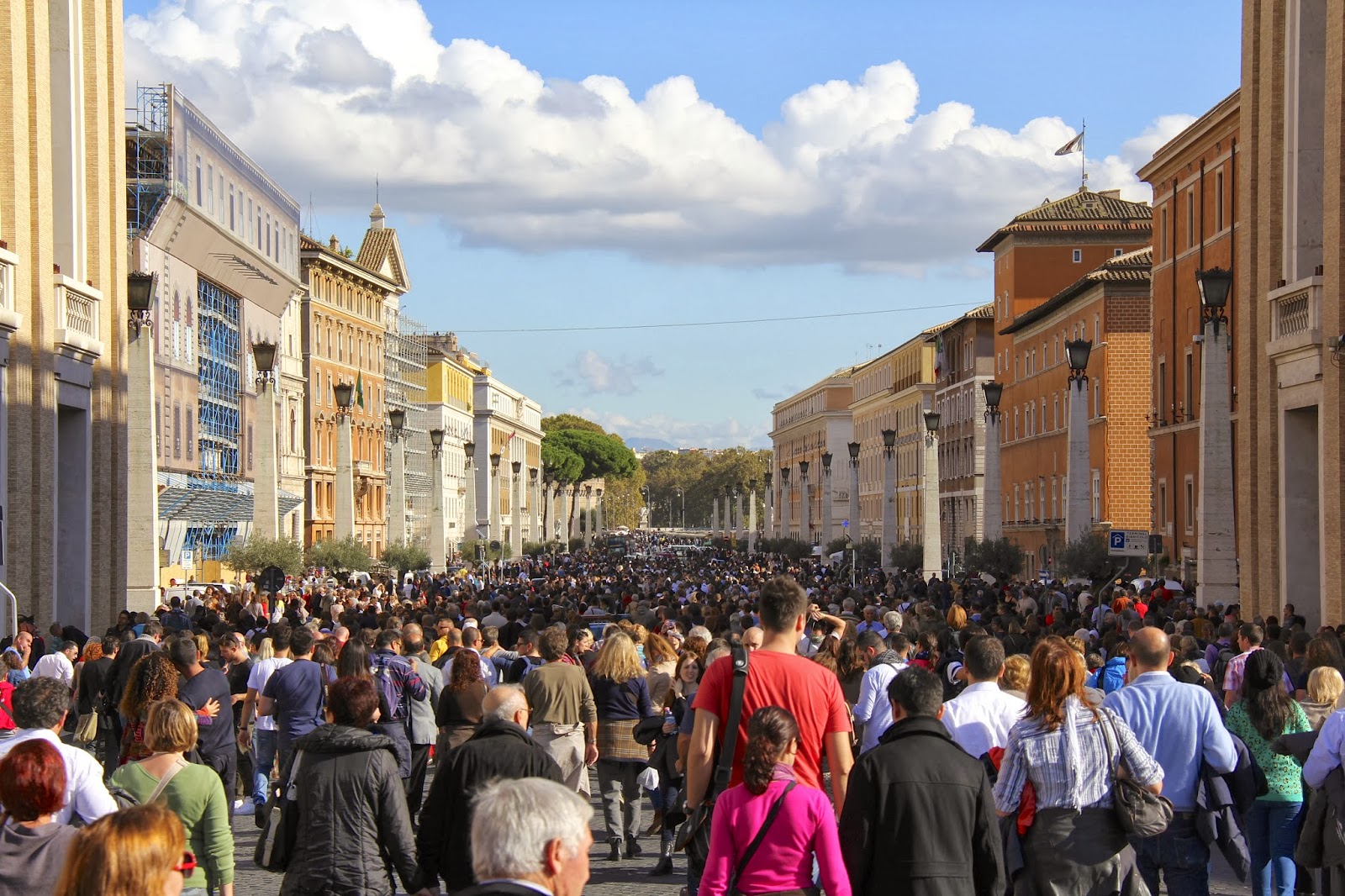
Large crowds await the Pope’s appearance
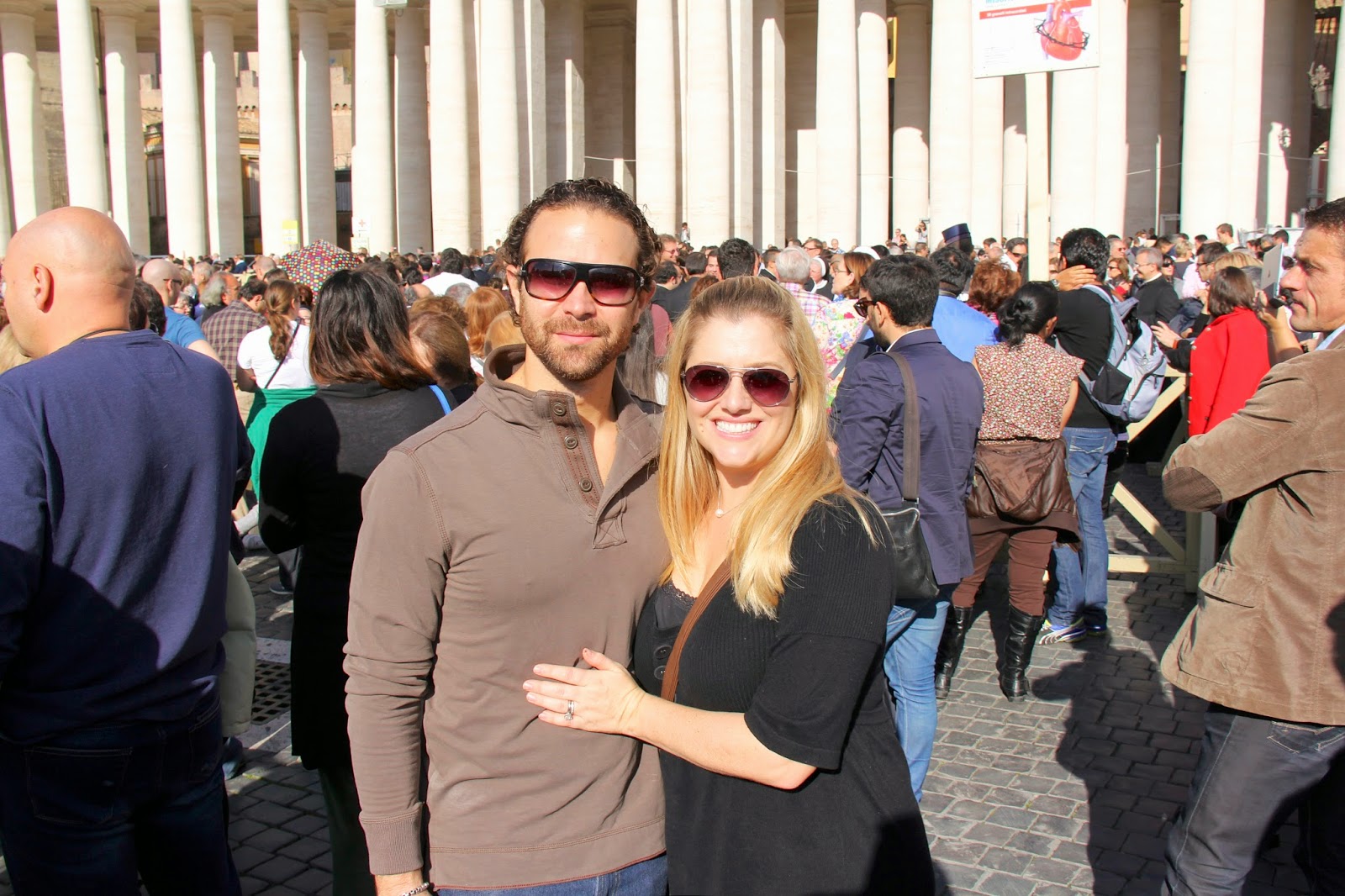
We take a picture amongst the crowd
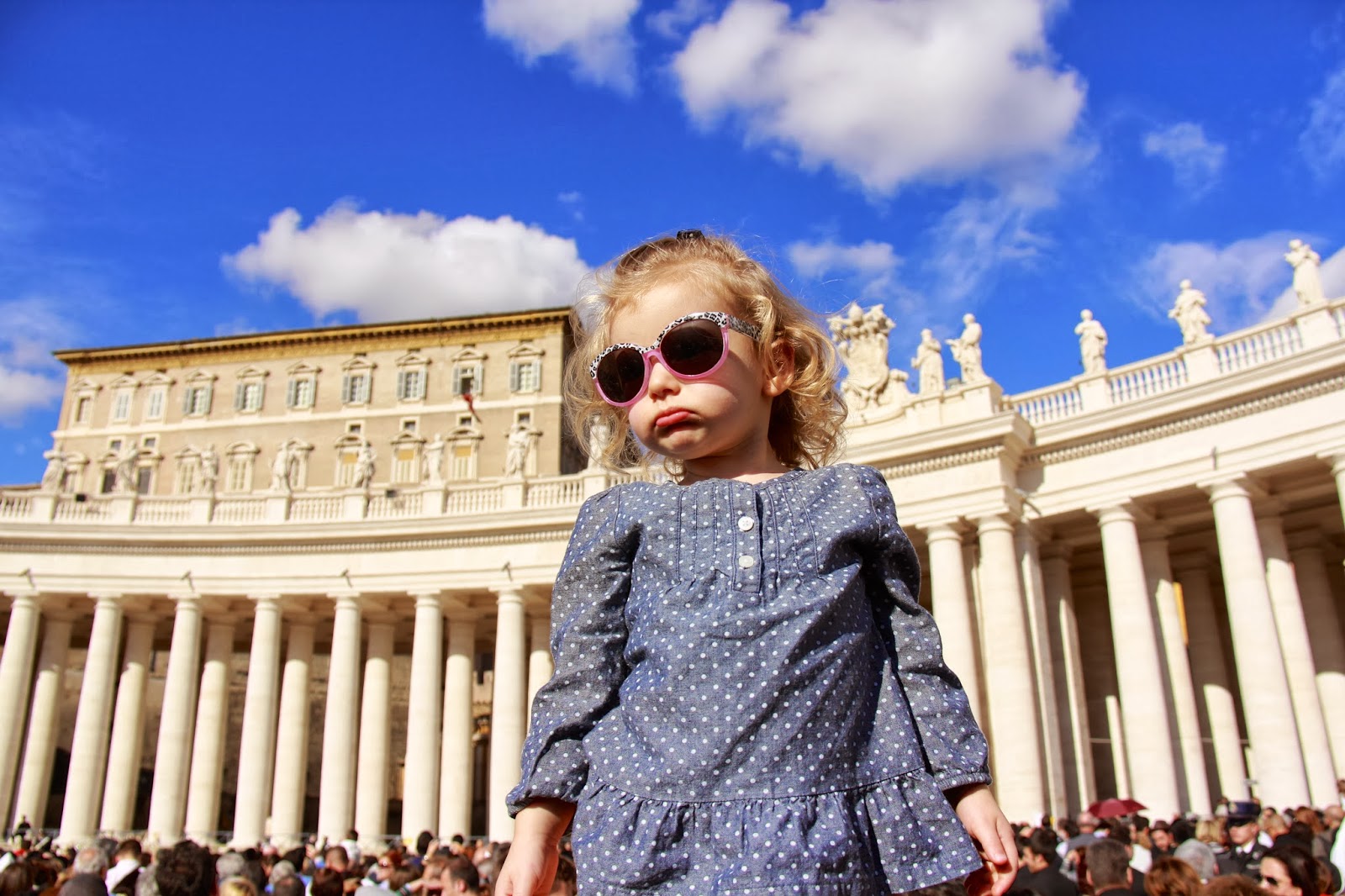
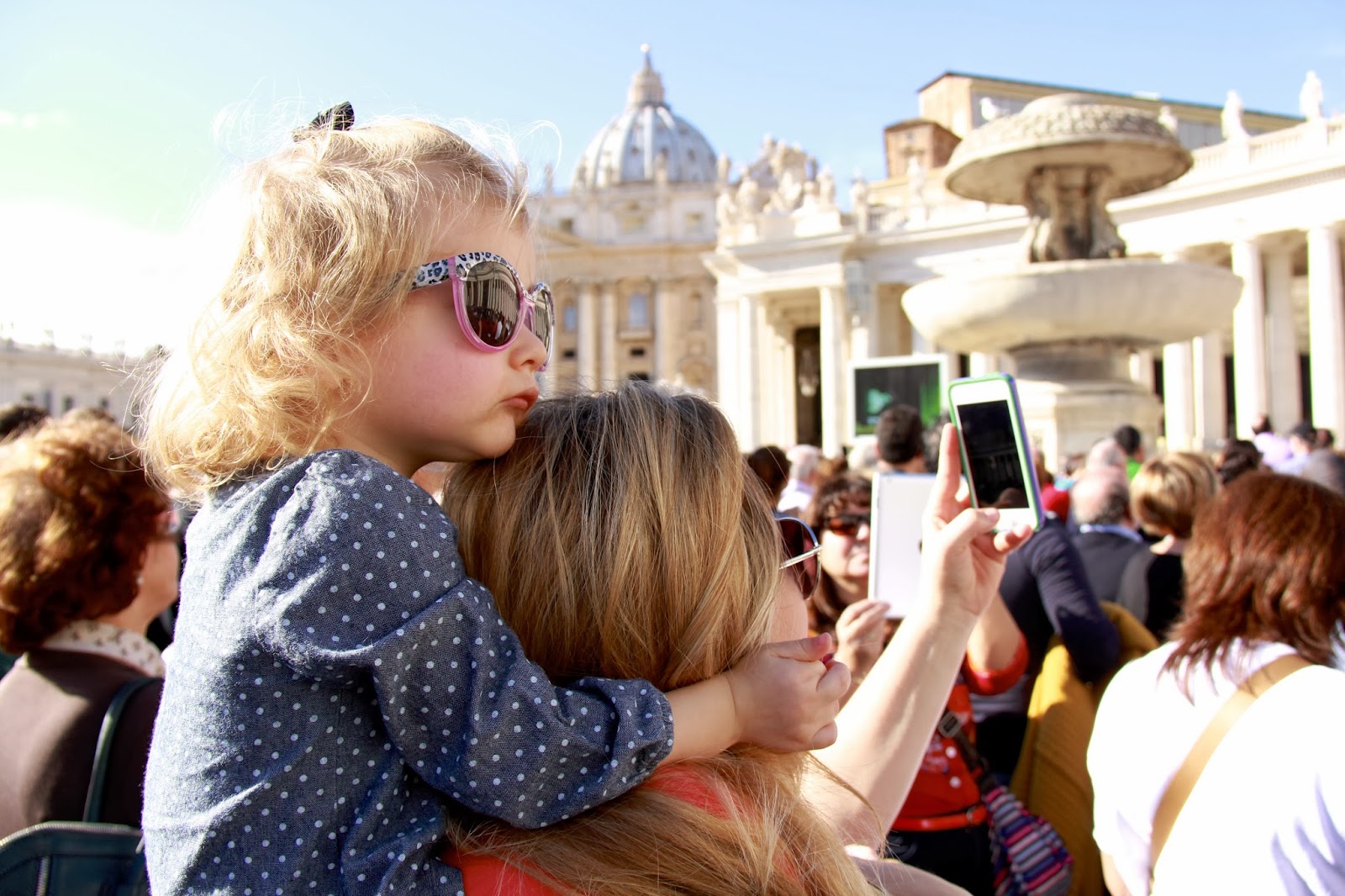
A somewhat grumpy Julia rises above the crowd to take a picture with the Papal Residence in the background
The crowd roared with jubilation when Pope Francis appeared
Jen and Julia listened intently during his address
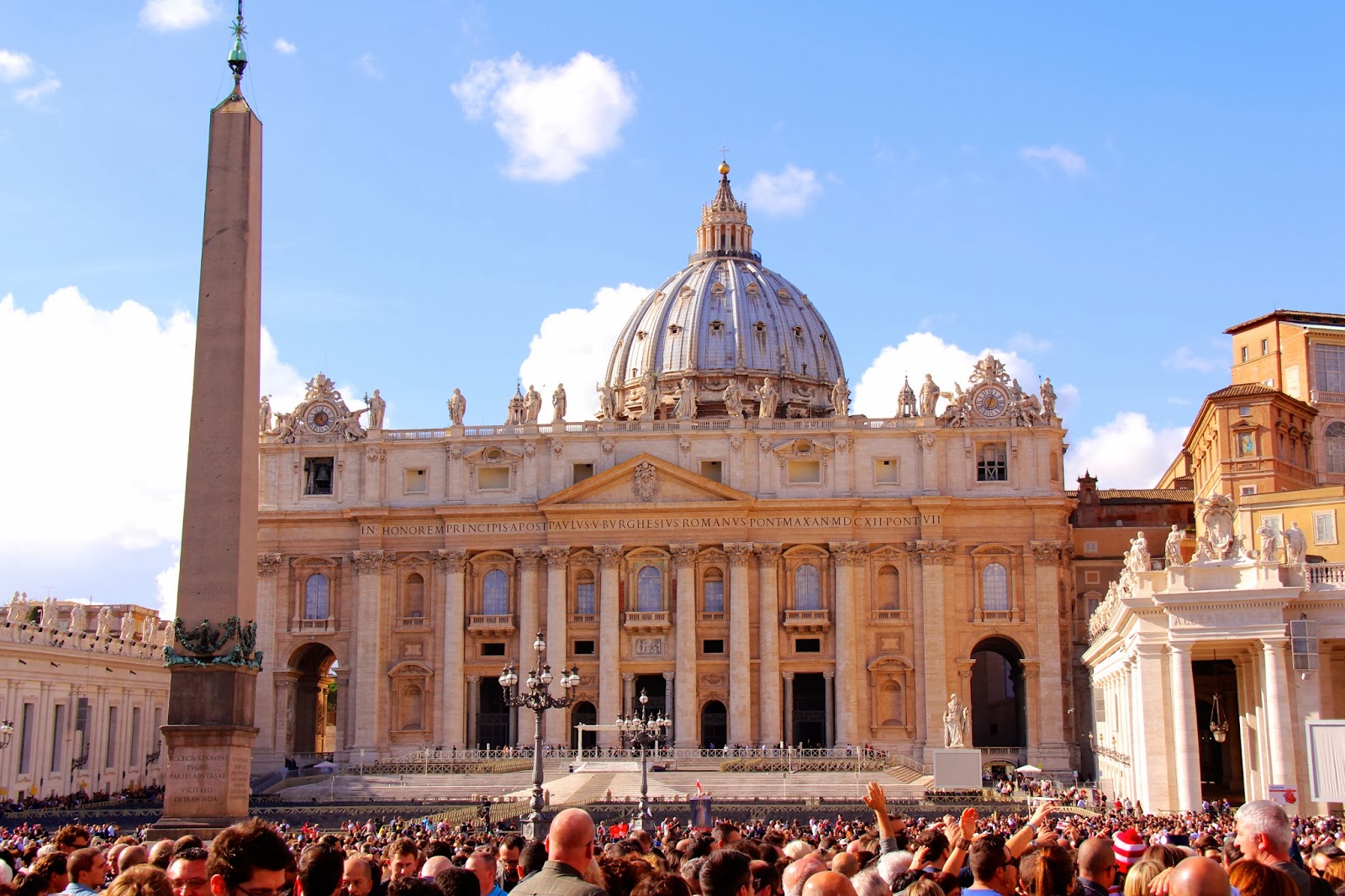
A view of Saint Peter’s Basilica with the crowd

We left the Vatican feeling great and enthralled by the beautiful weather.  We decided to continue our tour of Rome with wide detours, adding time and additional sights to our pedestrian footpath. We departed from the Vatican and walked past the Castel Sant’Angelo before crossing over the famous Ponte Sant’Angelo bridge.  We strolled along the Fiume Tevere (Tiber River), Italy’s third longest river that courses directly through the city of Rome.

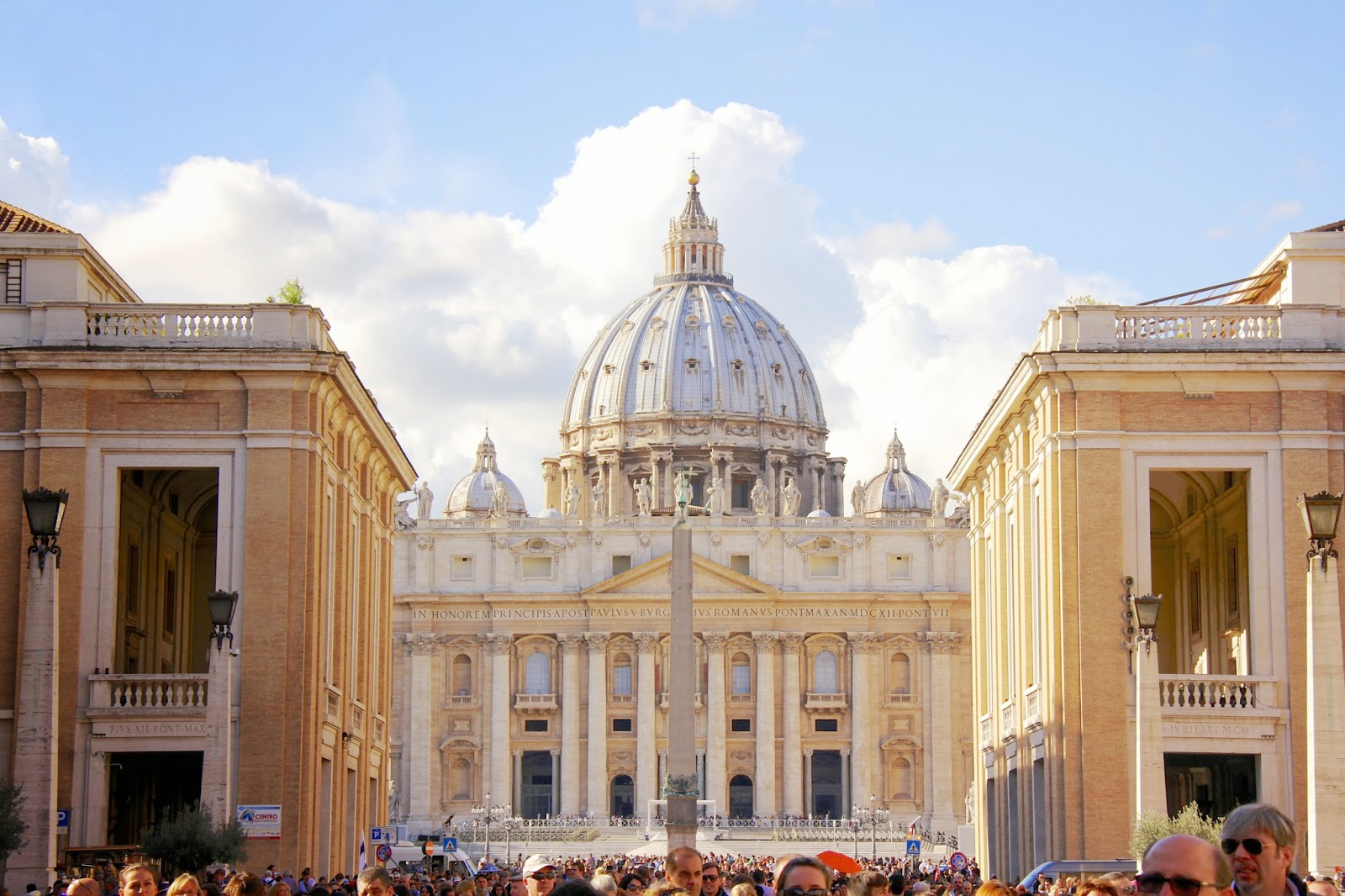
We were lost among a sea of people departing Vatican City along Via Della Conciliazione
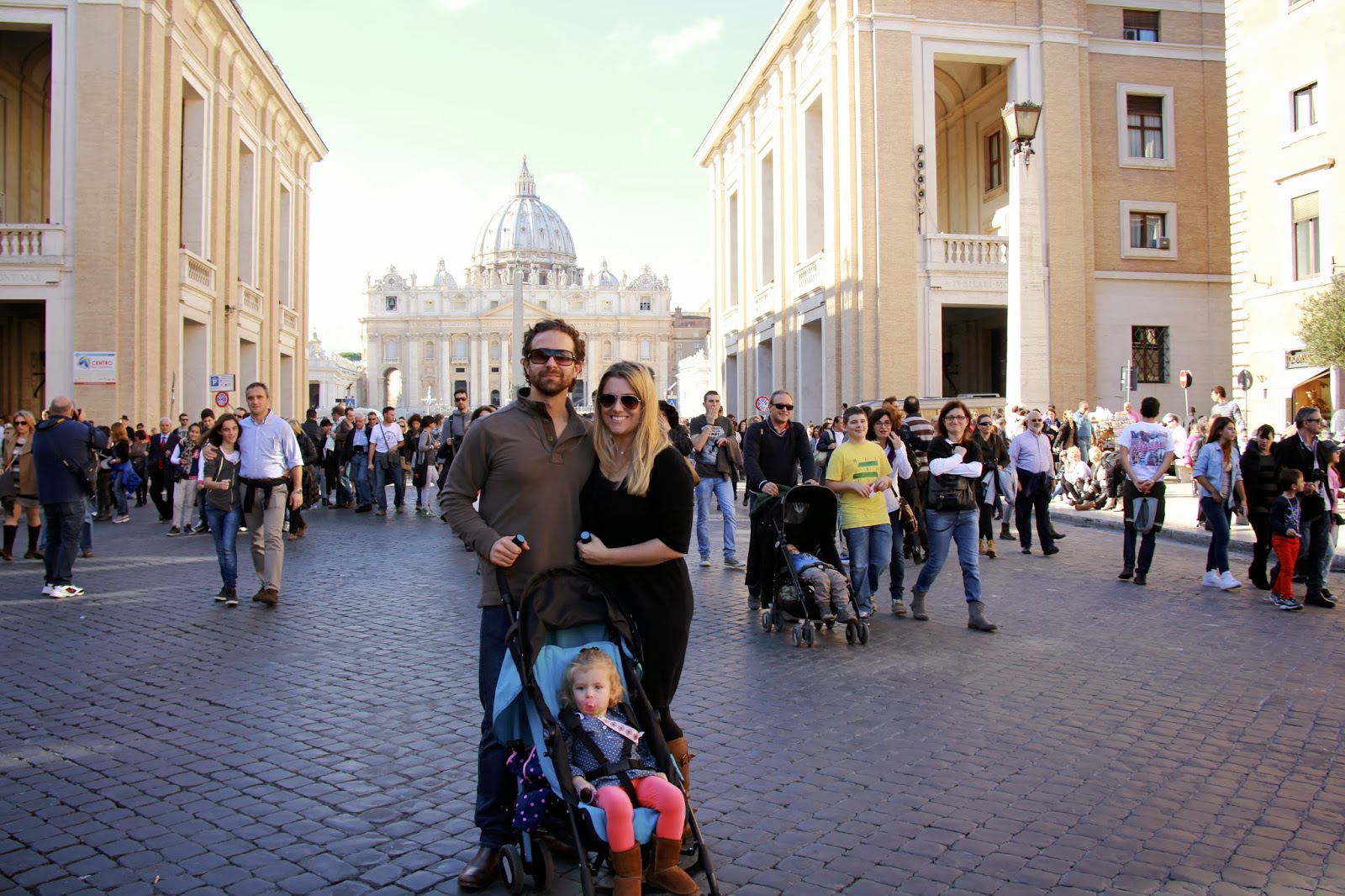
We have our photo taken with Vatican City in the background
A direct shot of Saint Peter’s Basilica and the Obelisk that sits in front
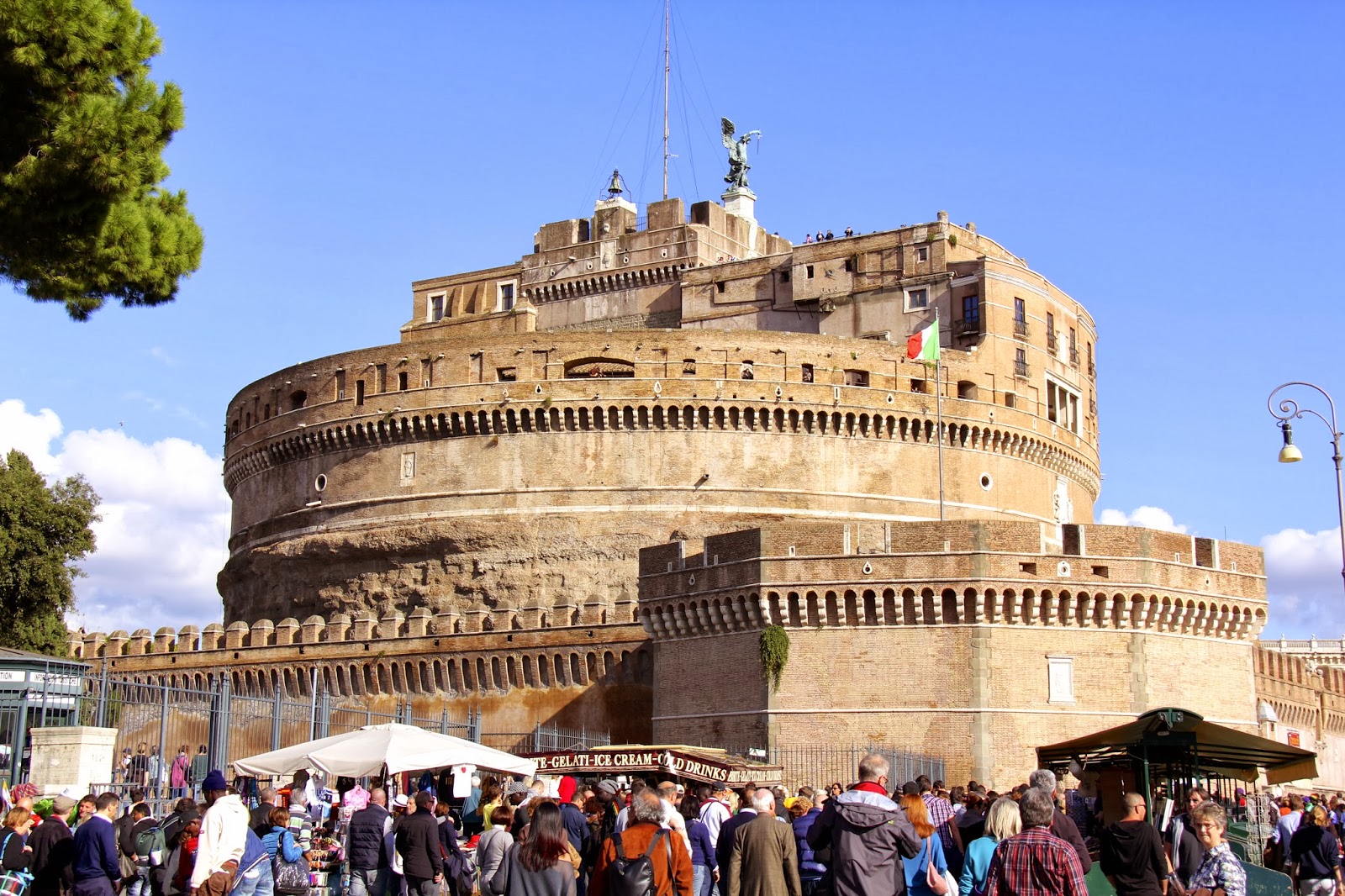
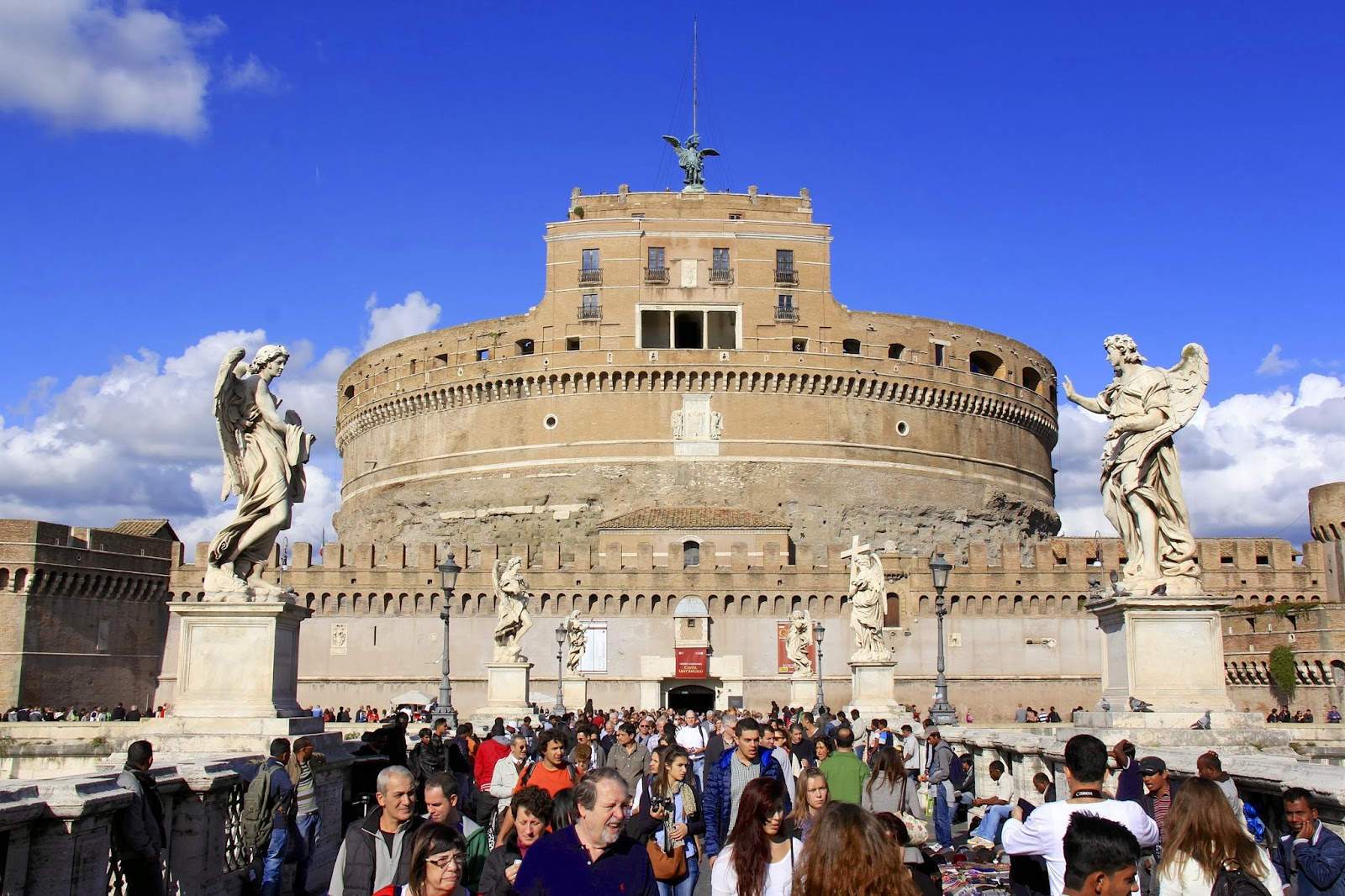
Castel Sant’Angelo
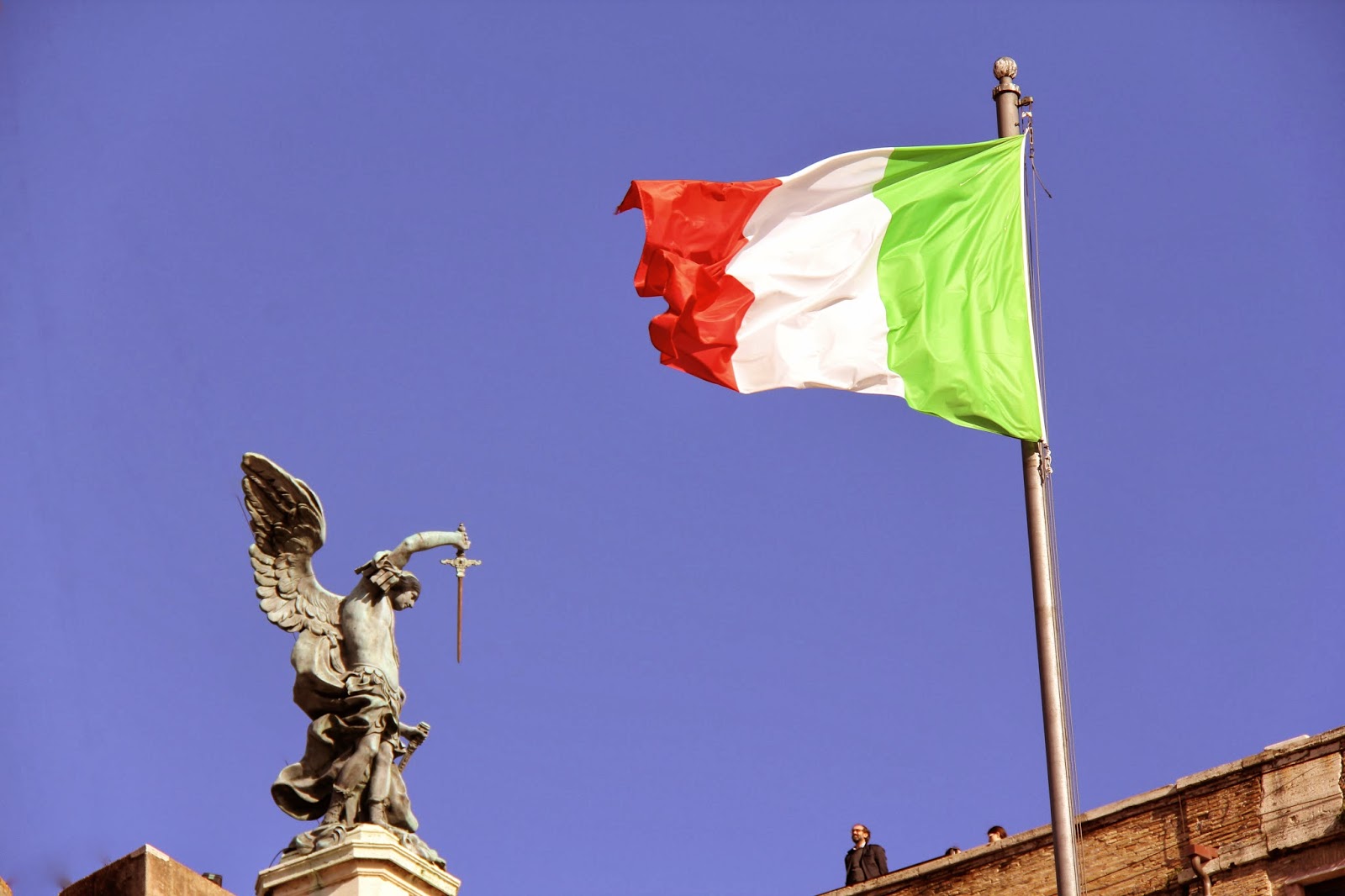
The Italian flag waves proudly atop the castle
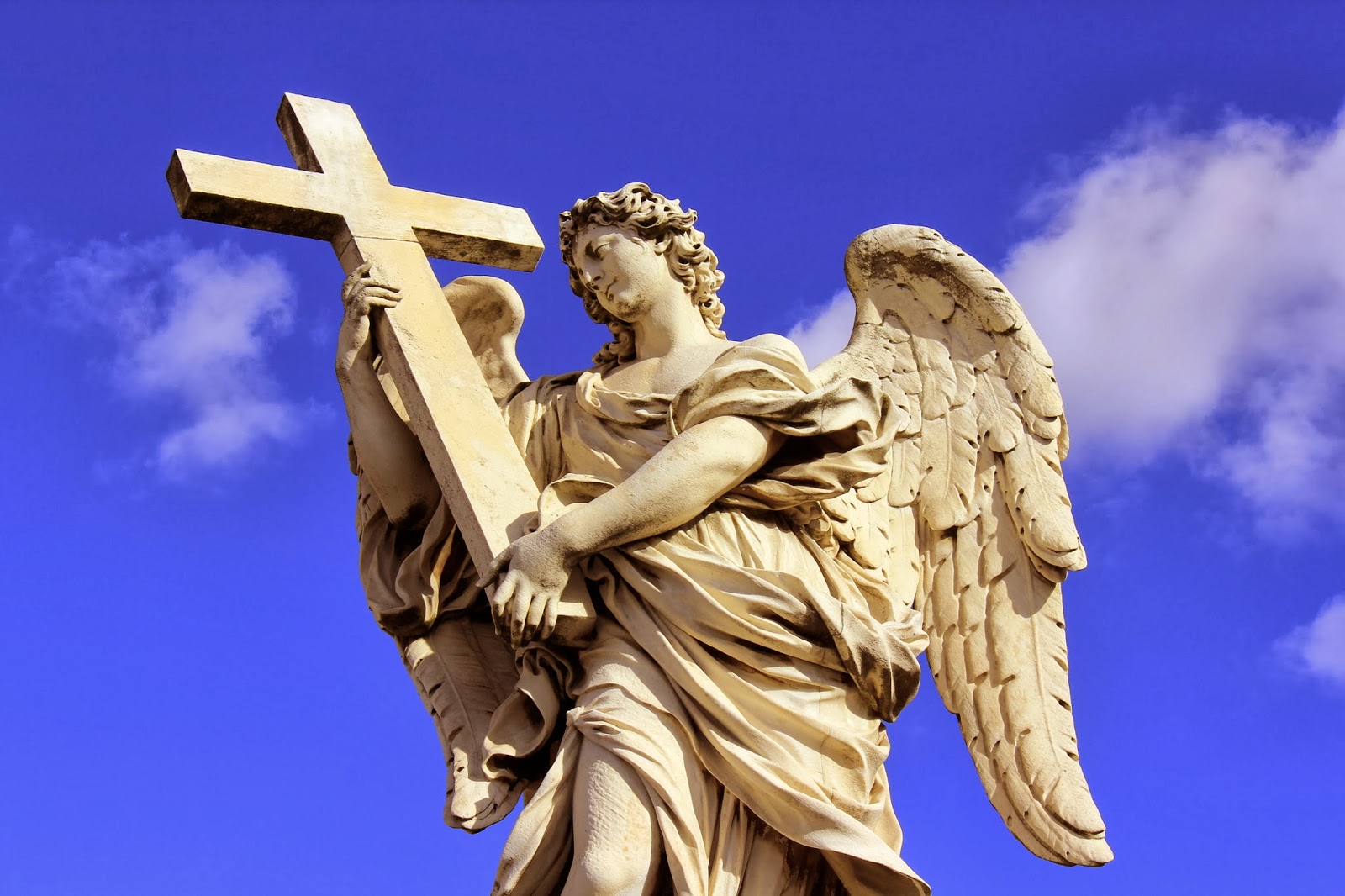
Angels fly overtop the Ponte Sant’Angelo 
Crossing the Ponte Sant’Angelo I turned for a view of the castle
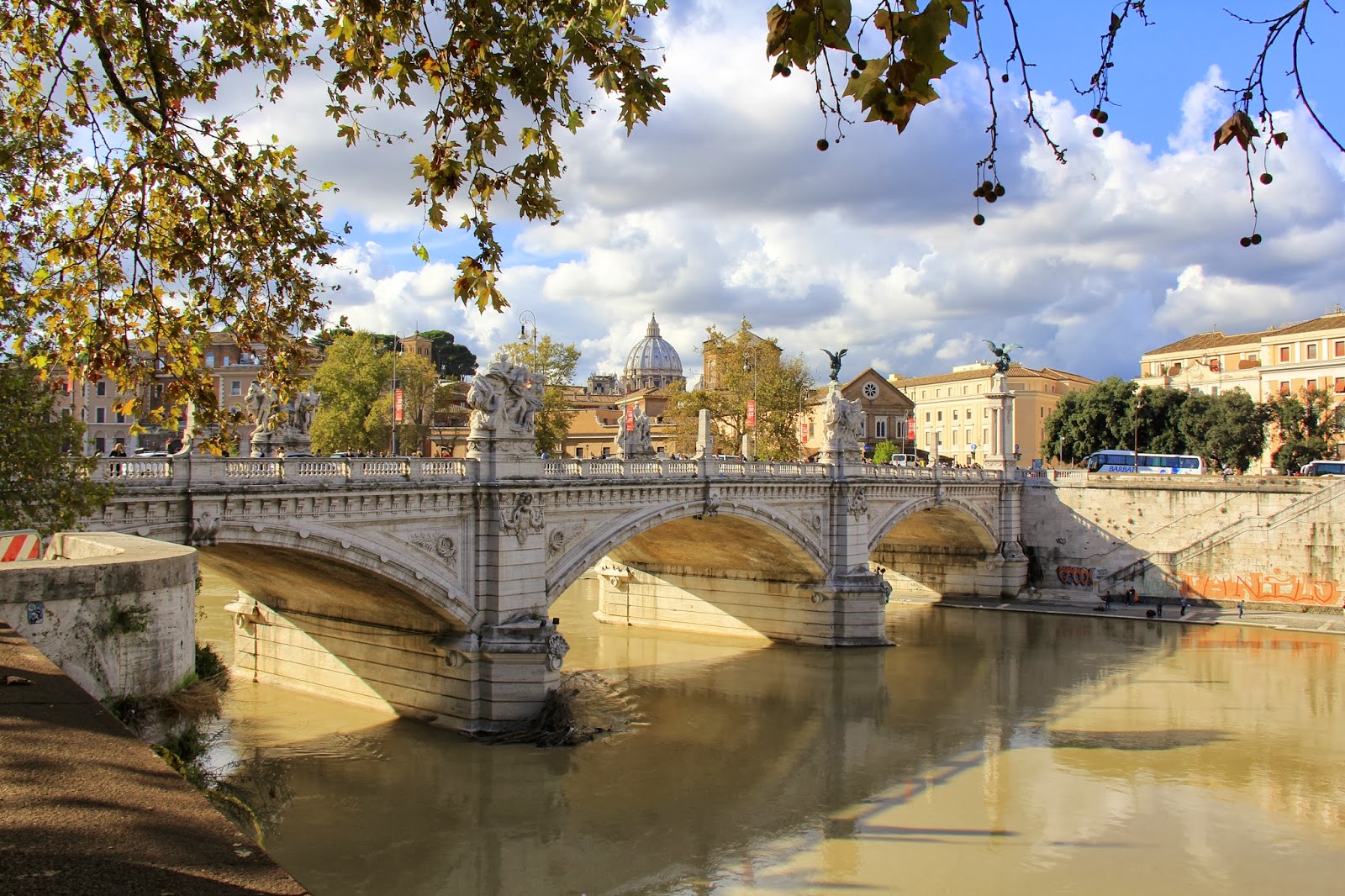
View along the Fiume Tevere (Tiber River)
Although, this was my favorite view along the river

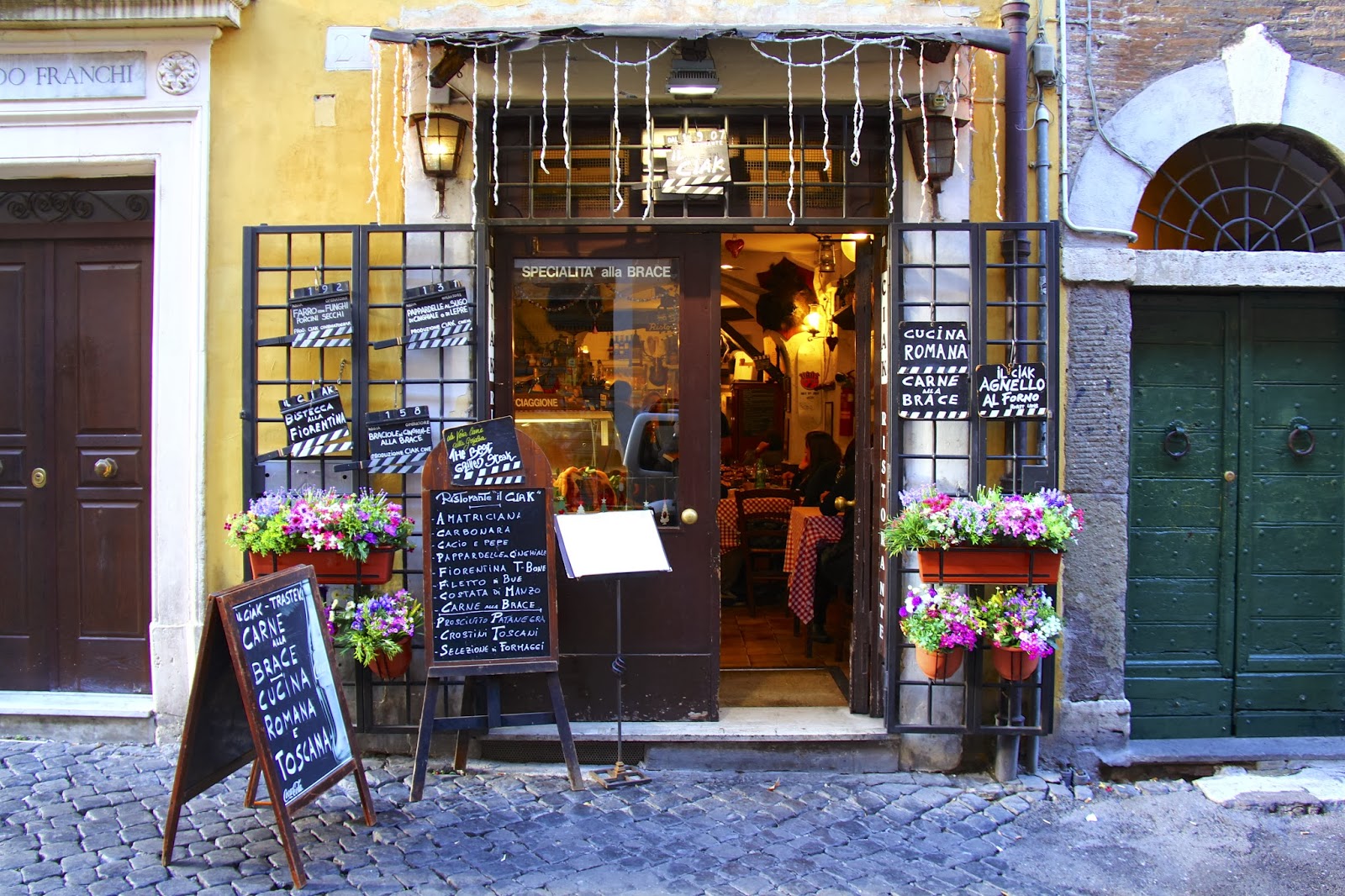
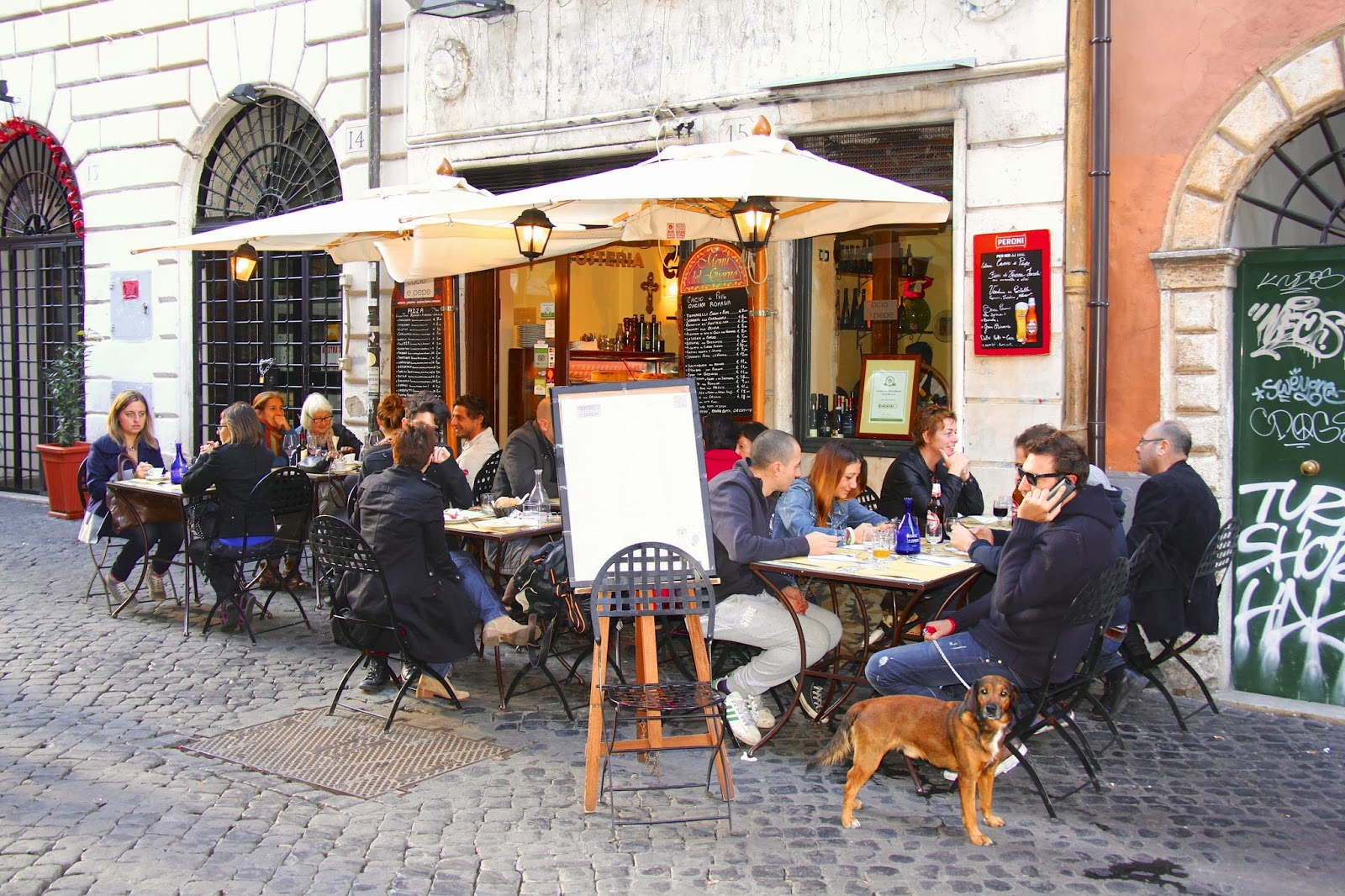
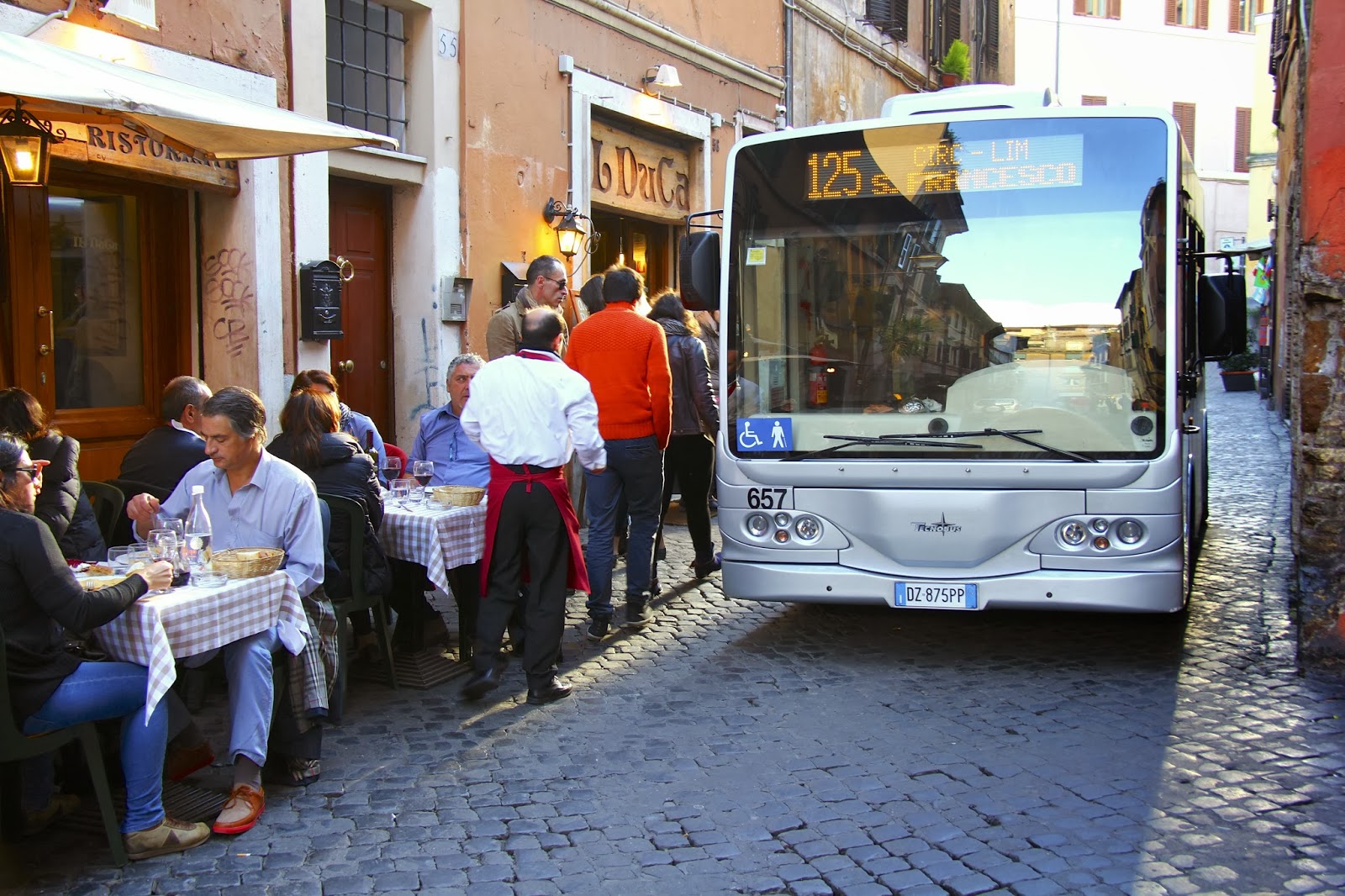
Our destination was the chic neighborhood of Trastevere.  Trastevere is to Rome as the West Village is to New York, but with fewer hipsters and MacBooks.  Small streets are lined with great shops, cafes and restaurants.  People spend time outside and congregate with neighbors.  The short time we spent there was long enough to fantasize about owning a pied-à-terre in this particular part of Rome.  We ate a fabulous lunch at a local place and continued on by foot.

A small ristorante in Trastevere
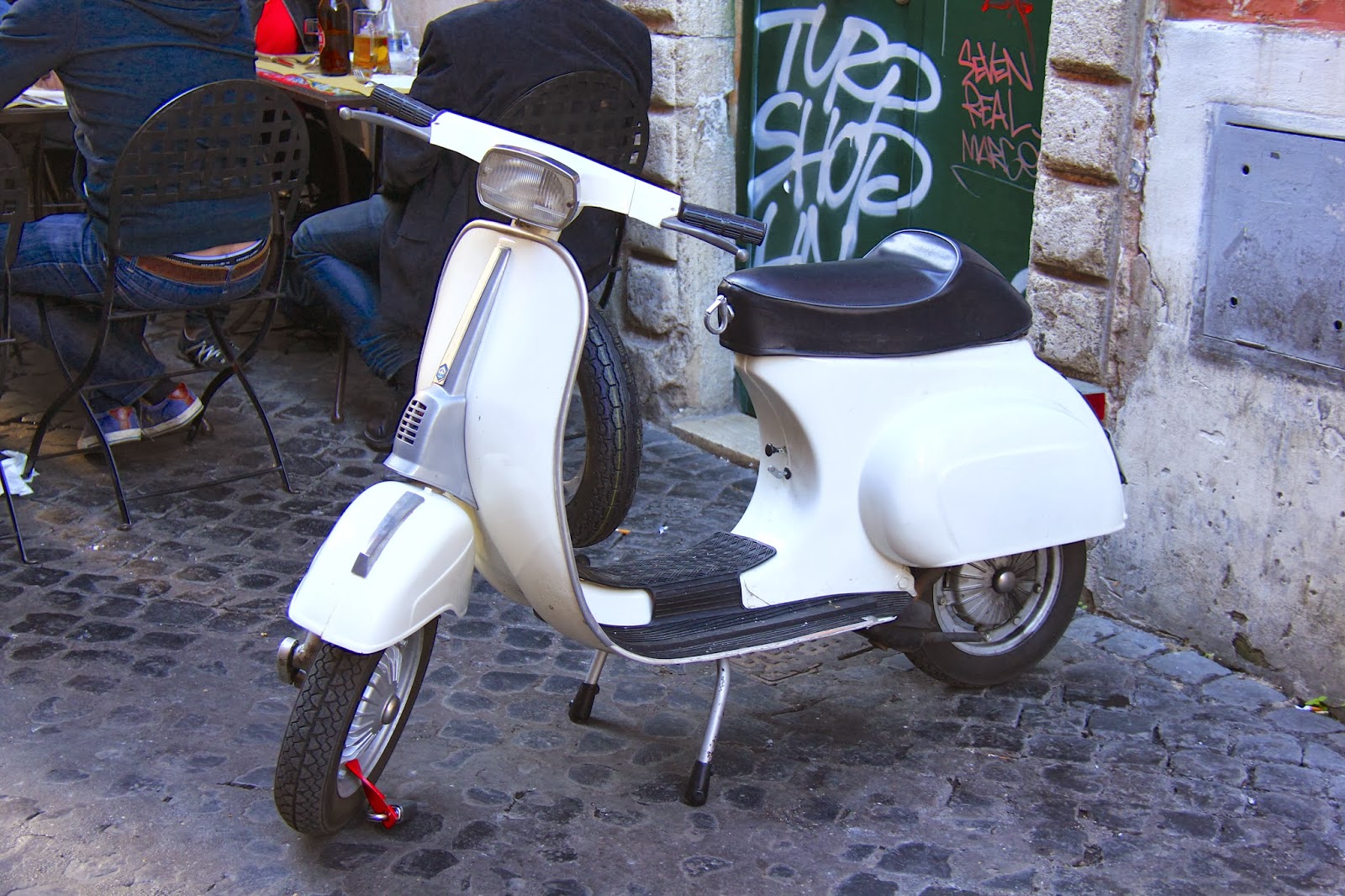
Even the Vespa’s look hipper
People gather at a cafe
The narrow streets don’t offer a lot of room for the public transportation

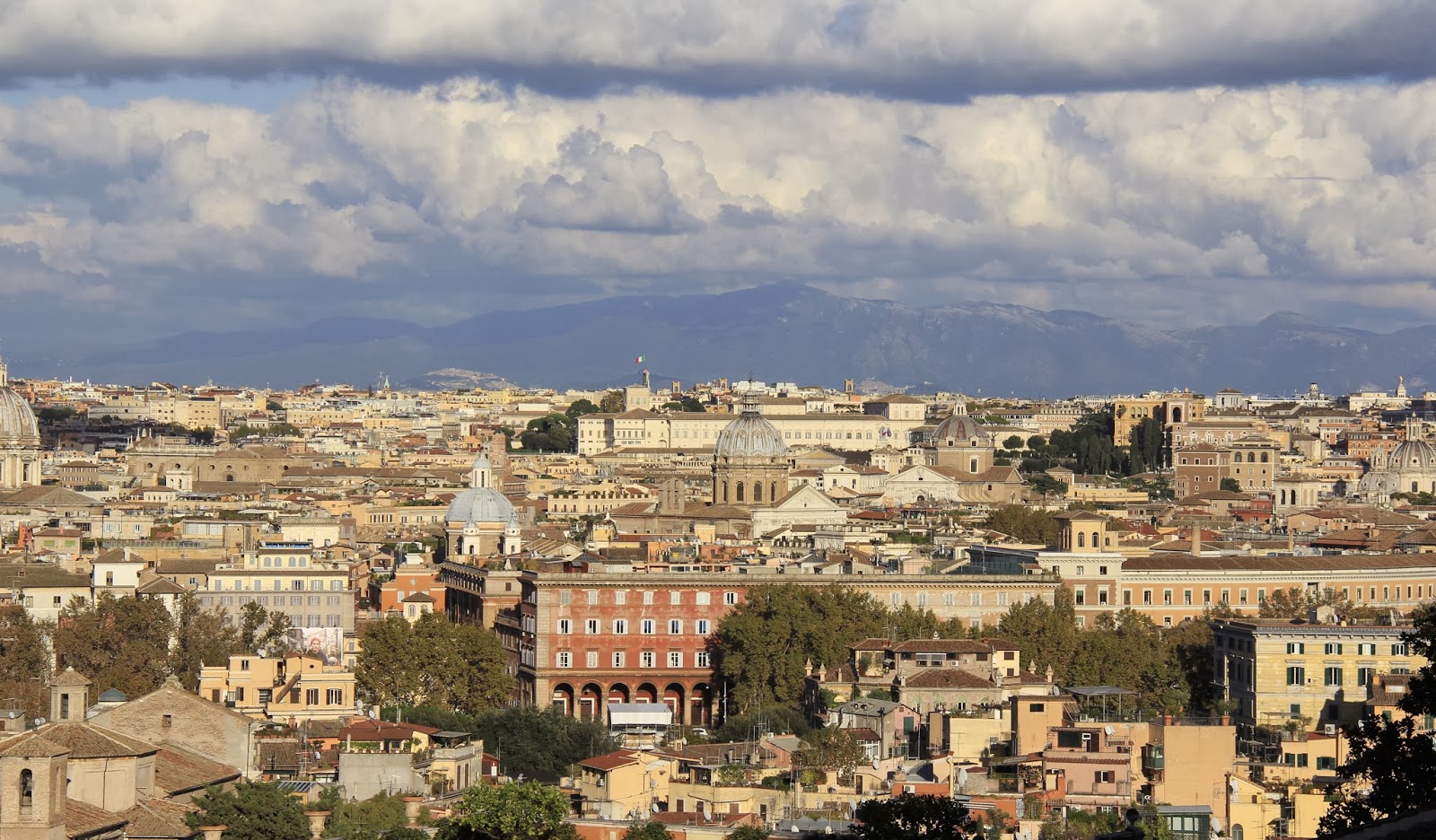
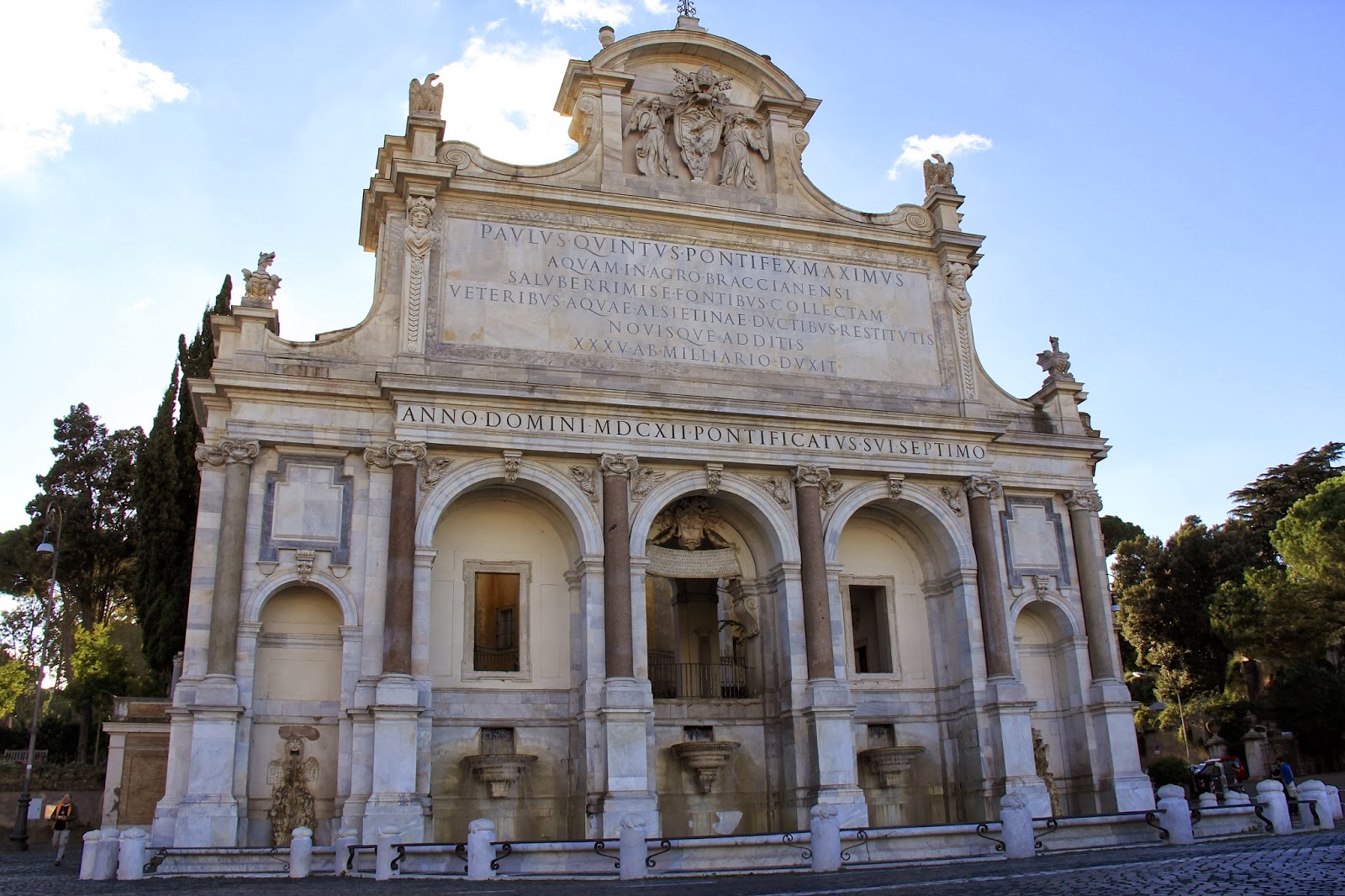
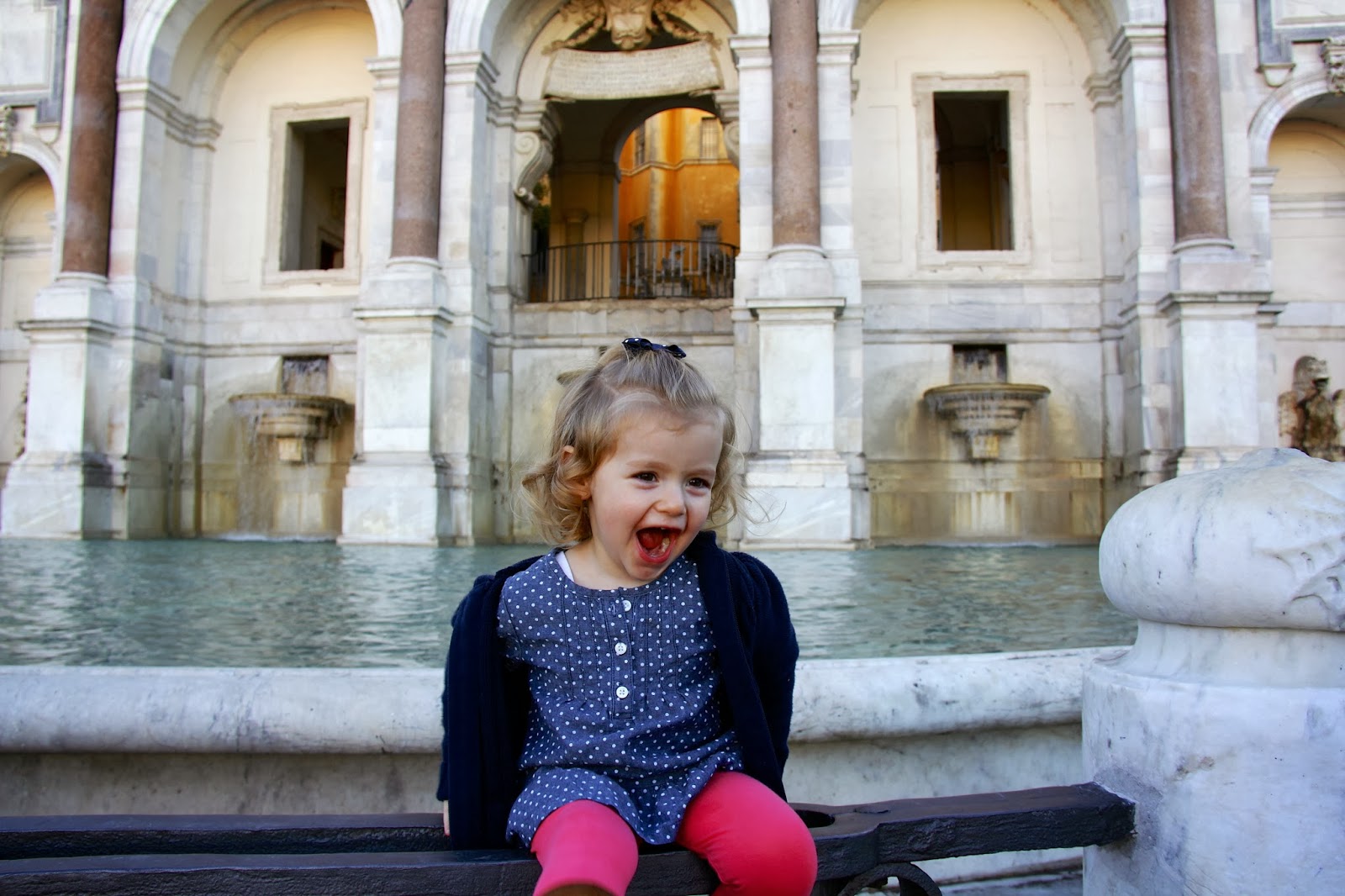
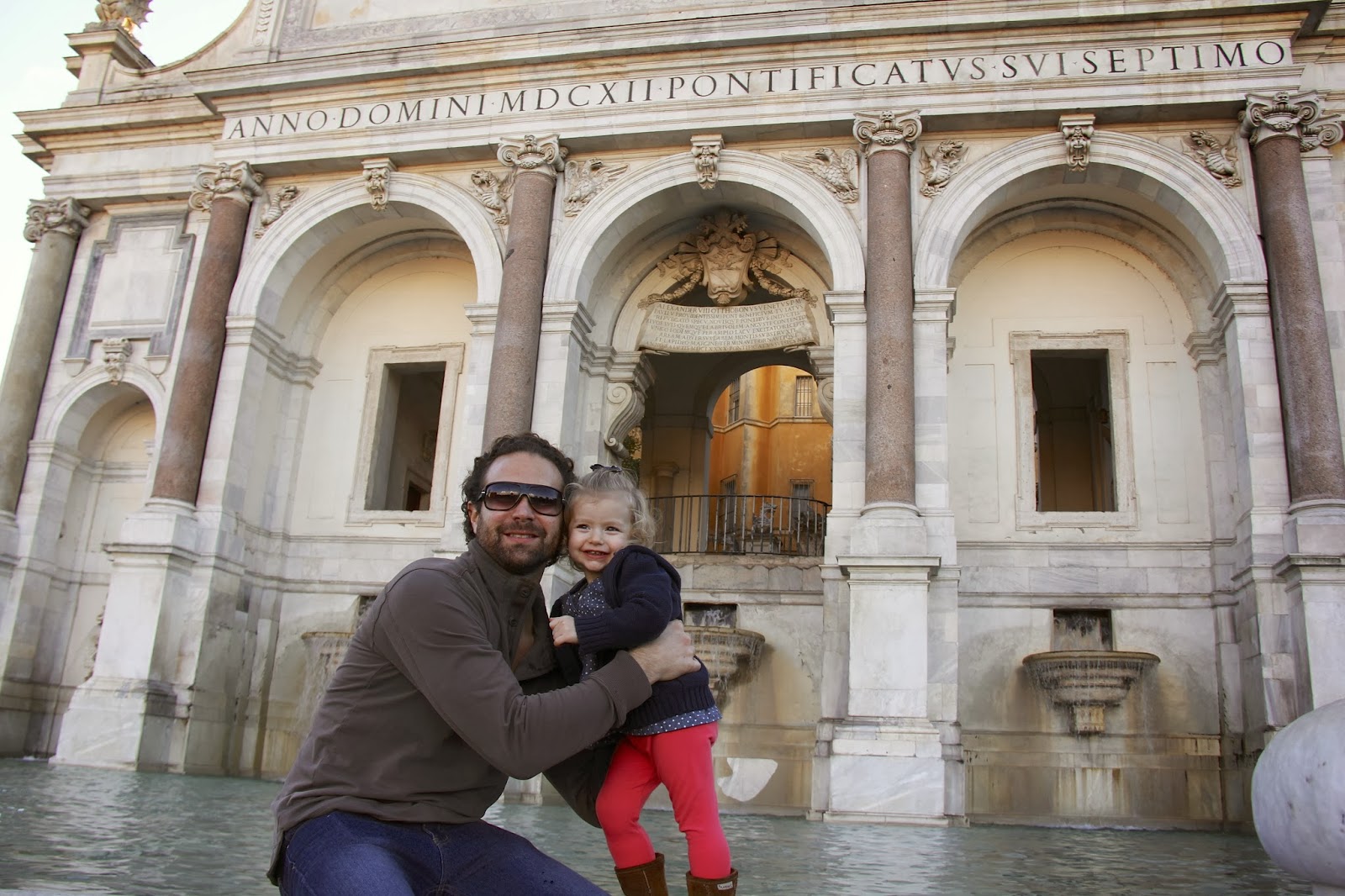
We wrapped around to the southwest portion of the city to see the Fonte Acqua Paola – a site that is seldom talked about, but worth a visit.  A panoramic view of the city opens before you eyes from the elevated vantage point.  The styling of the fountain is nearly as impressive as the Trevi Fountain, but without the crowds.

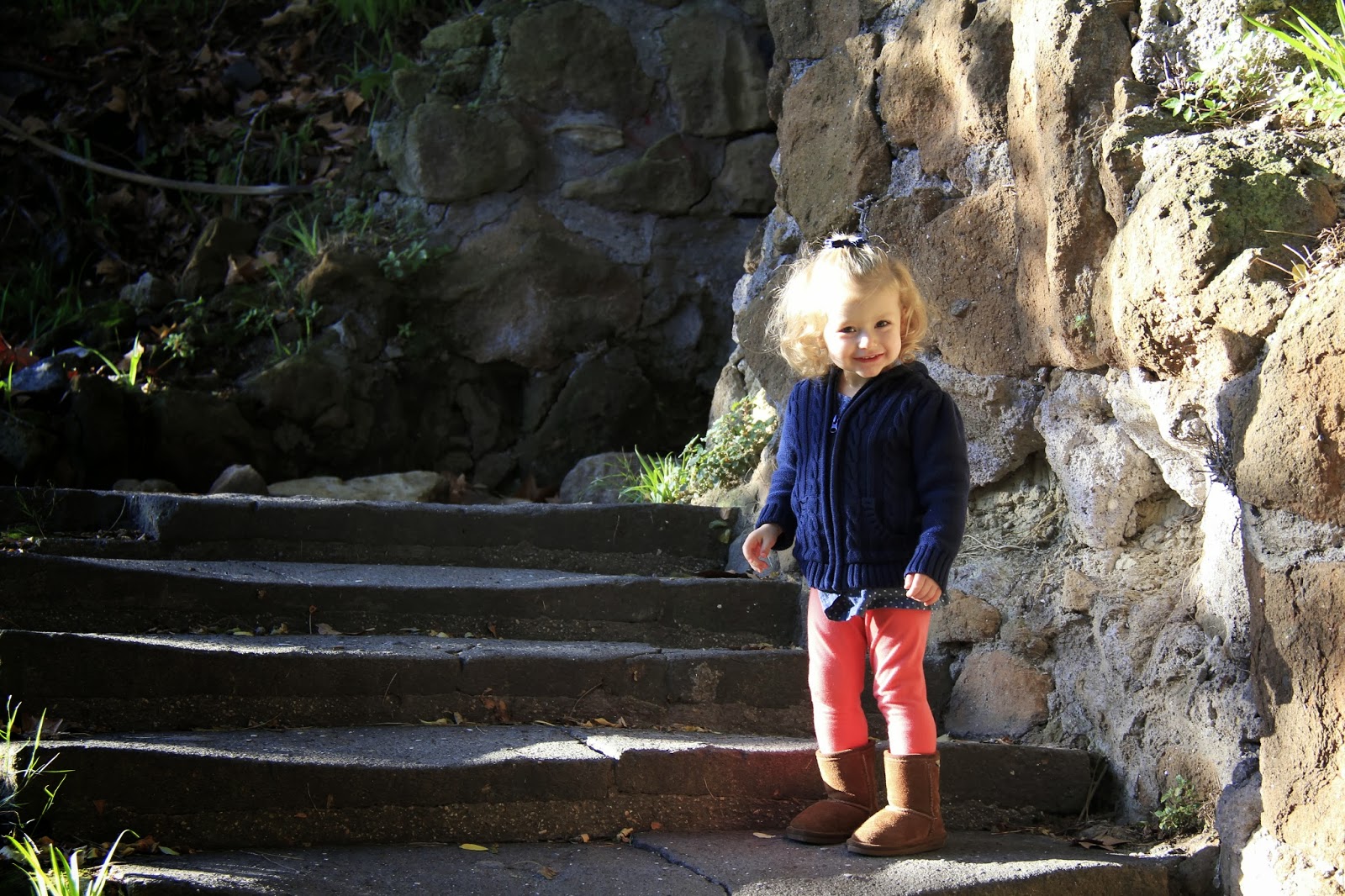
Julia leads the way up to the fountain
A beautiful panoramic view of Rome opens from this high vantage point
Fonte Acqua Paola –  built in 1610 to mark the end of the Acqua Paola acqueduct
Julia is thrilled to have discovered another fountain
She allows me to take a picture with her

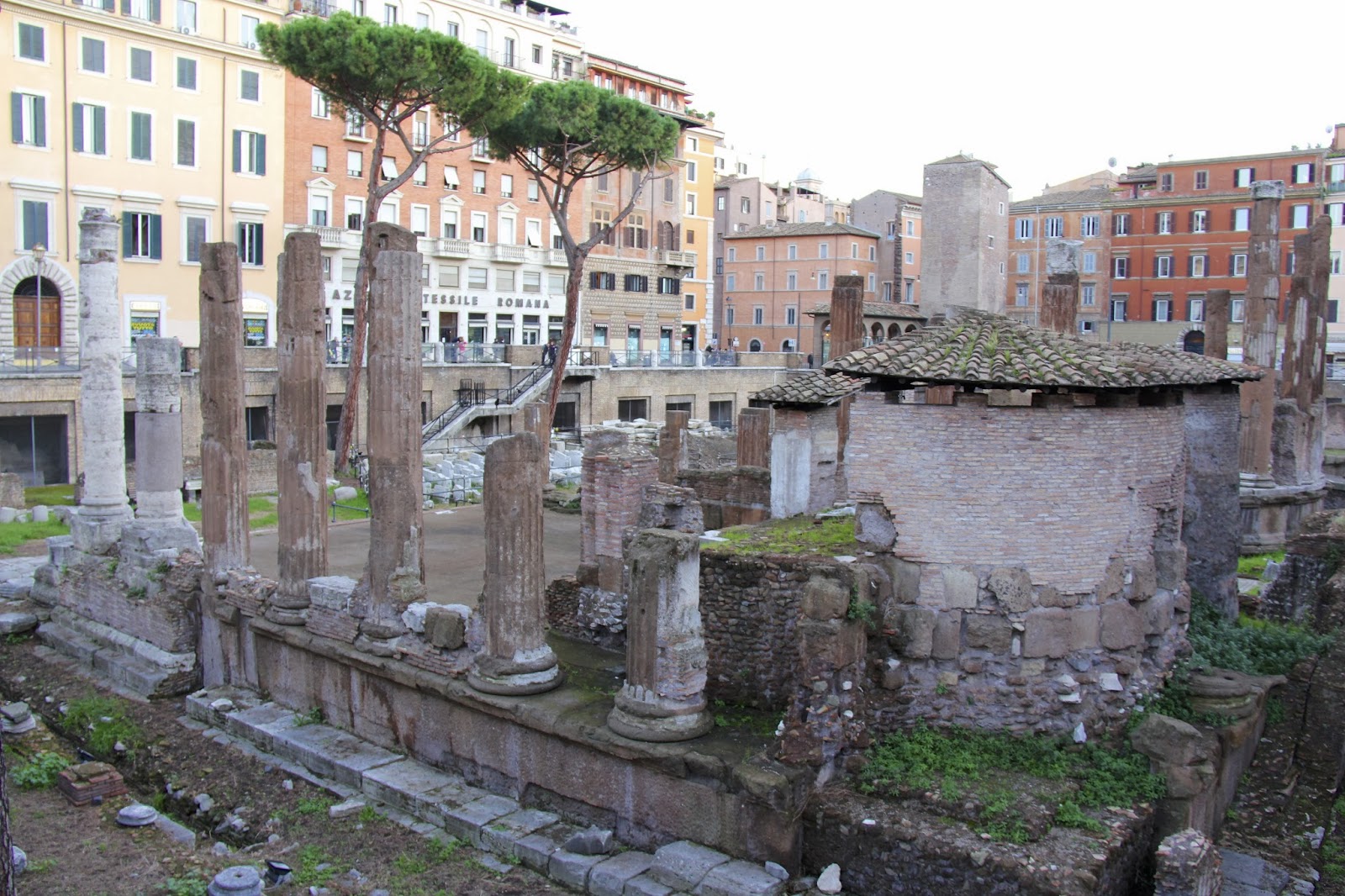
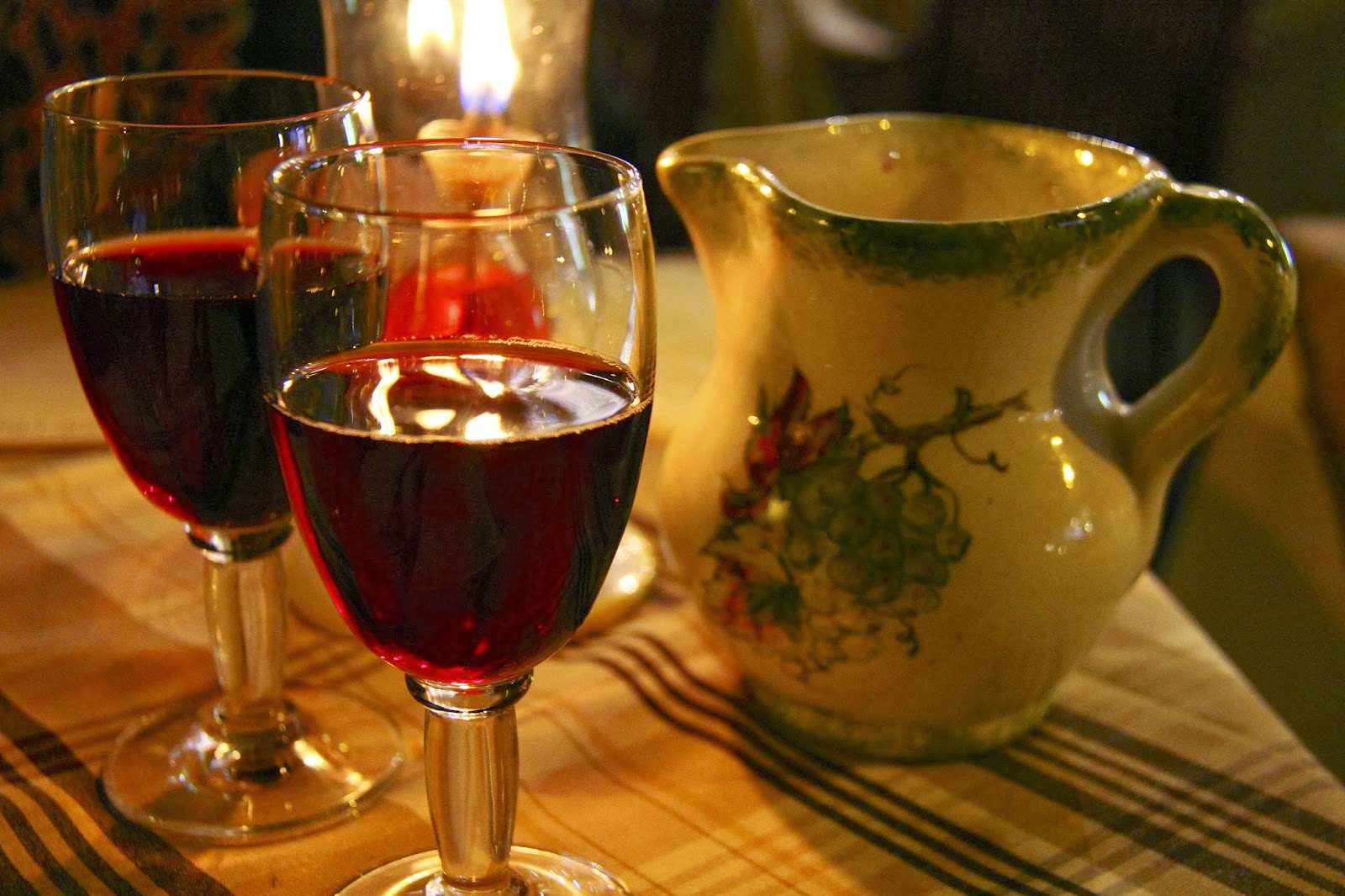
We next made our way to the east banks of the Tiber river and visited Campo dè Fiori, an outdoor marketplace.  We followed a short arc back toward the Pantheon.  Along the way, we saw the Area Sacra, one of Rome’s most significant archeological finds.  Four temples dating as far back as the fourth century BC were discovered quite by accident in 1926.  We planned to eat dinner in one of the restaurants in Piazza Navona, Rome’s largest piazza built on grounds of the ancient Stadio di Domiziano.  After taking in the beauty of the piazza, we spent all of three minutes evaluating and then quickly dismissing the restaurant options.  The places were obvious tourist traps, many of them boasting pictures of their food (which is always our first sign it’s time to scram).  Instead we tucked into a little trattoria on a nearly unnoticed street and settled in for a couple nice glasses of wine.

Area Sacra a significant find in the middle of the modern city
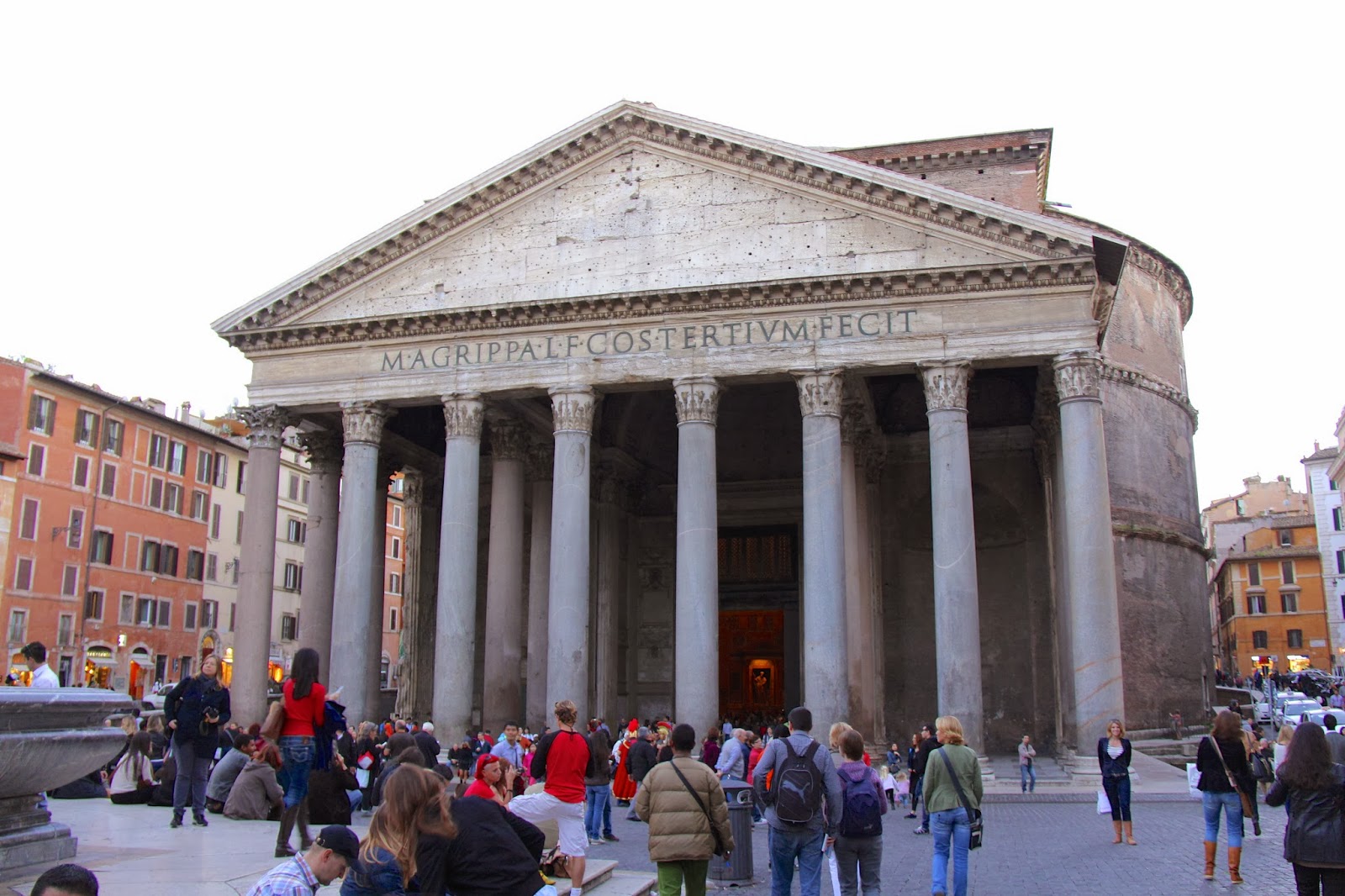
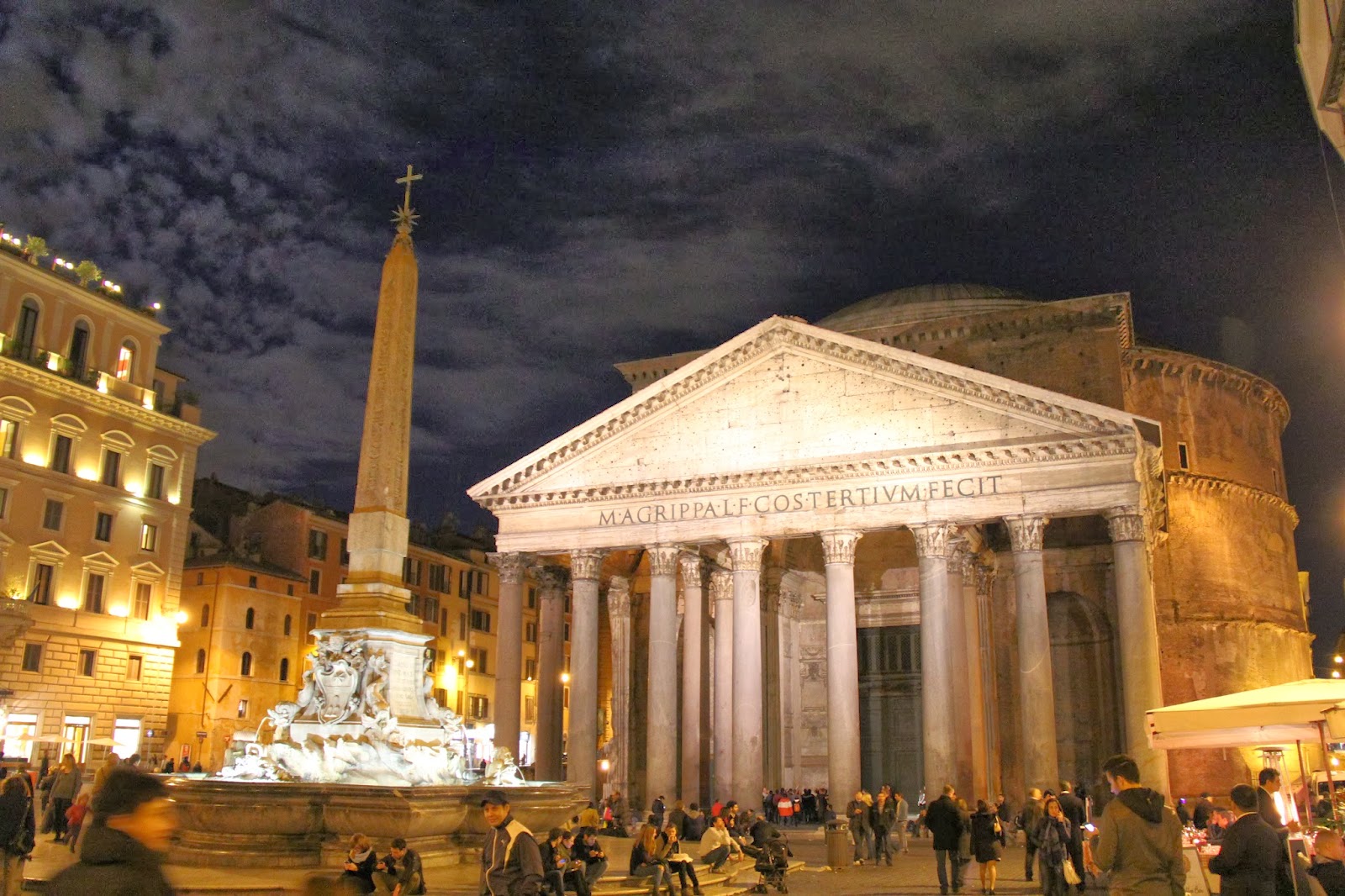
The Pantheon was built in 126 AD
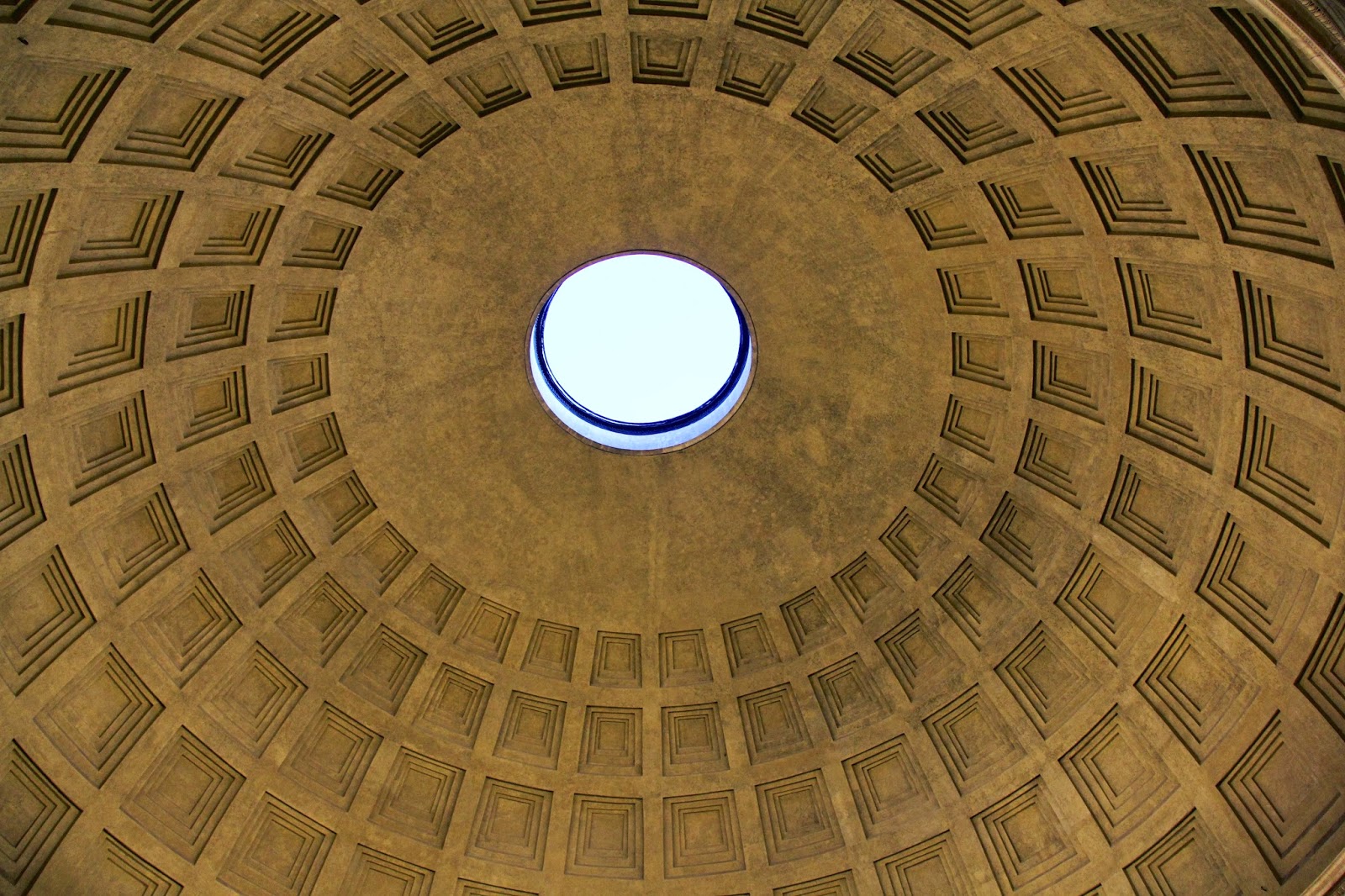
The Pantheon’s coffered dome was poured in concrete moulds- the oculus is the main source of natural light
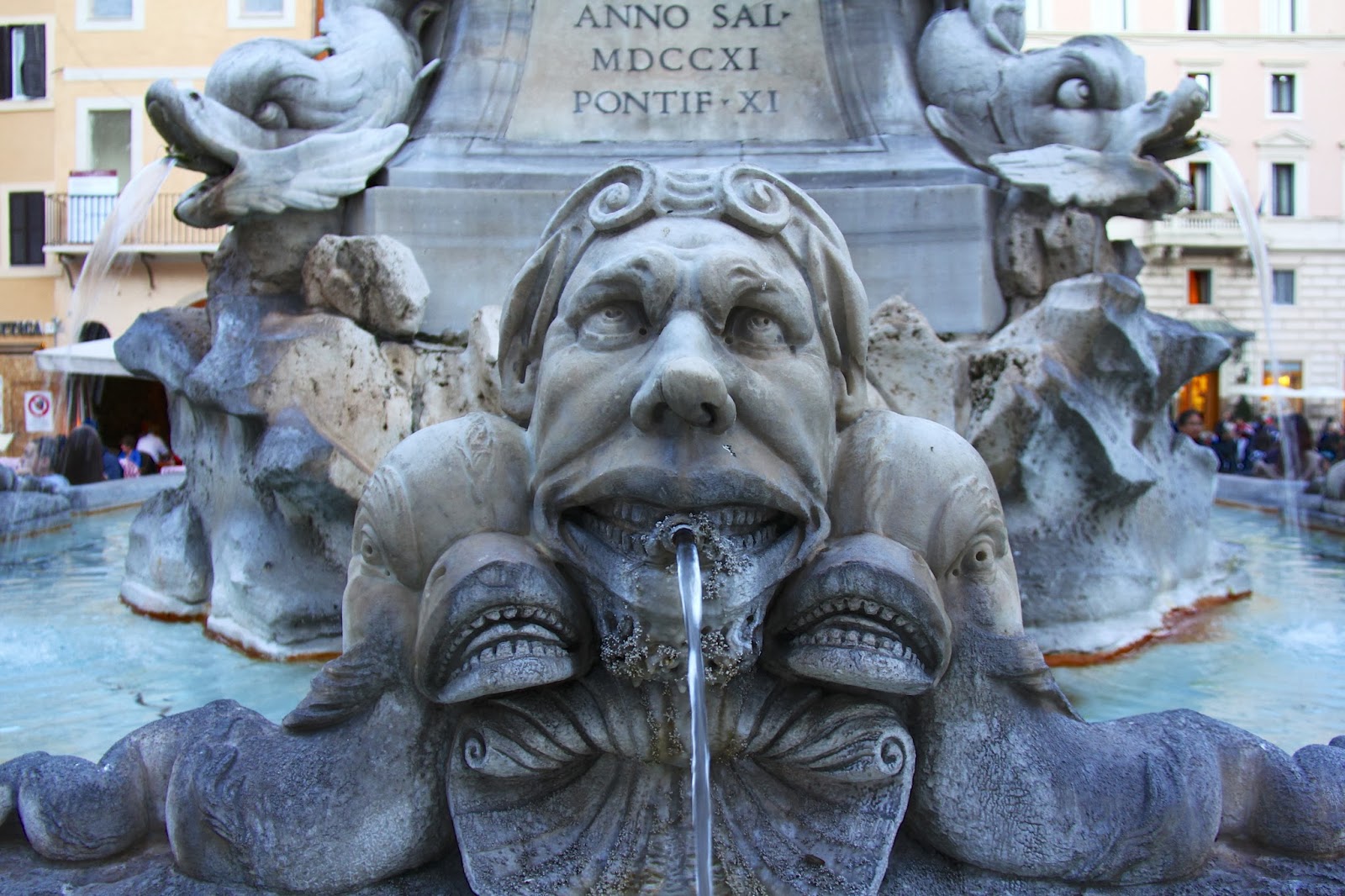
Fontana del Pantheon across from Pantheon in Piazza della Rotonda
We stopped for some wine in a nearby piazza while Julia had dinner
The Pantheon and Piazza Rotunda at night
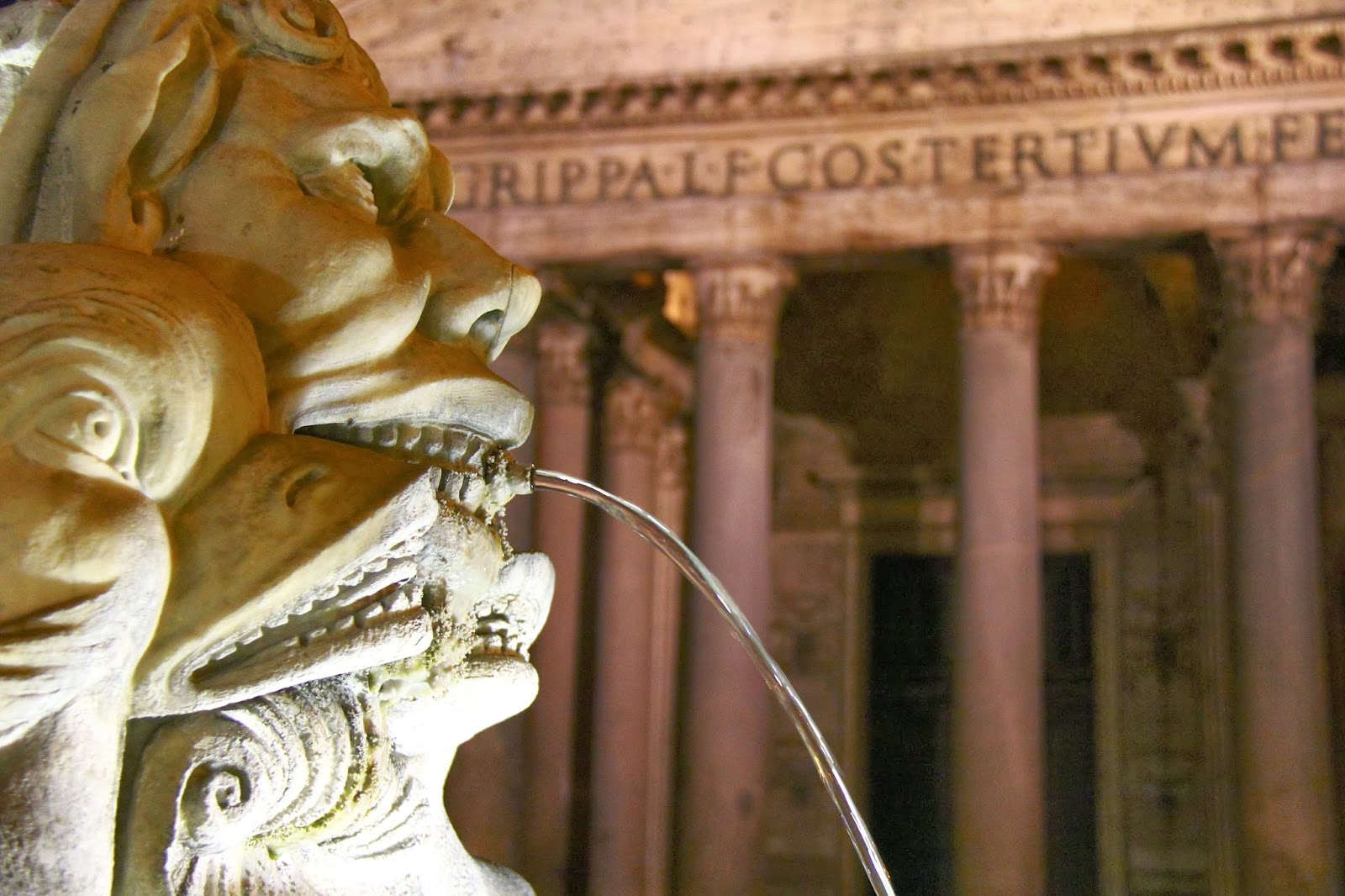
The fountain in front of the Pantheon
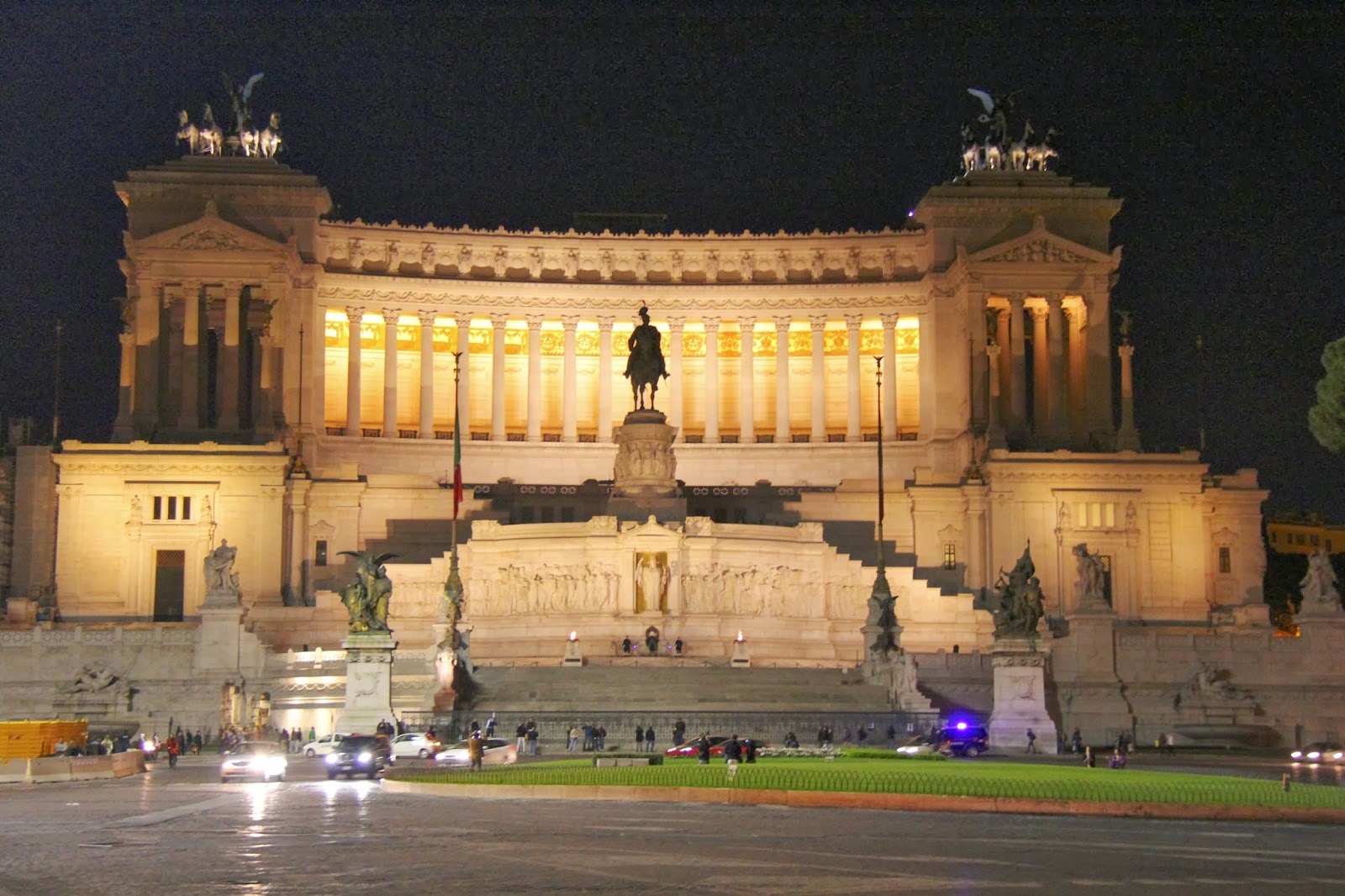
Altare della Patria (Alter of the Fatherland) also known as Monumento Nazionale a Vittorio Emanuele II

We had two big days in a magical city, but so much more still ahead of us.  We were departing on our cruise the next day; eager to embark on another adventure on the sea.

All Roads Lead To Rome

If all roads lead to Rome, nowadays you could also say that all European cruises start from Rome. Well, maybe not all – but a good many of the cruise ships use this port of call as a starting point for their Mediterranean voyages.  At least, this was the case on our cruise aboard Celebrity Cruise Lines ship, Silhouette.  The Silhouette is one of five ships in their newest Solstice Class – a group of sleek, modern ships with a heavy emphasis on style and dining.  The ship and the cruise did not disappoint.  We had many ports of call and a lot of wonderful activities that I’d like to write about, so let’s start at the beginning…

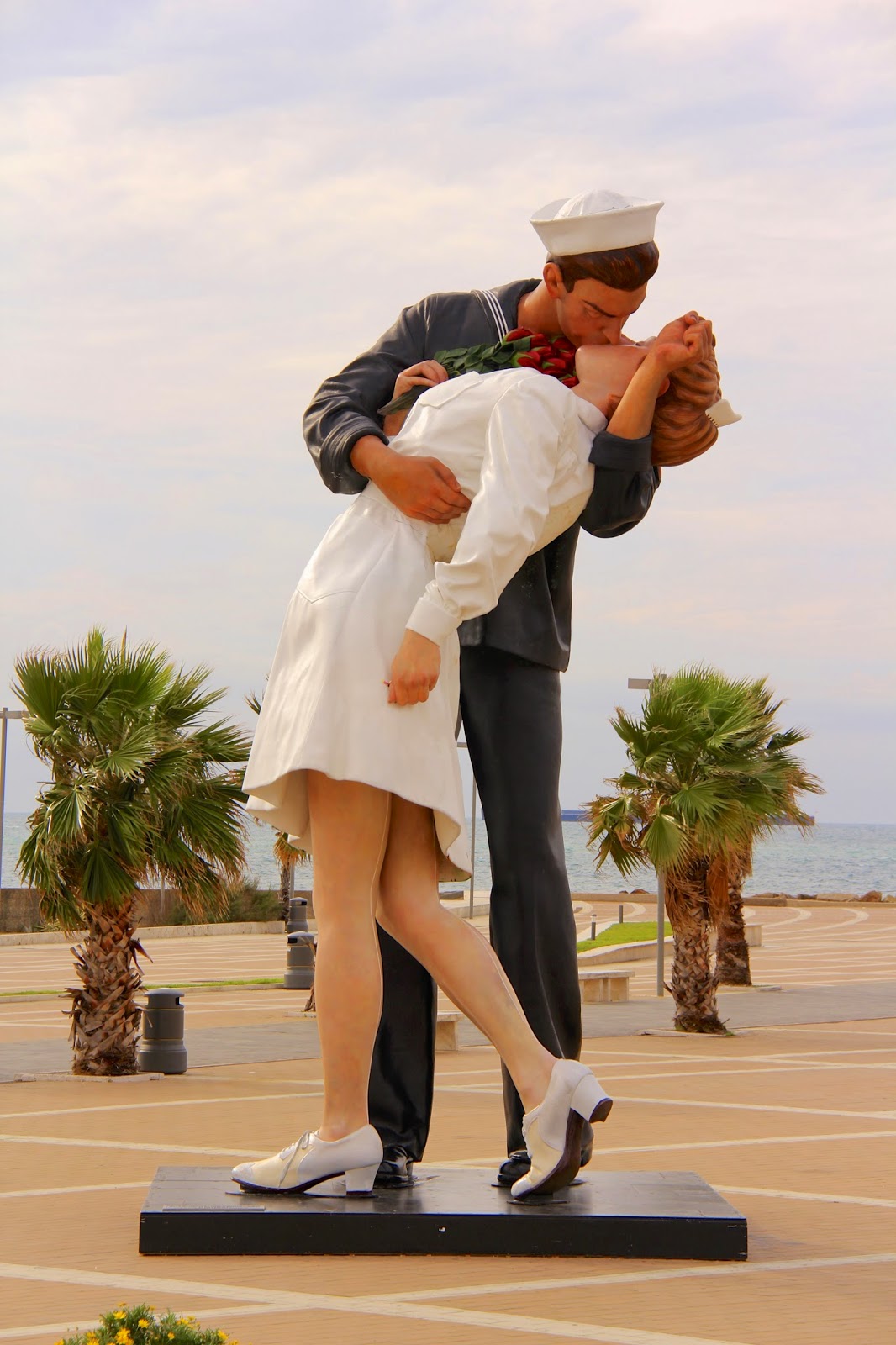
A wonderful statue stands outside the port of our ship
We arrived in Rome two days ahead of our ship’s departure to explore the city’s history, experience the cuisine and absorb the magic of a place you absolutely must see in your lifetime.  Two days is barely enough time to scratch the surface, but we did our best to fit in as much as possible.  On this blog, I’ll often write about a city’s history before detailing our adventures.  The history of Rome is so storied and captivating, that a single paragraph couldn’t possibly do it justice.  Instead, I invite you to click on this link to read about Rome and this link to read about Ancient Rome.  Or get off the internet and pick up a book (but not until you finish reading my blog post)!
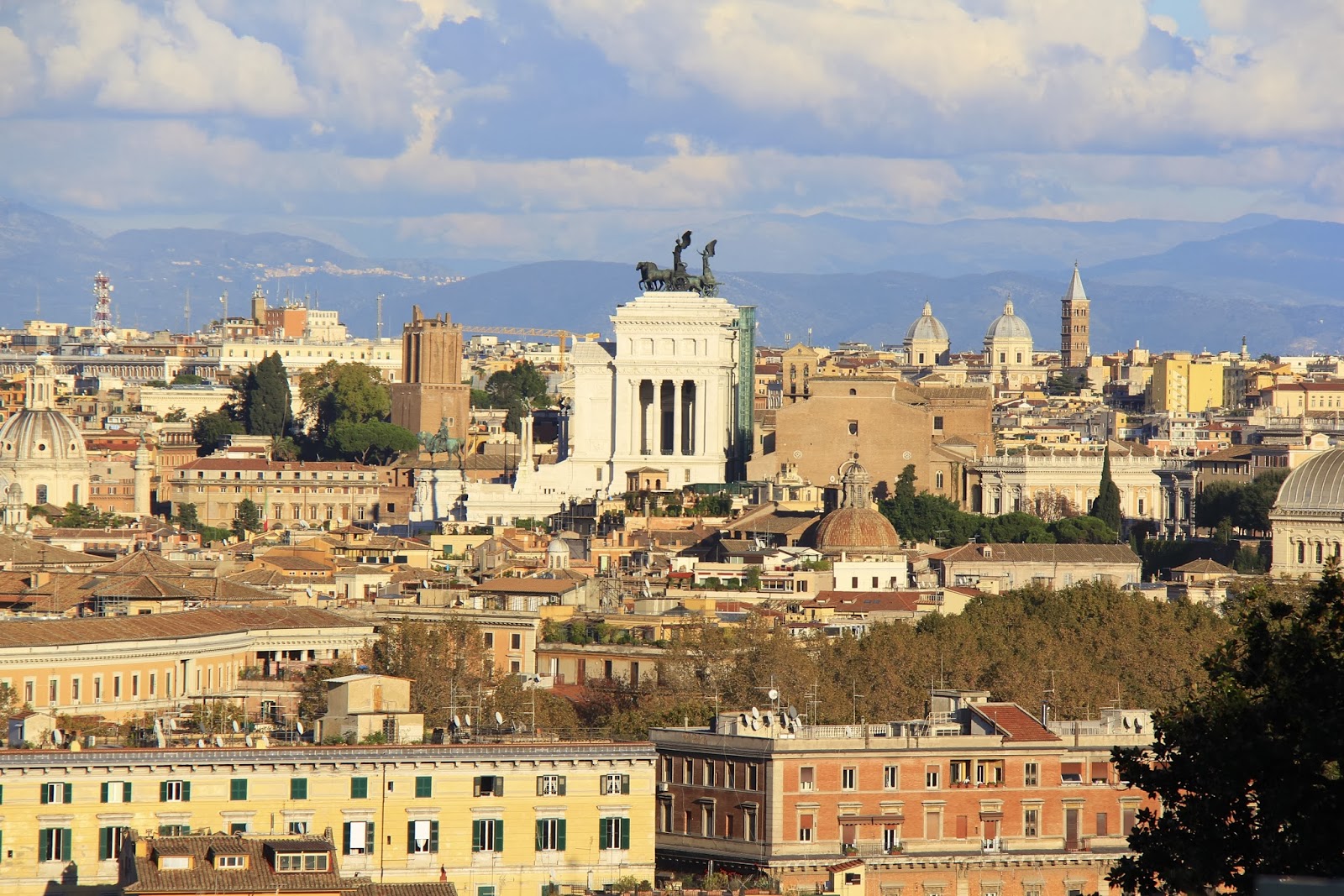
A view of Rome – Altare della Patria stands prominently above the rest of the city
After living in Italy for nearly a year, we are still learning travel tips on a constant basis.  A new lesson you may be surprised to learn (and one that could possibly be applied to real life) – procrastination doesn’t pay.  Even though I knew our travel dates, I waited months to reserve our train tickets.  I paid roughly €80 for two tickets from Milano to Roma on the express train (a great price), but more than triple that amount on the way back – they only had first class seats available. Suggestion – if you know your dates, book early!  Better suggestion – if you have flexibility in your dates, book your train first and then schedule everything around it (for example, I could have stayed an extra night in Rome for the difference in train fare).  Additionally, go talk to someone at the ticket counter (most of them speak English).  They often have access to fares that are different (and better) than the kiosks.  If you travel from Milano to Roma, book aboard the velocità alta (high speed train), which whisks you across the country at a remarkable 300km per hour, delivering you in just over three hours.
We arrived in Rome just after lunch and went immediately from our hotel to Città del Vaticano (Vatican City), thereby entering a country not apart of Italy.  The city-state is sovereign territory of roughly 110 acres entirely enclosed behind large ancient walls.  The city boasts a population of around 840 people, making it the world’s smallest internationally recognized independent nation in terms of both size and population.  As they say, good things come in small packages.  We opted to join a tour group, since there is so much to see and do inside the city walls.  The tour included the Vatican Museums, the Sistine Chapel and Saint Peter’s Basilica – the three main attractions in the city.
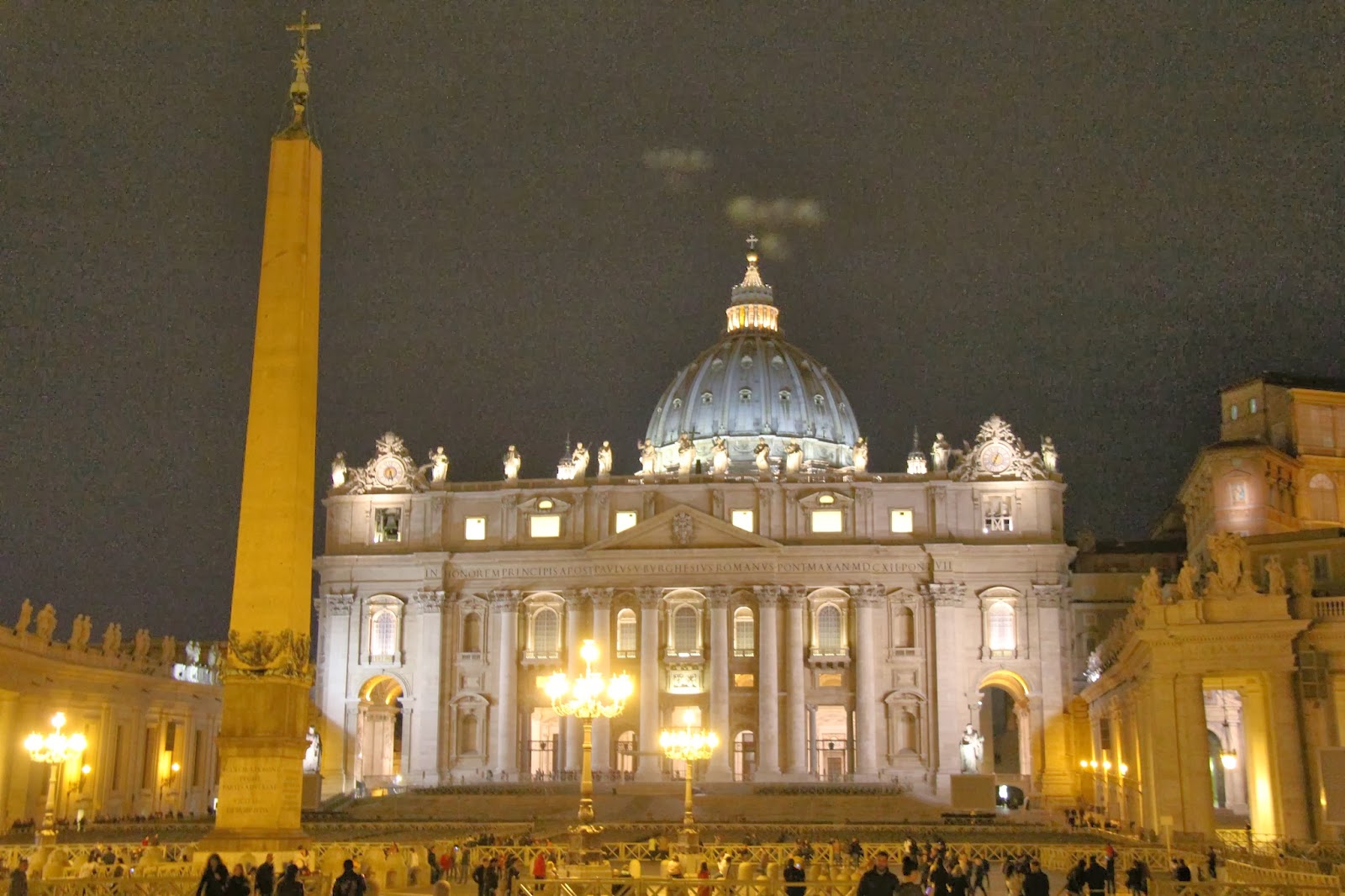
Saint Peter’s Square at night – shown here are the Basilica and the obelisk
We started in the Vatican Museums, a collection of buildings that hold some of the world’s most priceless and inspiring works of art.  My camera was smoking from staying on overdrive.  In 2011 over five million people visited the museums founded by Pope Julius II in the early 16th century [source].  Our tour included passage through the Borgias’ house; family of the controversial Pope Callixtus III, popularized by the hit Showtime series, The Borgias.

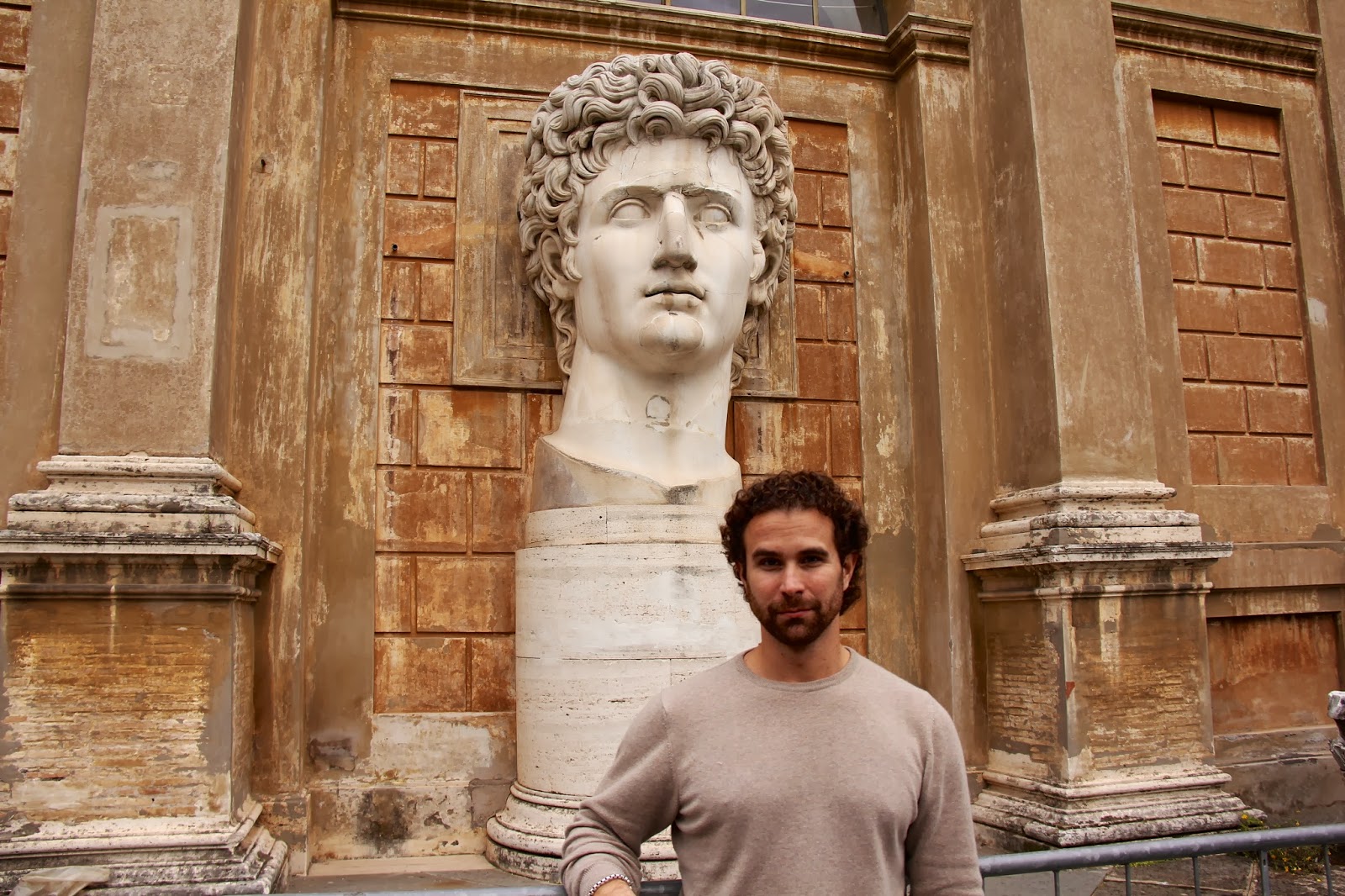
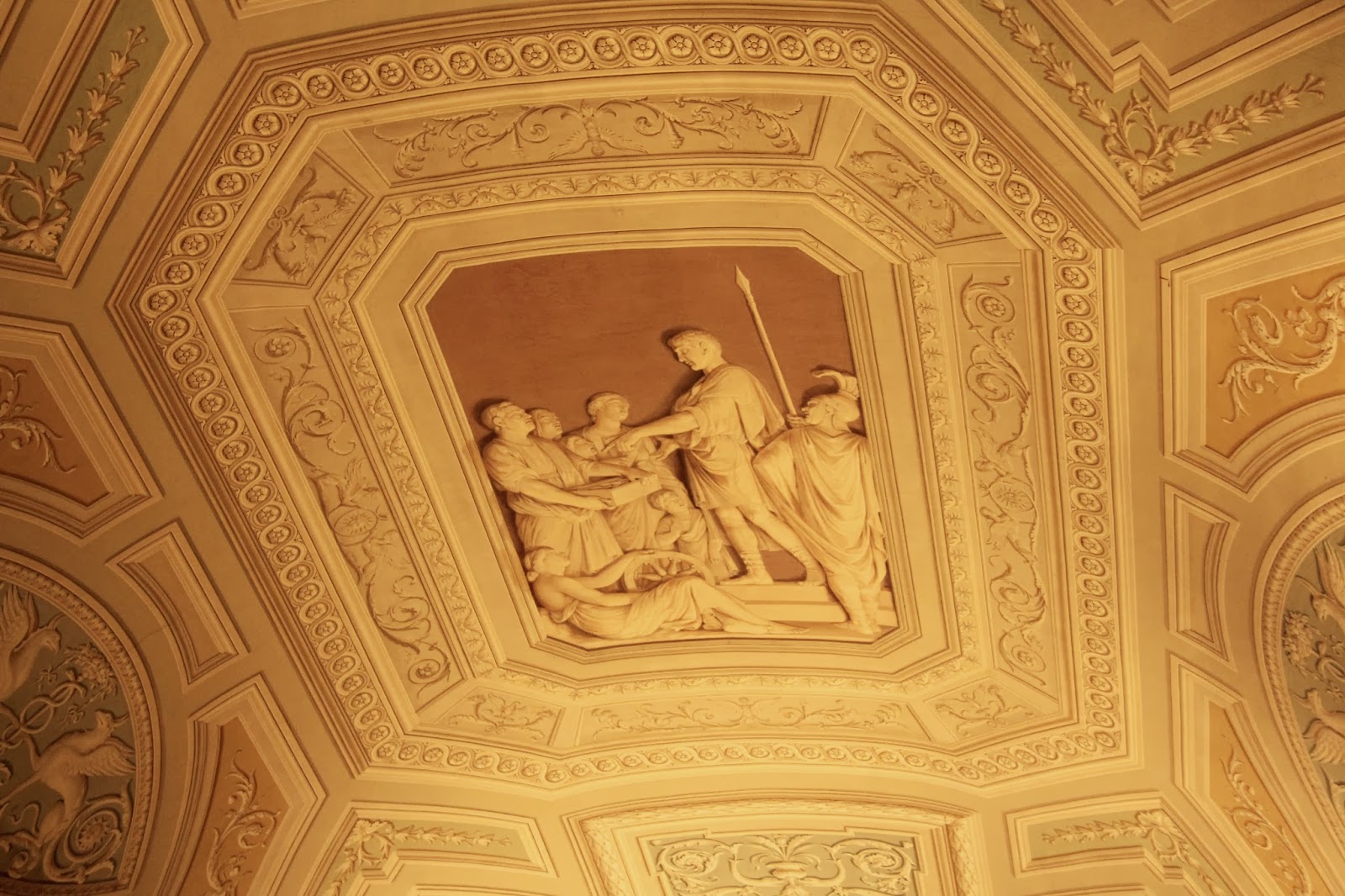
Just hanging out with my pal, Augustus  – “hmm, I like his hair… but he needs a beard”
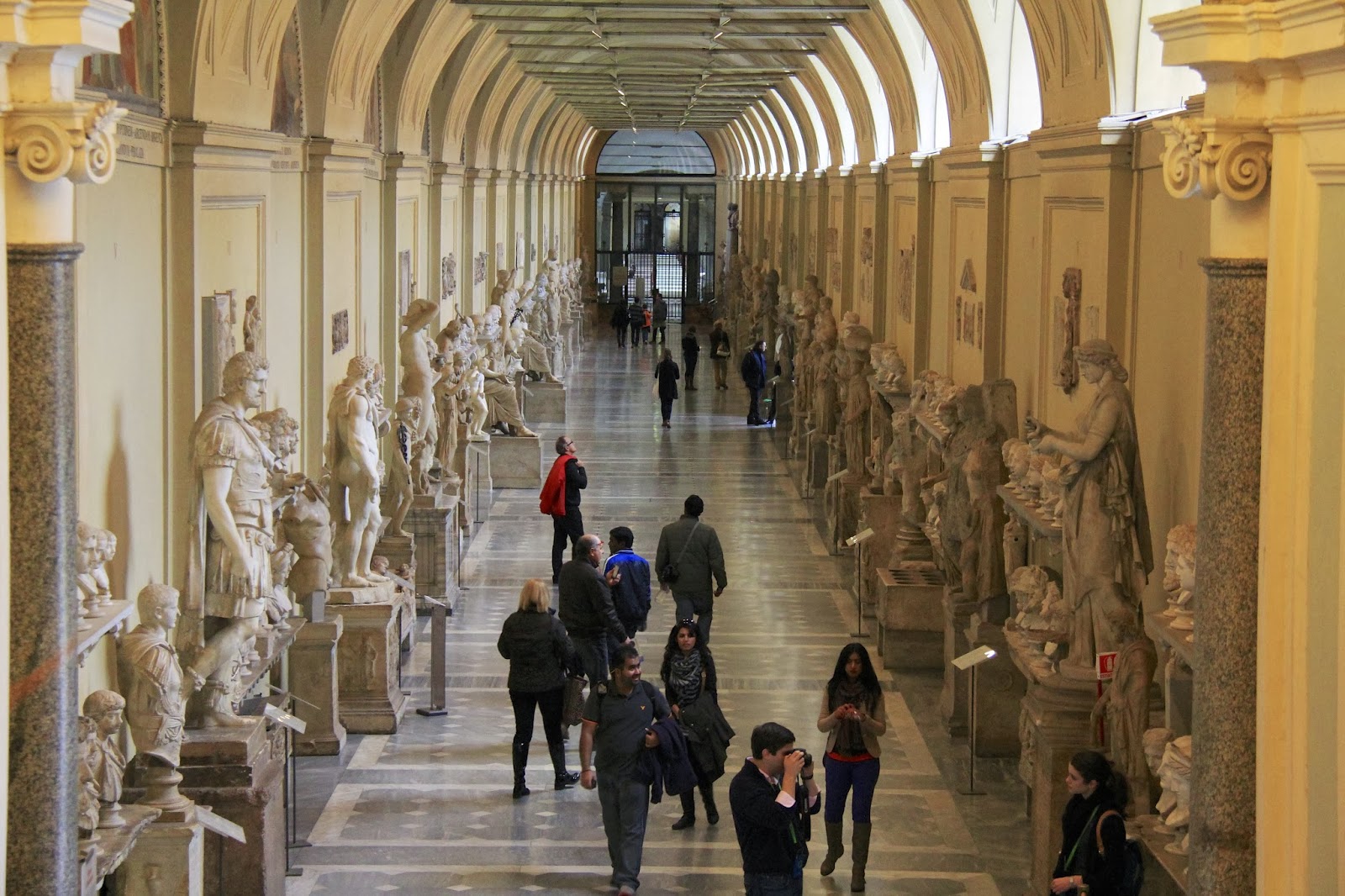
Amazing works of art carved from marble greet us in the entryway
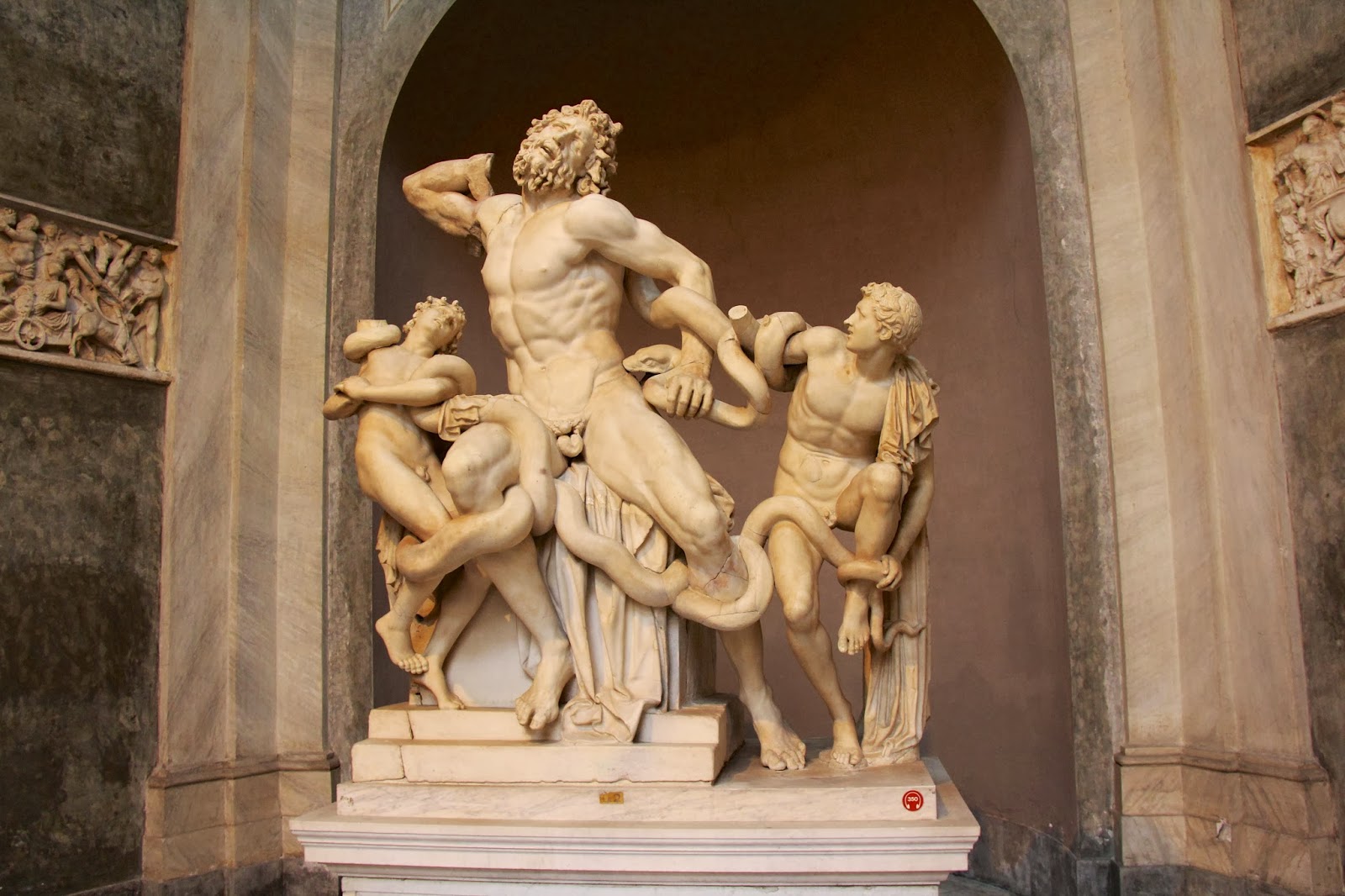
Laocoön and His Sons excavated in Rome in 1506
The piece is dated between 200 BC and 70 AD
An example of the French painting style, trompe-l’œi (deceive the eye) – the image appears three-dimensional
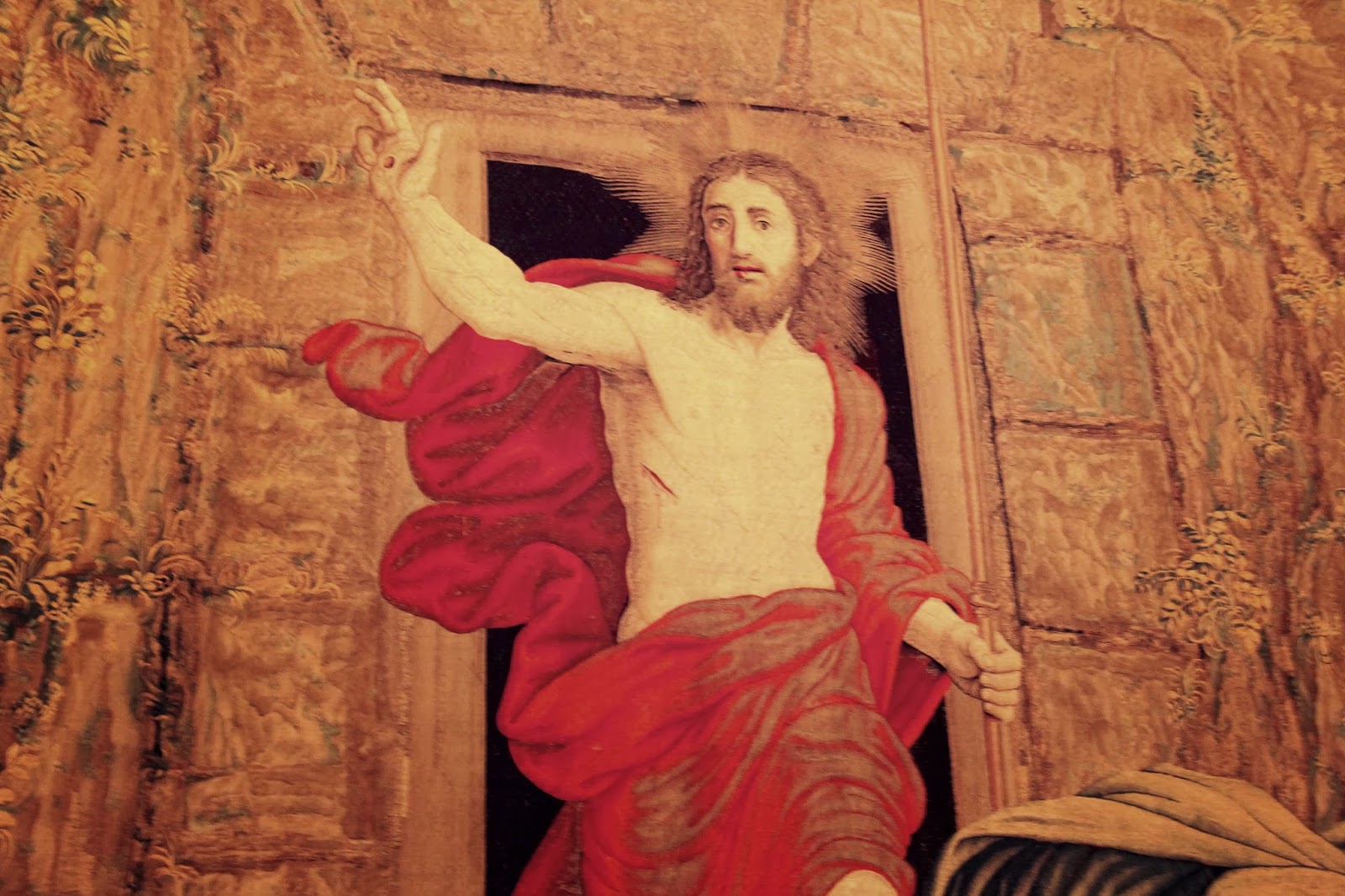
Central portion of the tapestry, The Resurrection of Jesus 
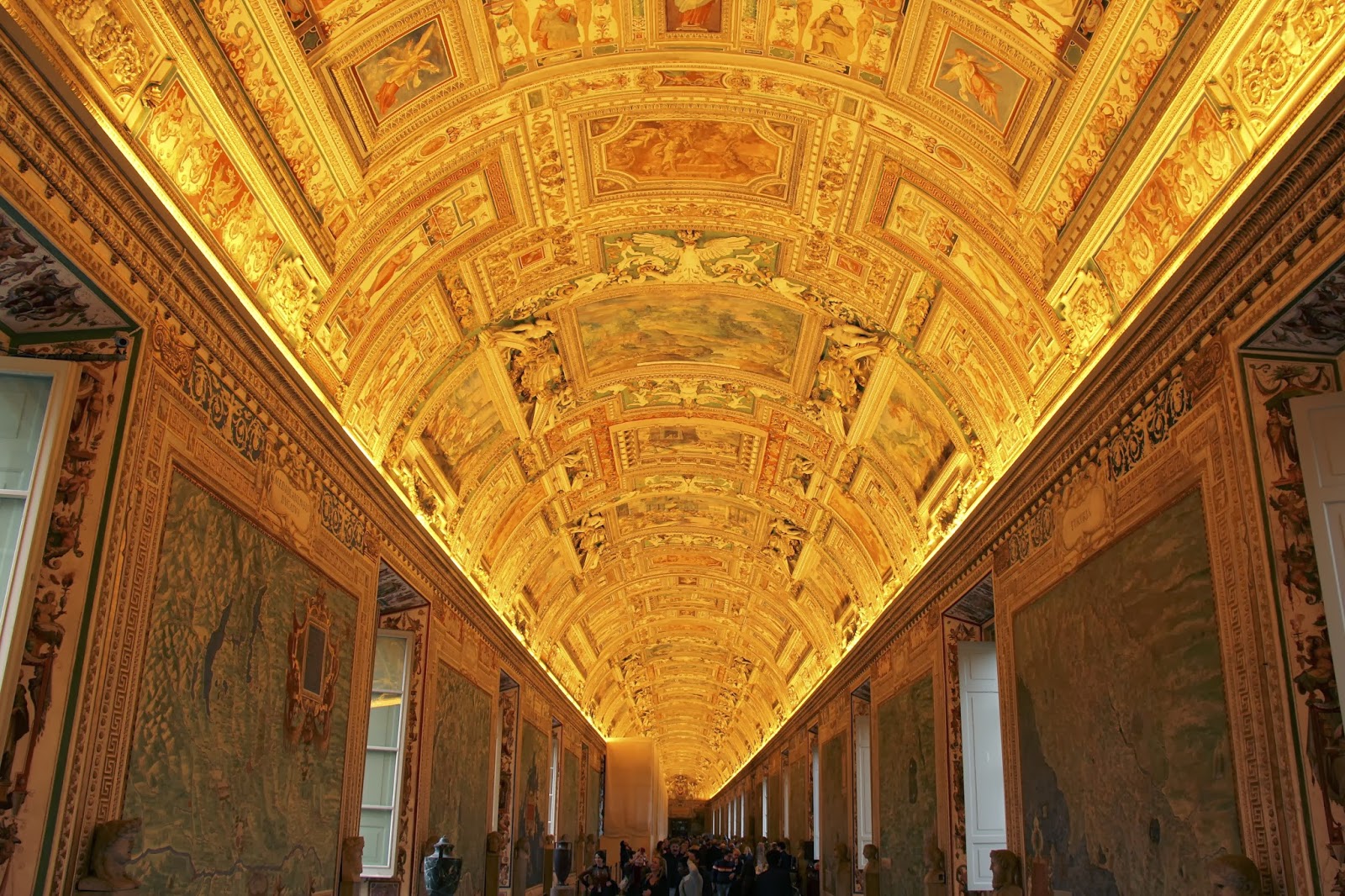
Eye-popping ceiling in the impressive Galleria delle Carte Geografiche (Gallery of Maps)
Jen stops for a photo

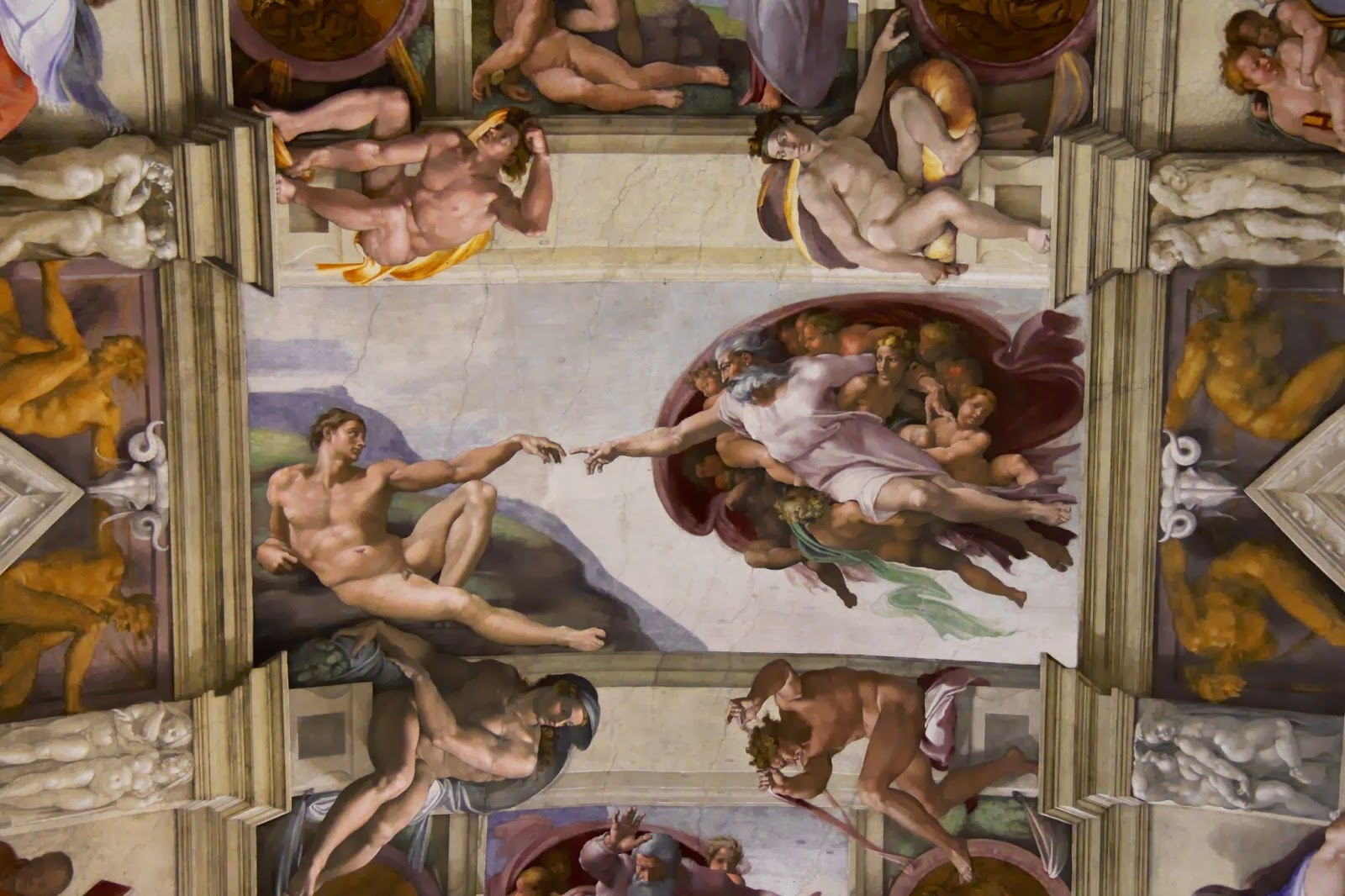
Next, we walked into the adjoining Sistine Chapel.  On the tour, we learned that the Sistine Chapel is the largest chapel in the world.  A chapel, practically by definition is a small place of worship (either freestanding or attached to a larger church).  This is significant because the papal conclave (the sequestering of cardinals when electing a new Pope) is held in the Sistine Chapel (as opposed to the more spacious Basilica, next door).  Inside the basilica, Michelangelo’s Last Judgement monopolizes the back wall, while the even more famous Creation of Adam rests prominently in the center of the ceiling.  Words cannot describe the feeling that washes over you as you sit in such a historically significant place.  The amazing frescoes inspire images of Michelangelo, resting on his back atop scaffolding and slowly painting each section, a brush in one hand and a candle in the other.

The most iconic portion of Michelangelo’s ceiling in the Sistine Chapel, The Creation of Adam

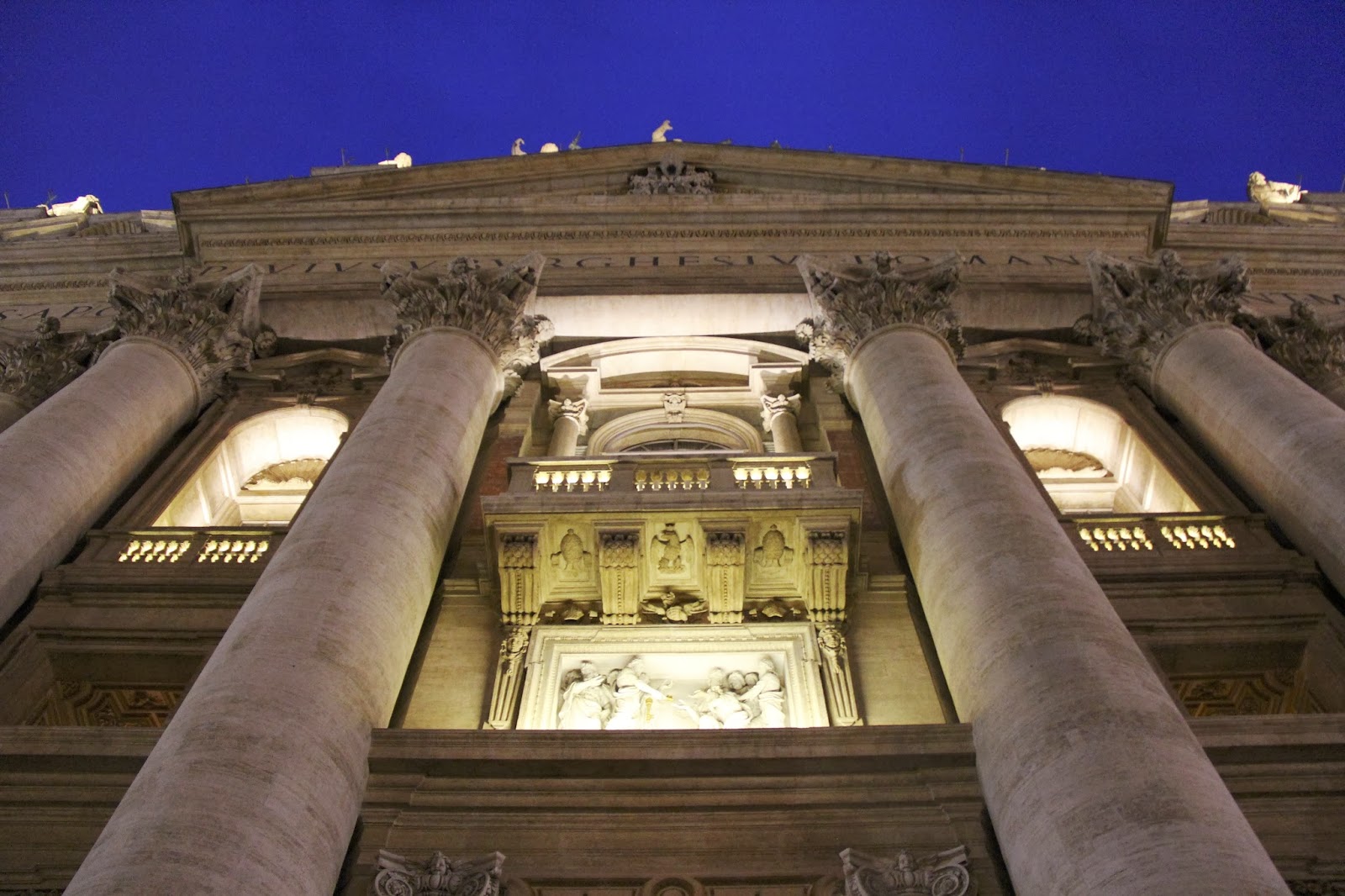
As the sun set on our tour, we visited Saint Peter’s Basilica, one of the largest churches in the world. The church sits in the center of St. Peter’s Square, which is flanked by large rounded colonnades – intentionally reaching out like long arms embracing visitors.  From an aerial perspective, you’ll see that the church itself is designed in the shape of the cross, while the entire square resembles a keyhole (echoing Saint Peter’s role as holder of keys to heaven).

A beautiful blue night’s sky had settled over St. Peter’s Basilica
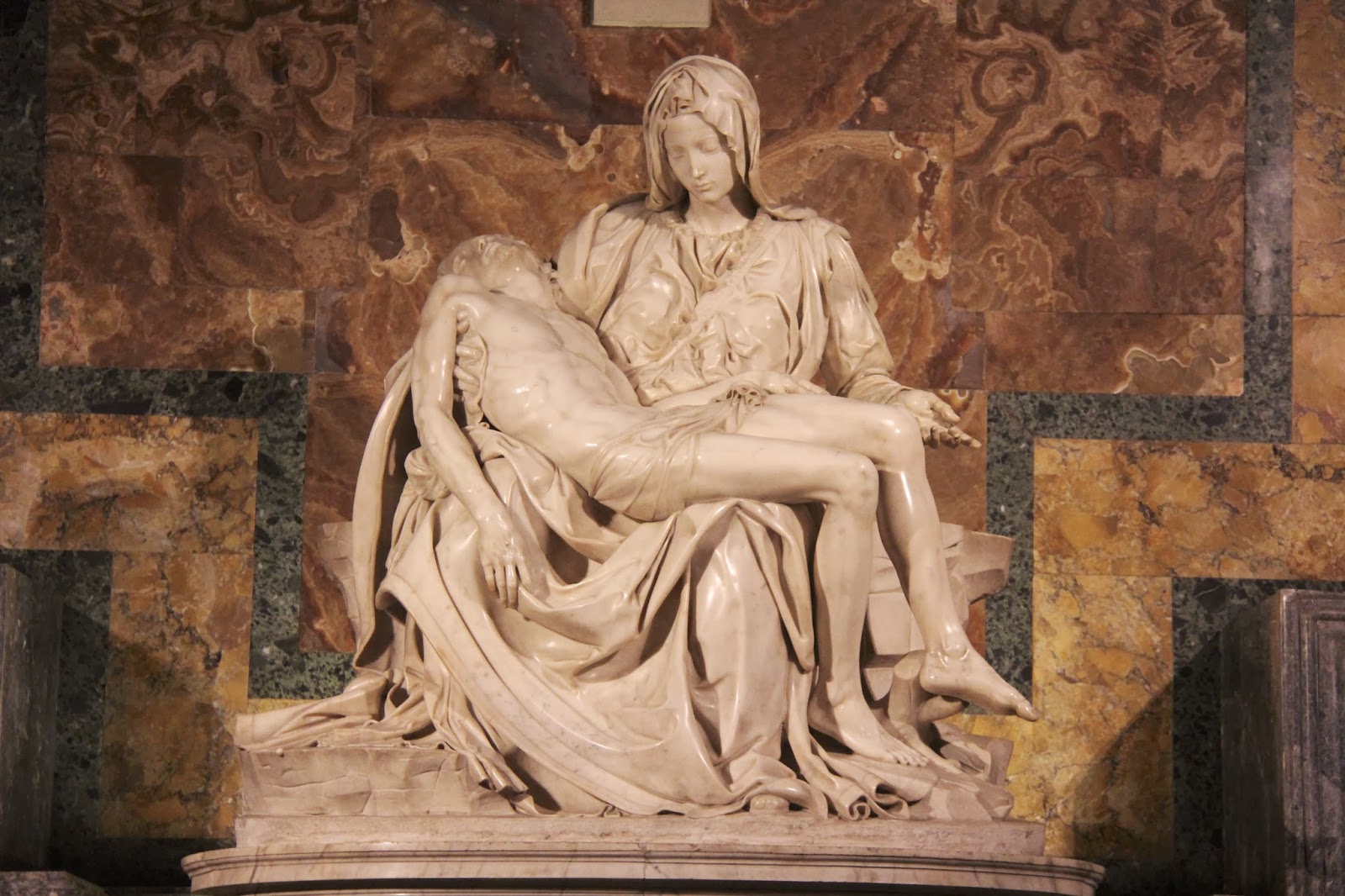
Pietà, also by Michelangelo

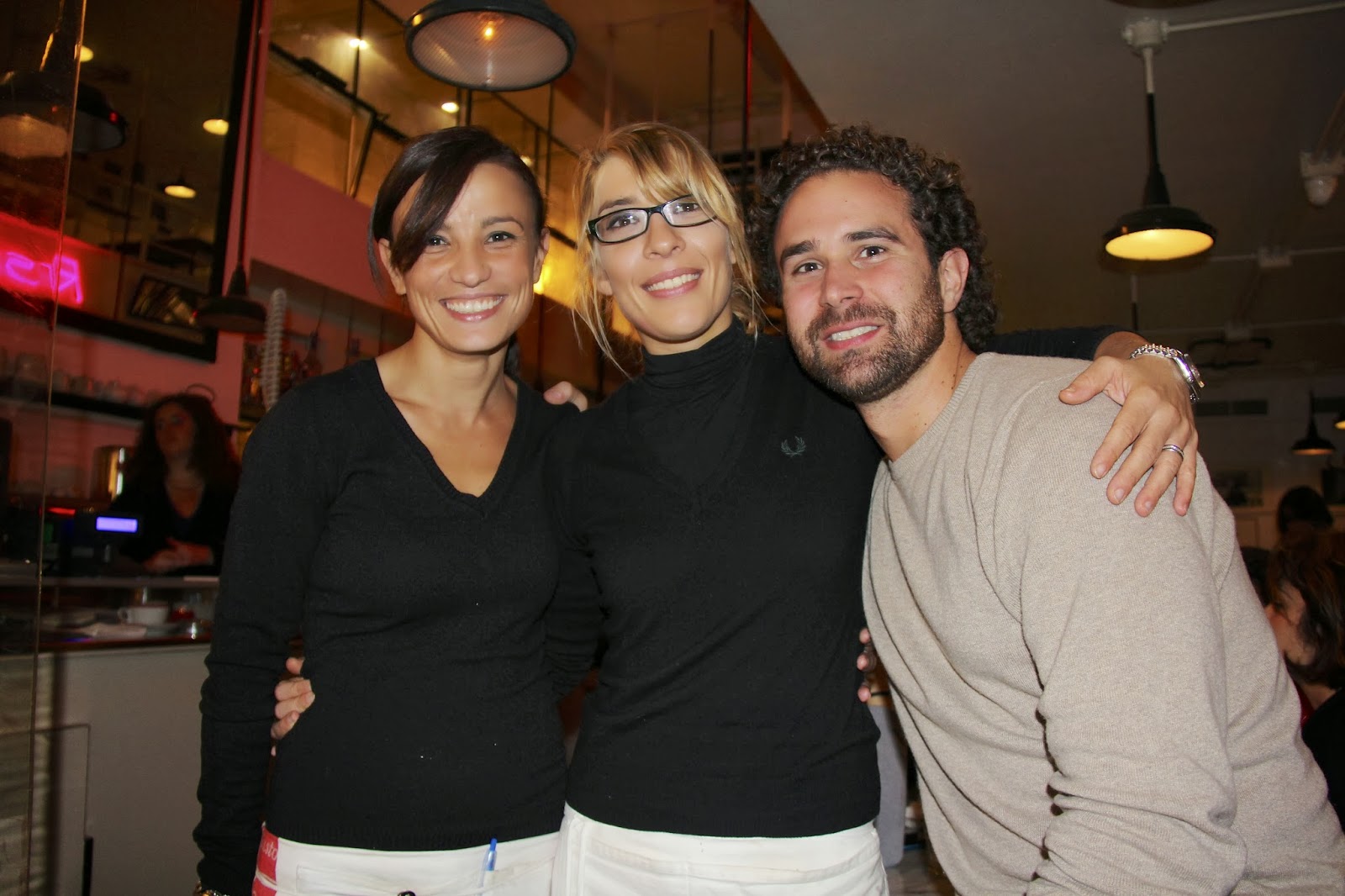
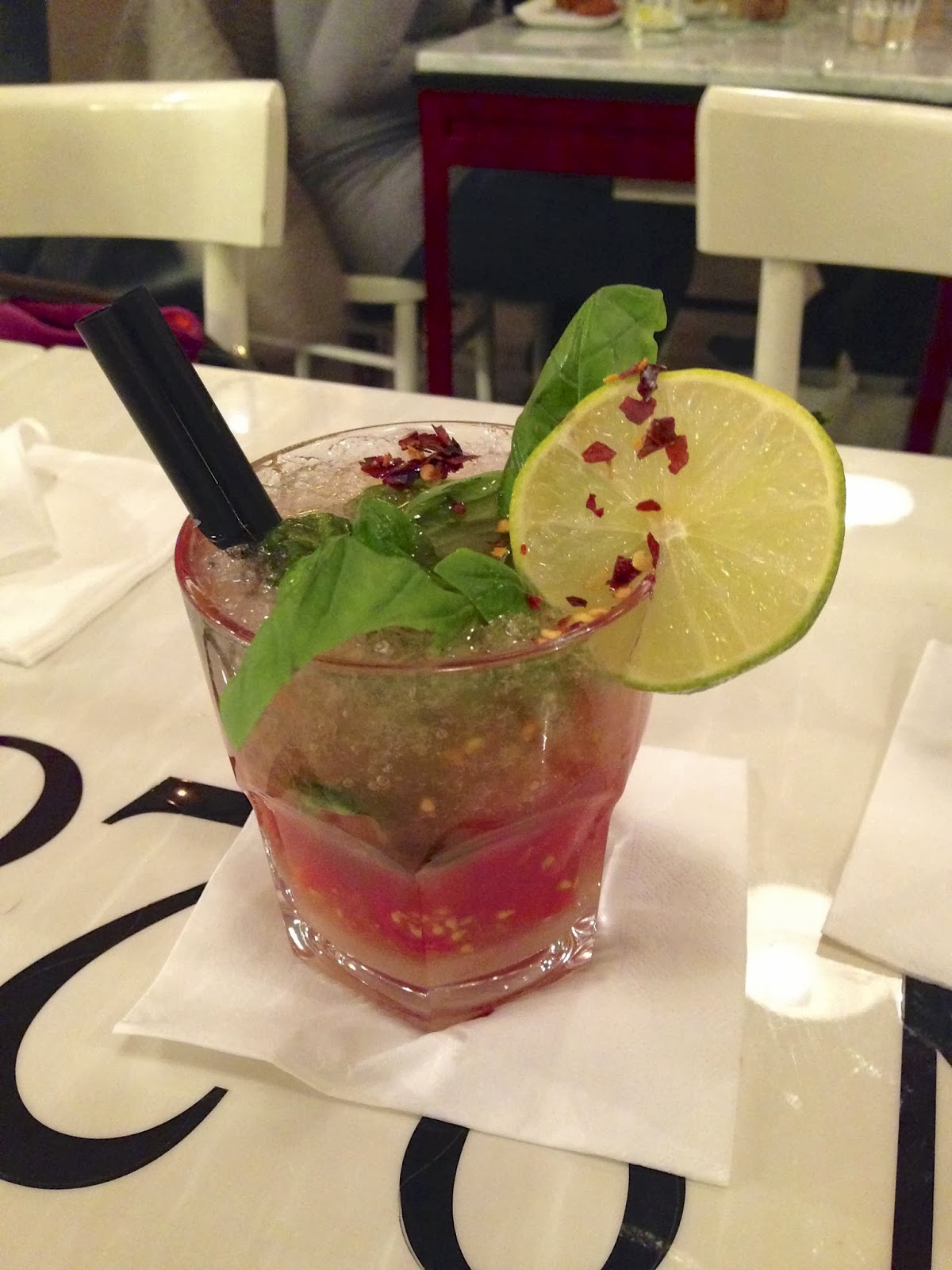
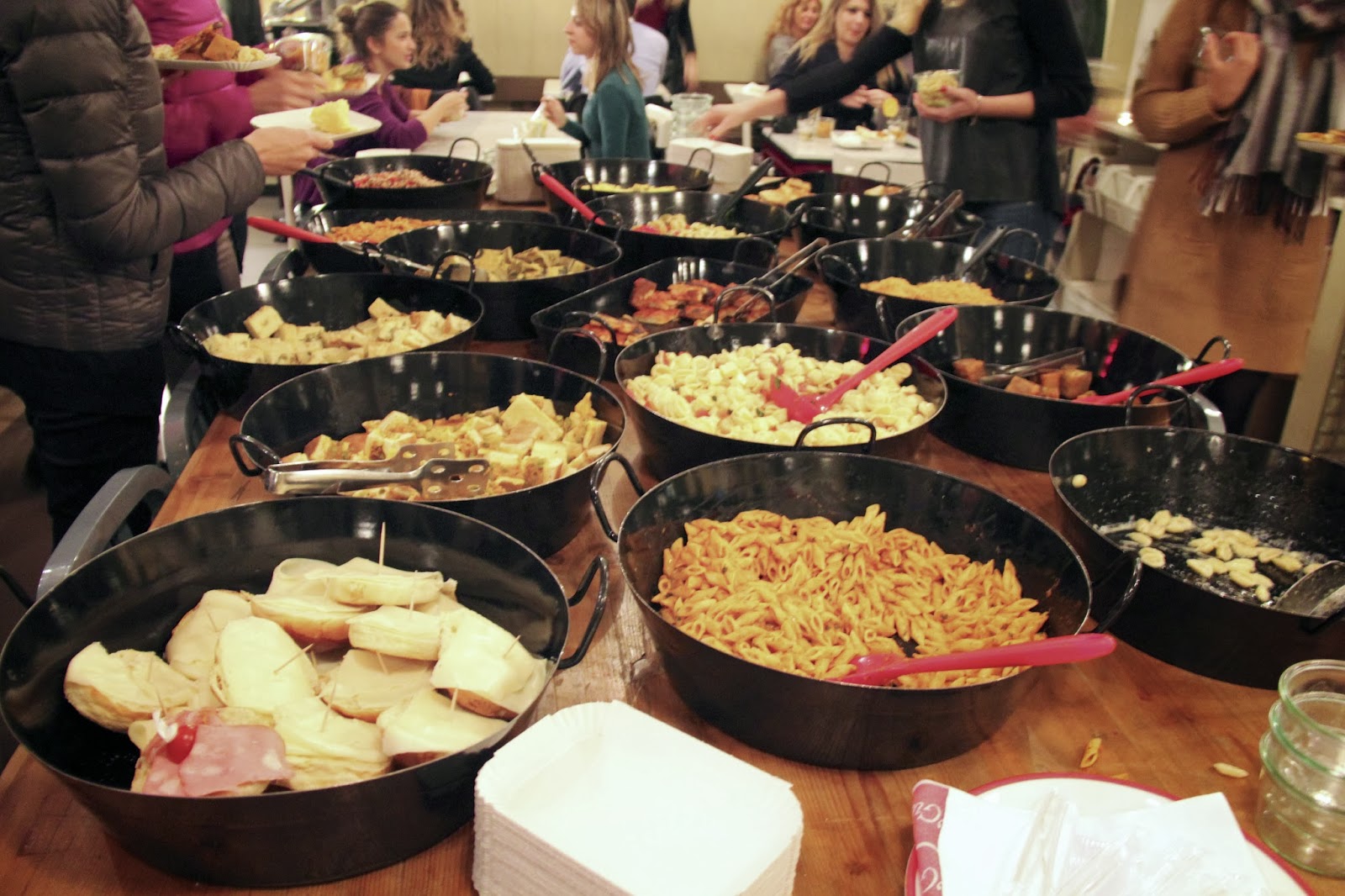
While our appetites for spiritual enlightenment had been quenched, our appetite for food was ravishing.  We found a wonderful place, Gusto Forno and went in for dinner.  What we found was even better – a happy hour with a buffet included in the price of your drink.  And the drinks were magical!  The bar-genius, Nina had created a cocktail inspired by a margherita pizza.  Sounds weird, but the result was nothing short of fabulous.  If you’re in Rome, stop by and see her.

I take a picture with our wonderful waitress and the fabulous bartender, Nina
Nina’s creation – the Pizza Margherita cocktail
Some of the buffet that was included with the order of a cocktail

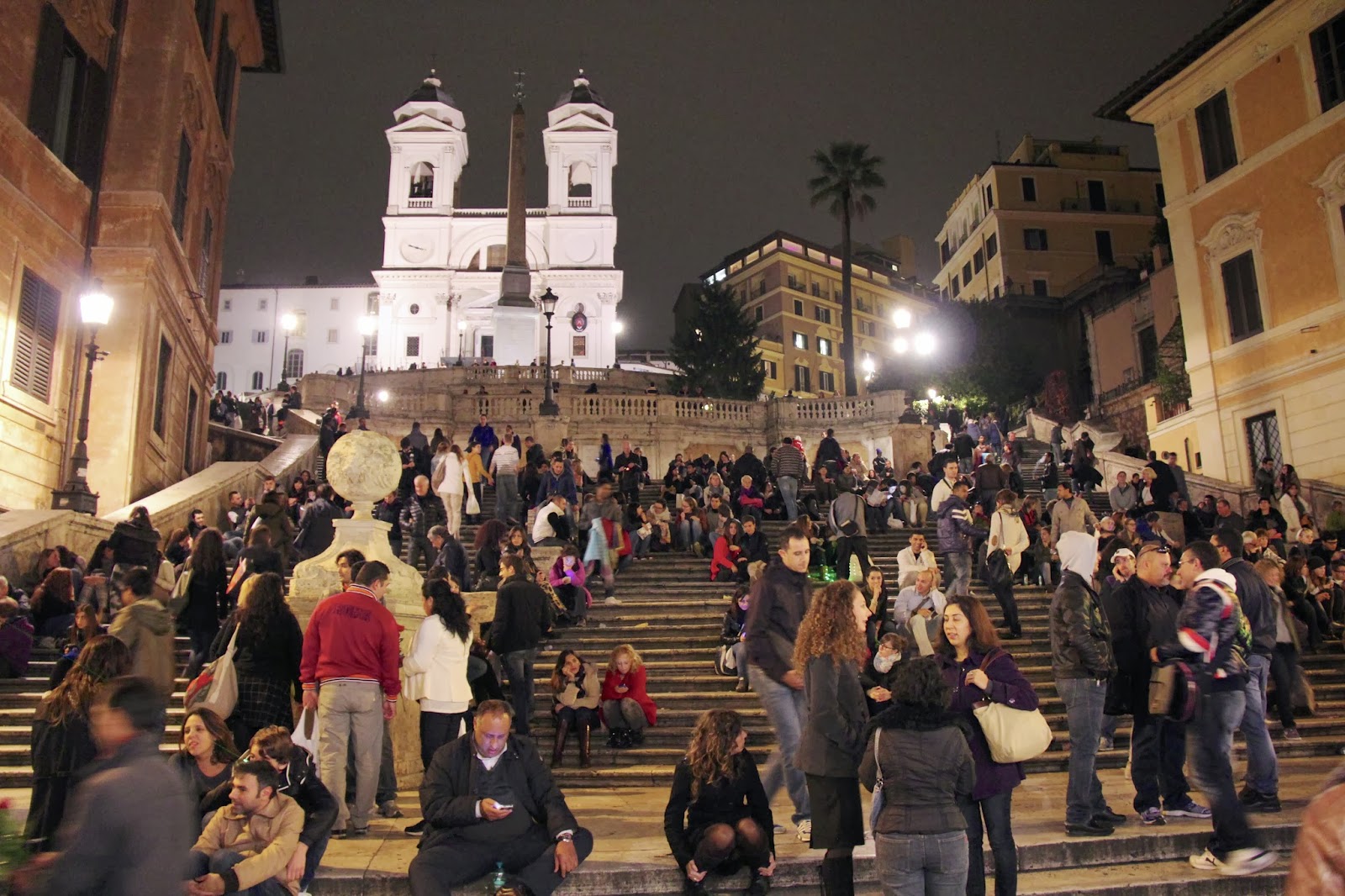
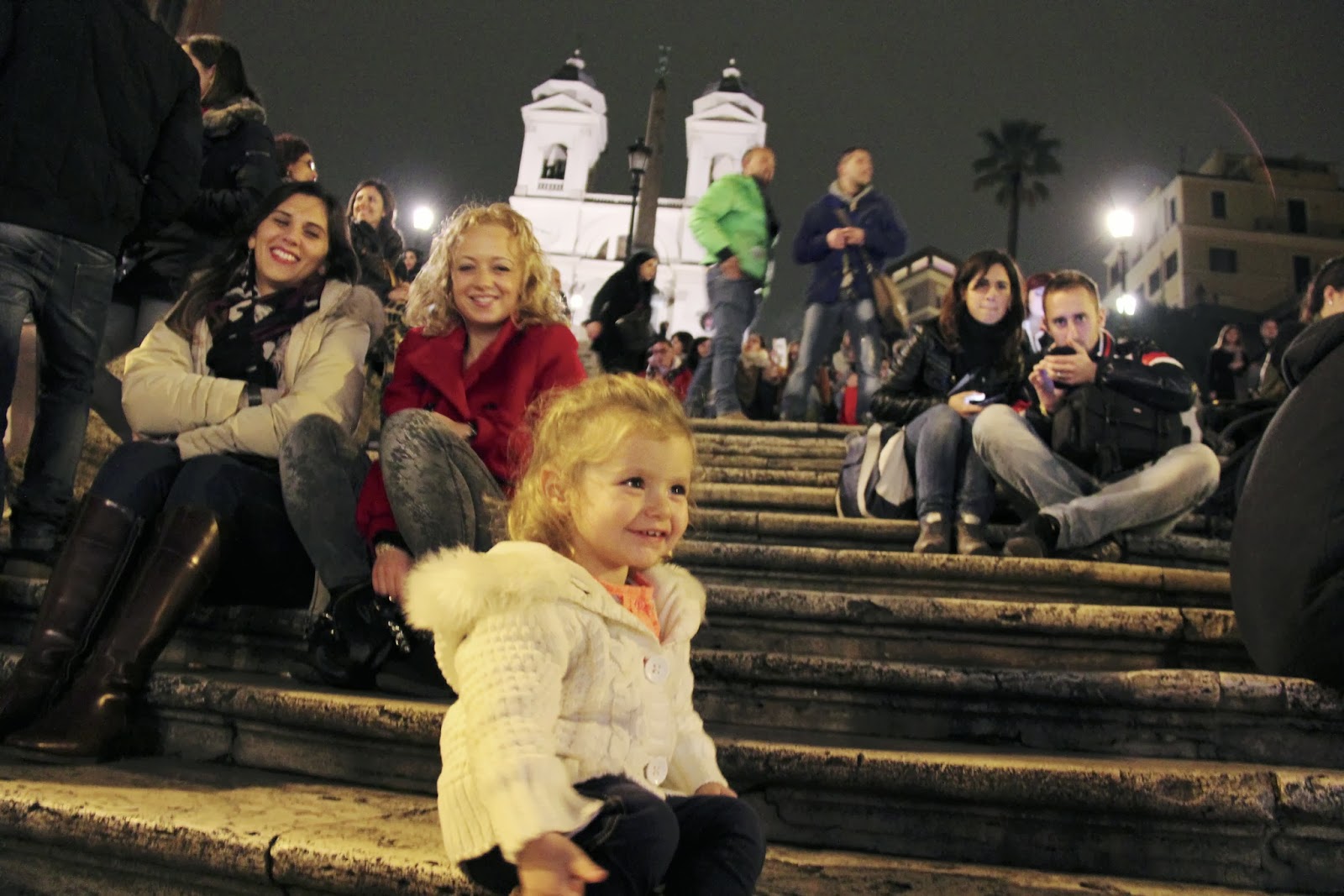
Before the night was over, we stopped by Scalinata della Trinità dei Monti (Spanish Steps).  Of course, no visit to Rome would be complete without throwing a coin over your shoulder (guaranteeing your return to the city) in the Fontana di Trevi (Trevi Fountain).

Scalinata della Trinità dei Monti (Spanish Steps)
Julia on the Spanish Steps
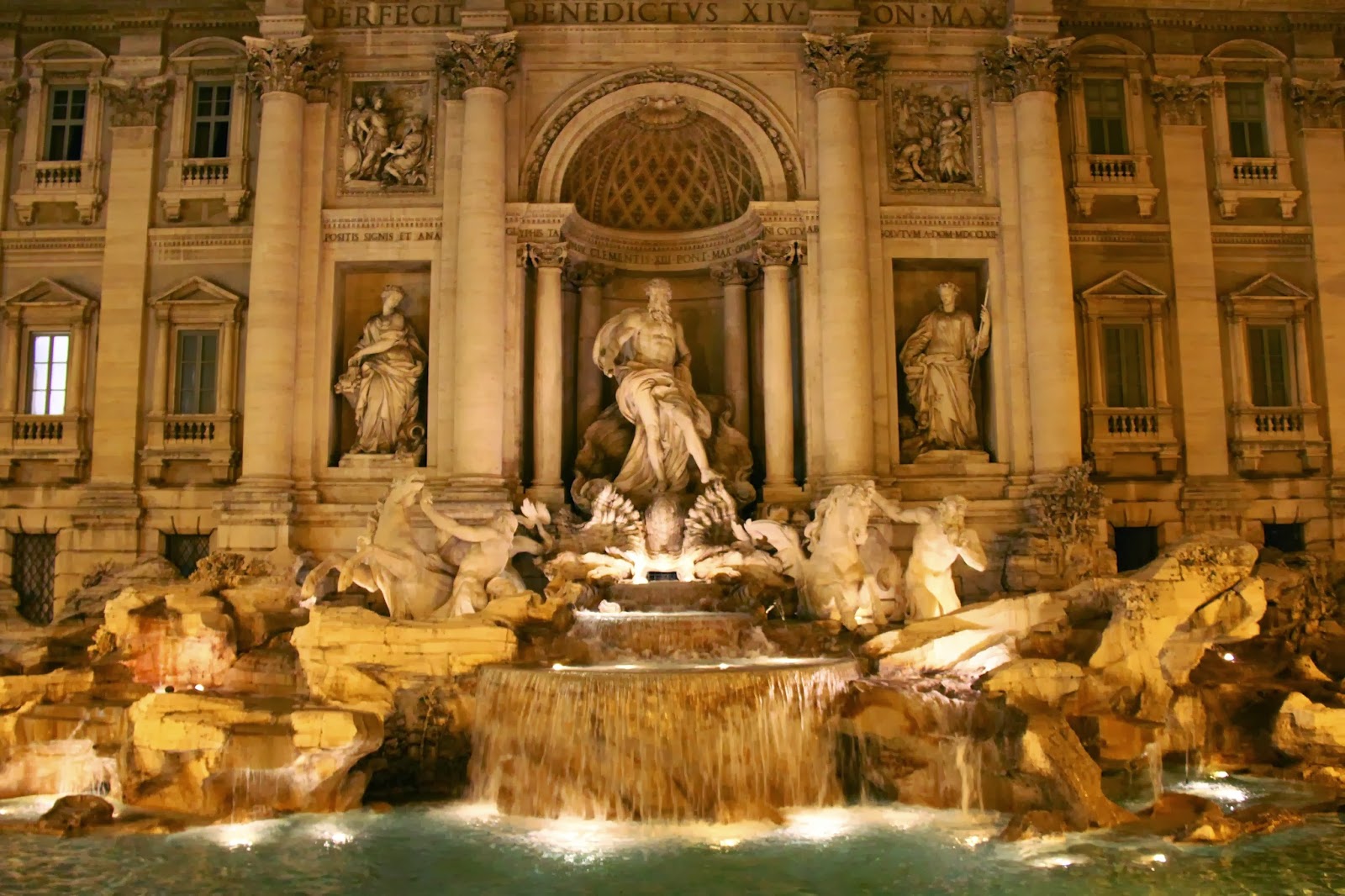
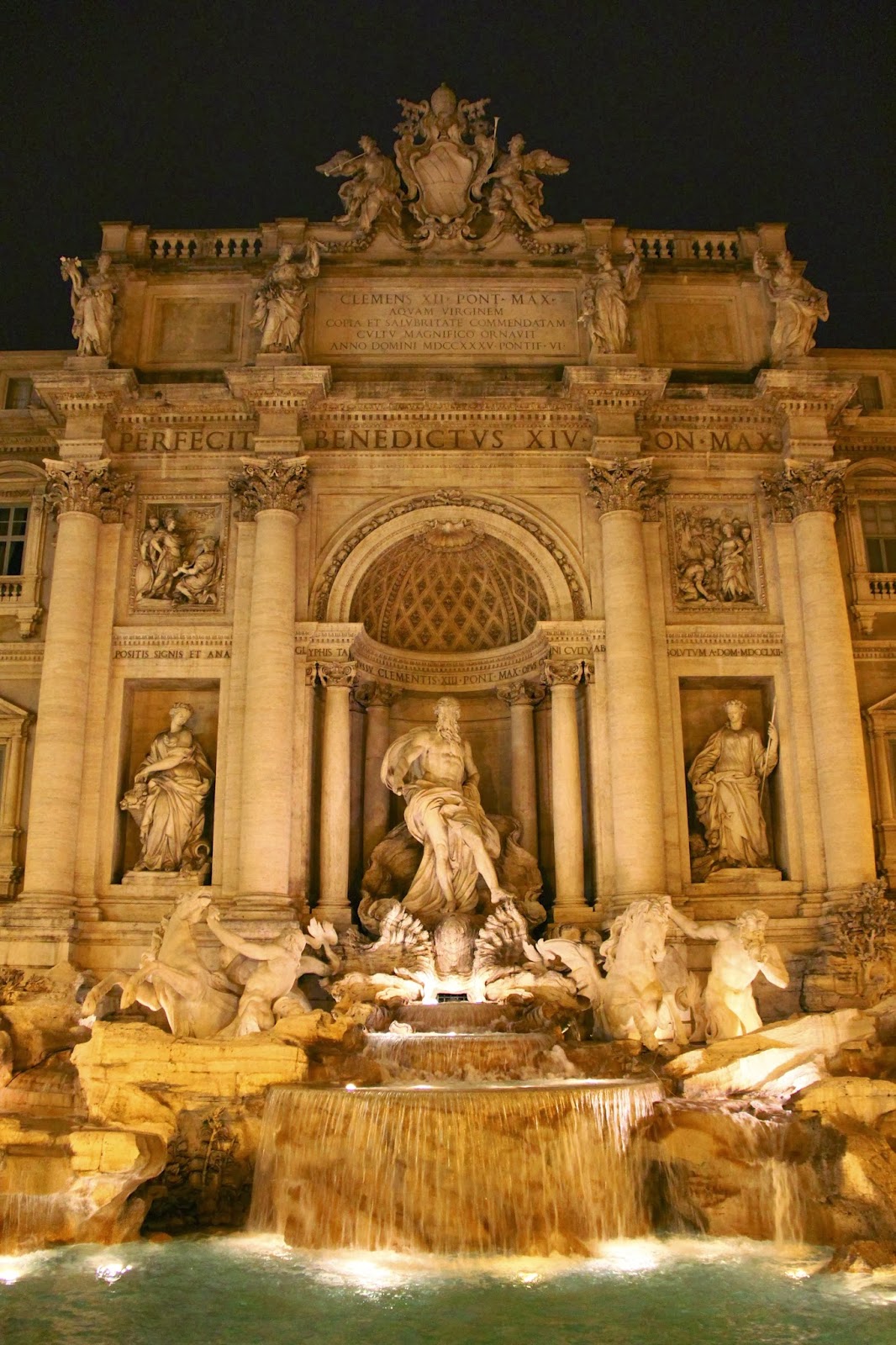
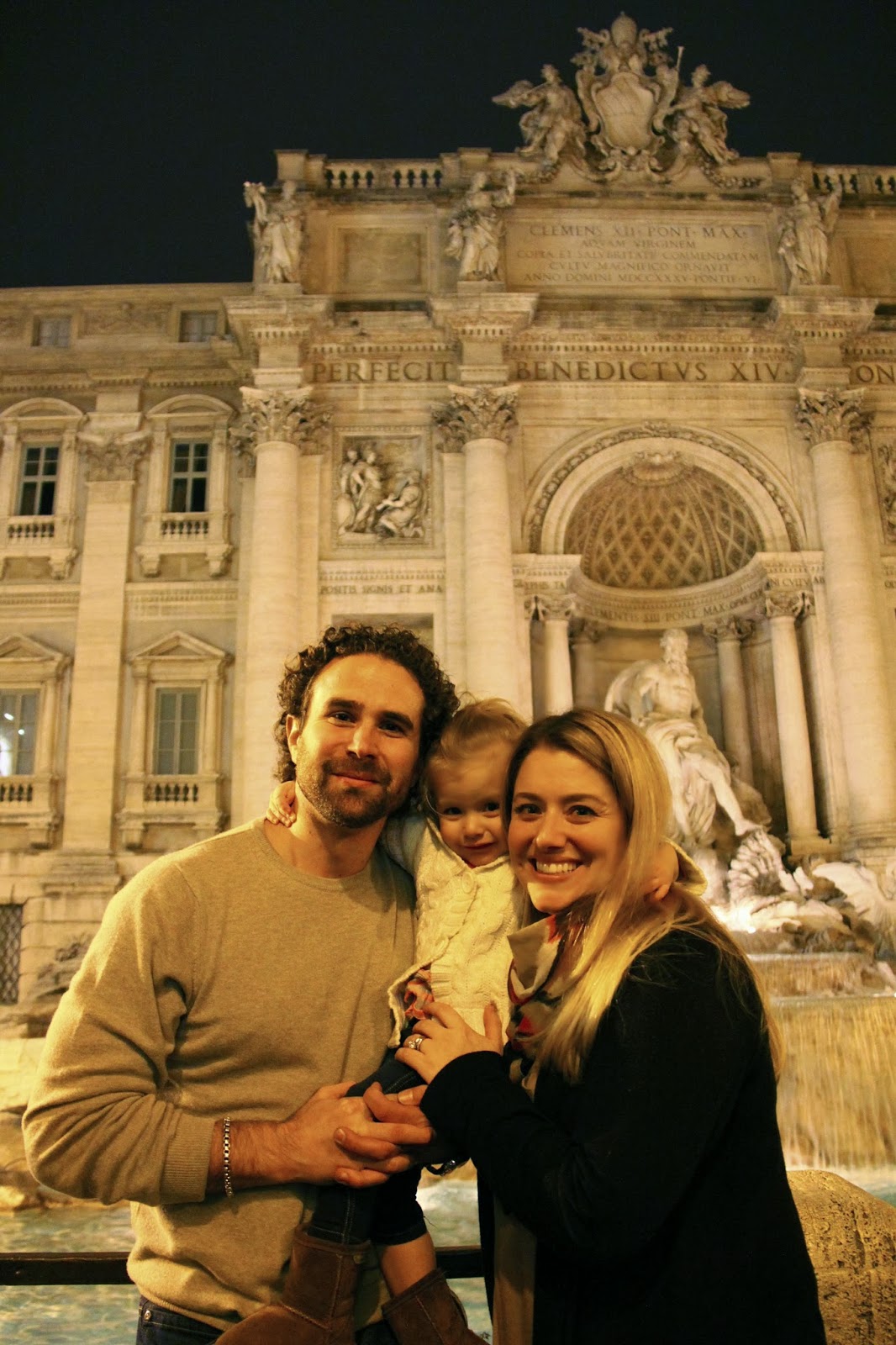
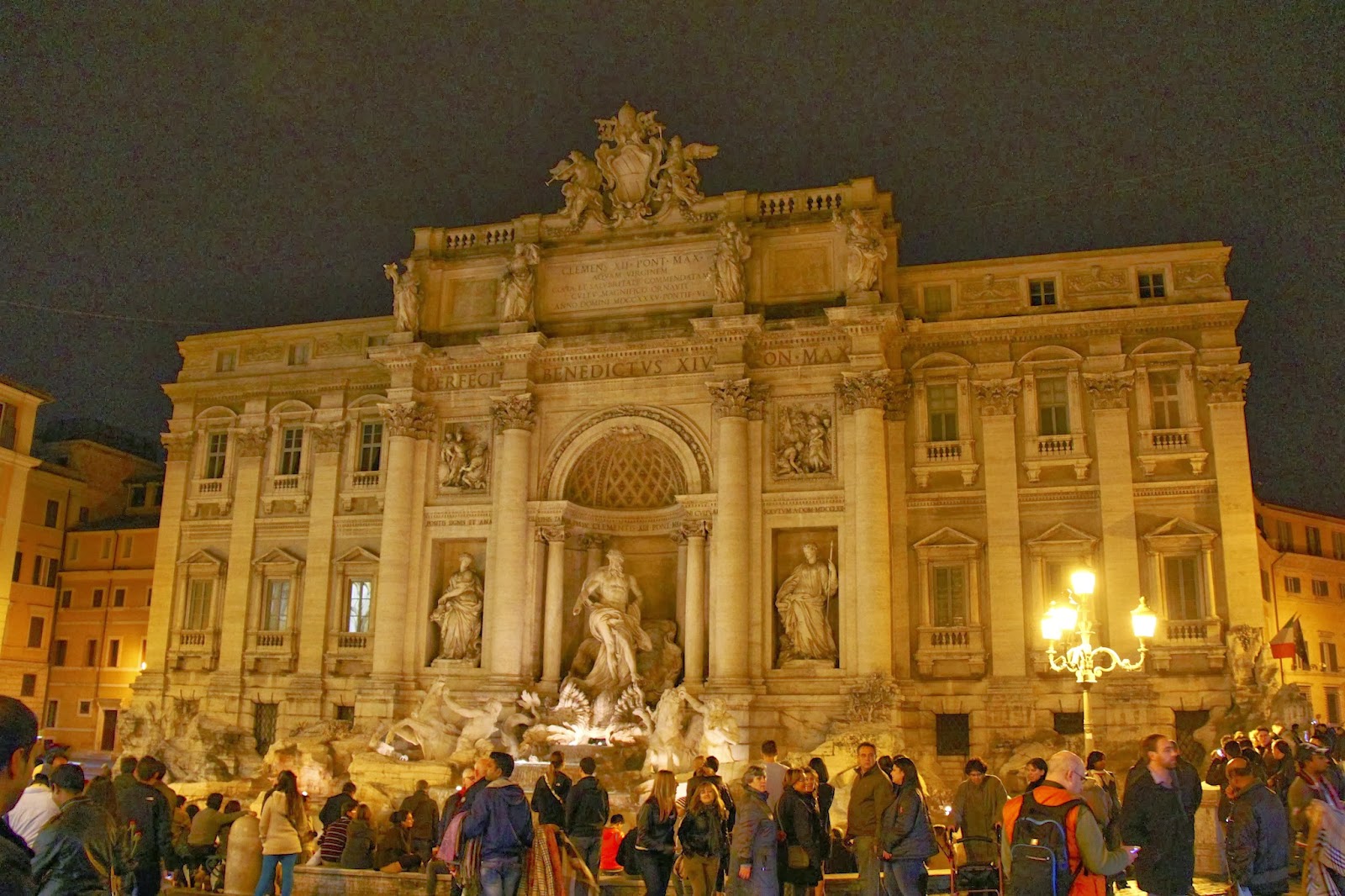
Fontana di Trevi (Trevi Fountain) at night
This magnificent fountain stands 86 ft. high
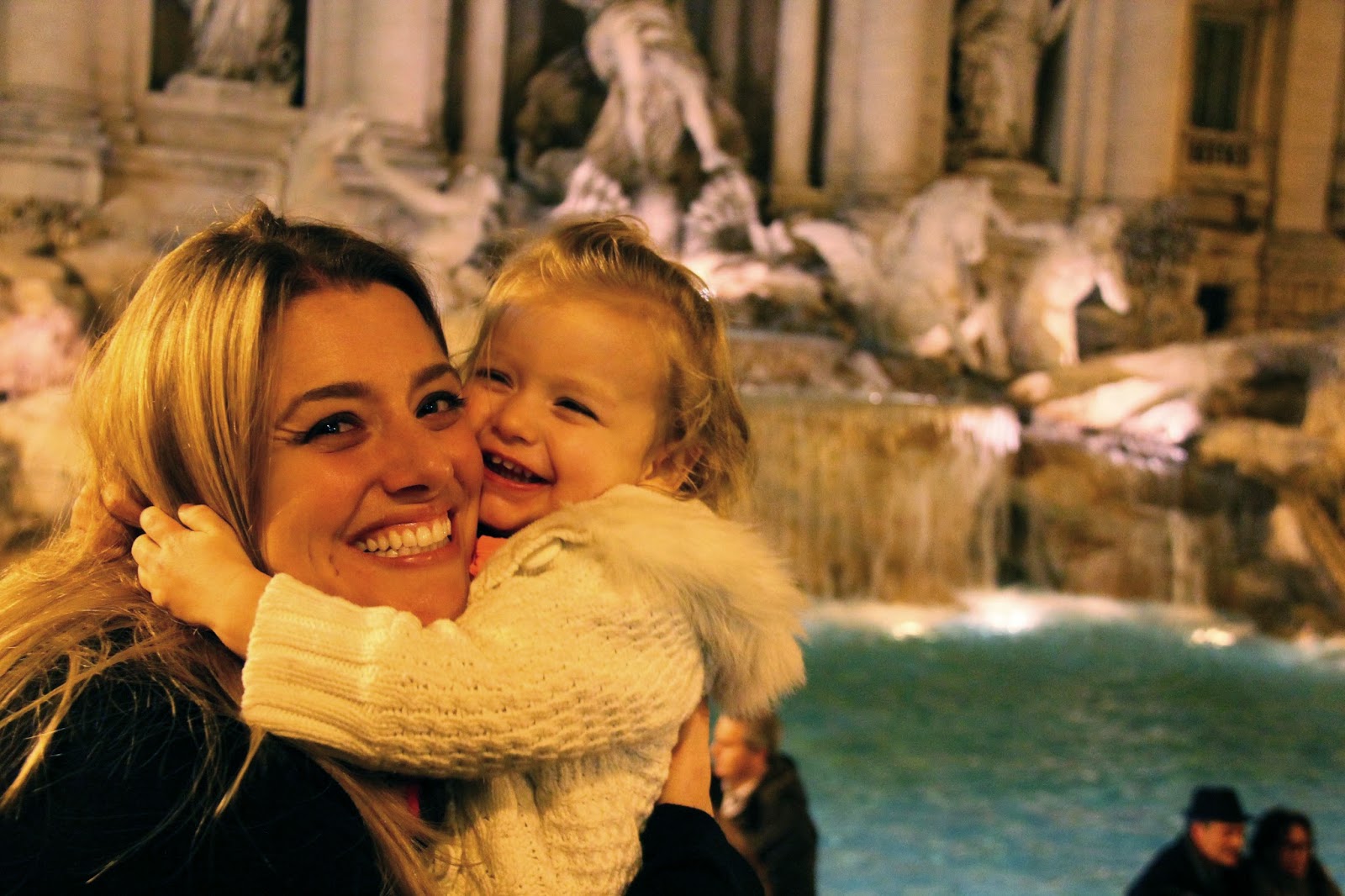
Julia gives her momma a hug
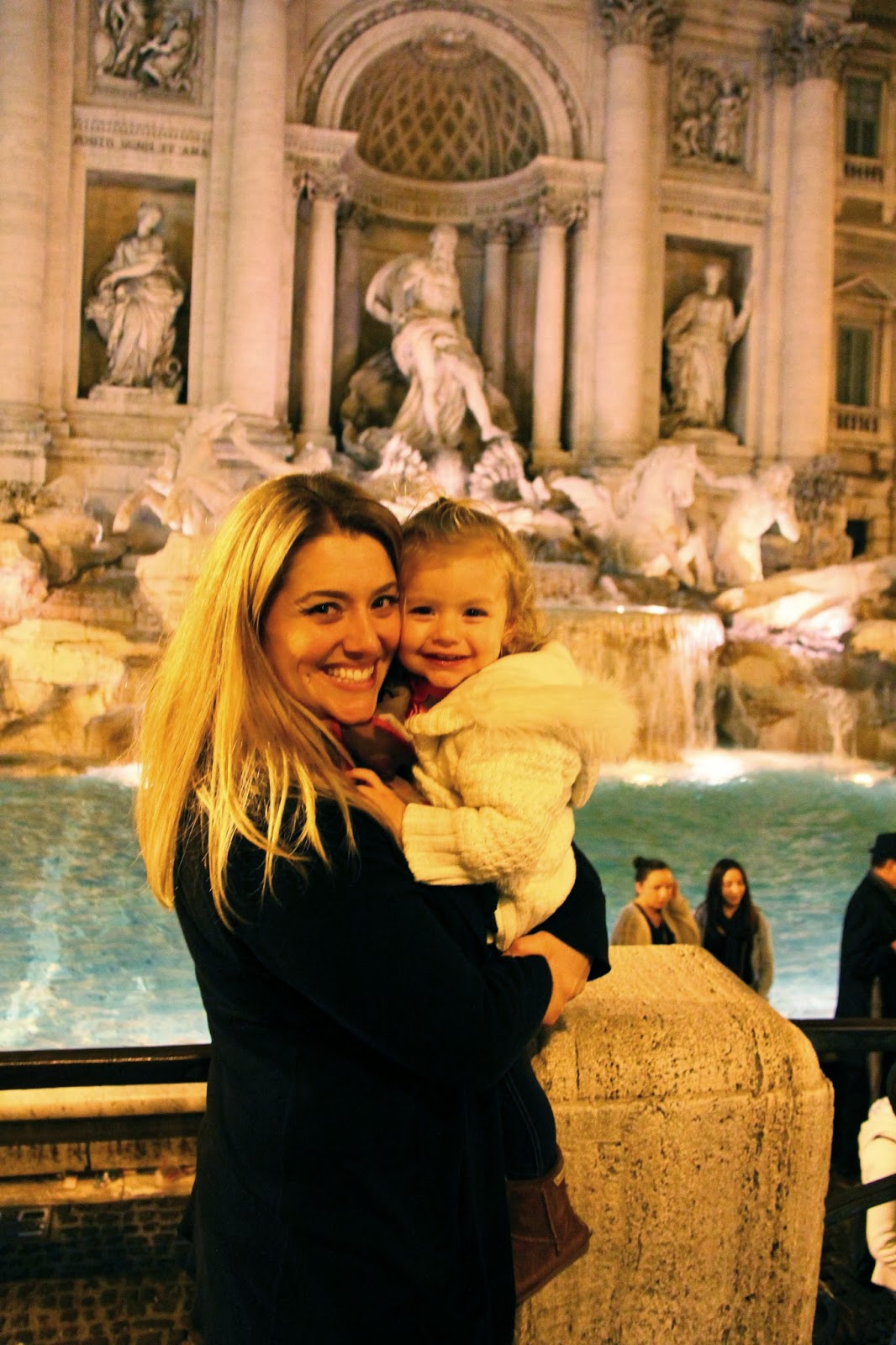
Jen and Julia in front of the Trevi Fountain
Family photo
Julia wanted to go for a swim
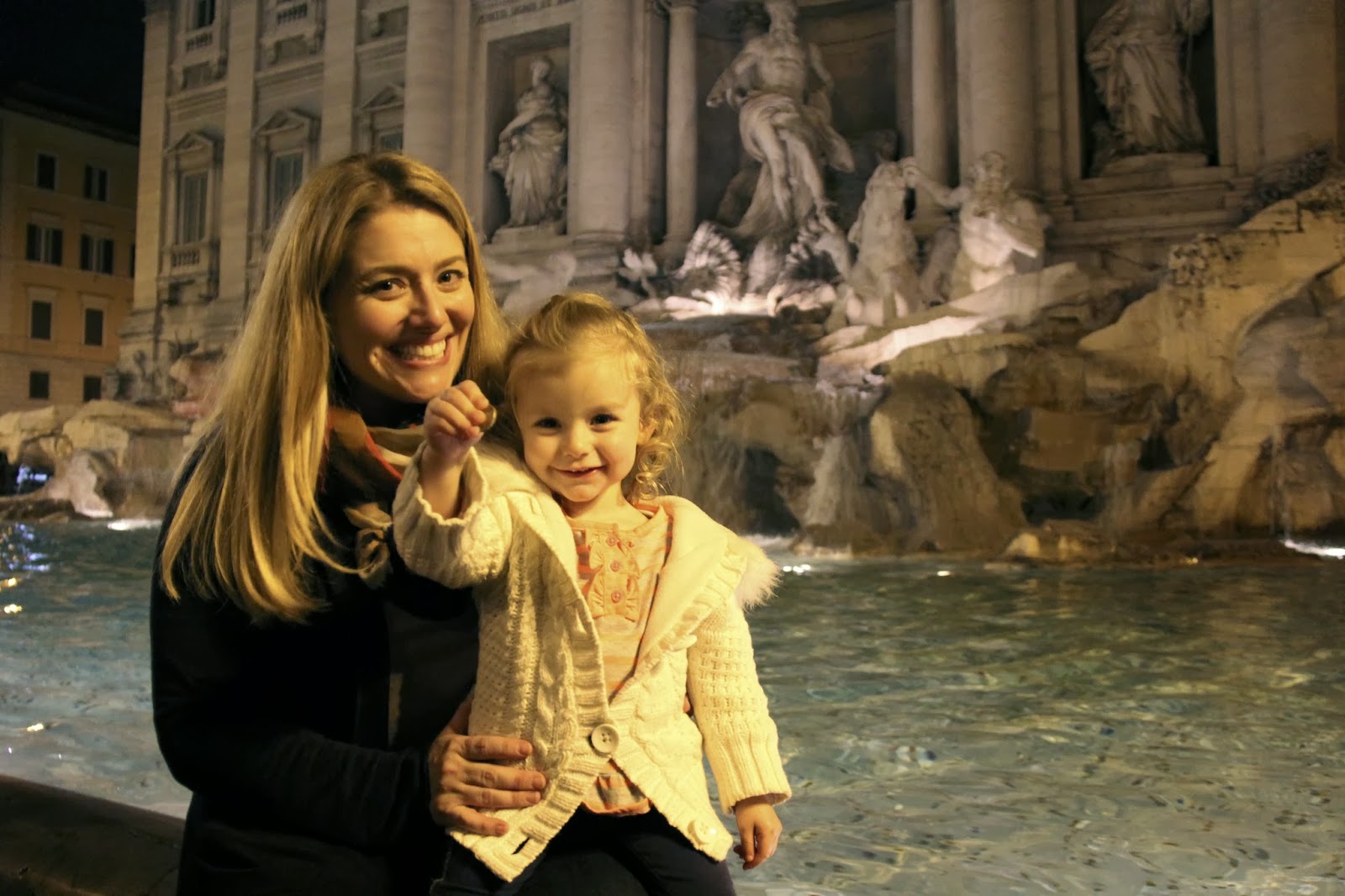
Julia gets ready to toss her coin and ensure her return to Rome
Italian architect Nicola Salvi lost the original contest to design the fountain, but was awarded the commission anyway due to public outcry in Rome that a Florentine (Alessandro Galilei) had won – a fortunate turn of events

As it turns out, two days in Rome is too action packed to fit into one post – so I’ll continue in a subsequent posting.  Ciao for now!

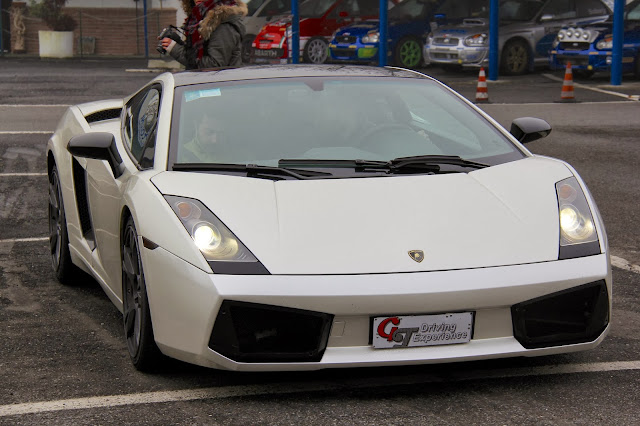
All I Want For Christmas is a White Lamborghini

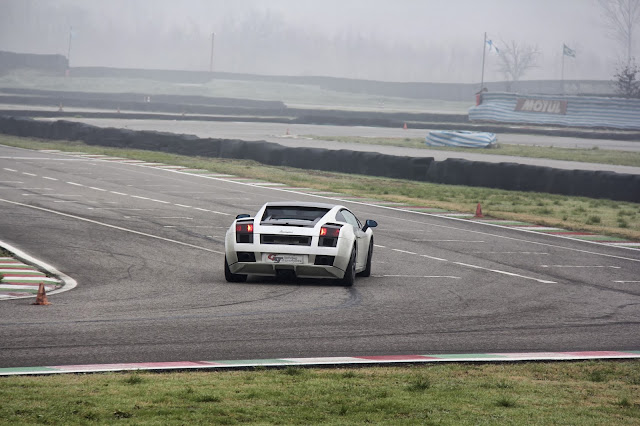
You can have your two front teeth – I’ll take the Lamborghini!

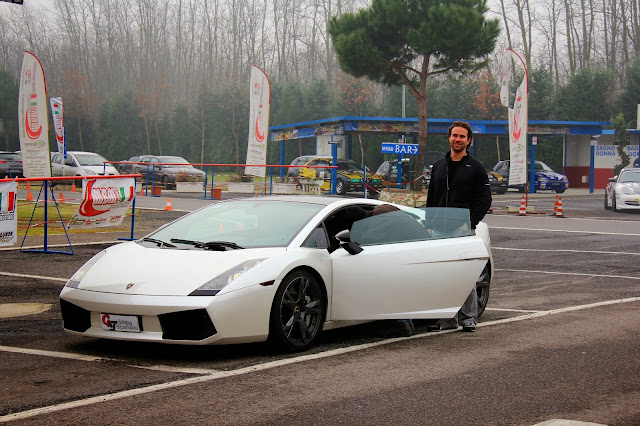
Oh yeah, that’s the one I want!

Periodically, my father-in-law will send me Italian Groupon deals that he thinks we may be interested in acquiring.  Through this site, we have found good deals on restaurants and hotels.  Just like Groupon or Living Social at home – some of the deals are interesting, others are not.  Some are phenomenal values – others are just cleverly packaged marketing schemes.  Recently, he sent me one item that had the hairs on the back of my neck standing tall.  The opportunity to take a Ferrari and/or Lamborghini out on a race track and really “open’er up!”

I wouldn’t call myself a true “car enthusiast” – but I am definitely a guy who loves his vehicles.  I’ve had the pleasure of owning a few very fast cars and I have relished driving them.  My favorite toy (Harley Davidson VRSC Nightrod Special) is sitting under cover at my parent’s house back at home. I love fine automobiles and have a propensity toward German vehicles.  However, when it comes to the worlds best super-cars… nothing can rival an Italian made vehicle.  Ferrari, Lamborghini and Maserati are the “dream cars” for every little boy (both here in Italy and around the world).  So it was no wonder that the little boy that still lives inside me was doing cartwheels over this particular Groupon deal.  Jen agreed that this was as good a gift as any – an early Christmas present for the bigger of her two kids.

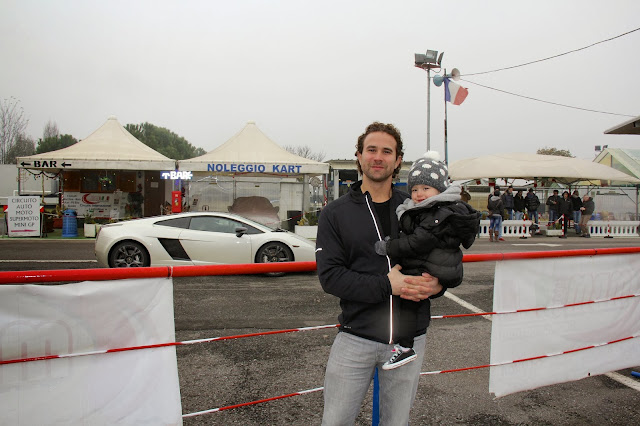
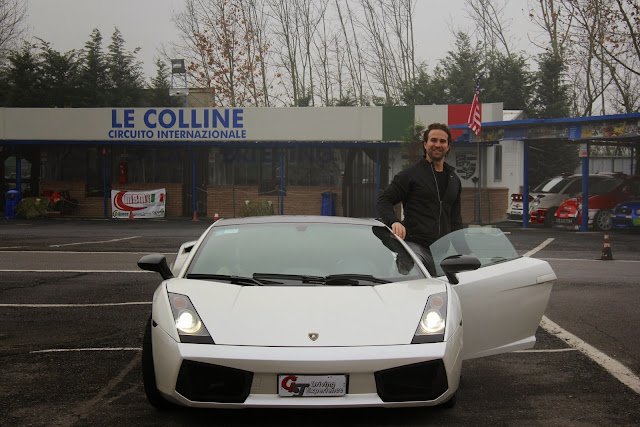
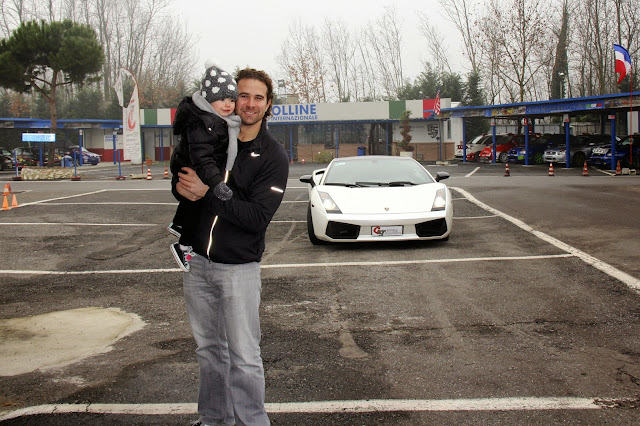
Julia stands with me before I get all set to drive the Lamborghini
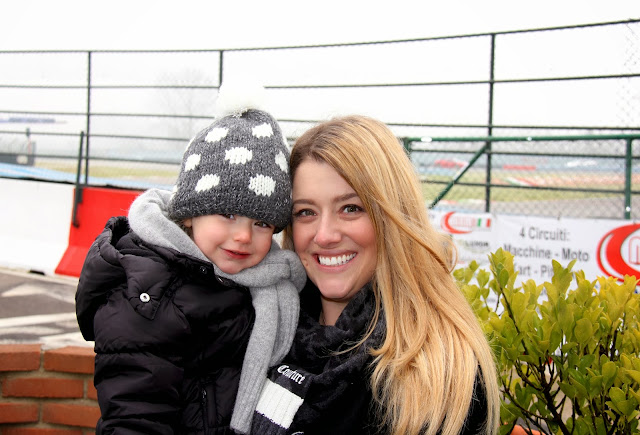
Jen and Julia in front of the racetrack

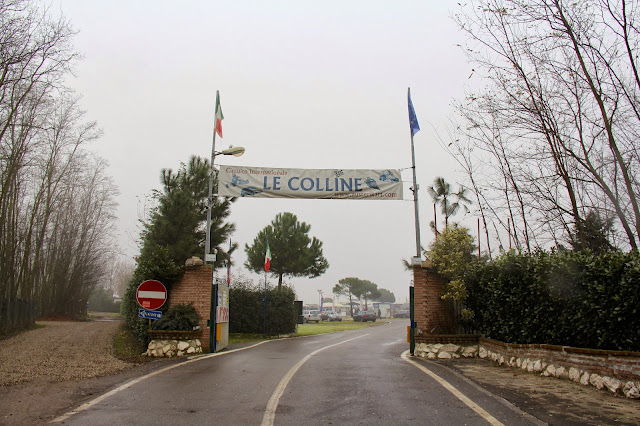
So on a recent cold December morning, we set our GPS toward the small town of Chignolo Po – home to the Circuito Internazionale Le Colline.  I had elected to purchase a package of 6 laps.  I chose this particular racetrack because of its substantial length and perilous turns.  I also chose the option to divide my 6 laps between two different Ferrari’s and a Lamborghini that this race track held in it’s fleet.  Having raced my own cars on a track before – I was beyond the limit of human excitement to do it all over again in some of the world’s most exclusive and powerful vehicles.

If you have been reading about our road trips over this past year, you’ll know that we are almost always late getting out the door.  Not this time!  I had a 10:30 start time and nothing was going to make me late.  Except traffic.  A heavy, inordinate amount of traffic.  The traffic devoured the extra hour I had budgeted for myself.  Then we arrived in the wrong city – the address on the website was wrong and we had driven roughly 30 minutes out of the way.  After almost 2.5 hours in the car, we finally crossed the gates of Le Colline and I rushed up before my spot was lost.  It did take some convincing on my part for them to let me race (they had already moved on to the next grouping of participants).  Fortunately for me, my skills in Italian arguing and hand gestures have come a long way over the past year.

I was beyond giddy as I crossed under this banner

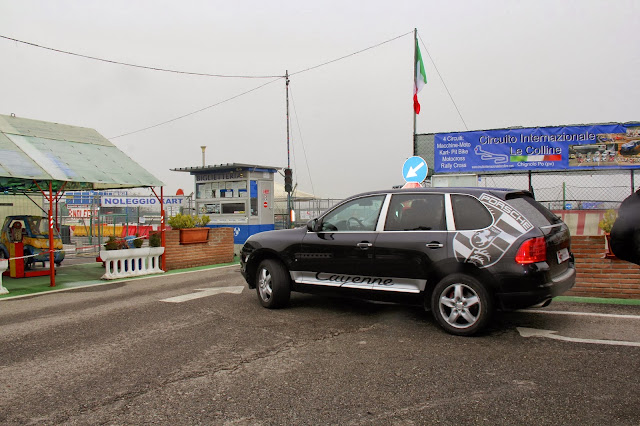
The young lady organizing the races asked me if I wanted to drive a Ferrari or a Lamborghini.  I told her that I wanted to drive both, but she told me I could only choose one.  I thought the miscommunication was due to my tardiness and so I opted for the Lamborghini.  Six laps in that monster would suit me just fine.  But then she told me that the first two laps would be in a Porsche Cayenne.  I protested, but quickly relented as she gave me a gesture like, “I did you a favor to squeeze you in.”  So I walked over to the Porsche SUV.  Then I realized I wouldn’t be alone.  And I wouldn’t be driving!  I was shown into the back seat, alongside two other participants.  One of the track employees was behind the wheel.  Jen later told me that my face was so obviously full of disappointment and frustration that she thought I might hurt someone or myself.

We set out in the Cayenne – there I am in the backseat!
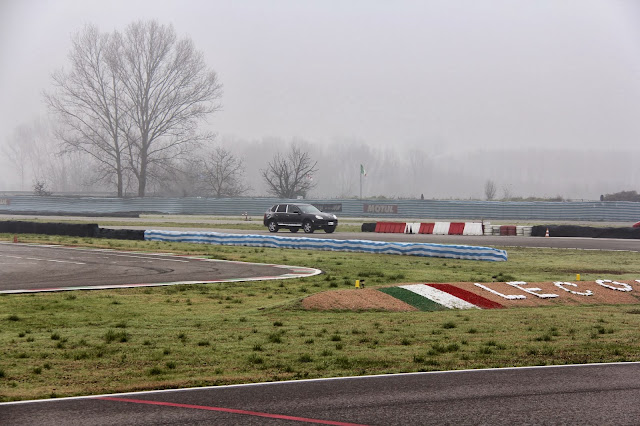
That’s us “burning” up the racetrack… I’m still in the backseat

I remained optimistic that the two laps in the back seat were just a tutorial – an opportunity to learn the turns and nuances of the track.  I sat in the backseat, bored and un-entertained while the other passengers proclaimed their excitement about being on a racetrack alongside Ferraris and a Lamborghini.  Meanwhile, I just wanted to drive them!  When we pulled back to the start, it became obvious that the first two of six laps had just expired in the back of a not-so-special SUV.  OK, well… I still had four laps left and the confidence that I could convince the lady to divide them among both a Ferrari and a Lamborghini.

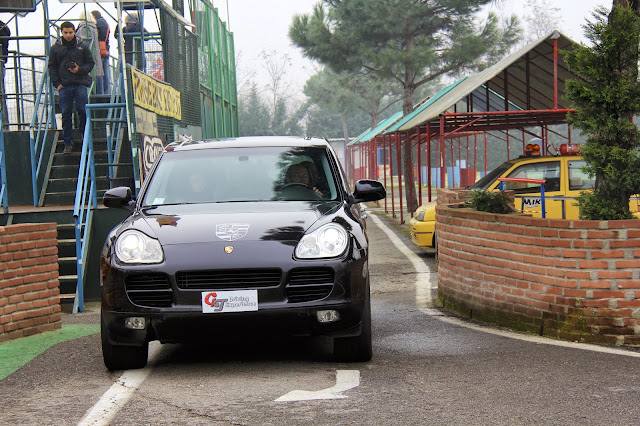
By the time we pulled back to the start it was obvious I had just burned two of my six laps

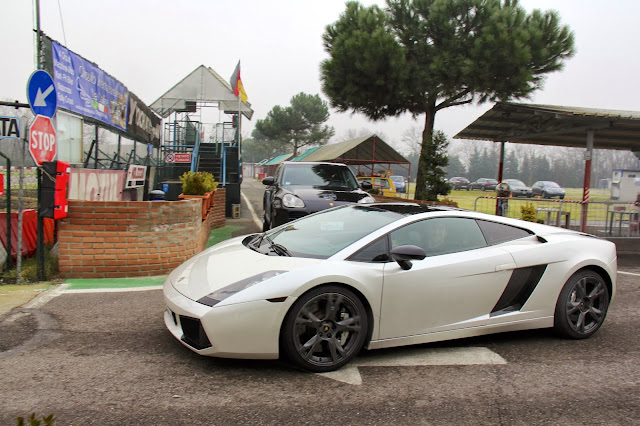
Almost immediately after I got back as a passenger, my name was called to be a driver.  I marched toward the Lamborghini and eagerly got behind the wheel.  After a brief explanation in a mixture of Italian and English – I put the pedal to the floor and took off.  I quickly got a feel for the track and even passed one of the Ferraris.  My instructor gave me an extra boost of confidence in my driving ability with many, “bravos” and “perfectos.”

I’m about to drive a dream car…
Here I go…
And there I GO!

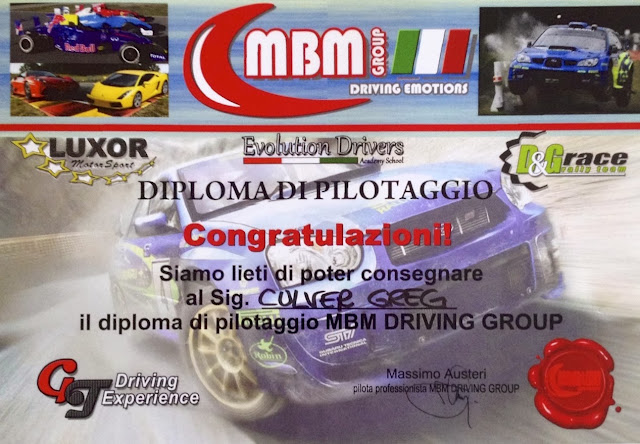
If my face before these two laps was full of frustration and disappointment, I’m sure that my face after those two laps was the polar opposite – I couldn’t hide the smile that stretched from ear to ear. That is, until I asked about the car for my final two laps.  The young lady explained that I didn’t get any more laps.  My companion (Jen) could opt to take the final two laps in the Porsche SUV as I had done previously, or I could opt to take that same ride again.  I couldn’t believe it.  We did not give up without a fight and made her pull out the paperwork to show us the fine print.  Sure enough, it was there.  Six laps somehow watered down to two laps.  Three super cars had somehow boiled down to one.  To add insult to injury, she presented me with a “diploma” before I had the chance to storm away.

Getting out of the car, you couldn’t wipe the smile off my face
Julia gives her favorite GT driver a big hug
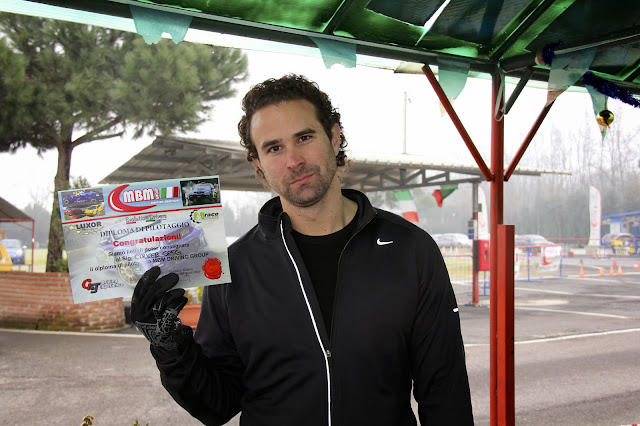
I “proudly” display my diploma
Here it is… my diploma!
I wasn’t the only one that got to race fast cars

In cases like this – there’s nothing more you can do than laugh.  So that’s exactly what we did.  Plus, I was still happy that I actually got to race a Lamborghini – something that I had always dreamed of doing.  So what if it was took four hours in the car to race for roughly 6 minutes?!  I had 6 minutes of fun and exhilaration and we got a funny story.  One thing is for sure – I’ll be certain to read the fine print of any future Groupon deals.

Merry Christmas to me!

Five Diamond Christmas Tour of Italy

Most people visit Europe in the spring or summer.  Of course, these are great times of year to see such a magical and historical place.  But may I suggest to you a unique alternative?

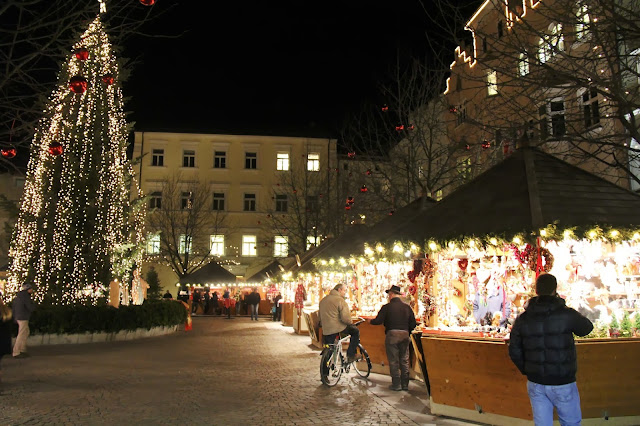
Come in December, when the weather is at it’s coldest and the people are their warmest.  When the cobblestone streets are strung with lights and the ancient buildings are trimmed with garland. Imagine your most magical place for the holidays – a winter wonderland, if you will.  You will be sure to find something that fits your image here in Europe.  There are amazing markets and festivals across the continent.  Some countries boast cities that are particularly renowned for their holiday cheer.  Finland, Germany and Austria are at the top of the list.  Denmark and Switzerland are there as well.  And of course, our personal favorite place to be for Christmas is right here in Italy.  Before you plan your next Christmas vacation, add Europe into the running.

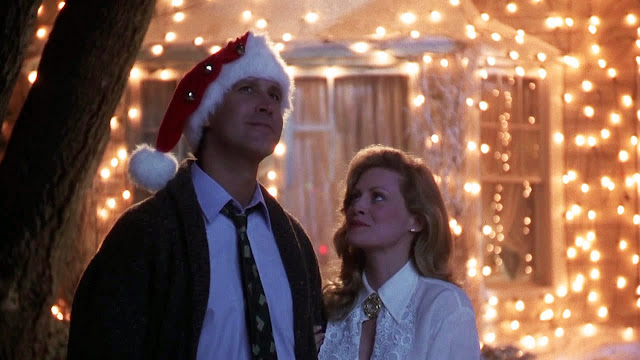
“Boy, Clark – I think we should go to Europe next year”

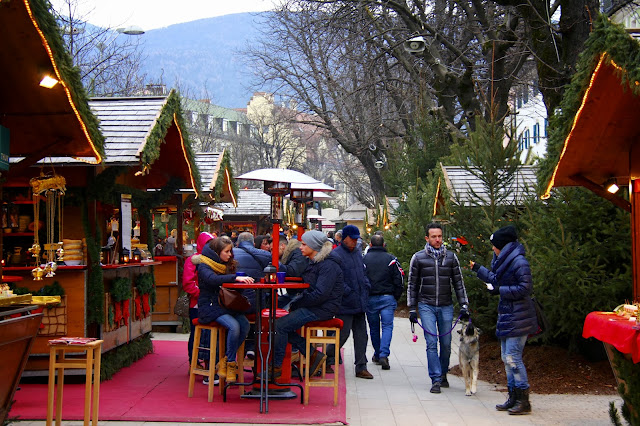
We had been toying with the idea of visiting another country to experience some of the large and festive Christmas markets (two of the top cities in the running were Cologne, Germany and Lapland, Finland). As we did more and more research, we kept noticing many towns in Italy topping the lists. We decided to stay close to home and shop in a language we know (well, sort of).  Jen came across this article describing some of the best Christmas towns in the Trentino Alto-Adige region of Italy. One look at the photos of each town and I was sold.  Beyond that, I was eager to explore this region of Italy for it’s unique wines and always breathtaking Dolomiti mountains.  So I went to work on google maps and figured out that we could comfortably see five cities (with a bonus sixth on the return) over a period of three days.  We would visit Vipiteno, Bressanone, Brunico, Bolzano and Merano with another full day reserved for the region’s capital city, Trento.

When I plotted our course, I literally sketched a rough map on a piece of scratch paper and realized that four of the five towns made a diamond shape.  The fifth was sort of floating off to the right side, but for creative purposes – we’ll just stick to the “Five Diamond Christmas Tour”.  It has a better ring than “Four Points & That Other One Tour”.

“Sounds great, dad – lets GO!”

We carefully chose our hotel, located just outside of Bolzano.  What I didn’t pay much attention to was the name of the actual town, Soprabolzano (literally meaning, above Bolzano).  ABOVE Bolzano it was.  Our hotel sat roughly 4,100 ft above the town, which gave us two options.  Drive up the winding and perilous mountain road or take the 15,000 ft cable car (gondola) ride.  I opted to drive, even when the snow fell and the tailgaters lined up behind me.

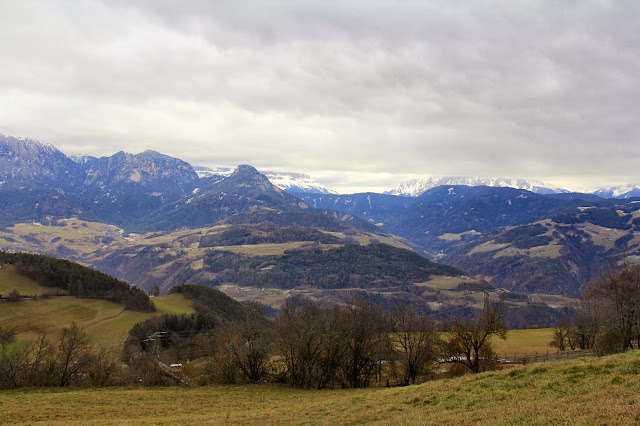
The view from the road leading to our hotel

We were surprised to learn from Franco and Claudia (Jen’s aunt and uncle) that the area of Italy we were visiting was more Austrian than Italian.  They couldn’t have been more correct.  We definitely felt as though we were in Austria (which feels just like you’re in Germany).  The houses are constructed with charming German architecture (picture gingerbread houses).  The food served in the restaurants is German (picture sausages and sauerkraut).  The people even spoke German instead of Italian!  It was strange to experience, because we were in Italy – but it was also nice because it felt like a more unique “vacation” away from our normal lives. Funny, we were nervous to order pasta for the first time in Italy because we felt like it would be ordering pasta in Germany (something you would never do).

VIPITENO (Sterzing – German)

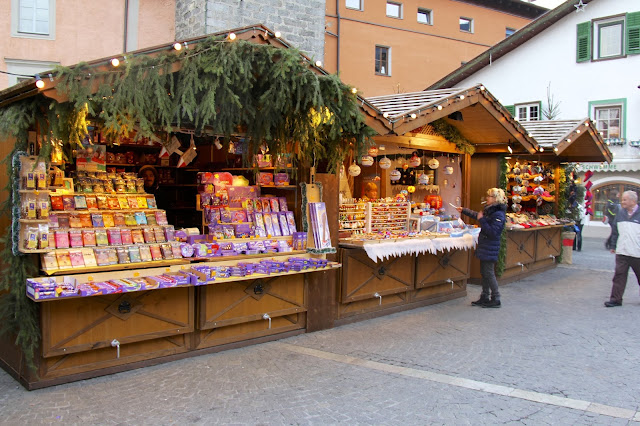
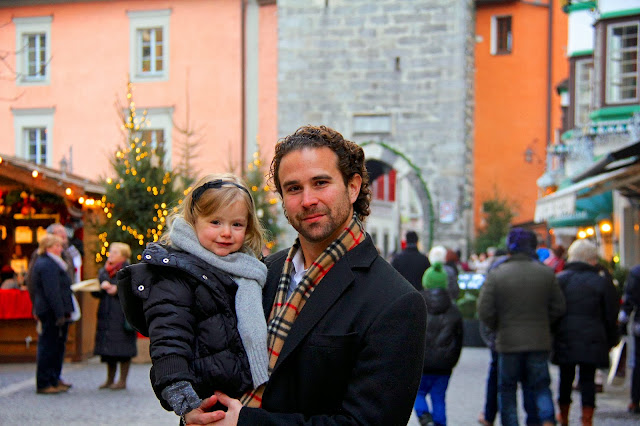
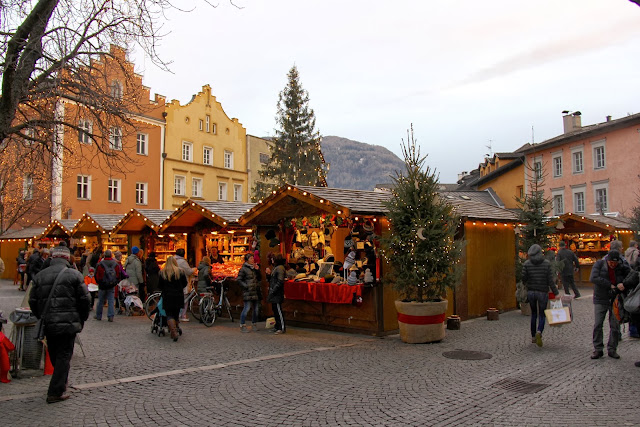
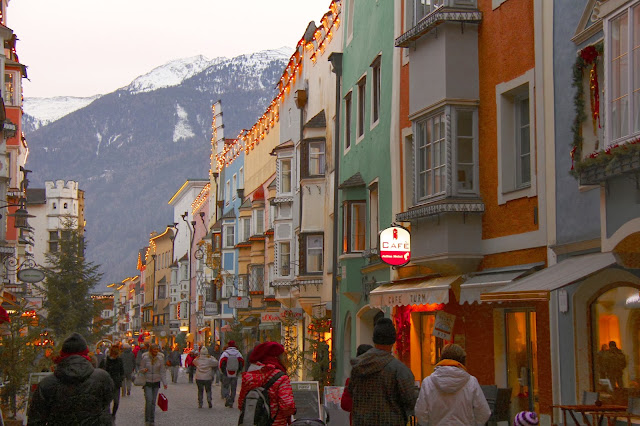
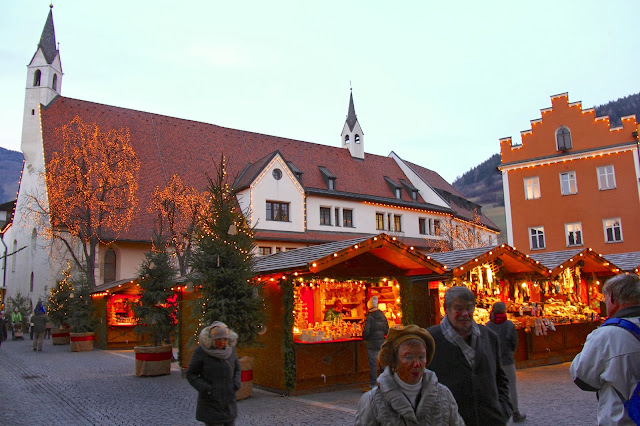
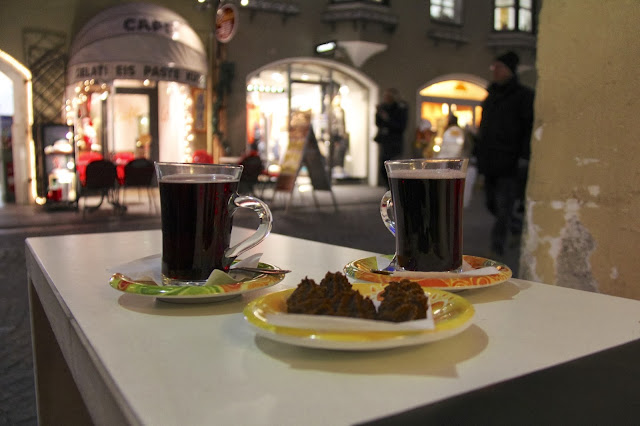
On the first day of our “Christmas Tour” we drove from our home directly to the northernmost town, Vipiteno.  We arrived after lunch and took our time strolling through the market and the charming streets.  We were eager to see the setting sun because we knew that meant the Christmas lights would soon be ablaze.  We stopped for a vin brulé to warm up and sit for a bit.  As opposed to going inside the restaurant, we instead opted to sit outside under the blankets they provided for their guests.  It was cozy, fun and comforting.  Eventually, we had to tear ourselves away from Vipiteno because we had one more stop on the schedule.

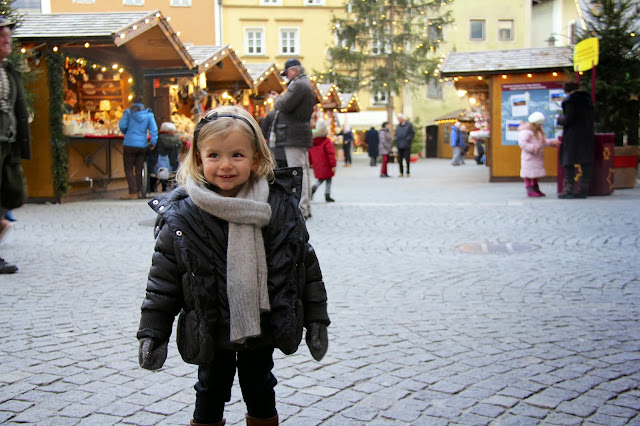
Julia is excited as we enter the market
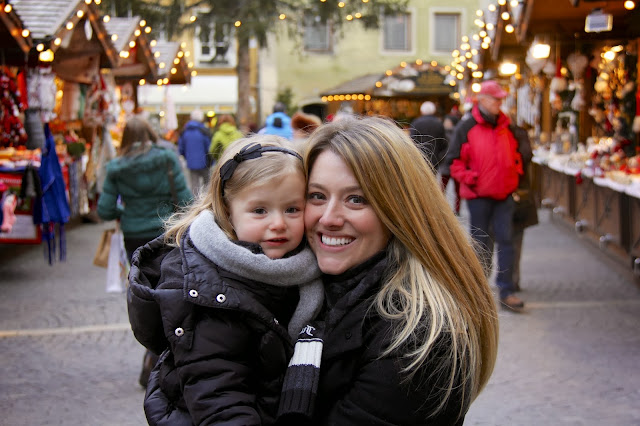
Jen and Julia hugging
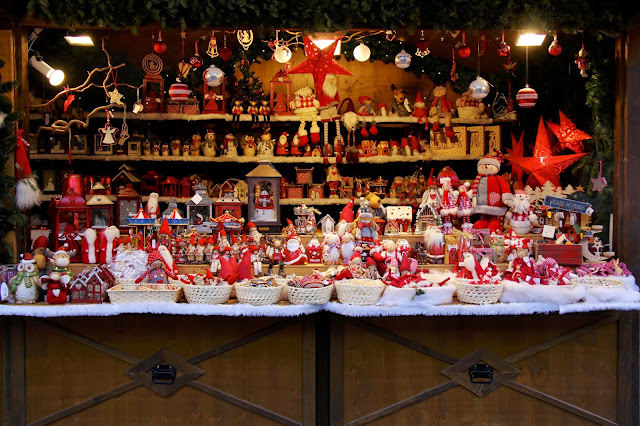
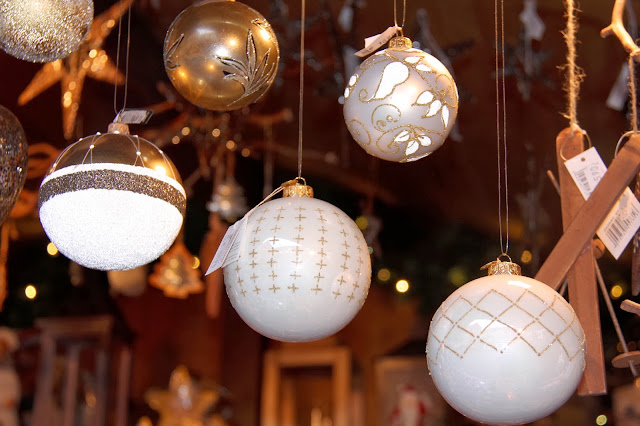
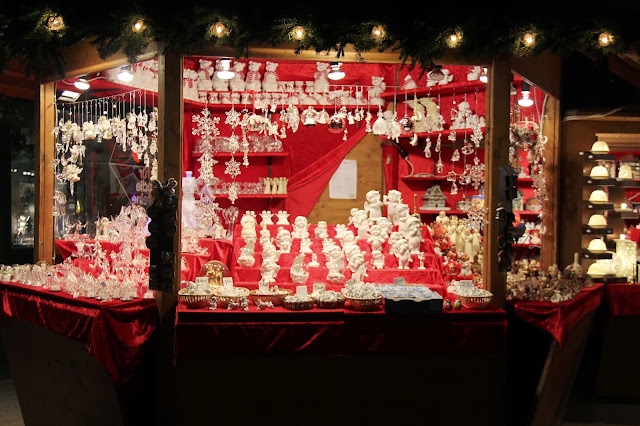
One of the stands, selling a variety of Christmas ornaments
Some beautiful ornaments
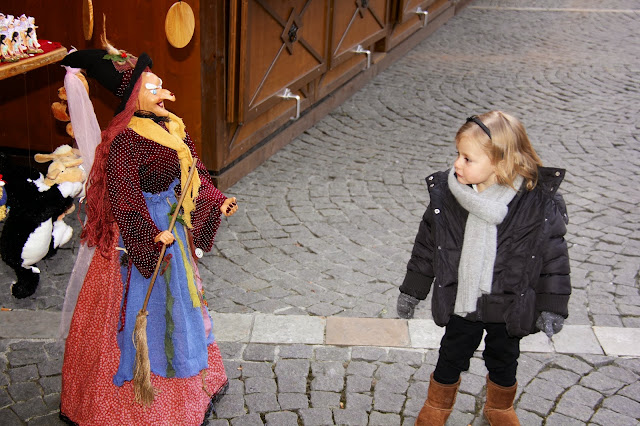
Julia sizes up a Befana (Italy’s Christmas Witch)
The charming town square
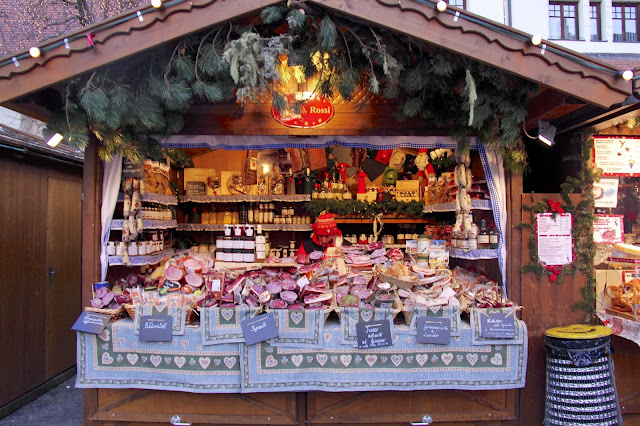
Another stand selling local specialties
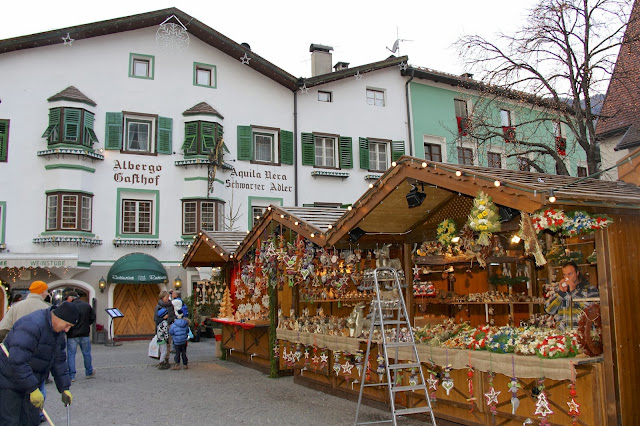
More Christmas stands
My favorite little girl
The lights got a little brighter as it got a little darker
The main street was stunning with a beautiful mountainous backdrop
The main piazza
We stopped to warm up and enjoy some vin brulé
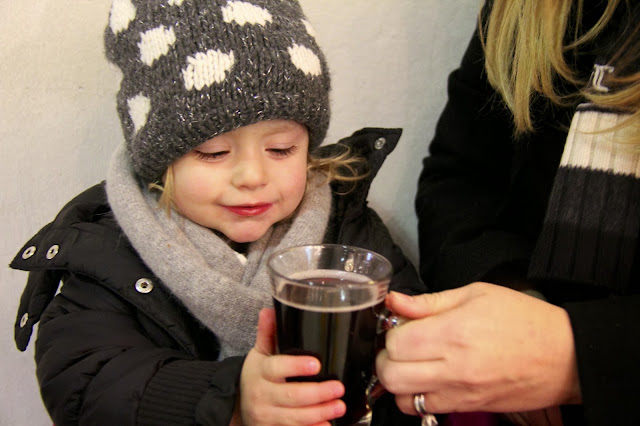
Julia warms her hands on mom’s cup
The sun officially sets
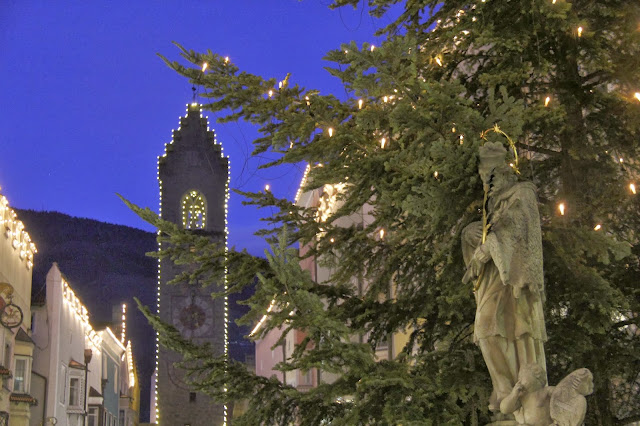
Vipiteno at night
The main square at night
Vipiteno was simply beautiful

BRESSANONE (Brixen)

I almost scratched Bressanone from the list – originally, I didn’t think I could fit all five towns and this was the one that I felt could be sacrificed.  We were VERY glad that we kept it in the itinerary.  This was arguably one of our favorite towns.  We didn’t realize that it is the third largest and and oldest town in the province.  Bressanone is absolutely full of charm.  Beyond all the Christmas festivities, we enjoyed just walking around the city itself, although most everything had closed by the time we finished dinner.

One street leading to the main piazza
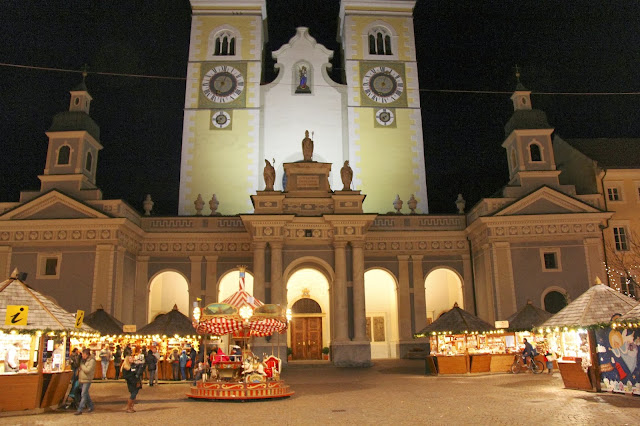
The market in the main piazza
The booths were different than the previous town
Julia rode the carousel in front of the main church
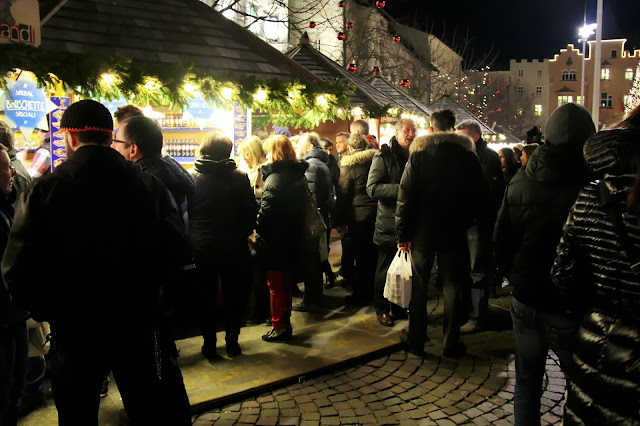
The most crowded and popular stands were always the ones selling vin brulè – they had an outdoor “bar” vibe
Holiday decorations

SAN CANDIDO (Innichen)

Did you catch it?  San Candido was not listed as one of the five towns above.  Franco and Claudia suggested that we add it to the voyage – they described the town as “piccolo ma bello” (small but beautiful).  It was only a half an hour away and snuggled tightly in the Dolomites, so it was a no-brainer for me.  They didn’t have nearly the amount of Christmas decorations as the originally planned towns, but it truly was “small but beautiful”.  Plus, there are only a handful of towns in the world that are nestled in the Dolomite mountains, so it was certainly worth the extra drive.

Julia and I enter the charming town of San Candido
Our first snow of the season
Julia remembered how much she loved to eat it
Main street in the town
Jen and Julia in the main piazza
“Hey guys, wait for me!” 
A small river runs through town
The Dolomites surround the town
Another town we passed on the way out

BRUNICO (Bruneck) 

Our second stop of the second day was Brunico.  We strolled through the markets and then through the city streets.  It was a beautiful town, but the markets were small in comparison to the other towns – so we didn’t spend a tremendous amount of time here.

The market surrounded the outer wall of the main city street
They had some great stands with local food and crafts
As usual, the busiest stands were the ones serving the drinks
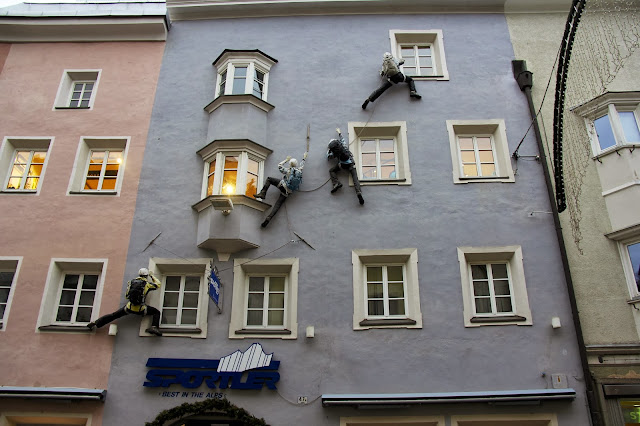
I just loved this outdoor sports store’s display
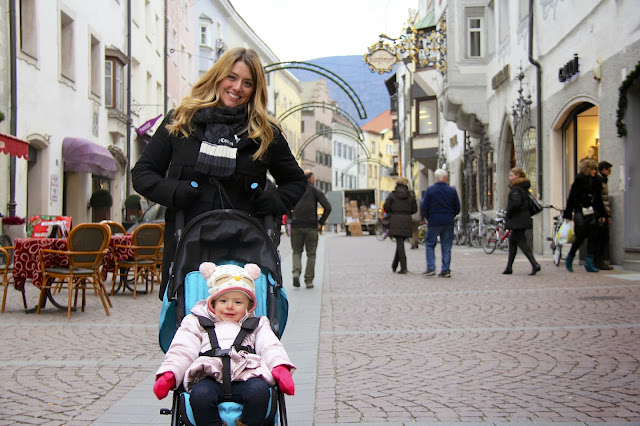
Jen and Julia in the center of Brunico

BOLZANO (Bozen)

We didn’t think that anything could top Bressanone, which we had seen the night before.  We were wrong.  We arrived in Bolzano after nightfall and our eyes opened wide as we walked into the center square.  Of all the towns, this one had the biggest Christmas market by far.  They had the most decorations.  They had the best rides for kids (a toy train that Julia loved riding).  In conclusion, one could say they had the most charm.  Beyond the markets, we loved losing ourselves in the city streets, taking in the restaurants and the shops.  We had a wonderful dinner and walked some more.  It was the perfect end to a fun-filled day.

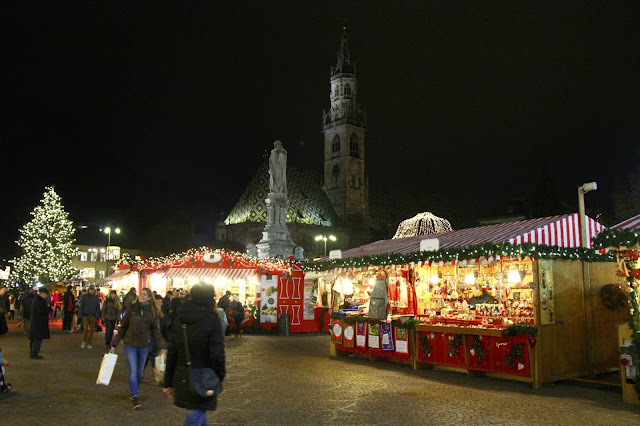
The markets and main church of Bolzano
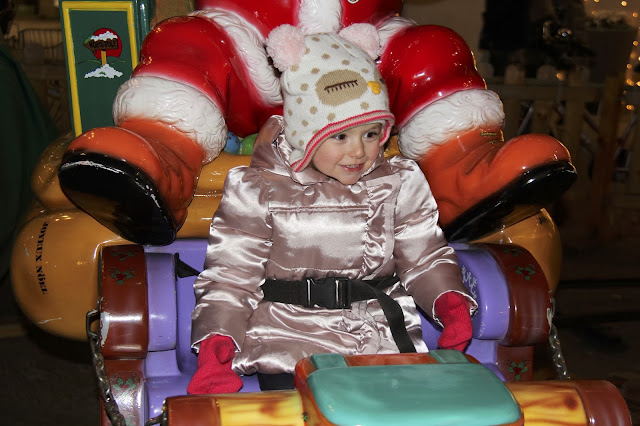
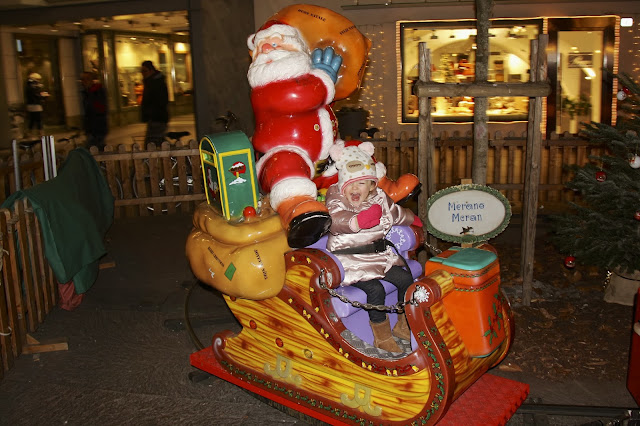
Julia goes for a train ride on Santa’s sleigh
For a kid that’s always happy, I’ve never seen her this tickled
We stopped for a little vin brulé
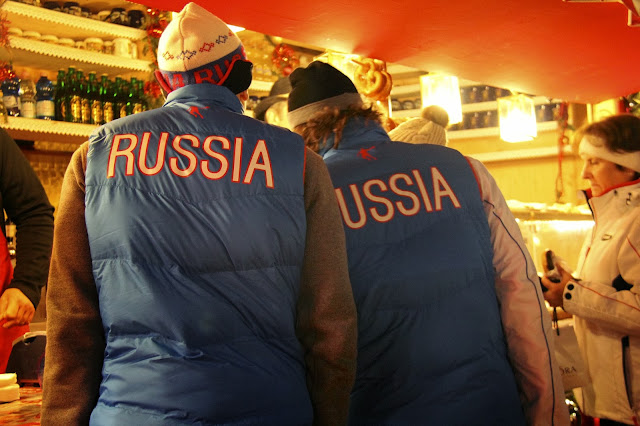
Looks like the Russian hockey team also wanted a little vin brulé to warm up
They had a secret Christmas garden off the main piazza
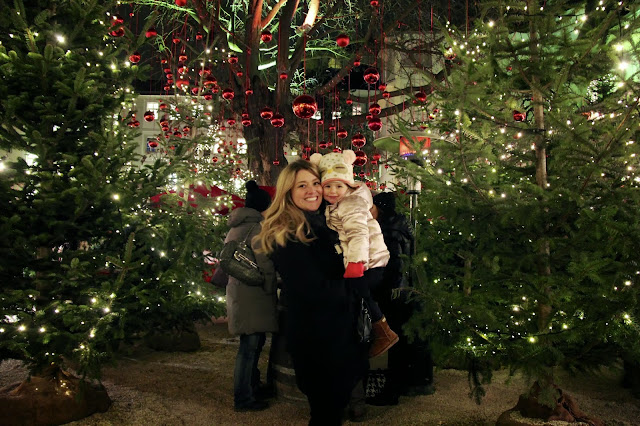
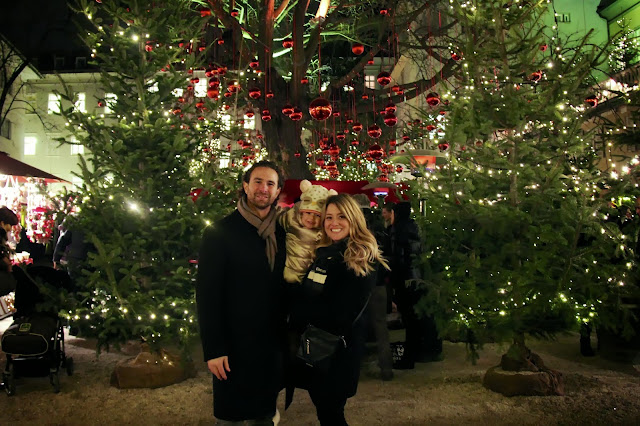
Family photo in the garden
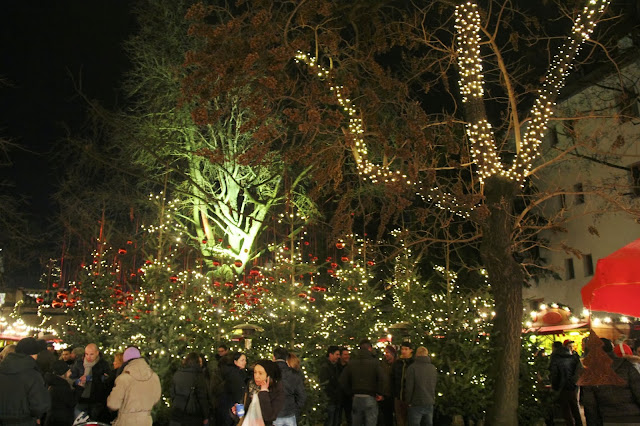
Vendors and crowds flanked the garden made out of Christmas trees, lights and ornaments
Julia floats through the trees
We just loved the garden
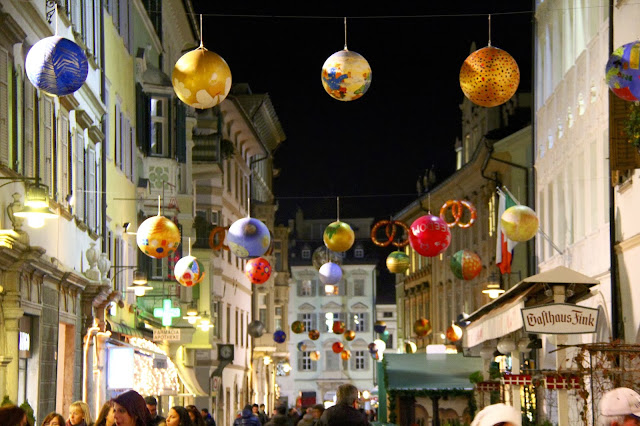
Big ornaments on this street were a nice surprise from the lights that are usually strung across
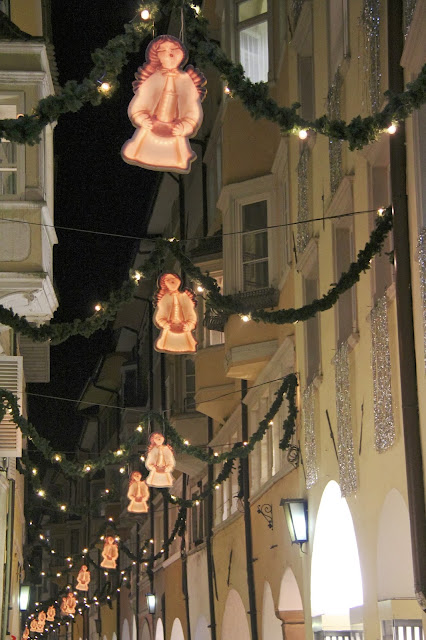
Angels glide across the rooftops

Sadly, our final day was marred by a heavy rain.  Our final two stops, Merano and then Trento (two of the places we were most excited about) were unfortunately, scratched from our trip.  We didn’t think it would be nearly as much fun to walk around in the rain.  If you do decide to take my “Five Diamond Christmas Tour” – do as I say, not as I do.  Stick to my original itinerary (VipitenoBressanoneBrunicoBolzano, Merano and then Trento) and be sure to check the weather forecast!

Hope you enjoyed – Merry Christmas!

Christmas in Italy – Bring on the Festivals!

“It’s the most wonderful time of the year”… and that means so many things!  It means snow flakes and Christmas lights.  It means cold weather and hot chocolate.  It means Santa Claus and stockings stuffed with goodies.  When you live in Europe, it also means tremendous Christmas markets and delicious vin brulè (cooked wine, usually sold on the streets).  Over the past couple weeks, we have been taking advantage of it all!  Because Christmas is only four days away – I will spend the next four days posting about our Christmas fun.  In order to do that, I have to bend my “unbreakable rule” and publish blog posts out of order.  I’ll fast-forward to Christmas and then flash back to some exciting posts that I have in the pipeline.

Oh bej!  Oh bej!

No, you don’t have to say “gesundheit”!  I didn’t sneeze.  That is the name of a festival held each year in Milan, spanning from December 7th through the following Sunday.  How did it get that wonderful name, you ask?  “Oh bej!  Oh bej!” means, “oh so nice!  Oh so nice!” in the Milanese dialect.  It is by far, the most important Christmas festival held in Milan.  December 7th is the day of the Patron Saint of Milano, Santo Ambrogio.  The festival is said to date back all the way to 1510.

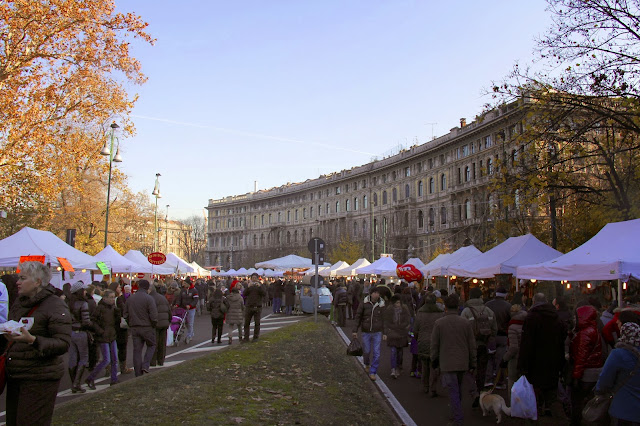
Vendors line the streets during Oh Bej!  Oh Bej!

We arrived in Milan early and parked far outside of the central zone.  You would think that living just outside of Milan for nearly a year would make me an expert driving in the city.  It’s quite the opposite, in fact.  I’m even more gun-shy now than I was when I first moved here.  Driving through limited zones and parking in residential areas has cost me hundreds of euros in fines.  So this time, I didn’t chance it – we parked in a garage outside the central zone and hoofed it just over a mile. The brisk winter weather was cold on our faces, but the fresh air and excitement of the day filled us with an energetic warmth.

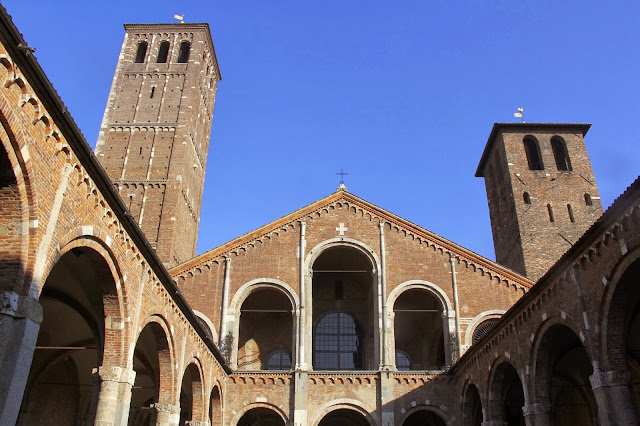
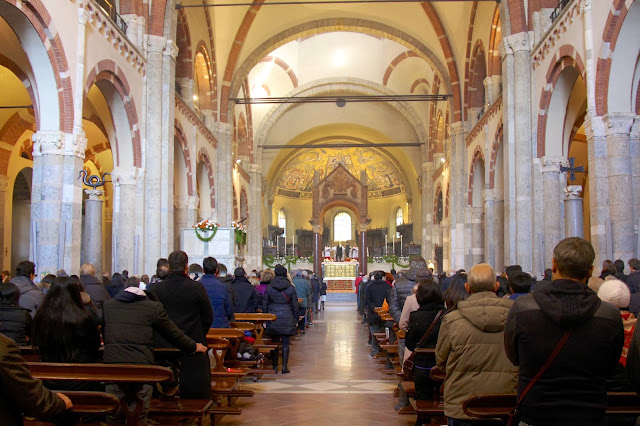
Our first stop was the Basilica of Sant’Ambrogio, the basilica commissioned by and named after Milan’s Patron Saint.  Construction of the basilica began in 379, making it among the oldest and most significant churches in Milan.  Since we were in the city on the actual day of Sant’Ambrogio, there was a large service being held in the basilica.

Basilica Sant’Ambrogio named for Milan’s Patron Saint, Santo Ambrogio
There was a large church service being held, even though it was a Saturday

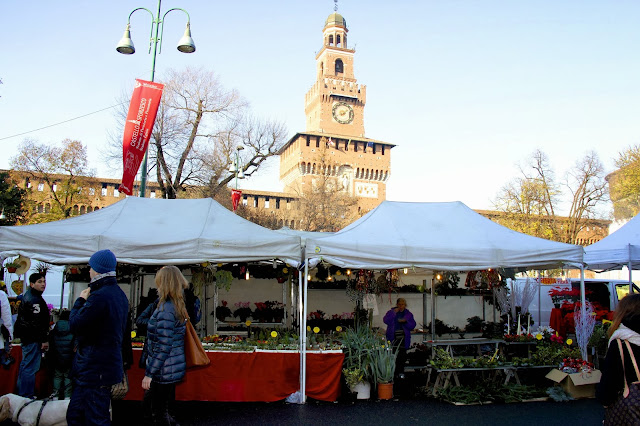
Next, it was time for us to see the festival and enjoy some of my favorite things – vendor food and vin brulè!  In the center of the city stands the Sforza Castle, a medieval fortification built in the 15th century.  Here in the 21st century, the fortification plays host to hundreds of vendors that encircle the great castle walls.  Over 400 vendors vie for the attention of shoppers looking for food, crafts, Christmas ornaments, books and so much more.  We got a couple wonderful pannini (sandwiches) and jockeyed for a spot to enjoy them.  After lunch and some shopping, we walked through the gates of the castle and explored the courtyard.

Over 400 vendors flanked the ancient castle walls
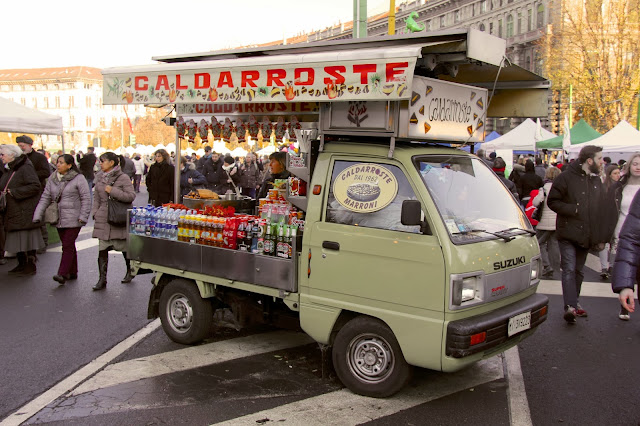
The best roasted chestnuts come from the back of trucks
There were literally dozens of stands with delicious Sicilian treats
A stand full of artisanal goods
I picked us up a couple sandwiches – porchetta and salamelle
Salamelle panino
After her first bite, Julia decided she didn’t want to share – I couldn’t blame her
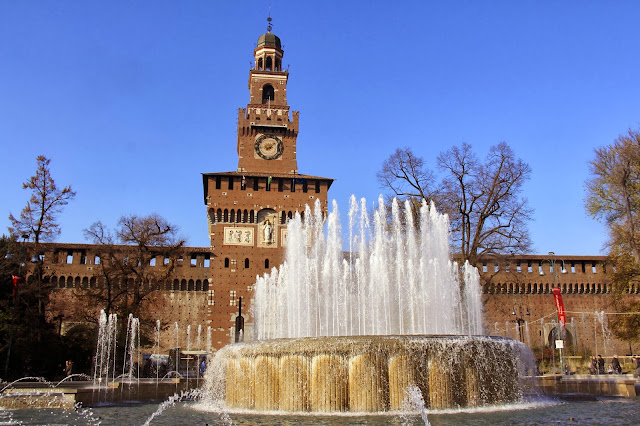
A fountain sprays in front of Sforza Castle
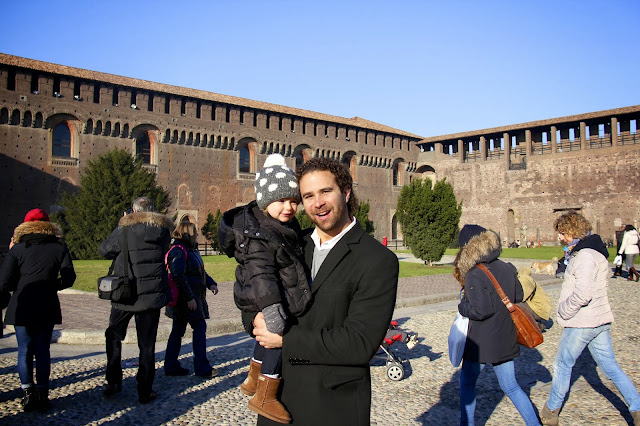
We went inside to explore the courtyard
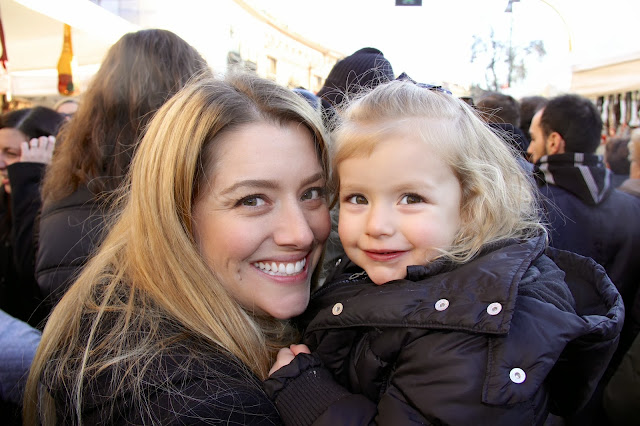
Jen holds Julia tight in a crowd full of people

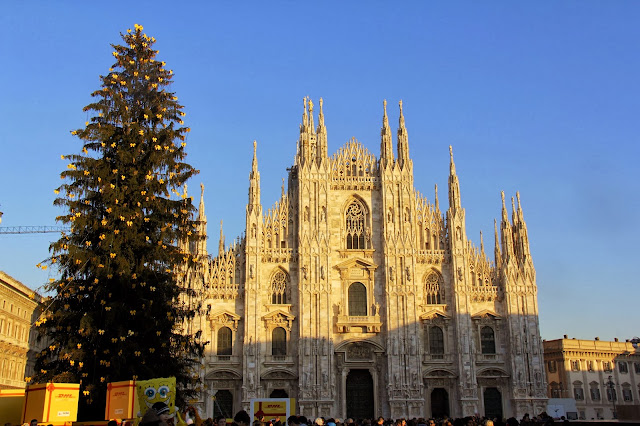
When we had our fill of the market, we strolled down Via dei Mercanti toward the Duomo.  No trip to Milan would be complete without seeing one of the most amazing architectural examples of our age. The Duomo is particularly special during Christmas time.  Ablaze with sparkling lights and framed behind a giant Christmas tree, you can’t help but become filled with Christmas spirit.

Duomo di Milano

The festival just whet our appetites for all the Christmas fun that we would enjoy.  I hope that I’ve been able to do the same for you.  We still have so much left to explore together, including the Christmas markets of Switzerland and a tour of some of Italy’s “best towns for Christmas.”  Plus, I got an early present… I hope that you’ll help me unwrap it.  I’ll give you a hint –  it’s got four wheels, two doors and 572 horsepower!  Grab a warm cup of vin brulè and get comfy (oh yeah, we’ll give you a recipe for that too) – we’ve still got a lot of exploring Christmas time in Europe left to do.

Vinegar and Ice Cream – A Delicious Combo!

It’s likely that you may think I’ve gone off my rocker.  Vinegar on a salad – of course.  Vinegar on french fries – sure.  But vinegar on ice cream?!  Greg, you must be crazy?!  I assure you, I am not (well, at least when it comes to this point).  Provided one very important detail is in play… that the vinegar used is aged balsamic vinegar from Modena.  This dark, delicious treat becomes sweet and thick (almost, syrupy) once it has been aged 12(+) or 25(+) years.

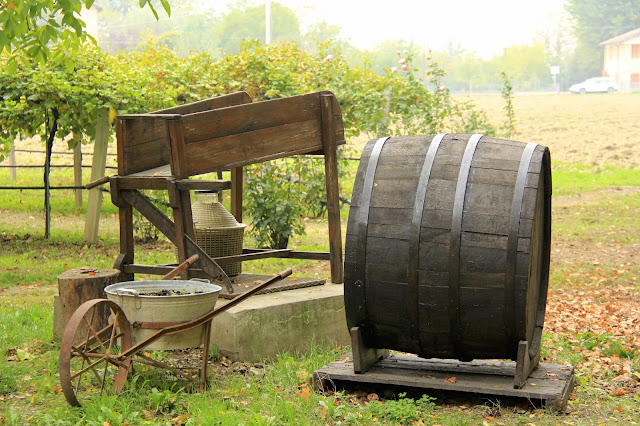
Old fashioned equipment used to make vinegar now stands as decoration

I have been a fan of all things vinegar for as long as I can remember.  Admittedly, a strange condiment choice (above ketchup or mayonnaise) – but the heart wants what the heart wants.  Although we use apple cider vinegar every single day, I have always been quite fond of balsamic vinegar.  Just the right amount can add the perfect hit of acid to round out a caprese salad.  However, I recently learned that I have become accustomed to eating the equivalent of a McDonald’s value meal when a readily available filet mignon was just around the corner.  But let’s back up and find out how I discovered this…

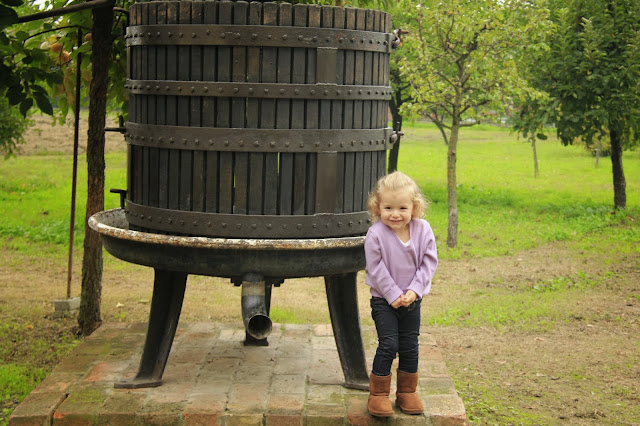
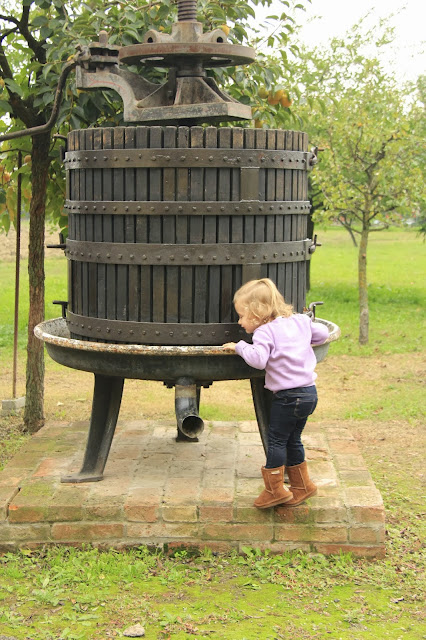
Julia stand by an old grape press
She’s a curious little girl
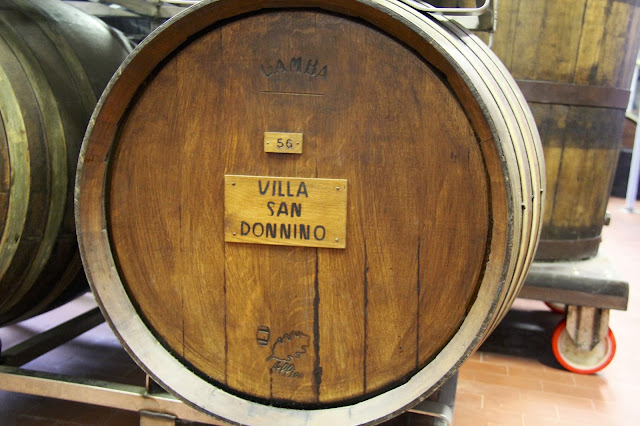
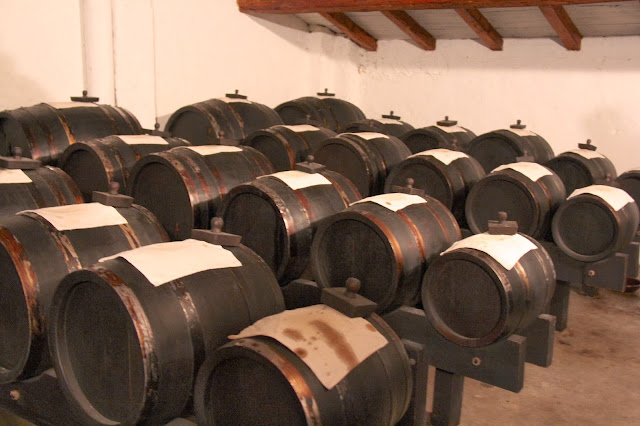
One of the barrels used for aging
Villa San Donnino has been a family run business for three generations
When my aunt Deborah and uncle S came to visit, we ventured on a road trip to the Emilia-Romagna region of Italy.  If you read that particular post, you learned that Emilia-Romagna is widely known for two things – cars and food.  One of the most significant contributors to the food column is the aged balsamic vinegar that is produced exclusively in Modena.  On our final day of the road trip, we arranged for a private tasting with a local producer, Villa San Donnino.  Jen had learned that a tour and tasting at Villa San Donnino was one of the top-rated attractions on Trip Advisor.  Once again, our favorite online guide for all things travel hit a home-run.

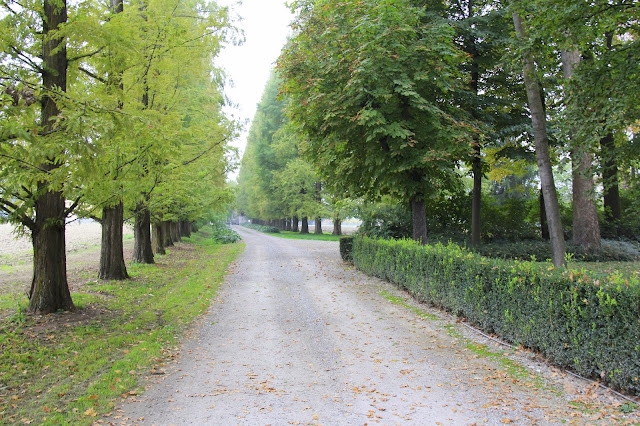
The driveway leading toward the villa
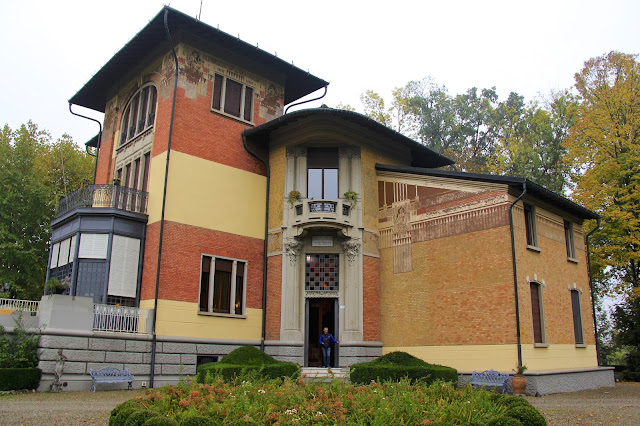
The villa of, Villa San Donnino
The important aging process begins here, in these barrels

Not only did the overall experience exceed our expectations – it raised the bar for what events like this should be all like over the country.  The owner and third generation producer, Davide greeted us warmly and took us into the portion of the property where the vinegar is aged.  He first gave us a brief explanation of the vinegar itself.  It was summarized nicely in a marketing brochure I took from the villa, so I will copy the text below:

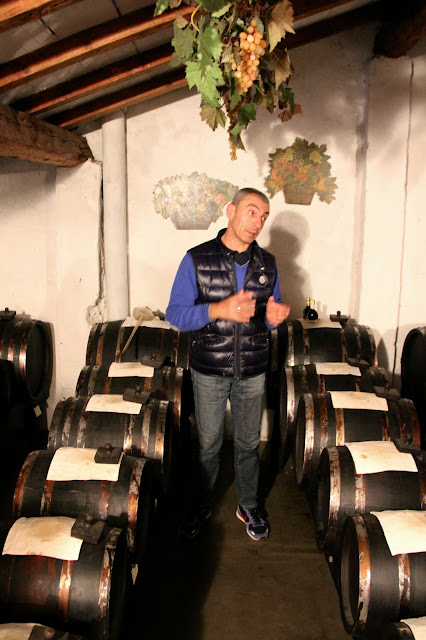
Davide explains the rigorous balsamic making process

Traditional Balsamic Vinegar of Modena is unique from all other vinegar based condiments.  Unlike ordinary vinegar which has its origins in an alcoholic liquid, balsamic vinegar is produced directly from grape juice.  Grapes, harvested in the region in which balsamic vinegar is produced, are crushed and their liquid – “must” – is boiled in an open vat over a fire.  This liquid is then placed in a high quality wooden barrels in which, through an oxidation process, it is transformed into vinegar.  The barrels are kept in a vinegar loft – acataia – where over a number of years, the precious liquid inside is lovingly cared for through a special technique involving transfers and topping up.  Over many years macrobiotic and enzymatic modifications unite to achieve an exceptional balance in the fragrance and flavor. 

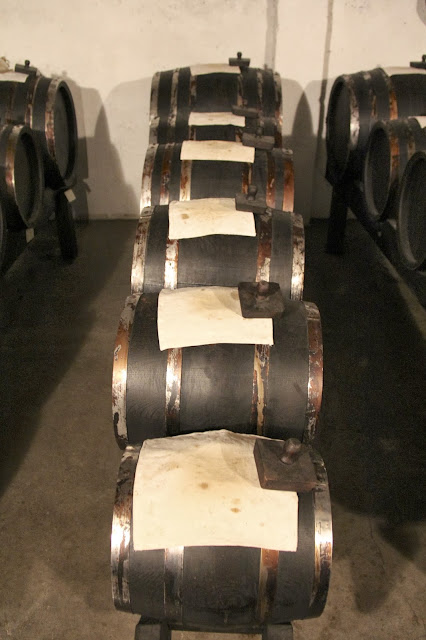
As we climbed the stairs to the acataia (vinegar loft) we were first greeted by the unique and pleasant aroma permeating throughout the loft.  Davide began to explain the aging process, having already described that his balsamic vinegar juice comes exclusively from grapes on his property.  In order to properly age vinegar, you must use a batteria, a series of five or six barrels that descend in size.  A process of “topping” off from the larger barrels into the subsequent smaller barrels is done over many years in order to replace evaporated liquids.  Since the last, smallest barrel is the object from which the final contents are removed for bottling – there is no way to identify a specific amount of time in the barrels (i.e. twelve years).  Because the liquids have been mixed from the larger barrels over many years, a unique system of labeling was created.  A balsamic vinegar that was aged for 12 years will have been aged for at least twelve years (meaning, that 12 years is the youngest portion allowed in that mixture).  The same is true for 25 years and the extremely rare 50 year vintages.

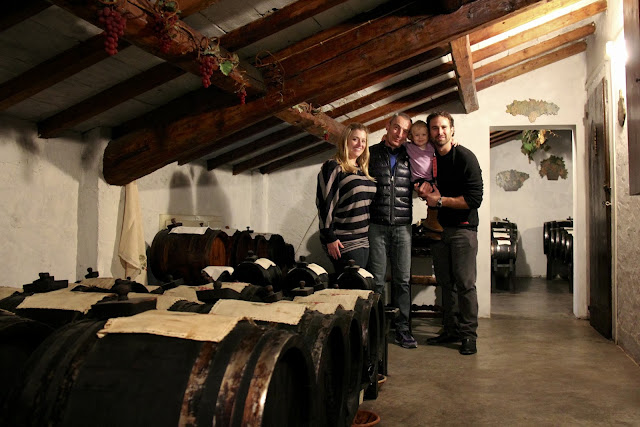
A batteria, aging the vinegar
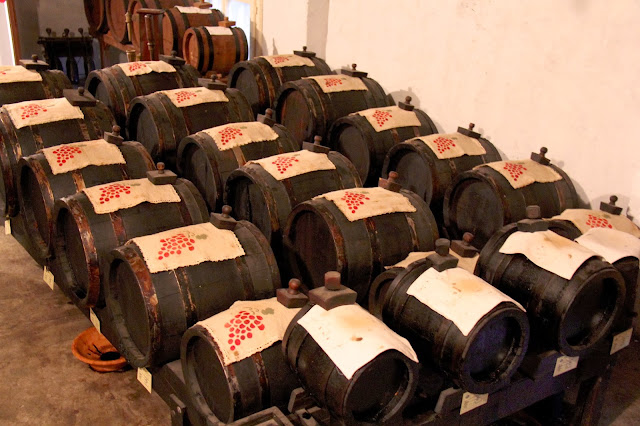
Another room with a different collection of barrels
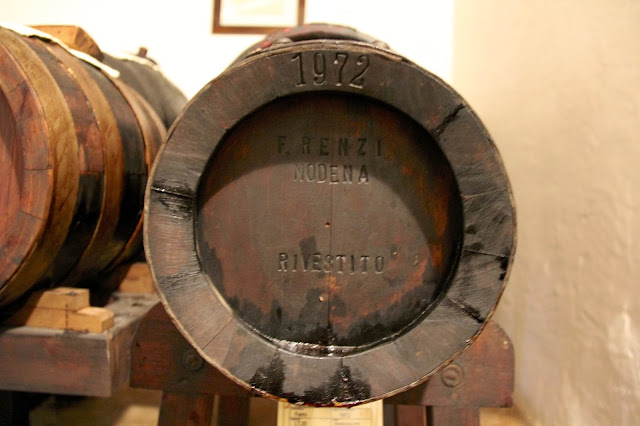
This reserve vinegar has been aging since 1972

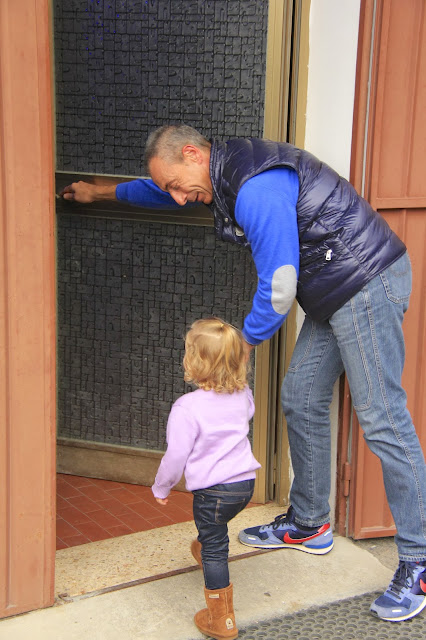
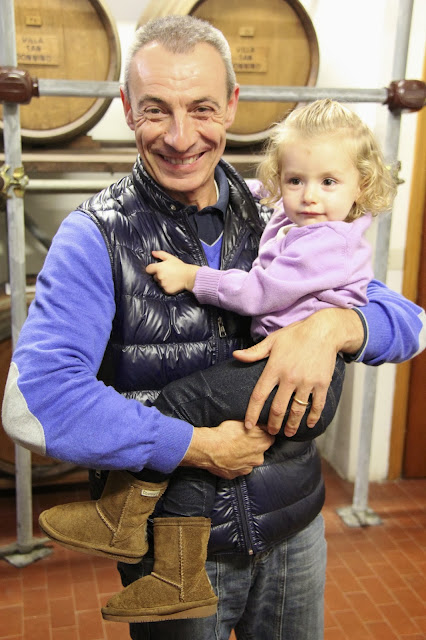
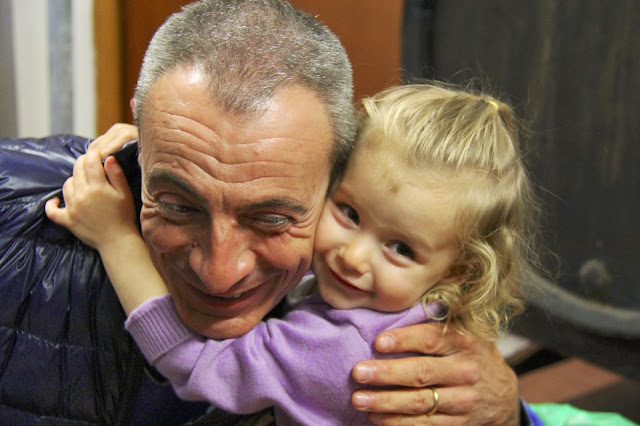
As Davide was explaining the process, we all noticed that he acquired a little two-foot groupie.  Our little Julia seemed more than just enamored with Davide, she fell head over heels for him!  She kept asking him to pick her up and would require his attention at almost every point hereafter.  It was hard for Davide to focus on the remainder of his tour, when at each turn he would hear a little voice saying, “Davide… hold me!”  If she liked him this early on in the tour, she loved him when he brought out the gelato (ice cream) for us to try.

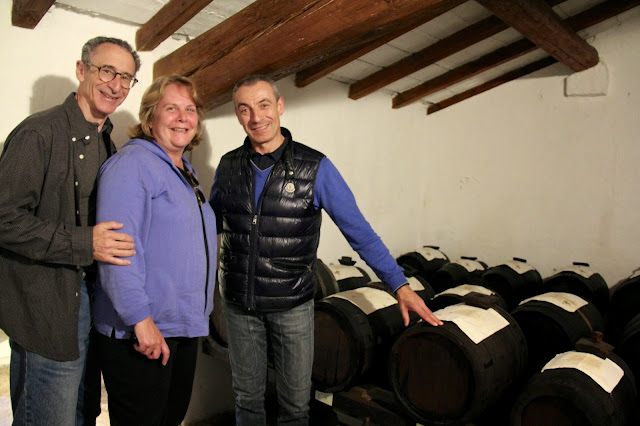
Davide with S and Deborah
Julia holds Davide close for a photo
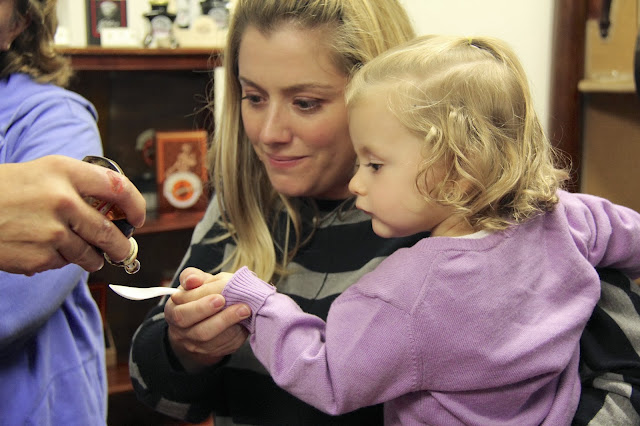
Davide brings Julia in to taste the vinegar with ice cream – she wouldn’t let him go

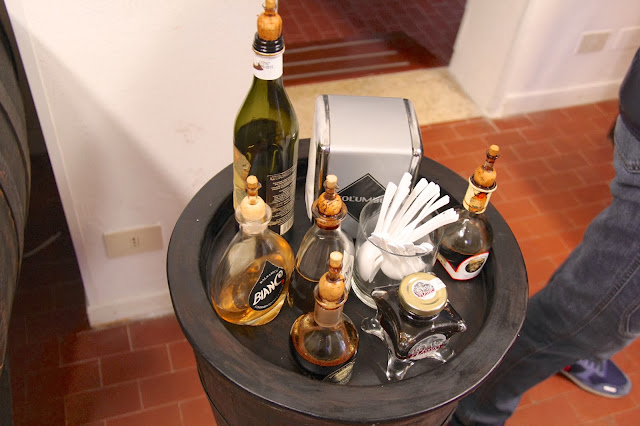
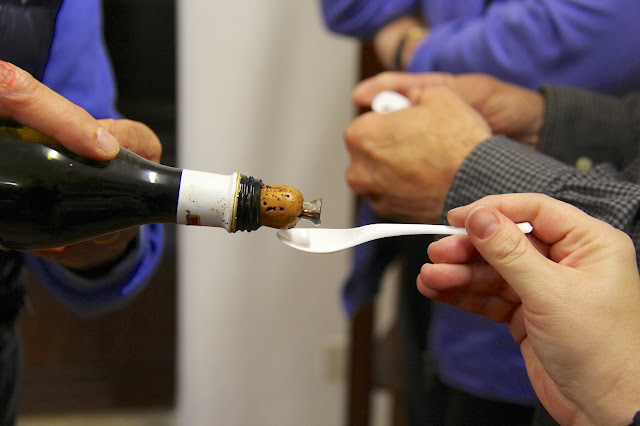
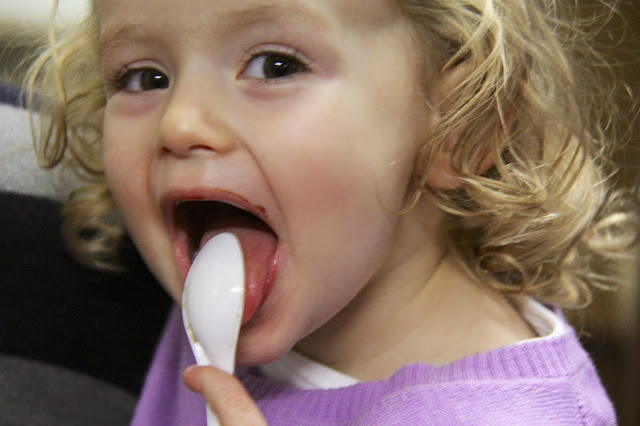
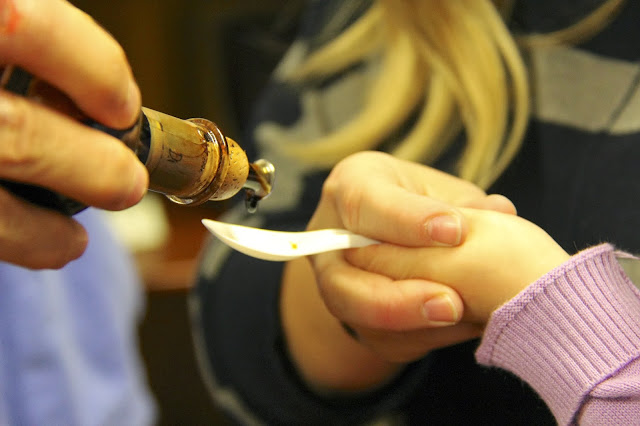
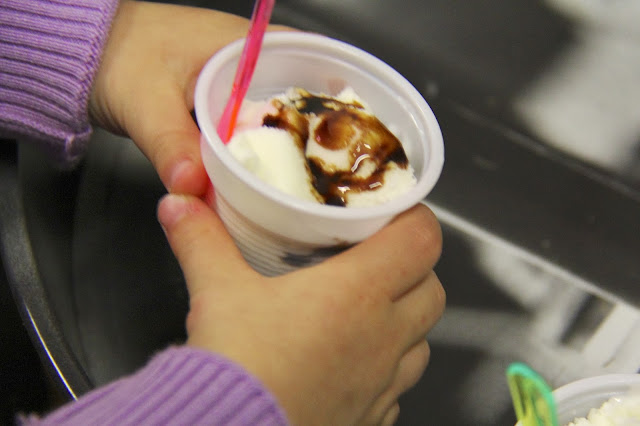
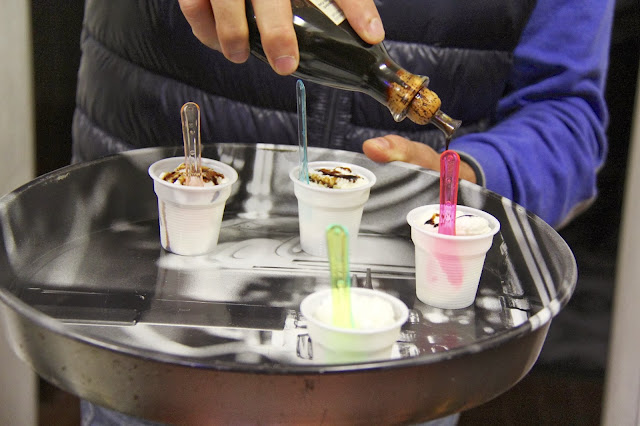
You see, as I mentioned earlier, aged balsamic vinegar has a wonderfully sweet taste with a somewhat thick consistency.  It pairs wonderfully with fruit (melon, strawberries), meat (a nice hearty steak), cheese (a few drizzles over parmigiano)  and especially ice cream!*  In order to prove this point, Davide had arranged a tasting – a  “flight” of vinegars, if you will.  We started with a store-bought, uncertified vinegar.  It was not good.  Then we moved onto his white vinegar before climbing the ladder through his 12 year and on to the 25 year.  Each one was more magical than the last.  When he drizzled it on the ice cream, we couldn’t believe how well it paired.  Julia was such a fan of the vinegar that she didn’t want anything to do with the ice cream, and just wanted more vinegar!  This is one Italian baby!

A display set, ready for us to taste
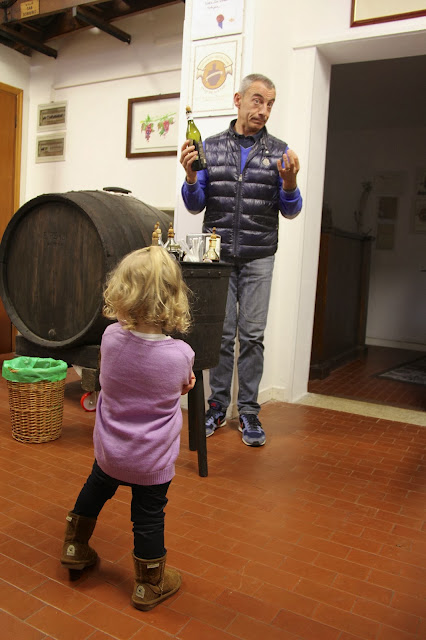
Davide explains the differences of the vinegars to an enamored fan
“Let the tastings begin!”
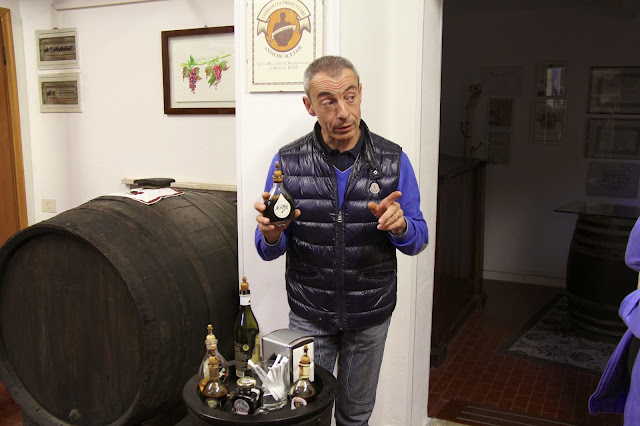
Davide gave us a very informative and interesting lesson
Julia did not want to miss her turn tasting
She loved the vinegar of Villa San Donnino
“More please!”
The vinegar coats the ice cream like a sweet syrup
Davide drizzles the vinegar for the rest of the group

As the tour wound down, Davide was starting to feel more like a family member than someone we had just met.  Each couple bought some of his wonderful aged balsamic.  Jen and I got some to use here in Italy and some for when we move home (unlike olive oil, the vinegar can last for many years in the bottle).  I think S and Deborah bought his entire supply, including an affinato (aged 12+ years), an extravecchio (aged 25+ years) and the riserva (aged 50+ years).  I think I’ll risk facing ten years in prison to smuggle home a wheel of parmigiano-reggiano cheese if S will promise to drizzle some of his riserva on it!

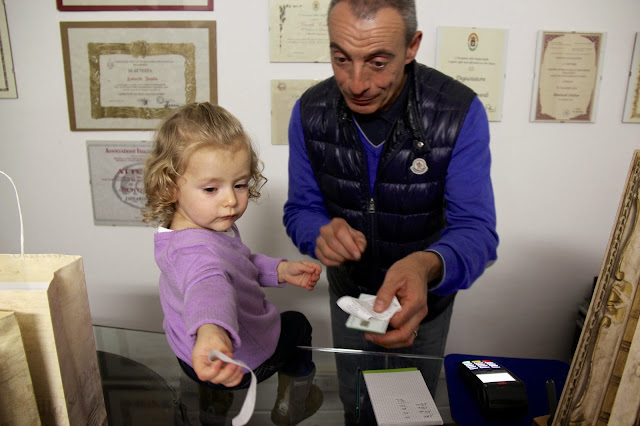
Julia helps Davide ring her father up
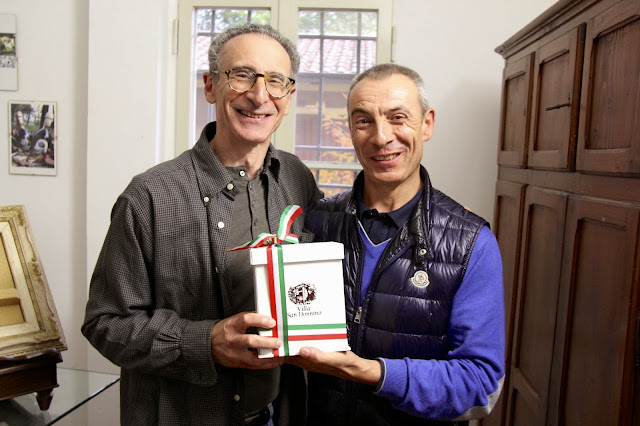
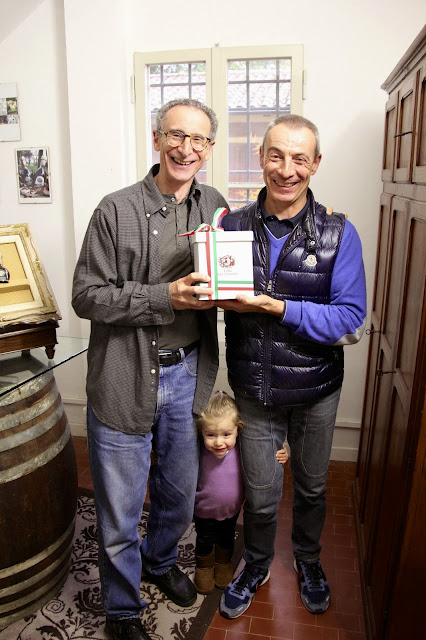
S and Davide take a picture with his new 50 year Riserva
All of a sudden, we all heard, “anche io” (“me too” or “so do I)
Julia didn’t want them taking a picture without her
Davide holds Julia for a hug
Julia gives Davide a big hug

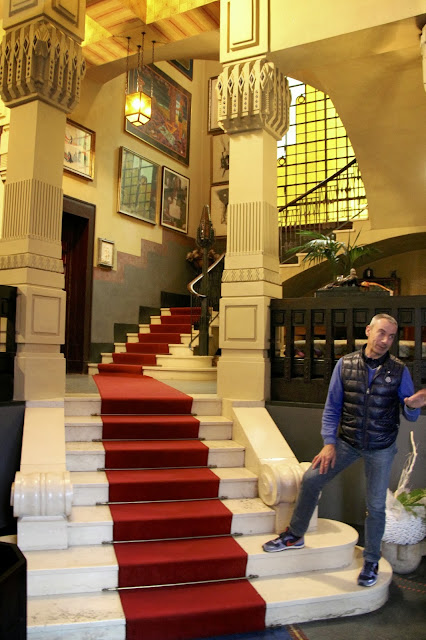
When we had completed the tour and acquisition of our newfound condiments, Davide did something that I suspect he doesn’t do for most tour groups.  He offered to open his private home to us, the villa pictured in the brochure.  This villa was acquired by his grandfather in the 1940’s and has stayed with the family ever since.  In fact, the villa itself plays an integral role in the history of Acetaia Villa San Donnino.  After acquiring the property, his grandfather happened upon a barrel used for making vinegar and so he thought he would “give it a try”.  Over seventy years later, the family is still making vinegar in the traditional way.  Davide explained that to be included in the small fraternity of roughly 80 producers in the world… you must have time, patience and a passion that cannot be taught.  The tour of his home was simply amazing, jaw dropping examples of art and collectables abound around each corner.  It was no wonder that Bernardo Bertolucci chose this location to film part of his movie, 1900, staring a young Robert DeNiro and Gérard Depardieu.

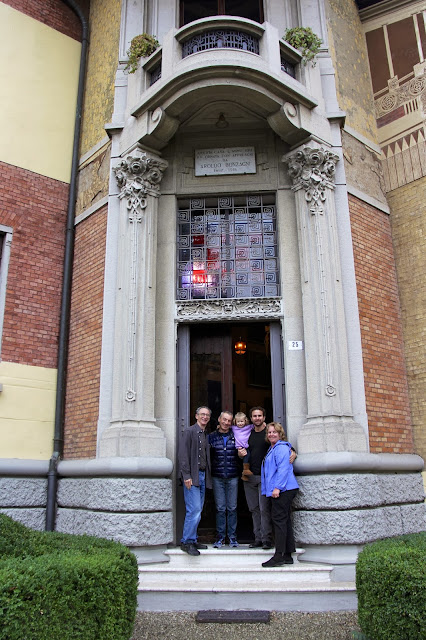
Everyone prepares to go into Davide’s home
Quite a grand entrance
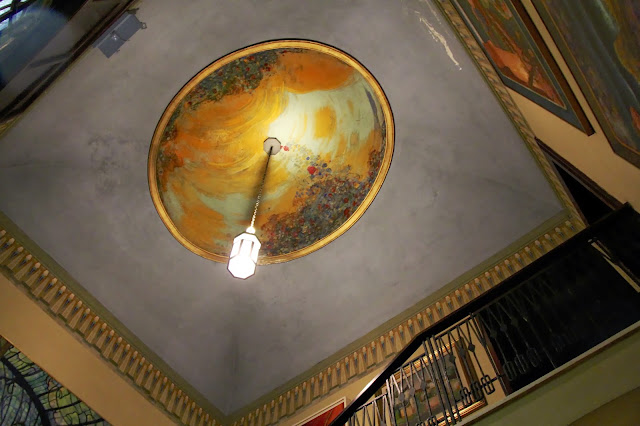
The ceiling above the staircase
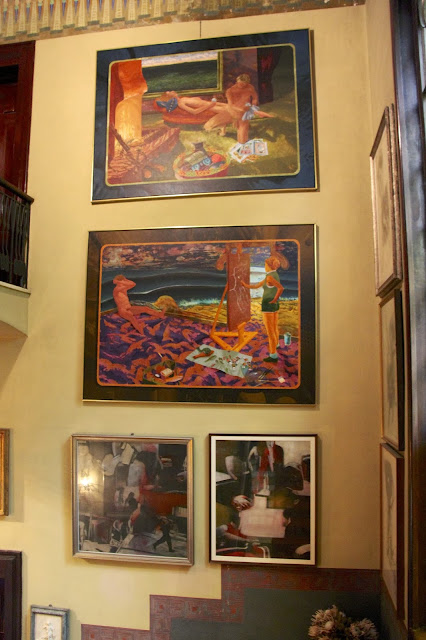
Stunning artwork adorns nearly every wall
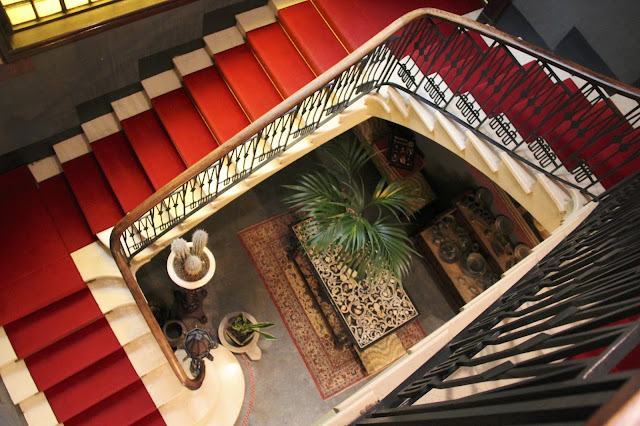
The stairwell from the second floor
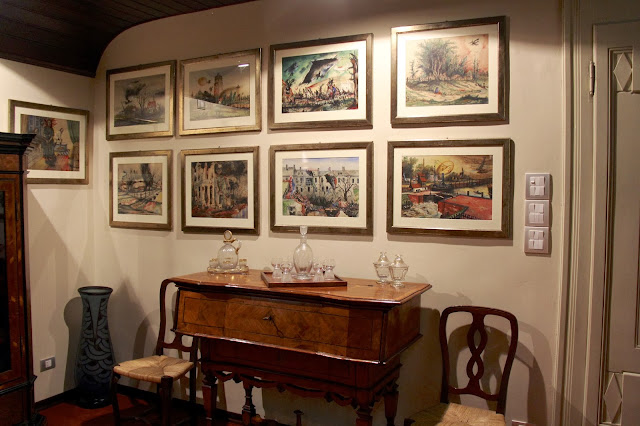
A collection of smaller original prints frame an antique desk nicely
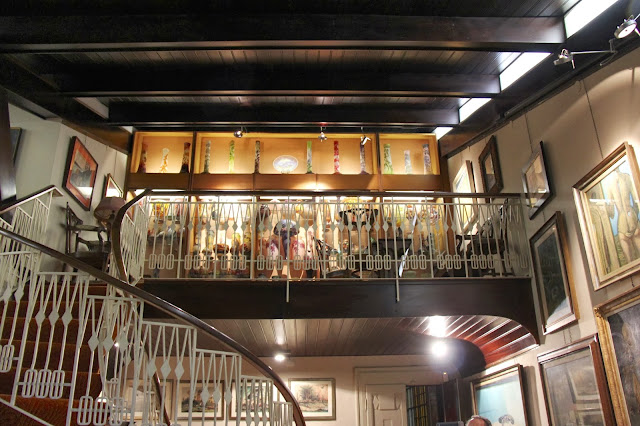
A stairwell leads to an annex full of glass pieces
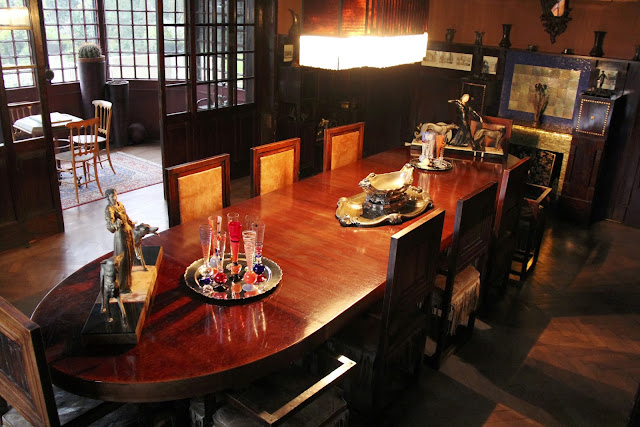
If this dining room could talk… I can’t imagine the history it’s seen.  Robert DeNiro, for starters…
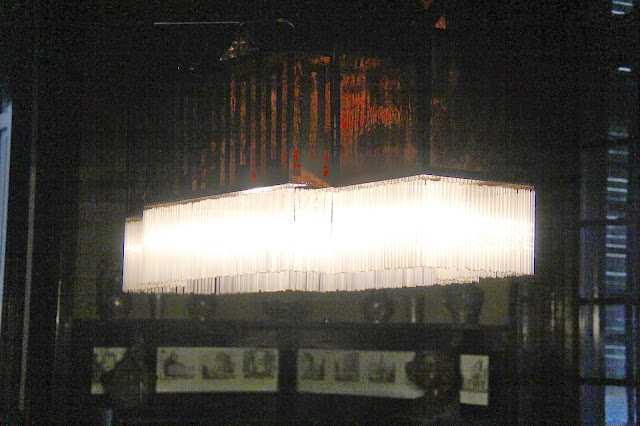
This was one of the more beautiful chandeliers I’d ever seen

As the sun was setting on a long and wonderful day, we bid Davide a fond farewell and Julia tossed her new friend many many kisses.  We will definitely come back to see Davide again and re-stock our balsamic vinegar; if you find yourself anywhere near Modena, I suggest you pay him a visit as well!

Villa San Donnino
Strada Medicina 25/1
San Donnino MO 41126
www.villasandonnino.it

*These are just a few of the wonderful uses for the condiment.  While there are many, many uses for aged balsamic – most applications require a unique understanding of the complexities of this liquid gold.  Since it is very expensive and can also overpower a dish with careless use, it is recommended that you do a quick bit of research before adding to your next dish.

An Unexpected Gem

Living in Italy grants us access to a lot of great restaurants.  We fully take advantage of that and eat at… a lot of great restaurants.  I recently read that 75% of the food in Italy is great and 25% of the food is exceptional.  I would agree with that – most meals leave you feeling completely satisfied and pleased with the overall experience.  But occasionally, you’ll find yourself “mmm’ing” and “aahhh’ing” with more delight than you intended to express aloud.

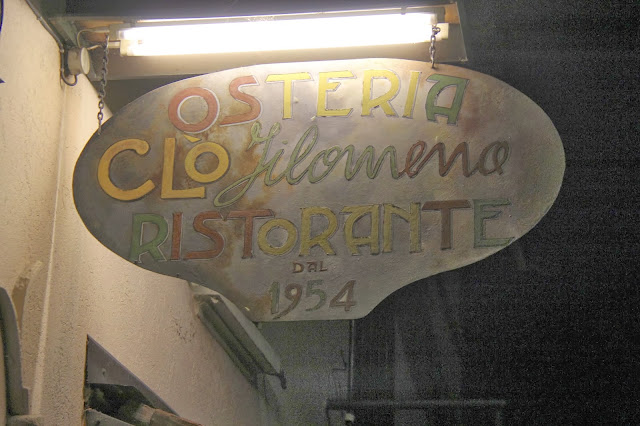
We can usually spot these exceptional places before we’ve walked in the door.  We may have heard about the joint from a friend or relative.  It’s possible I’ve read about it on the internet or a travel book.  Or sometimes, we just walk into a place and the intense amount of “old-world charm” smacks us in the face.  We’re greeted by a little nonna (grandma) who then scurries to the back to cook our meal – and we just know that we are in for a treat.  Since it is usually one of those three paths that lead to our exceptional meals, I had all but dismissed, Osteria da Clo’ Filomena when we made our reservation.  The reason for the swift dismissal, you ask?  Well, the restaurant was in our B&B, in a remote part of Emilia-Romagna, surrounded by nothing by small villages and towns.  I’m usually quick to dismiss restaurants in hotels anyway, with a few exceptions.  Furthermore, the place was empty.  I wasn’t surprised, because it would probably be a 20-30 minute drive for most patrons to arrive.  I assumed that the restaurant was in place, merely to service the guests of the hotel and therefore had to serve mediocre food (which, if you remember still falls into the 80% “great” category).

The Osteria at night – the outdoor patio is used in the spring
The ristorante opened in 1954

I am happy to say that I have never been so wrong!  And we weren’t the only ones in on the secret – by the time we left, the place was nearly full.  People had been coming in from [presumably] all over – from towns and villages several miles away.  The waiters, two young men (I regret not getting their names) were very helpful and pleasant.  Our server spoke fluent English, but indulged me and kept the conversation in Italian until I really needed the help on a word or two.

Our group decided that we would order several dishes and that we would be generous with each other when it came time to share.  There were too many things to taste to keep each dish all to ourselves.  Our group?  Four weary travelers (and a baby past her bedtime), comprised of myself and Jen as well as my aunt Deborah and uncle S, visiting from the States (read about their trip HERE and HERE).

Antipasti

For the antipasti (appetizer), each couple elected to order the:

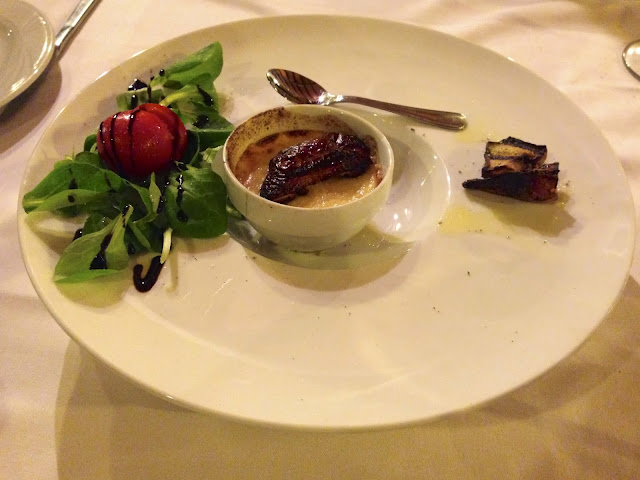
Creme Brulè ai Quattro Formaggi con Porcini e Balsamico  

Four Cheese Creme Brulè with Porcini Mushrooms and Balsamic Vinegar
This dish was so tasty, we asked what the four cheeses were so that we could attempt to recreate it at home

Primi Piatti

For our primo (first course), each couple shared a pasta:

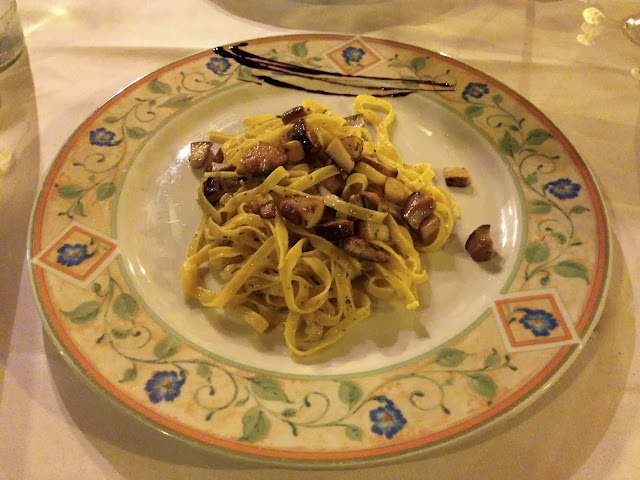
Tagliatelle ai Fungi Porcini (S and Deborah)

Tagliatelle Pasta with Porcini Mushrooms
Dishes with porcini mushrooms were among the restaurant’s specialties

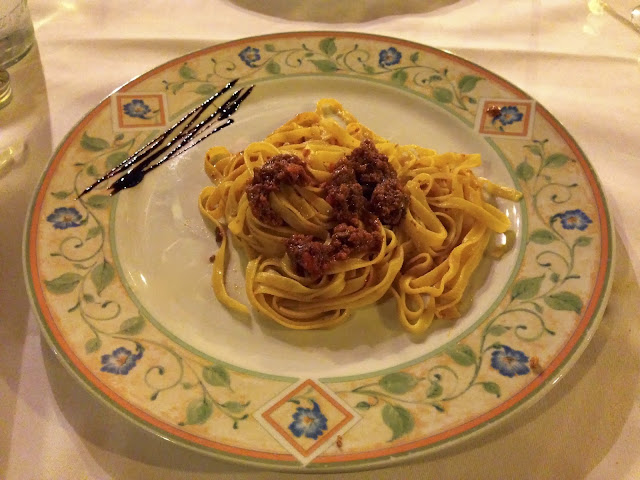
Tagliatelle al Ragù alla Bolognese (Greg and Jen)

Tagliatelle Pasta with a Meat Ragù
Jen and I like to try classic examples of Bolognese – it is a dish that has subtle changes across various regions of Italy

Secondi Piatti Tipici

For our secondo (main course), each couple shared once again:

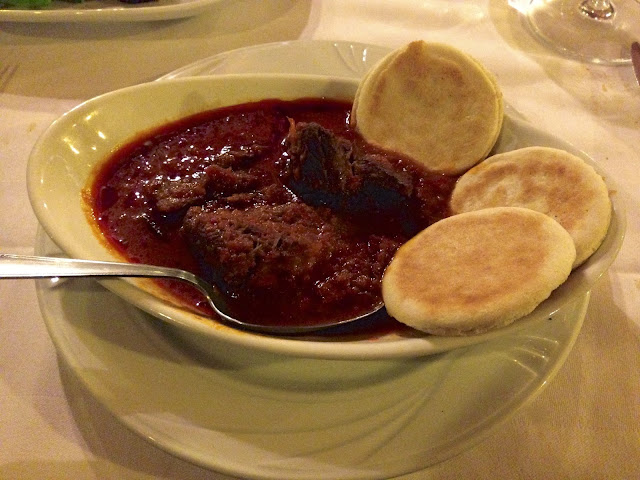
Spezzatino Rosso di Cinghiale con Tigelle (S and Deborah)

Red Stew of Boar with Tigelle
Tigelle is a bread that looks like a small pancake, local to the region

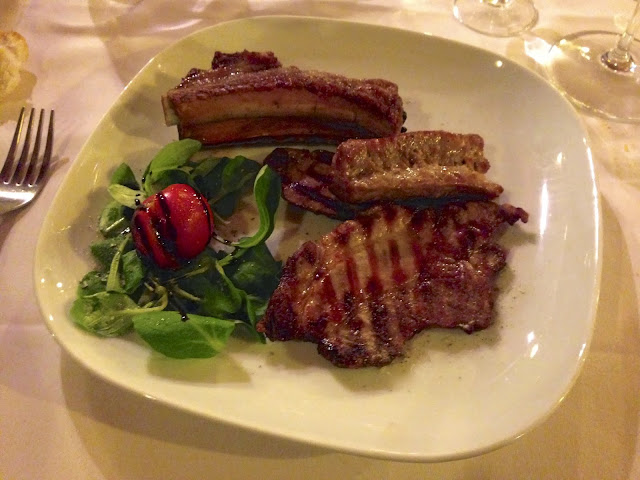
Grigliata Mista di Maiale (Greg and Jen)

Mixed Grill of Pork
This is a fairly common dish throughout Italy, but this was superior to most – perfectly seasoned and tender

Contorni

For our side dishes we selected:

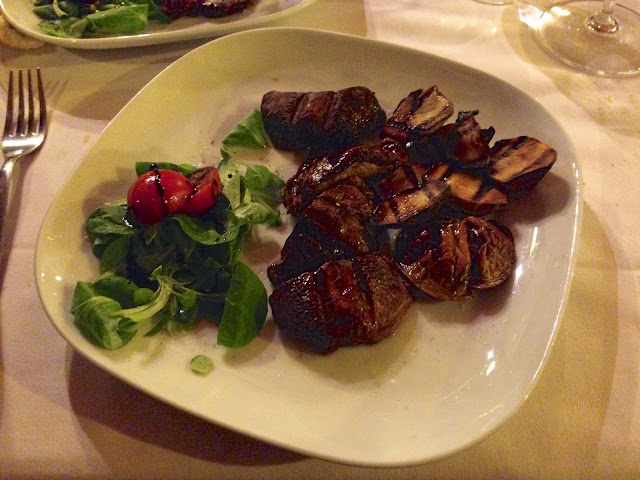
Funghi Porcini Grigliata (a seasonal dish)

Grilled Porcini Mushrooms
This dish is only served during “mushroom season” (September, October, November)

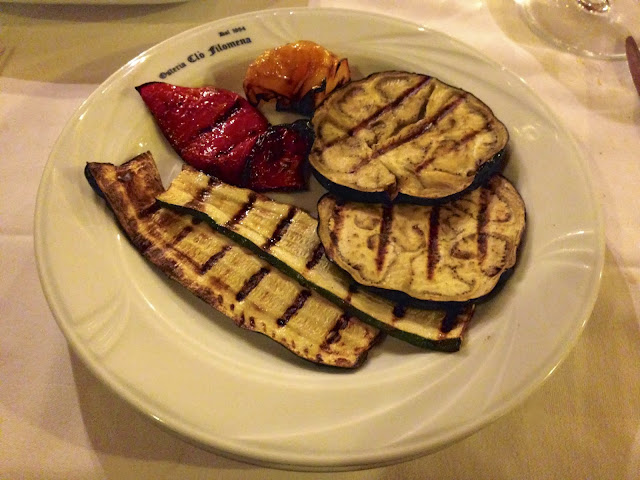
Verdure alla Griglia

Grilled Vegetables
A simple and healthy selection from the grill

Dolce

For me, dessert is usually the weakest part of the meal – I was proved wrong once again.  I had to tell myself over and over that it was impolite to pick my plate and lick the remaining chocolate residue.  We all shared:

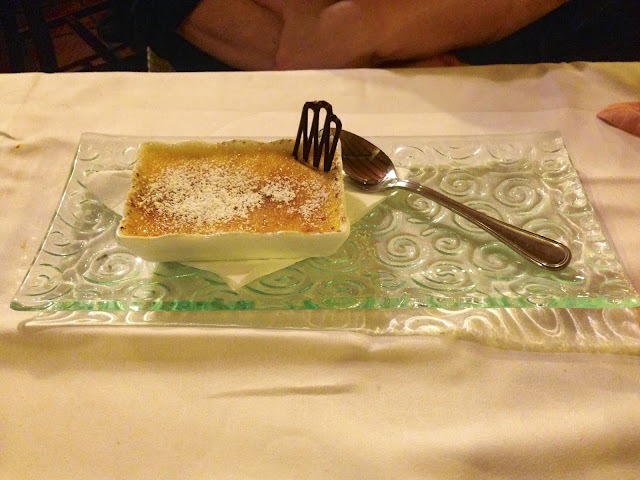
Creme Brulè

Creme Brulè
As delicious as it looks

Torta al Cioccolato di Lave

Chocolate “Lava” Cake
Jen had to restrain me from licking the plate

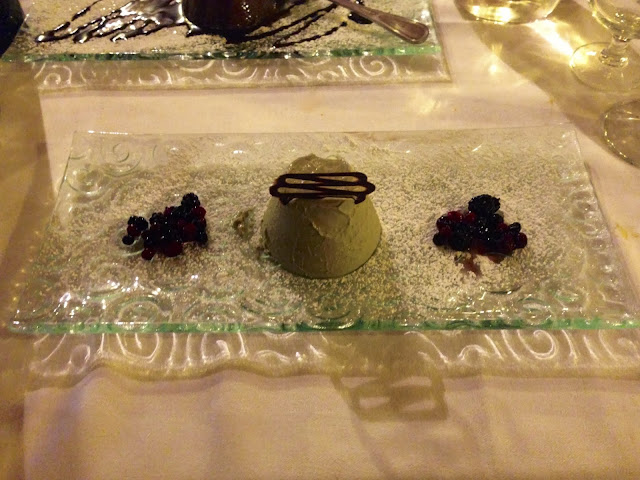
Torta di Pistacchio

Pistachio Cake
I’m not a huge pistachio fan, so it came as no surprise that this was my least favorite of the trio

We were fortunate to have found, Osteria da Clo’ Filomena as a byproduct of first discovering the hotel in which we were staying,  La Locanda Gli Ulivi.  From what I could gather, the restaurant was established first, in 1954 – and is still the main draw on the property.  The hotel is a charming B&B, set just far enough away from Modena and Bologna that you can’t help but become immersed in the nature and hills of vineyards.

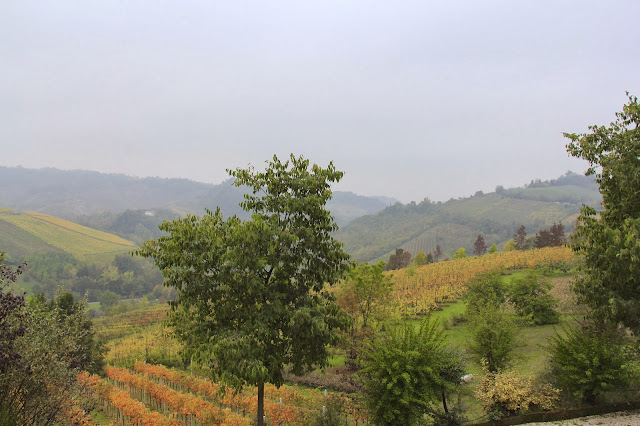
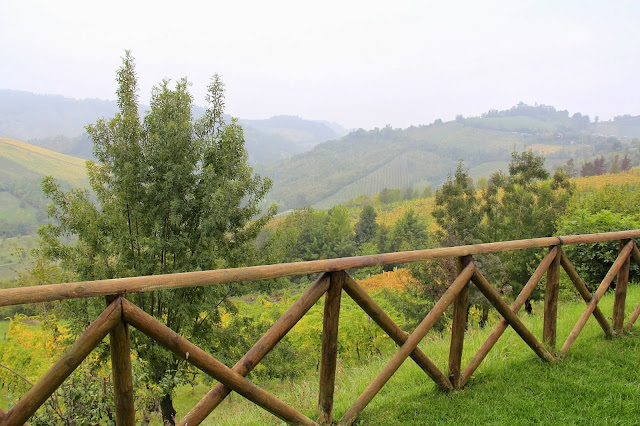
The rolling vineyards behind Osteria da Clo’ Filomena

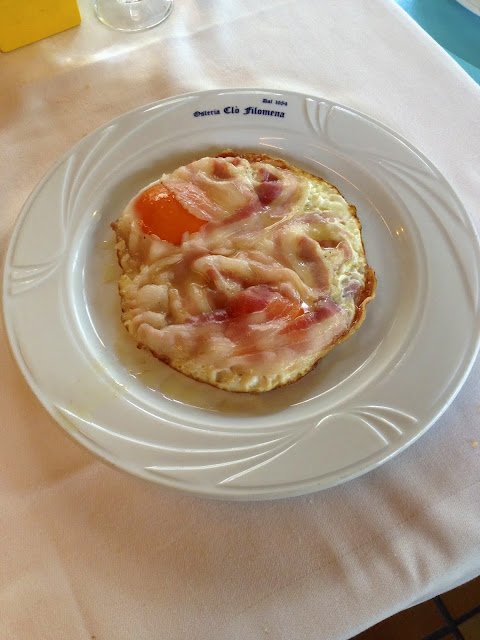
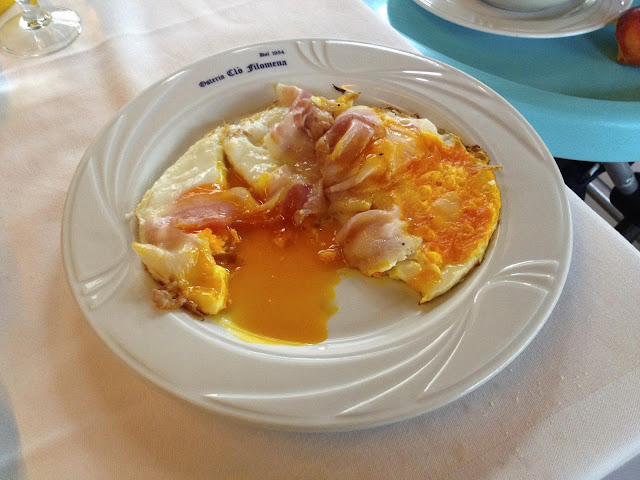
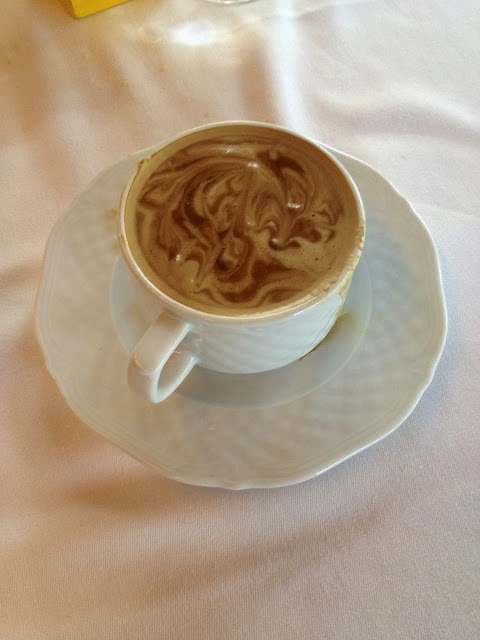
In the summer, a small waterfall cascades on the patio as diners eat under a setting sun and in the winter the fireplace is always glowing – warming the patrons next to the chestnut wood tables.  If you stay at the hotel, you can expect a breakfast as delicious as the one pictured below.

Eggs, made to order
Perfectly cooked with delicious pancetta
Cappuccino con doppio espresso (cappuccino with double espresso)
Next time you’re in Emilia-Romanga, stop by and have a meal.  Be sure to tell everyone that we said, “ciao!”
 
Locanda Gli Ulivi
Via Montebudello 33 
40050 Monteveglio (BO) Italy
www.locandagliulivi.it

Loosen Those Belt Buckles – Some Serious Eating Ahead

Before I’ve even written the first word of this post, my OCD brain is trying to figure out if this post should be categorized under the “Food” or the “Travel” sections of the blog.  I will be taking you along with us on our travel adventure to go eat some of Italy’s best food.  It’s quite the dilemma…

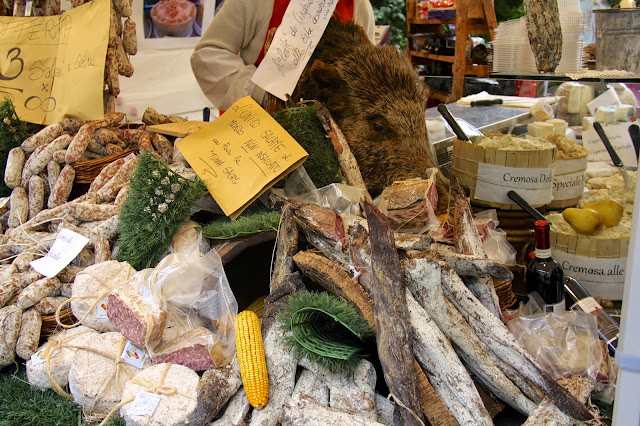
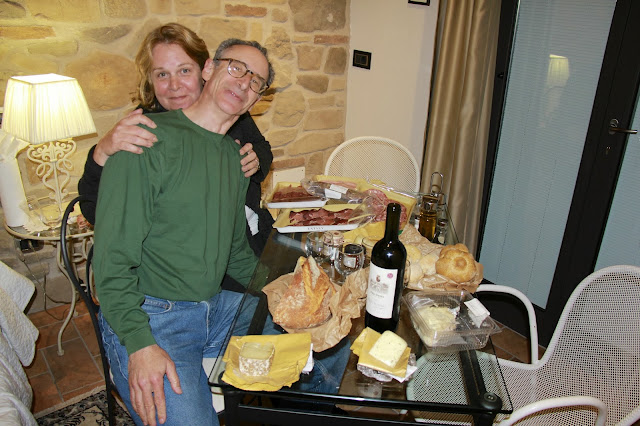
A selection of salumi (cold cuts), formaggi (cheese) and the cinghiale (boar) that gave his life to the cause

You may have read about part of our visit with Aunt Deb and Uncle S where we ventured into the wine region of Piemonte during the first portion of their visit.  Their two week sojourn in Italy included a mission to explore the best of what the country has to give.  It was no coincidence then, that their adventure had been neatly divided into three of the country’s best offerings.  Part I was Vino (wine).  Party II was Cibo (food) – the subject of today’s post.  Lastly, Part III was Storia (history).  Since they experienced the rich history of Pompeii and Venezia on their own, I will let them tell you all about it at their next dinner party.  I’ll simply report on the parts during which we were present… and luckily for us, we were present for a three day trip into Italy’s richest “food region”, Emilia-Romagna.

“Now I’m hungry – let’s eat!”

I always laugh when I speak to Italians about their trips to the United States.  Before they even tell me, I know that they’ve been to New York City and then Miami (bypassing Washington DC; a detail they don’t want to admit but one that I always extract).  If they’re fortunate enough to have a lengthy stay, they will then travel to Las Vegas on their way to Los Angeles.  Occasionally, they may venture up the coast to San Francisco before returning home.  That’s it.  Every.  Single.  Time.  Heck, I don’t blame them – they were raised in large part on American cinema, and that’s what most Europeans see as the sum total of the United States – New York and LA.  And of course, who wouldn’t want to throw a trip to Vegas in the mix?!  Likewise – it is the same for Americans coming here.  Where do we go?  Rome.  Milan.  Venice.  Tuscany (Florence and Pisa) and occasionally the Italian Riviera if there’s time.   But there is so much of this country that is left undiscovered (I feel like we travel non-stop and we still haven’t gotten a flavor of more than 10% of Italy).  One region in particular that is largely overlooked is Emilia-Romagna.  Heck, I’m willing to bet you probably haven’t even heard of it!  But there are a few things that I know you know.  You’ve heard of Ferrari, Lamborghini and Maserati.  They’re all produced here, in Emilia-Romagna.  Or aged balsamic vinegar?  That also comes from here, in Modena.  What about parmigiano reggiano (parmesan cheese)?  Or prosciutto?  I’d be wiling to bet that you’ve even heard of Ferrara chocolate.  With culinary delights like these, it’s no wonder that Emilia-Romagna is often considered the “heart” of Italian cuisine.

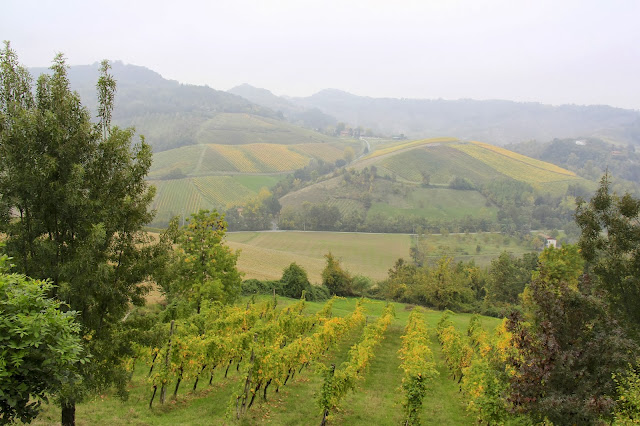
Vineyards in Emilia-Romagna
S studies the frame of his photograph
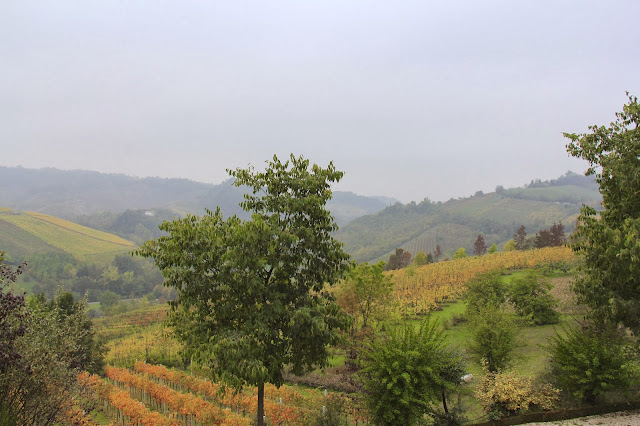
The colors at this time of year were stunning
Julia takes a stroll and soaks up all that Emilia-Romagna has to offer

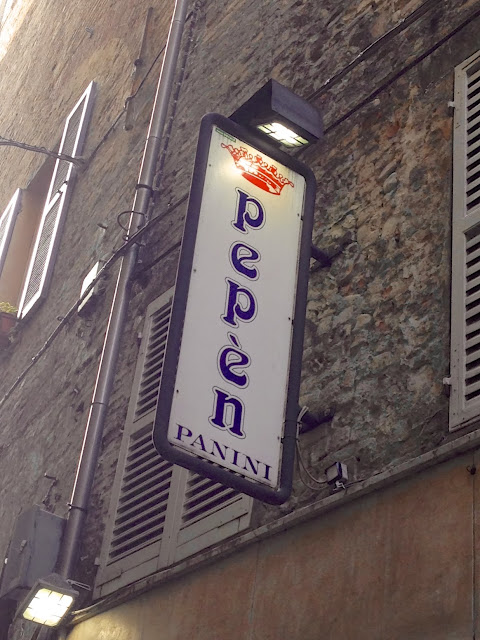
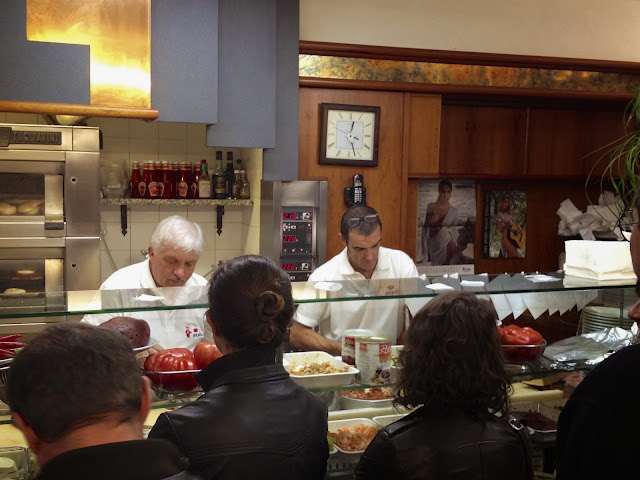
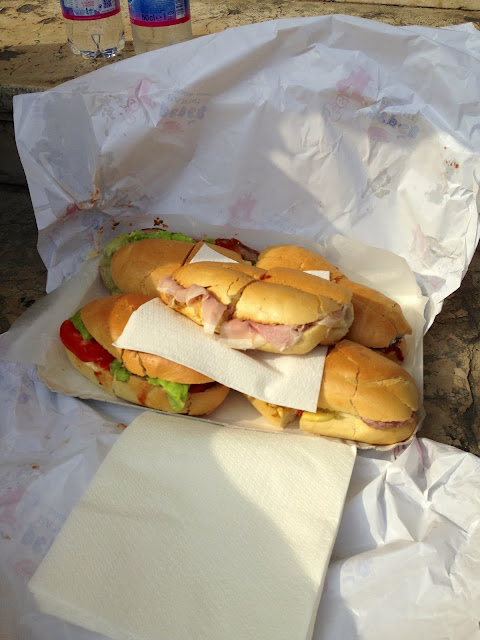
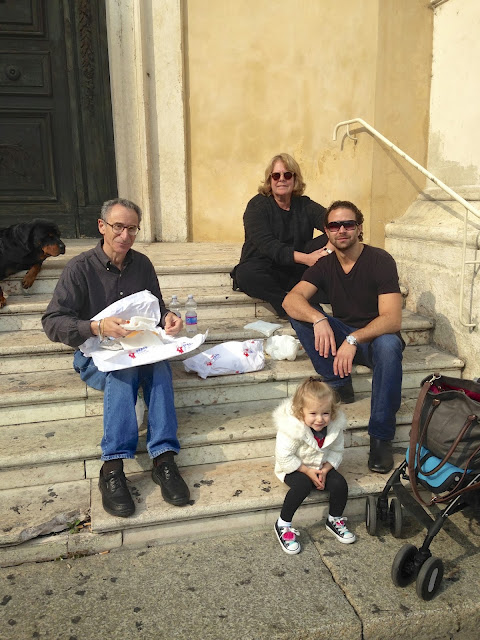
On our first day, we stopped in Parma (of Proscuitto di Parma fame) to begin our culinary escapade. We started small – just panini (sandwiches) at the most popular sandwich place in northern Italy, Pepèn.  I was not at all surprised to learn that this tiny shop that has been around for over 200 years does not have a website.  I think that they figured out the perfect panino (sandwich) somewhere in the past 100 years and have unabashedly decided not to change a thing since (earning them a #1 rating out of 430 restaurants reviewed on TripAdvisor – although calling it a “restaurant” is a stretch).  Uncle S and I crowded into the tiny restaurant and I told the sandwich maestro to give us a mixture of some of his favorite concoctions.  We awoke our taste buds with succulent porchetta, life-changing salsiccia crudo (raw sausage) and mind-altering gamberi piccanti (spicy shrimp) – all on perfectly toasted buns (these were just some examples of our sandwiches – we got many more to share).   Since the place doesn’t really have any seats, we camped out on the steps of Chiesa Cattolica Parrocchiale San Pietro (St. Peter’s Catholic Church Parish) in Piazza Garibaldi Giuseppe to enjoy our delectable treats.

Pepèn is hidden on a small side street – you have to know where you’re going to get there
These two guys have been making panini in this crowded little shop for many years
One package of our delicious panini
We camped out on the stairs of the church to eat our lunch
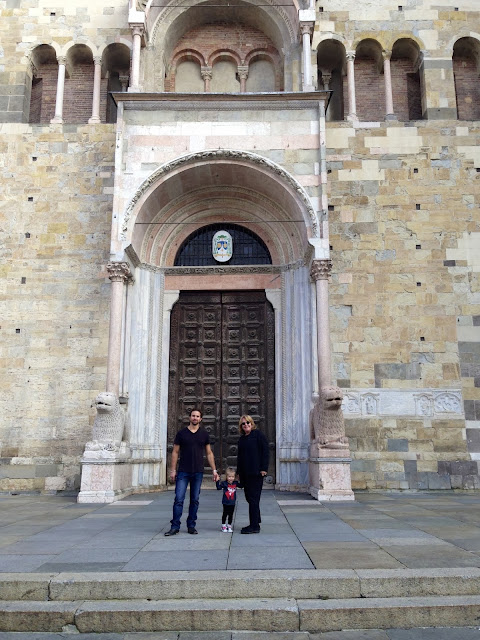
Julia escorts Deborah and me into the Cattedrale di Parma
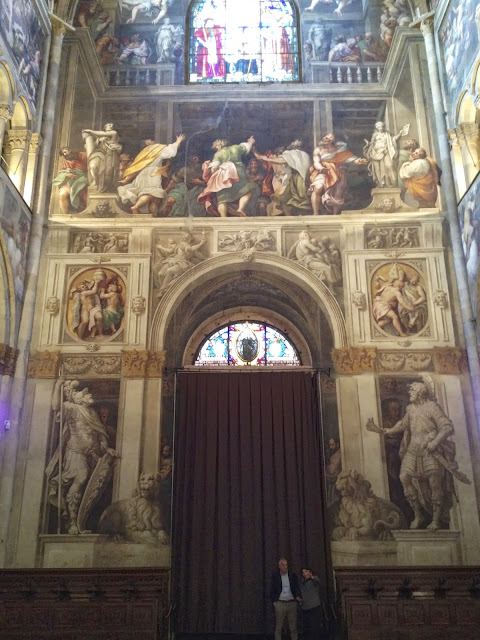
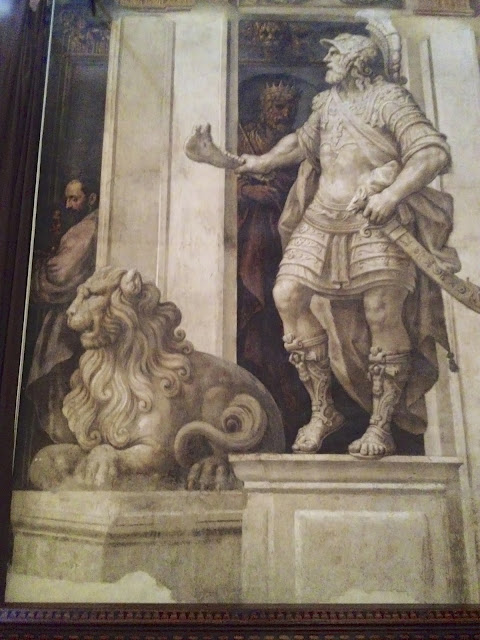
Amazing frescoes adorned every single wall in the church
The paintings on the wall were so lifelike I was mesmerized
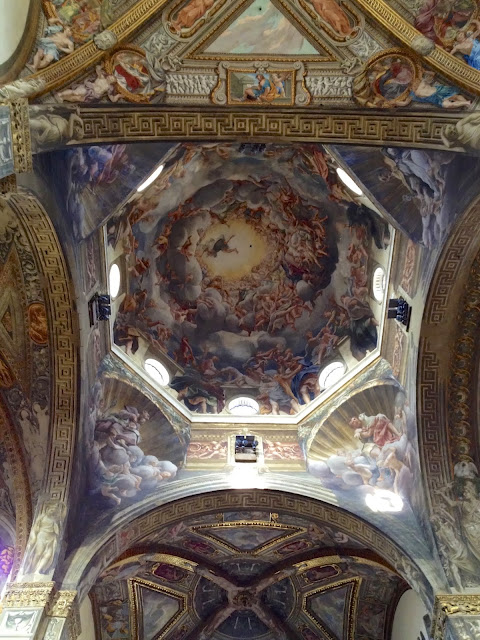
The ceiling amazed all of us inside the Cathedral
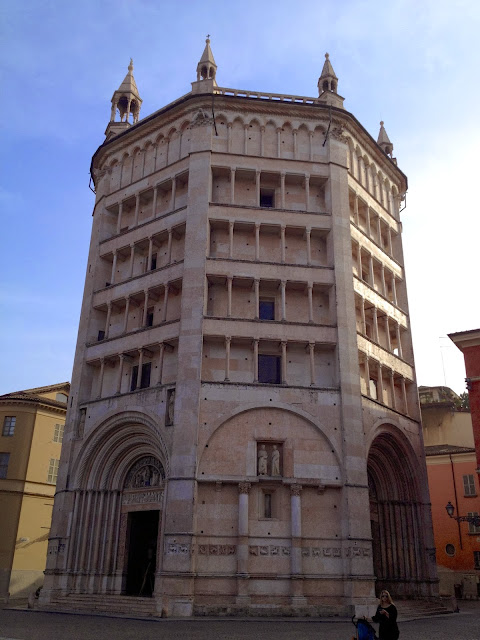
The Baptistery of Parma, commissioned in 1196 by the city counsel of Parma

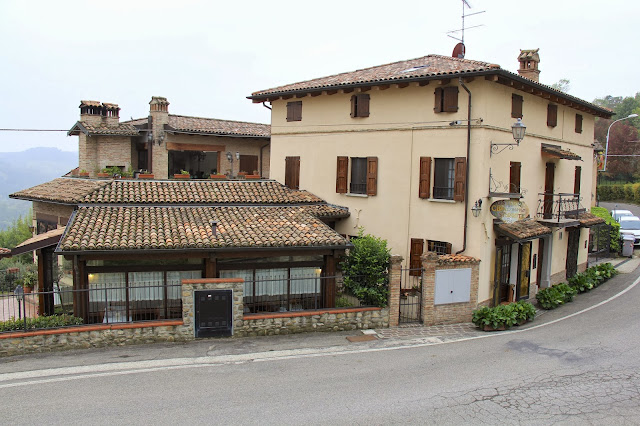
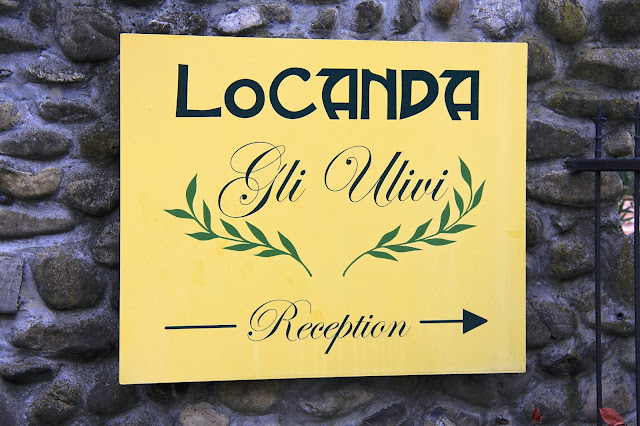
After a complete and rewarding day in Parma, we drove the forty five minutes to our B&B, just outside of Modena.  After researching for many hours, we had booked a stay at, Locanda Gli Ulivi because it was centrally located to the places we would be visiting and has a wonderful online presence (great reviews and photos across our most reliable travel websites).  We were not disappointed with the place – it was simply wonderful.  Since we were weary road warriors on that first day, we decided to eat at the hotel’s restaurant, Osteria  Clo ‘Filomena that night.  Since the food was so wonderful and I was able to capture a picture of each course, I’ll complete a separate post about that meal.

Locanda Gli Ulivi
“Come on in…”
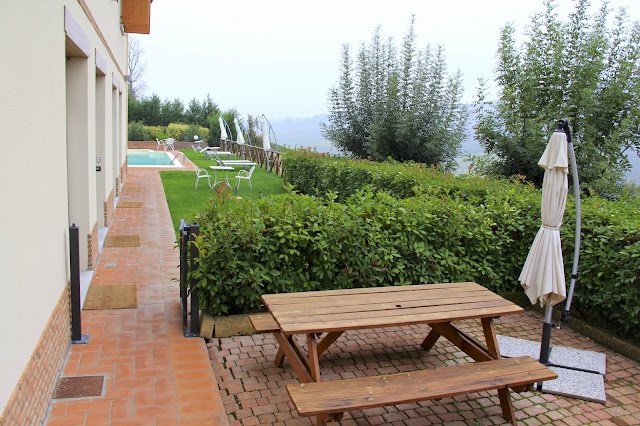
Our backyard
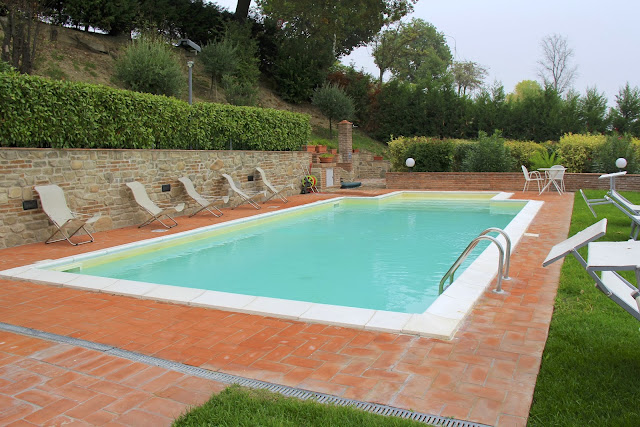
The pool
A nice place for a picnic
View from immediately across the room
Same place, looking to the right
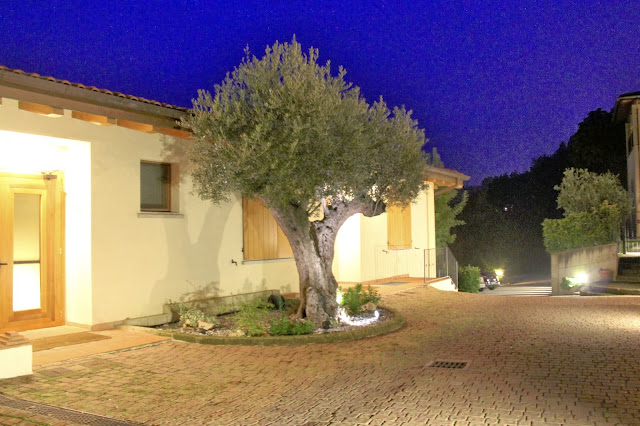
An olive tree at night inside the property
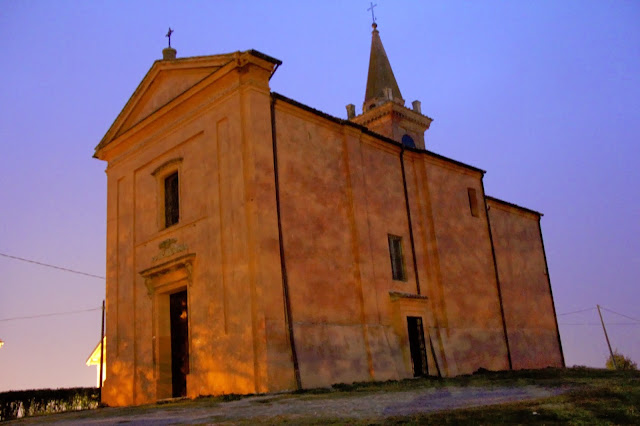
An old church across the street, lit up by the purple sky of early evening

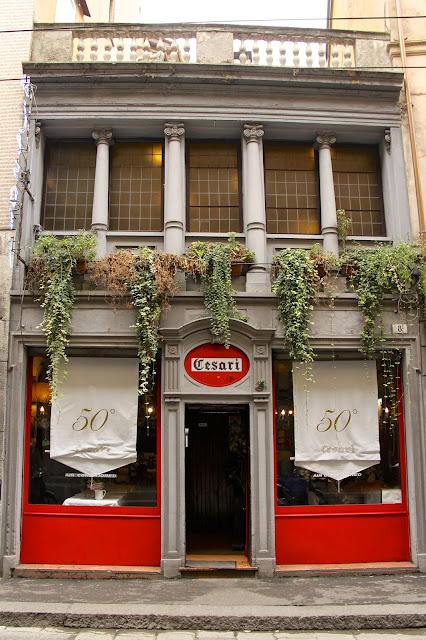
The next day, we departed with our sights on the largest city and capital of Emilia-Romagna, Bologna.  To most Americans, bologna is a processed meat (that you either love or hate) sandwiched between two pieces of good ol’ fashioned white bread.  In the States, we named “our” bologna after the city that is a major producer of mortadella – a staple meat of Bologna (and very similar – but much, much tastier than “our” bologna).  My bologna has a first-name, and it’s…”send this back and bring me a slice of mortadella, please!”.   To most Europeans, Bologna is much more than just a processed meat.  It is a university town.  Home to the oldest university in the world, University of Bologna, founded in 1088.  Today, the university accepts students from all over the world – eager to complete a full program, or just a study abroad in the seventh most populated city in Italy.  We walked around all day, stopping for a wonderful lunch at Cesari – a selection from S and Deb’s Fodor’s guidebook.  The gang at Fodor’s know what they’re doing, it was a wonderful place.

Cesari was as delicious as it was charming
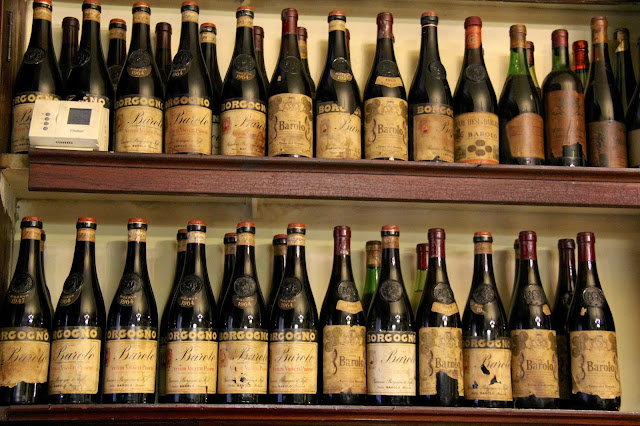
“Hey… we recognize that wine”
(from a tasting we did at Cantina di Borgogno a few days earlier)

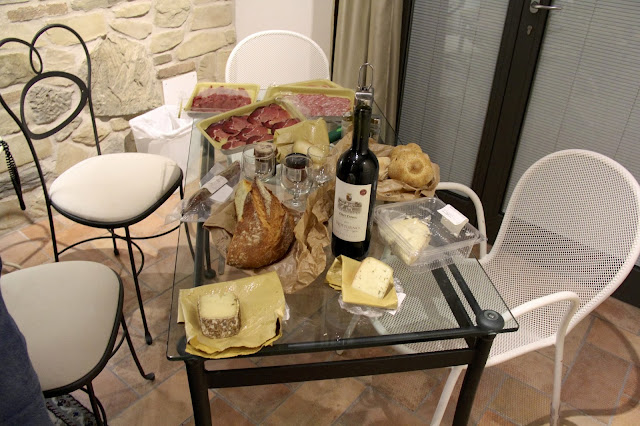
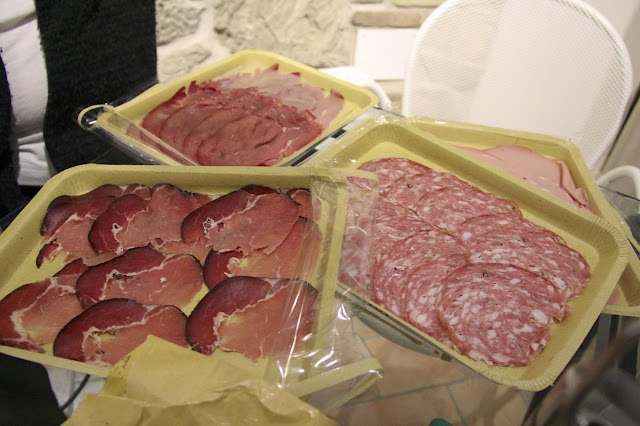
We spent more time walking though this historically significant and important city, before ducking into a building with a much more modern vibe.  Eataly is the brainchild of Oscar Farinetti; a store that is a proud Italian marketplace, selling the best ingredients and offering access to goods that are otherwise hard to acquire on a massive scale (imagine a Whole Foods on steroids that just sells Italian products).  Even though Oscar opened his flagship 30,000 sq. ft store in Torino in 2007, the company really took off with locations around the world (including New York City) when B&B Hospitality Group (Mario Batali and Joe Bastianich) became a partner.   Admittedly, the Bologna location was very underwhelming in size and scale (especially compared to the unique Torino store) – but we were still able to acquire some wonderful salumi (variety of cured meats) and formaggi (cheeses).  That night, we procured reservations at the the most exclusive table in all of Italy – we had a little picnic in S and Deb’s room.

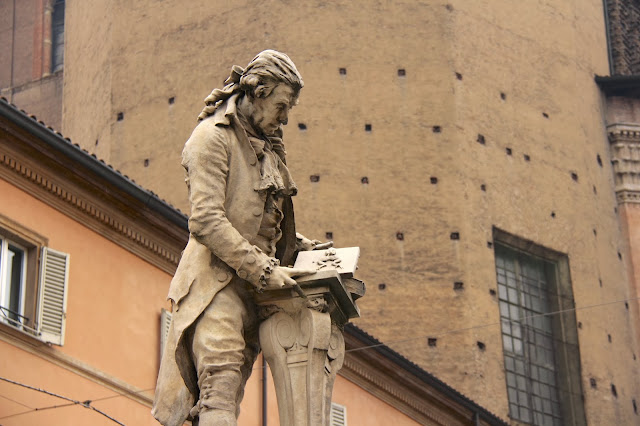
A statue stands near the University of Bologna
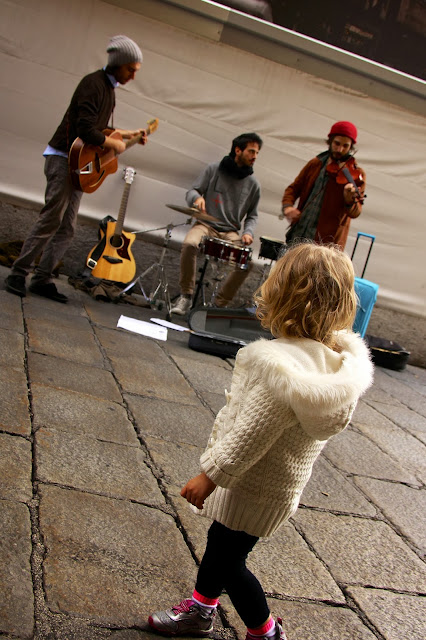
Julia becomes taken with a small group of performers
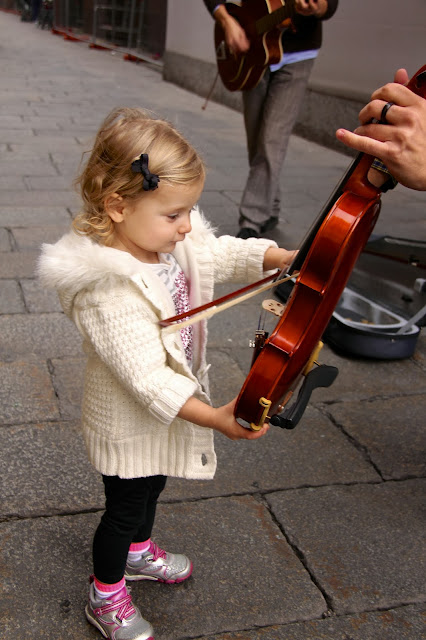
She takes a shot at playing – she started with some Mozart
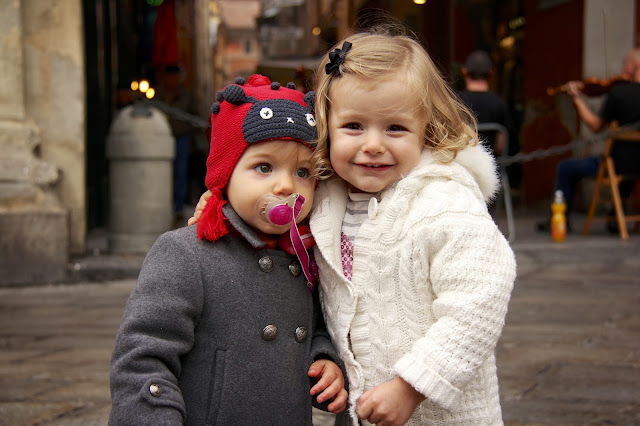
Julia made a friend in the main piazza
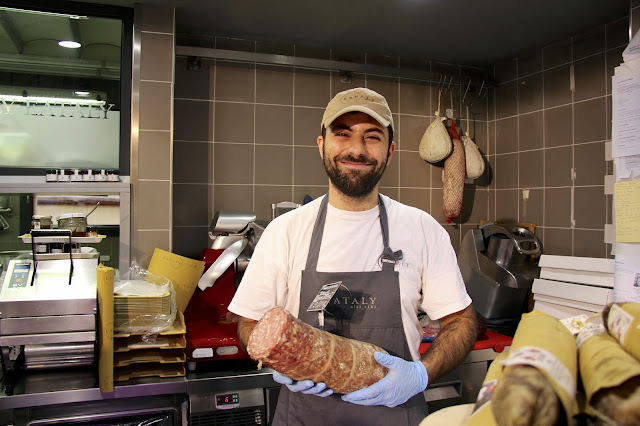
Inside Eataly, our friend helps us select the best meats and cheeses for our picnic
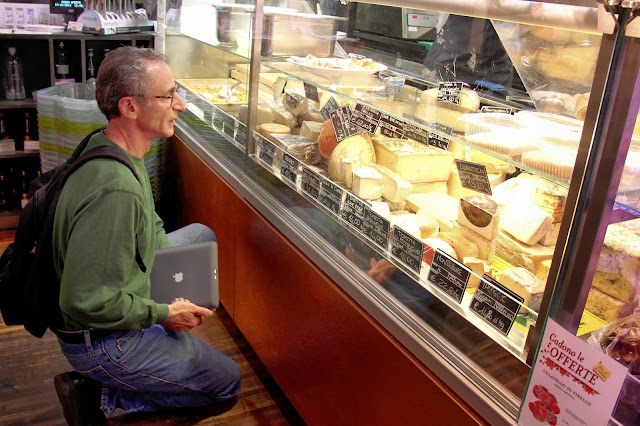
S takes his job selecting for the group very seriously.  Good thing he did, we had a wonderful meal
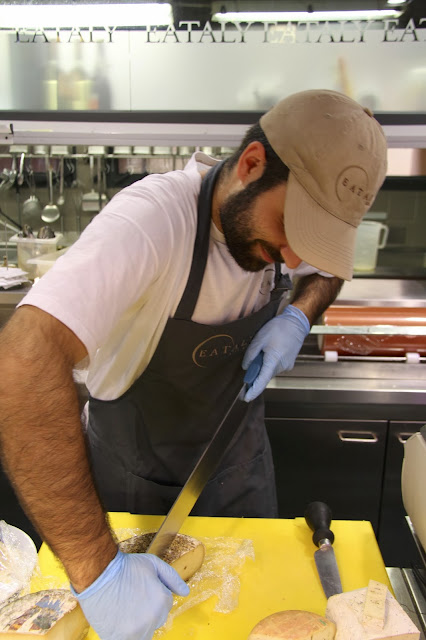
He cuts us a hard cheese
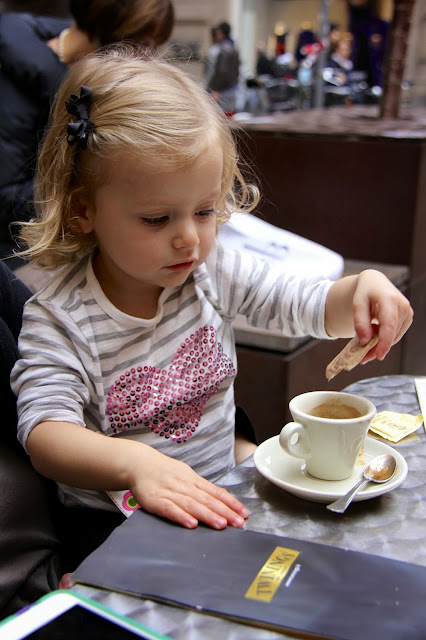
After our visit to Eataly, we needed a little coffee
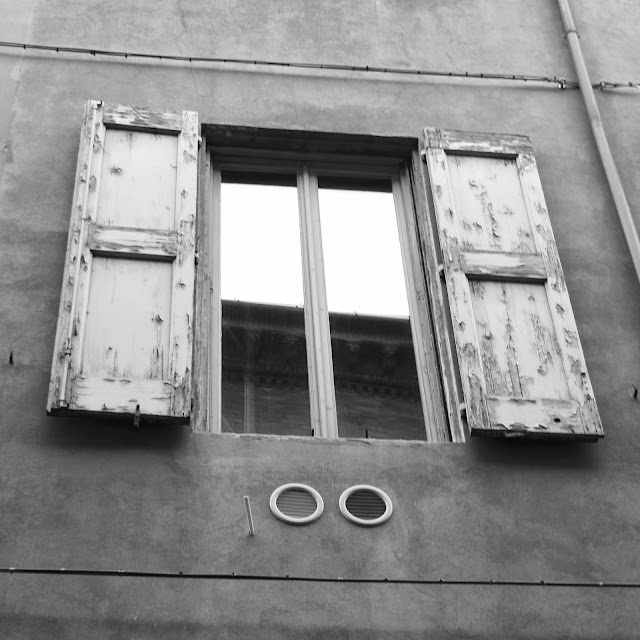
I just thought this window was interesting
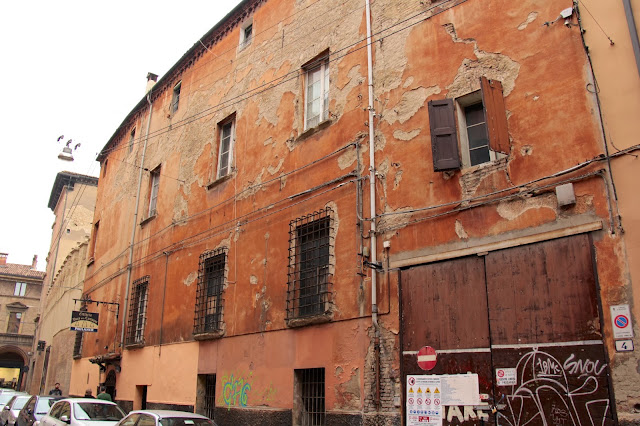
As well as this ancient building
The table is set
Our salumi (meats)
S and Deb are about to dig in with us

Our final day in Emilia-Romagna was no less packed with activities than the first two.  We had scheduled a visit to the Museo di Ferrari (Ferrari Museum), exploration of Modena (with a stop for lunch) and a balsamic vinegar tasting.  Car enthusiasts the world over can appreciate a visit to the “mecca of all things automotive”.  This is what Modena can offer you – Ferrari and Maserati all have their factories within a few kilometers of the city (Lamborghini moved their headquarters from Modena to Bologna).  Ferrari chose to name one of their models after the city itself (Ferrari Modena 360).  We chose to learn a little bit about the legacy of Enzo Ferrari himself, one of the world’s truest visionaries.  The museum did not disappoint….

Museo Ferrari in Maranello
“Welcome to paradise!” 
An old Ferrari 166 F2
This classic symbol is at the heart of most men’s desires
1966 Ferarri 330 P3
1954 Ferrari 750 Monza
F1 Constructors’
Formula 1 World Champion 2008
Julia and I sure felt like champions
The heart that powers the machine
2013 Ferrari 458 Speciale
These babies can grip – Pirelli is the tire of race professionals
Concept car of the future
This is a clay model – what they use to construct a concept in the early stages of development

After soaking up all things, Ferrari – I drove us (albeit, much slower than a Ferrari could have gone) to the center of Modena.  The town itself is a wonderful place, certainly worthy of a daily visit.  It is believed that the city was already in existence by the 3rd century.  Here in the 21st century, we lucked out and caught an open air market in the center of town.  We were also treated to a marching band that passed us twice as we strolled through the city.

Main piazza in Modena – a street fair had been set up
Julia runs through the city
The streets of Modena were beautiful
S and Julia sit by their new friend
Meanwhile, these two are deep frying pig skins
Crispy, delicious and probably 130% fattening
S bought some prune jam – here he is bottling the jar for S
A marching band happened to pass through as we were in the market
Walking through the city again – there are a lot of pedestrian streets in Modena
Family photo
We ran into the marching band a second time

The day passed by [too] quickly and we had to bid a fond farewell to Modena – we had an important event coming up later that afternoon.  A tasting at one of Modena’s finest producers of aged balsamic vinegar – Acetaia Villa San Donnino.  Since it was such a fun and noteworthy event, I will post about it separately.  After our trip back from Emilia-Romagna, S and Deborah took off for Pompeii and just a few days later, we were hugging our goodbyes.  It’s amazing how quickly time time goes when you are filling it with great food and wine!