So, I’m back here on Sipping Espresso… blogging. Weird. I’m in America. I’m blogging aboutItalyfromAmerica. Can I do that?! Is that even allowed?! Well, I promised you in my Final Blog Post From Italy that I would finish our tale of overseas adventure and intrigue (OK, OK – more like overseas adventure of gluttony and transparency), so I suppose that I’ll have to make good on my word. For those of you that are sick of hearing about these adventures… I’m sorry, but I’m OCD and I am not much good at leaving things unfinished.
“Well, get going already Dad and tell us this story”!
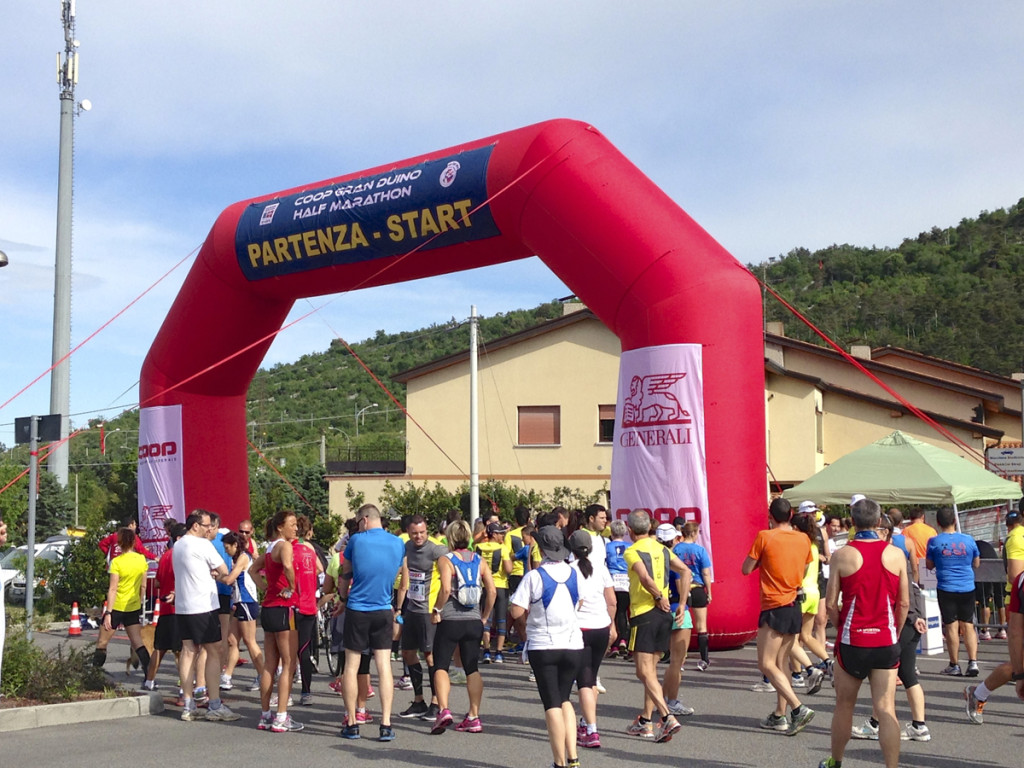
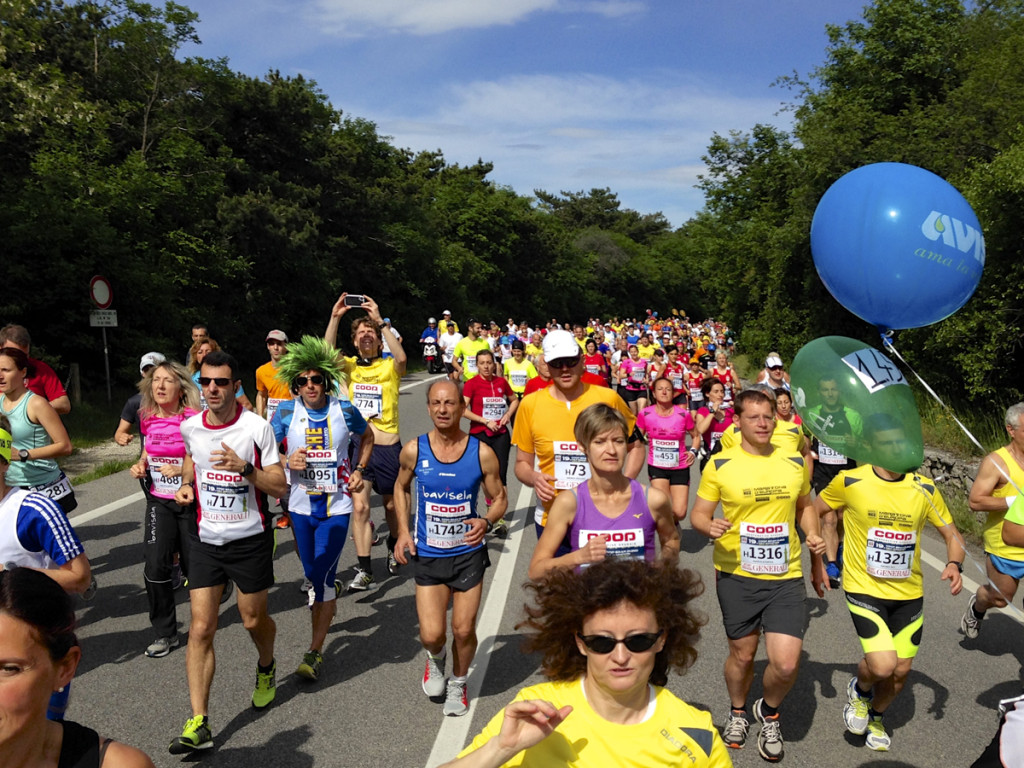
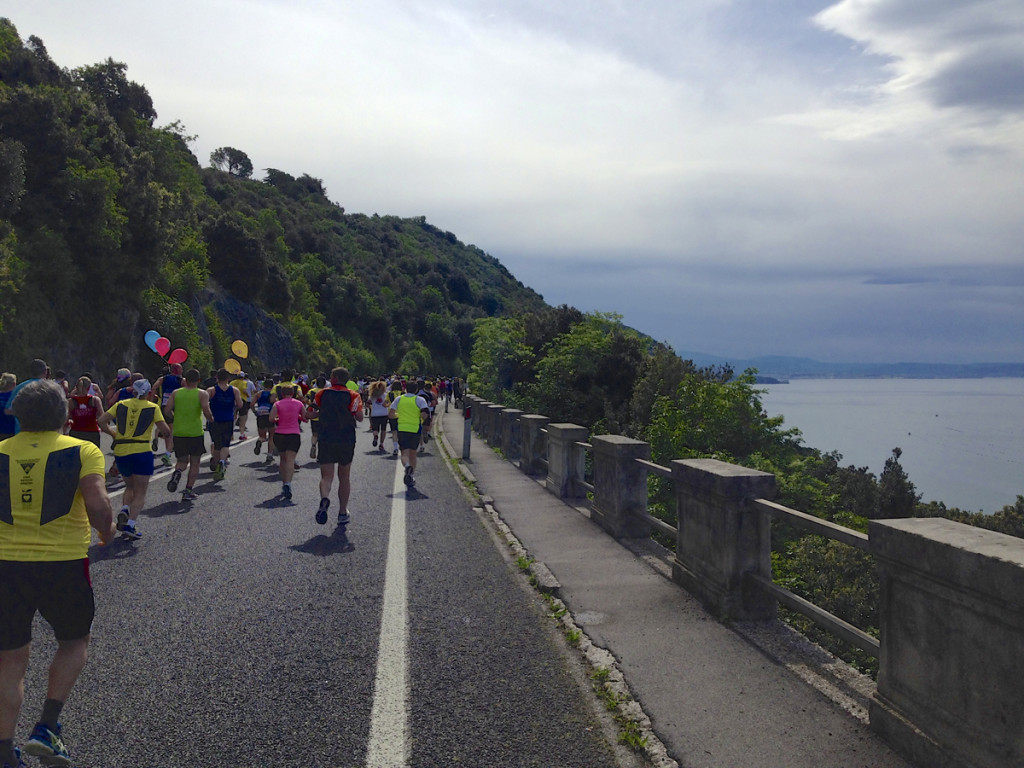
So, let’s flash back; way, way back to this past spring when Jen’s sister came to visit. Just as they departed for Venice and Rome, we took our own leave from Como and headed toward the metropolitan city of Trieste. When I think about what brought us to Trieste, I finally understand the word bittersweet. We undertook the four-hour road trip to Italy’s easternmost city so that I could run in the Maratonina d’Europa (Europe’s Half Marathon). Despite having to add the somewhat embarrassing “ina” suffix to the end of Maratona (changing the meaning to “very little”), completing my first half-marathon was a very “sweet” accomplishment for me. However, the impetus behind the race was a very “bitter” one. Jen and I had started listing all the things that we wanted to do before our time in Italy came to an end. This particular road trip checked many of our boxes; competing in a race in Europe, a visit to the city of Trieste, time in the region of Friuli–Venezia Giulia, capped off with a visit to Slovenia (upcoming post). Now, that checked a lot of boxes, so careful planning began and hotels rooms were booked.
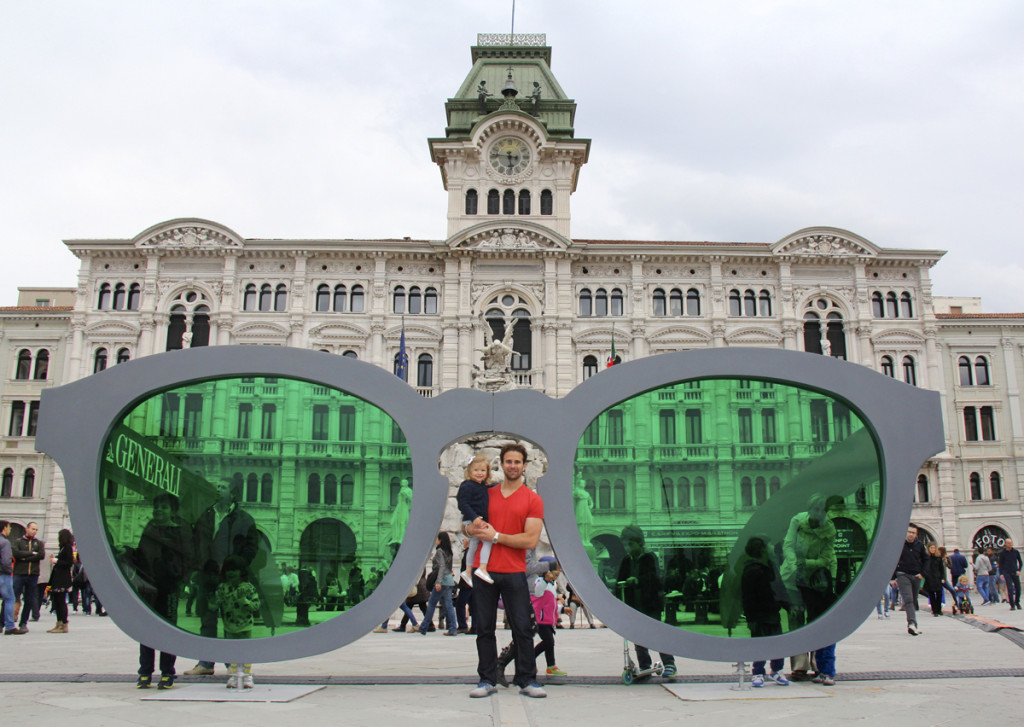
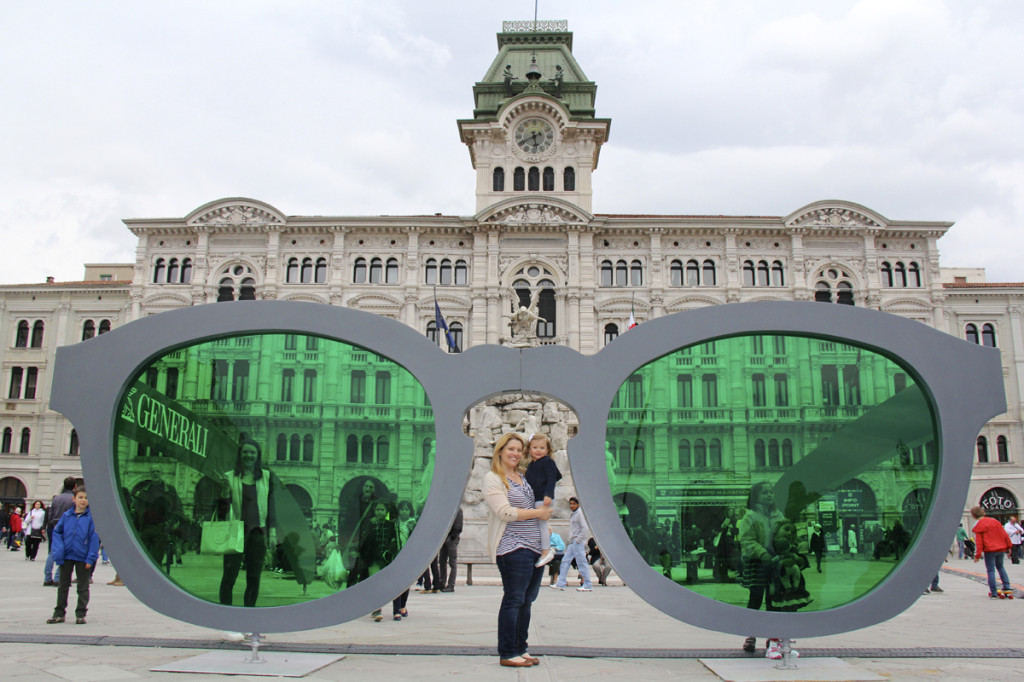
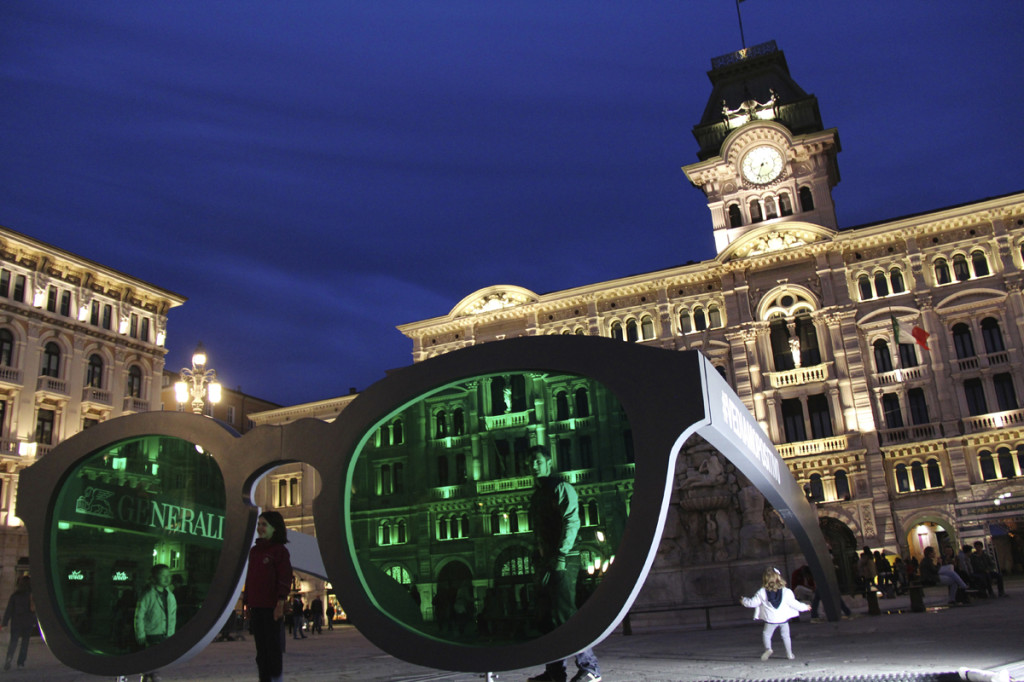
Julia and I stand in front of the glasses they had set up for the race
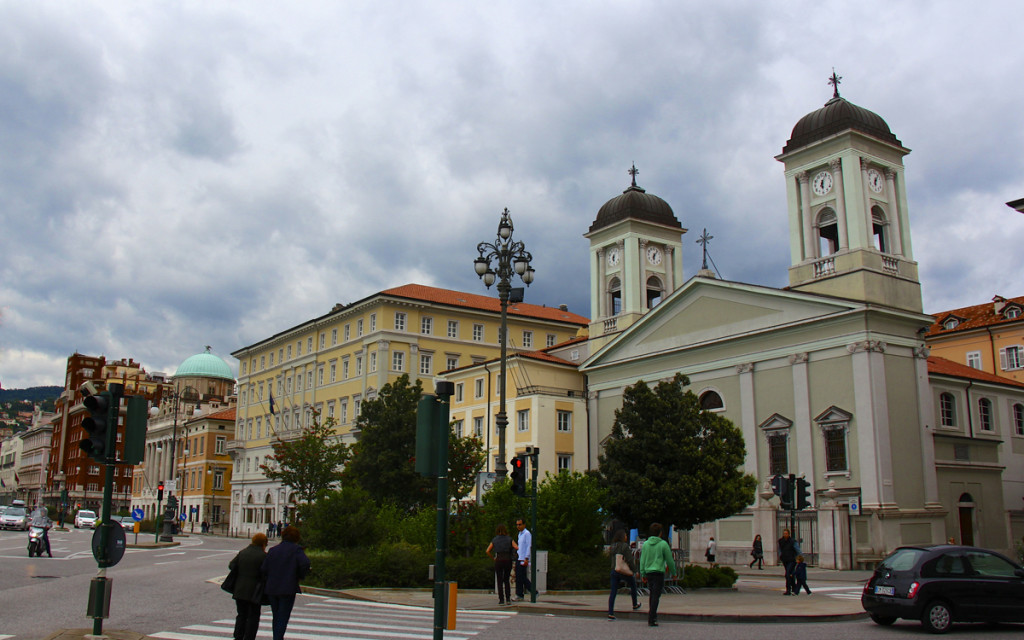
Here’s how I would sum up Trieste – it is a MUST-SEE city. Sometimes I find myself guilty of trying to label a city by comparing it to another city. “Rome is like New York, but much older and without the high-rises”. Sometimes, you’ve just got to stop and appreciate where you are for what it is. Don’t try to “label” the place or put it in a box; its easy to fall into that trap with Trieste. A city that has bounced back and forth between Slovenian, Austrian and Italian rule leaves us with a place today that is proud of its blend in architecture and attitude. Trieste is a city not at all confused about its confusing identity. With a rich mix of Slavic, Germanic and Latin influences – I am simply content to label this magical place as one of the most “European” cities I have ever visited.
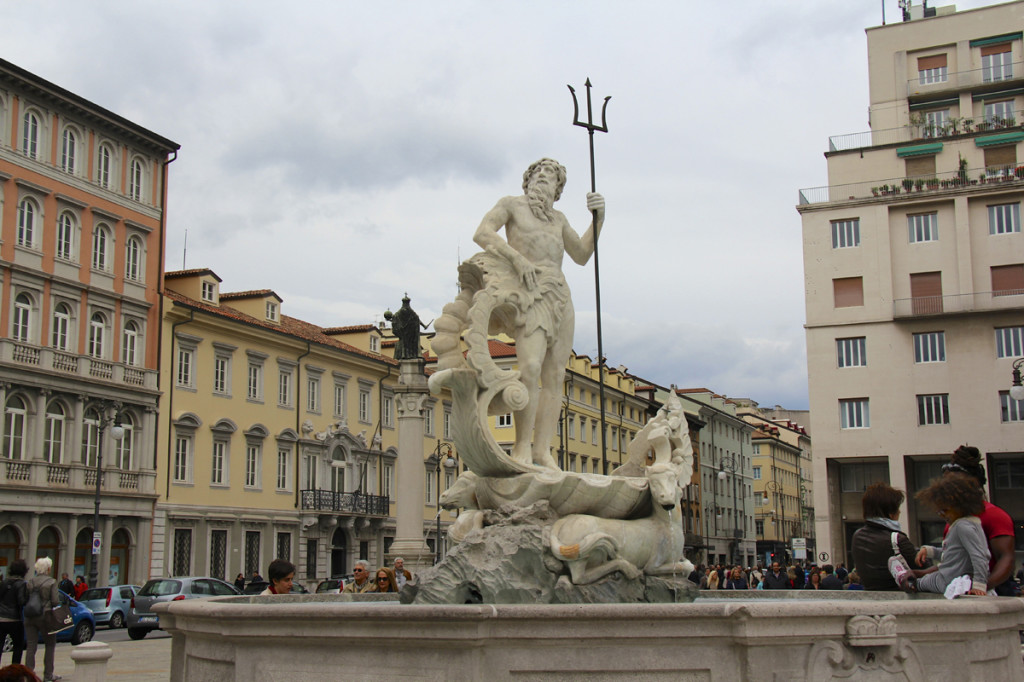
We’re finally here in Trieste!Fountain that accurately describes Trieste’s ties to the seaAlong Corso Cavour, the main street adjacent to the cities famous piazza
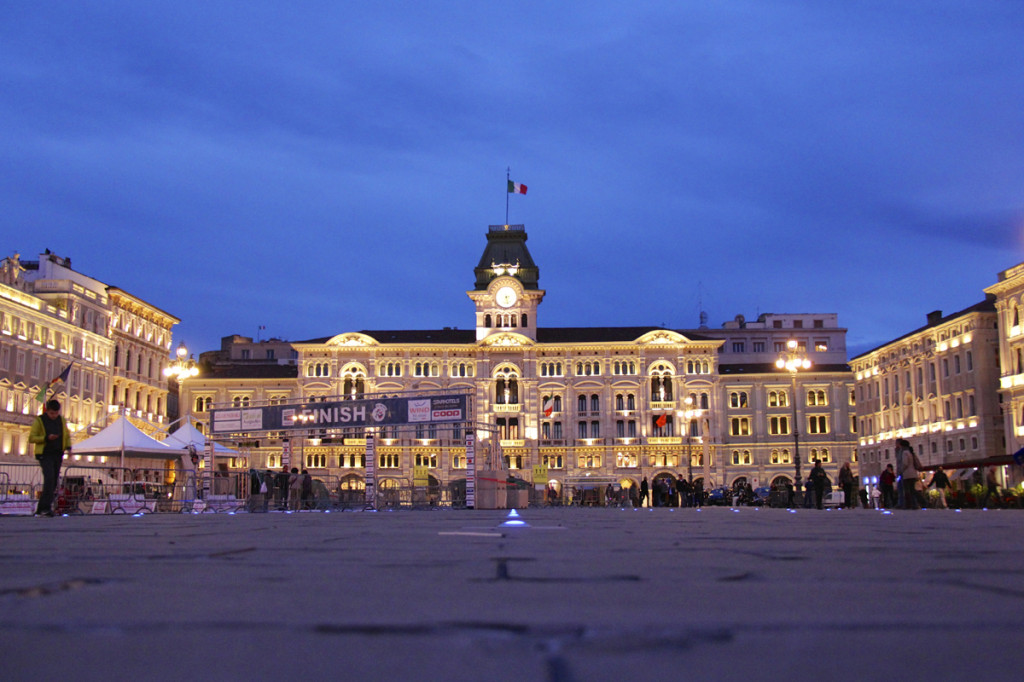
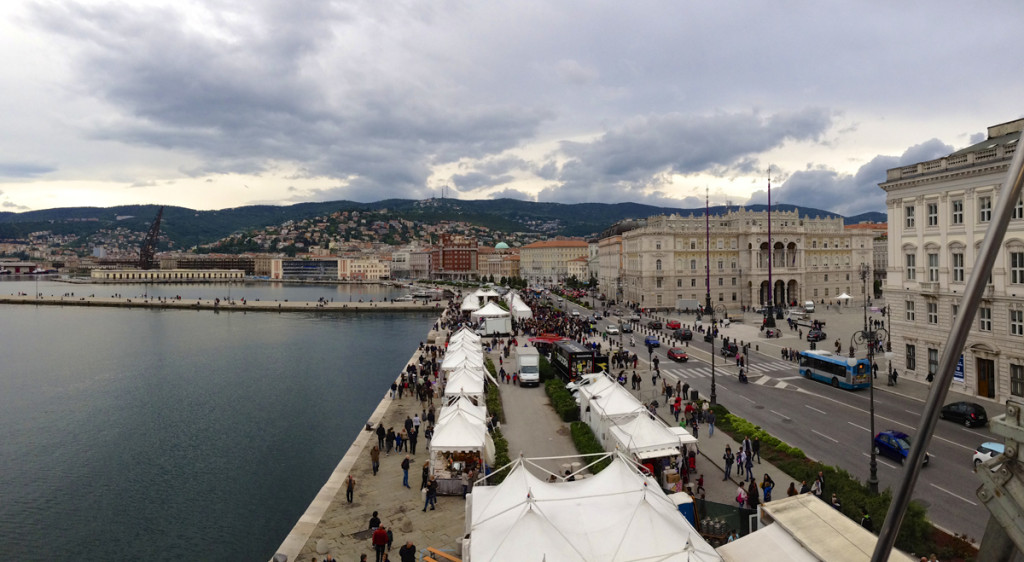
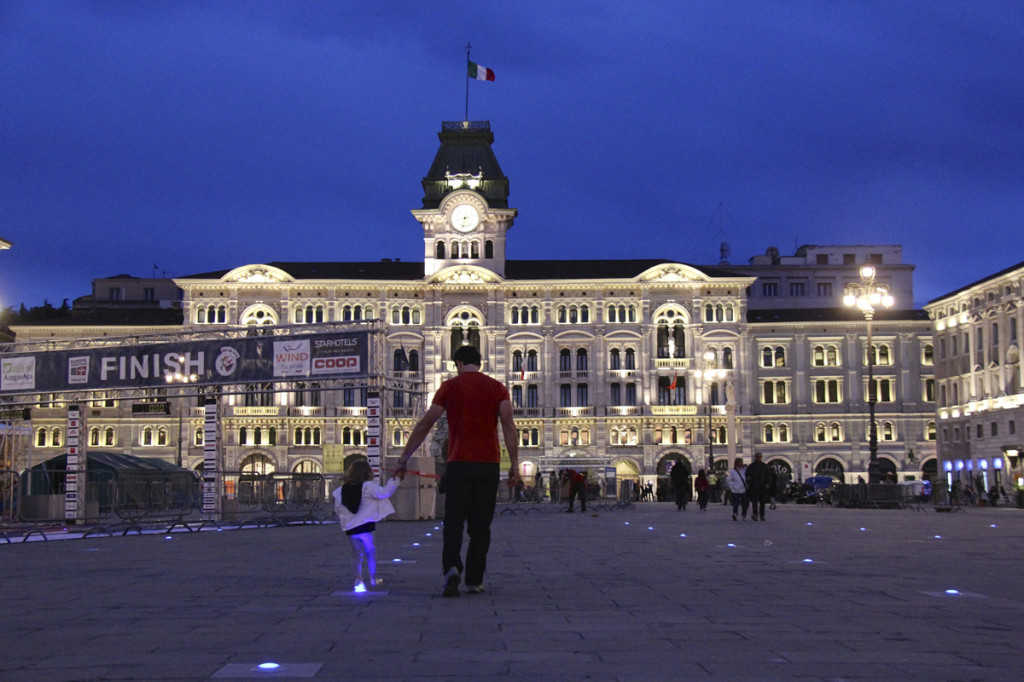
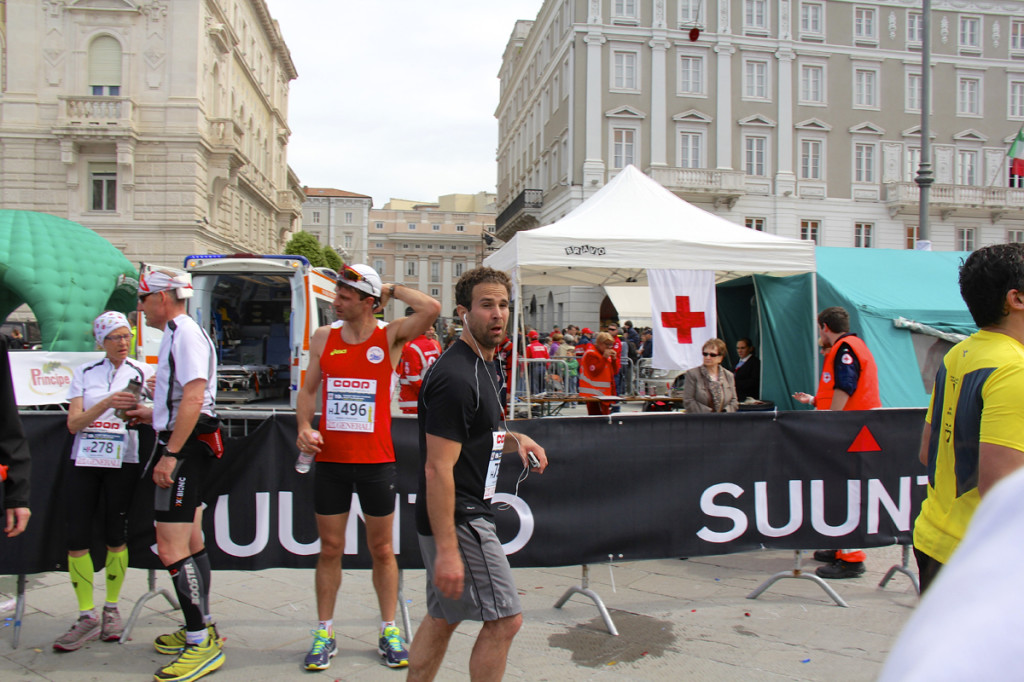
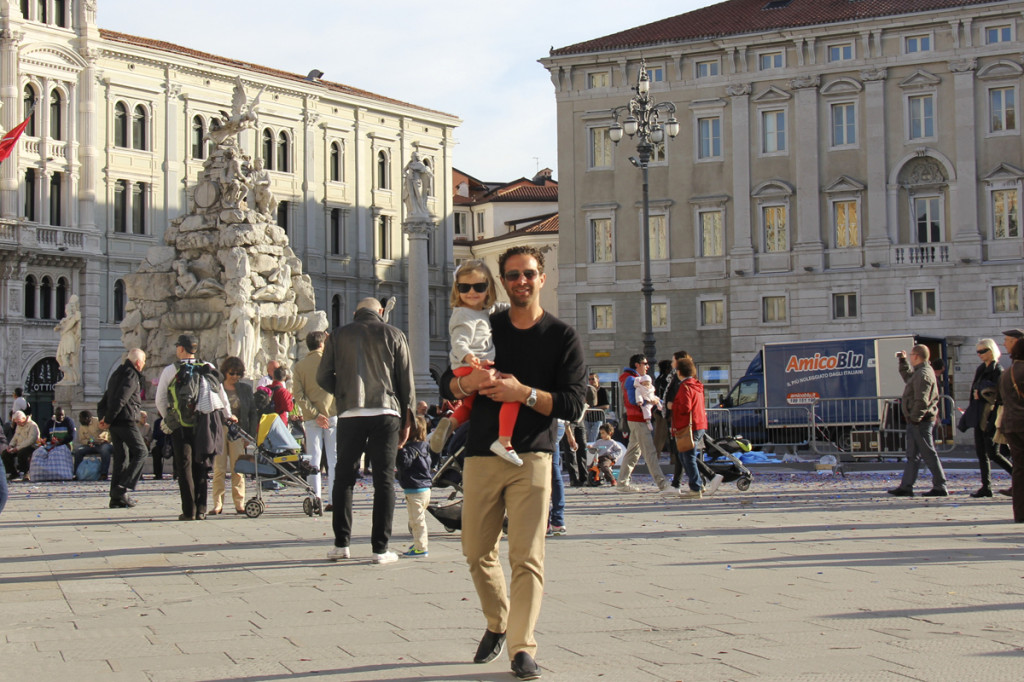
My race was on a Sunday and so we arrived Saturday with a planned departure on Monday. After we checked into the hotel, we strolled down to the Piazza Unità d’Italiato register for my race. I had often heard this piazza referred to as “the most beautiful piazza in Italy” and what I saw did not disappoint. The grand square is the largest of any on the water in all of Europe. On this particular spring weekend the piazza was also the location of my finish line.
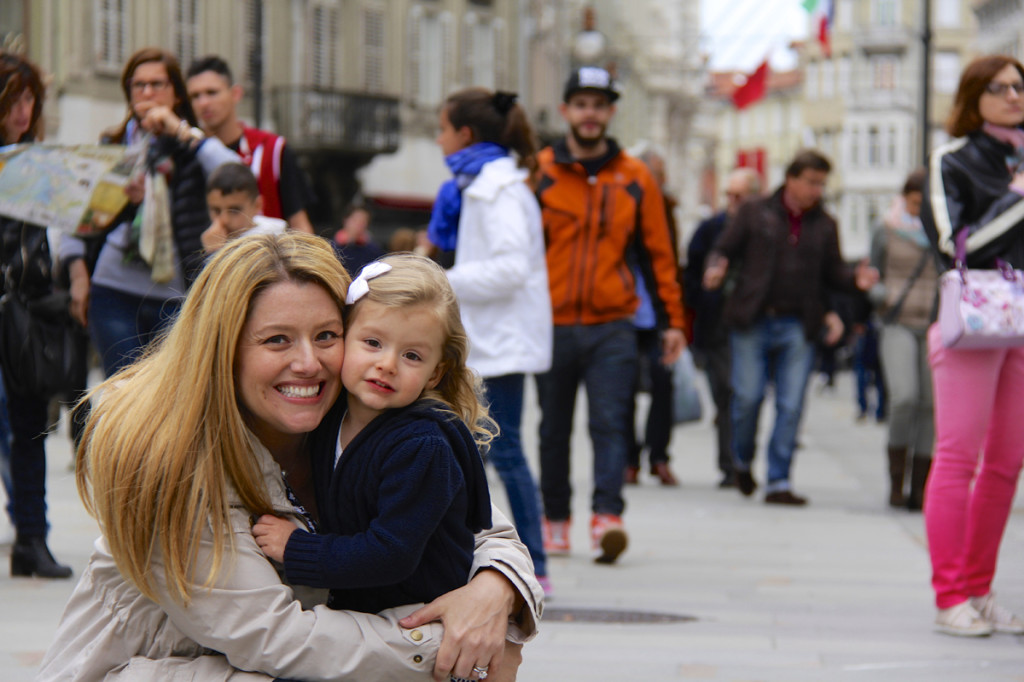
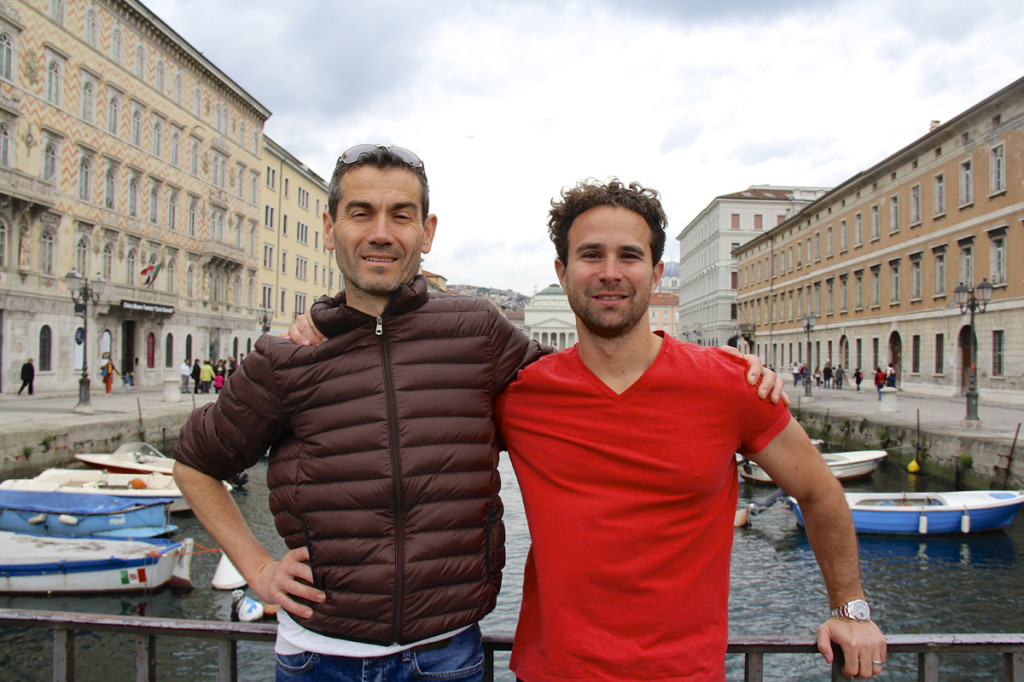
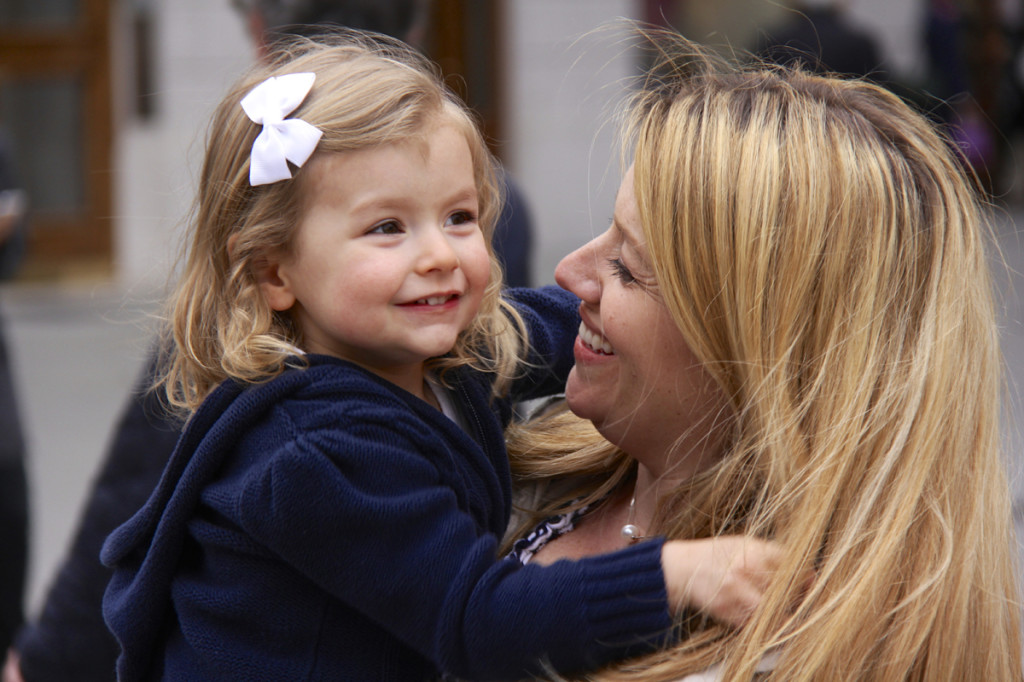
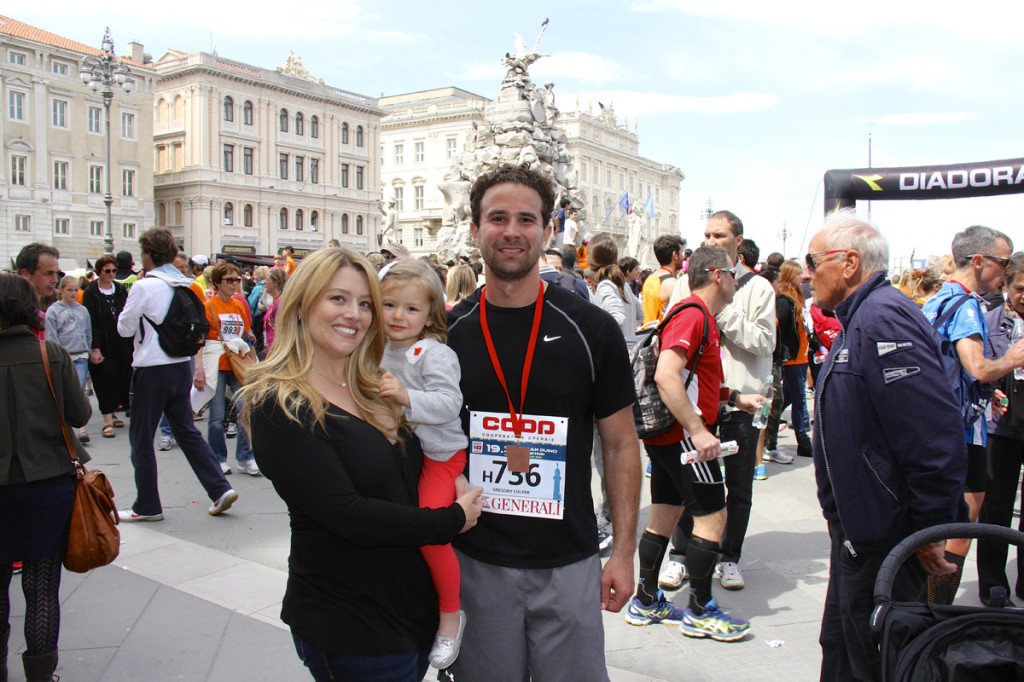
We walked down with a friend I made in the hotel – he was also running in the raceJen hangs out with Julia in the squareThe Piazza Unita d’Italia at nightJulia hugs Jen while we were walking around
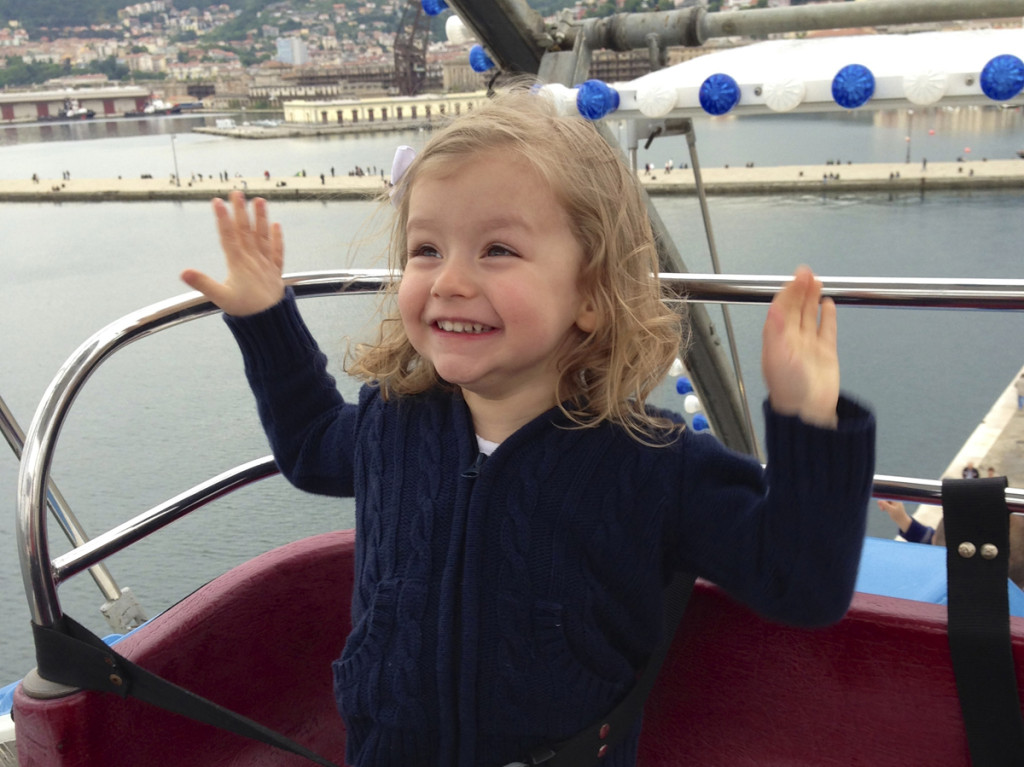
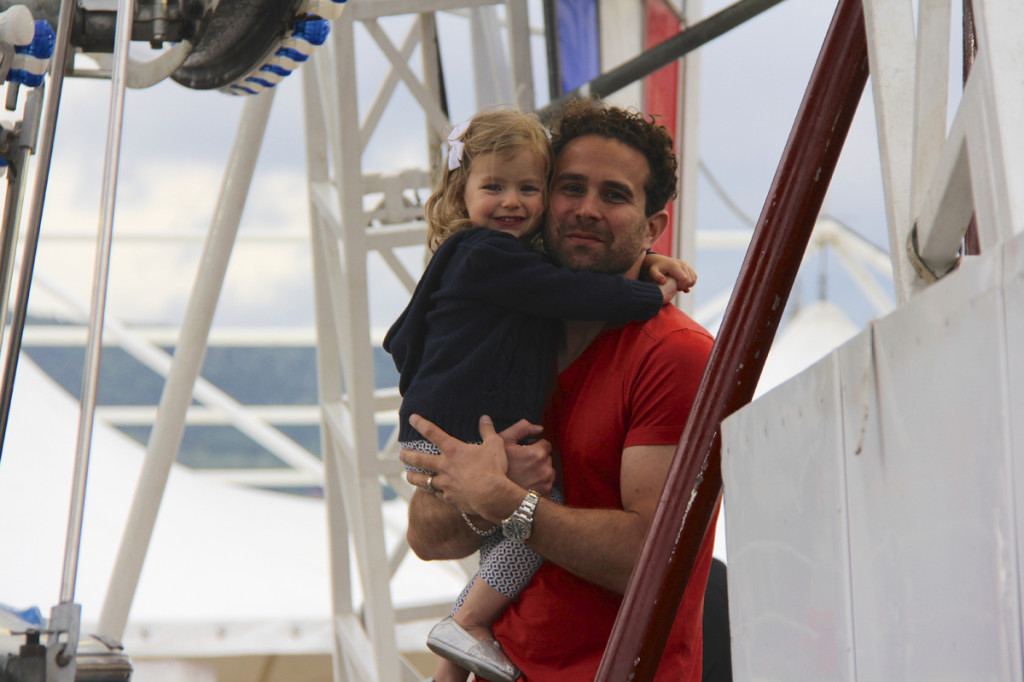
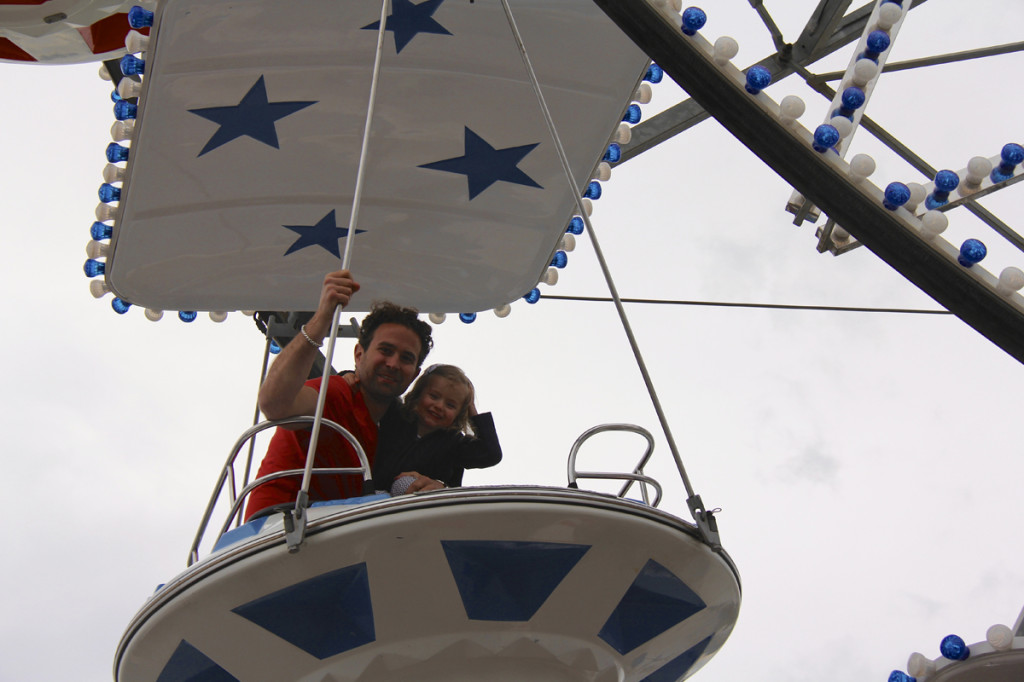
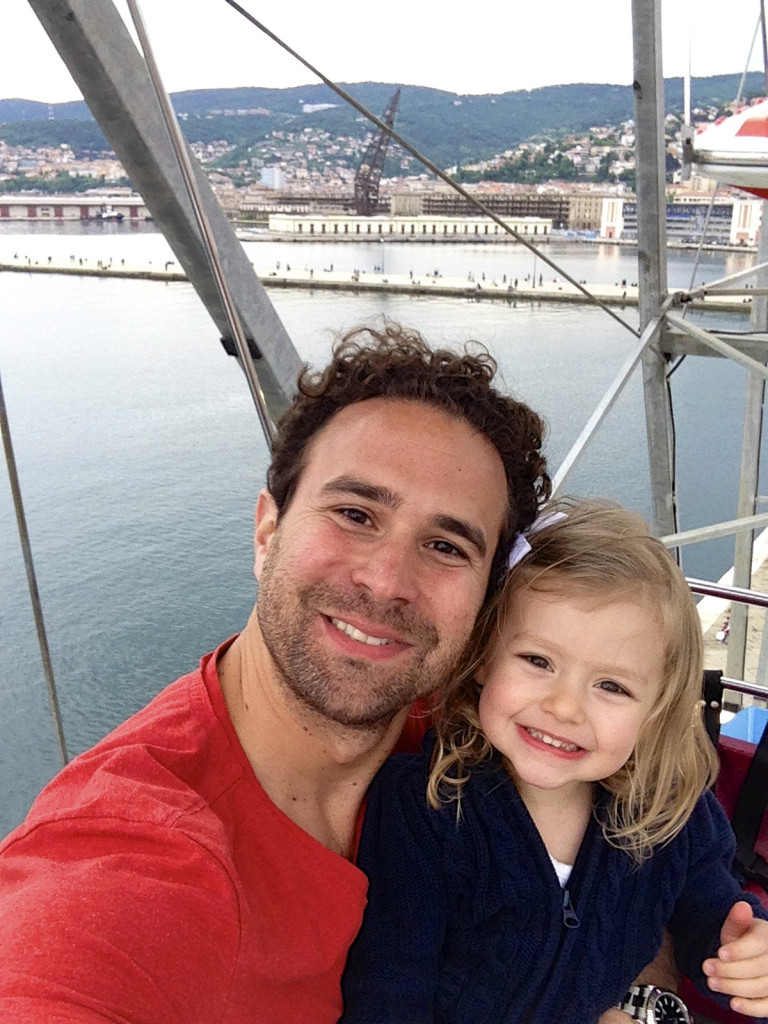
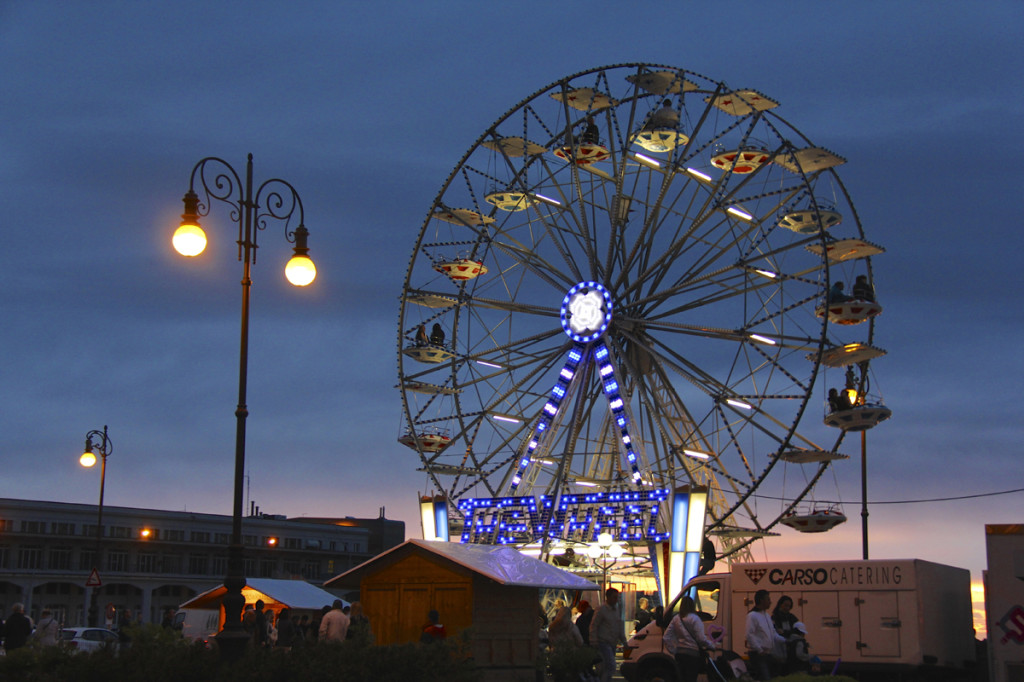
We didn’t have much to worry about the night before the race, so we strolled through the piazza and walked the roads along the water. They had all sorts of fair-type events set up for the race, including tents serving beer, desserts and carnival rides. I took Julia on the Ferris Wheel and got a great view of the city and the harbor. After the fun, we took in a spectacular seafood dinner near the harbor (mm’mmm I’m making myself hungry for fresh Italian food. Never had that problem while writing until now, when I can’t get it quite as easily).
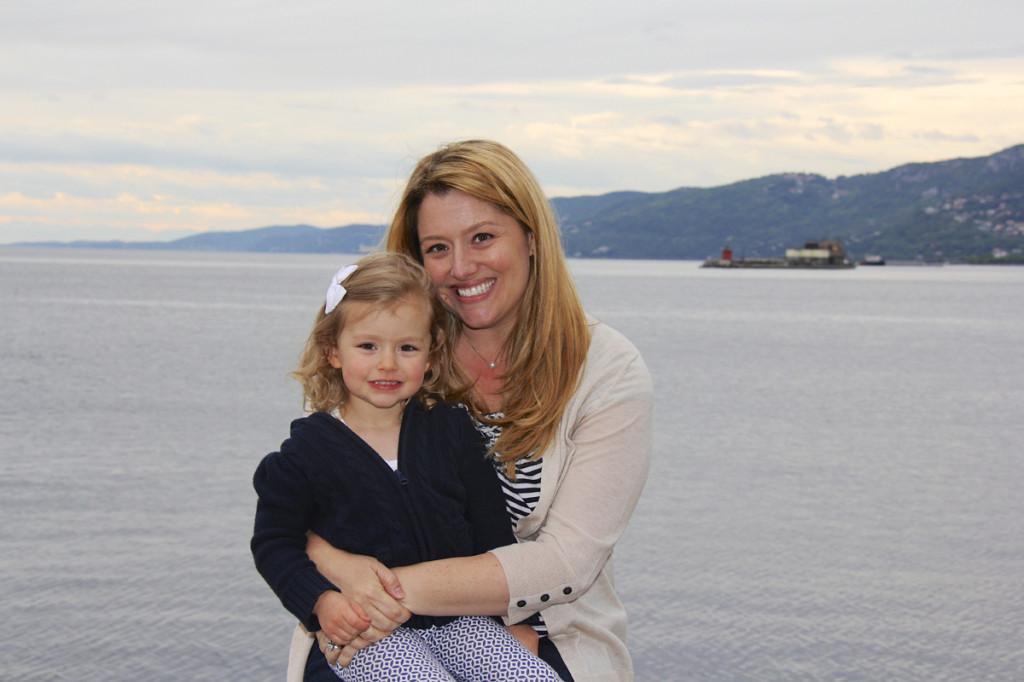
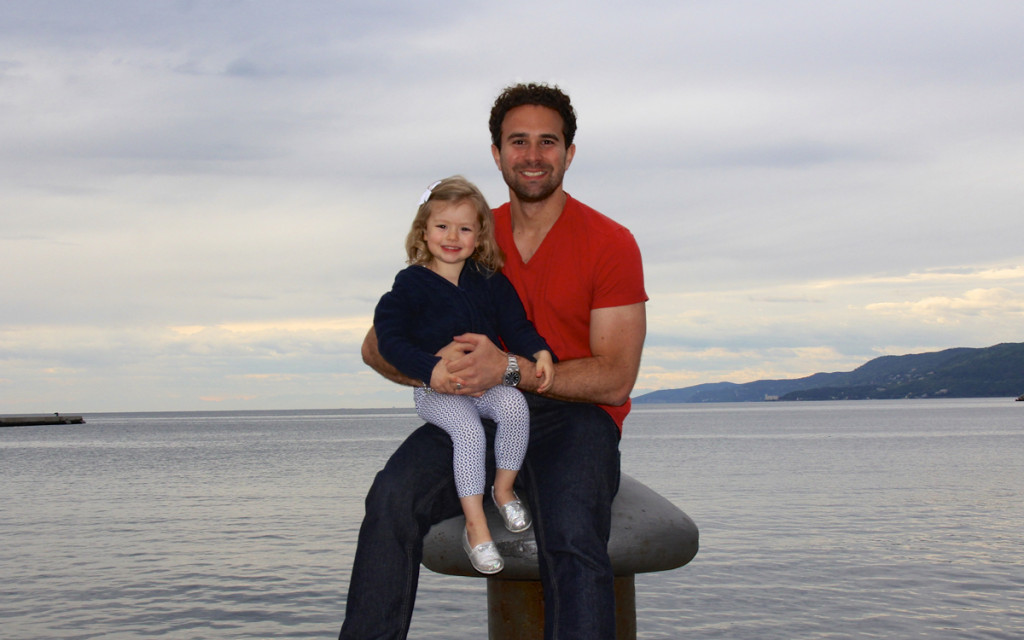
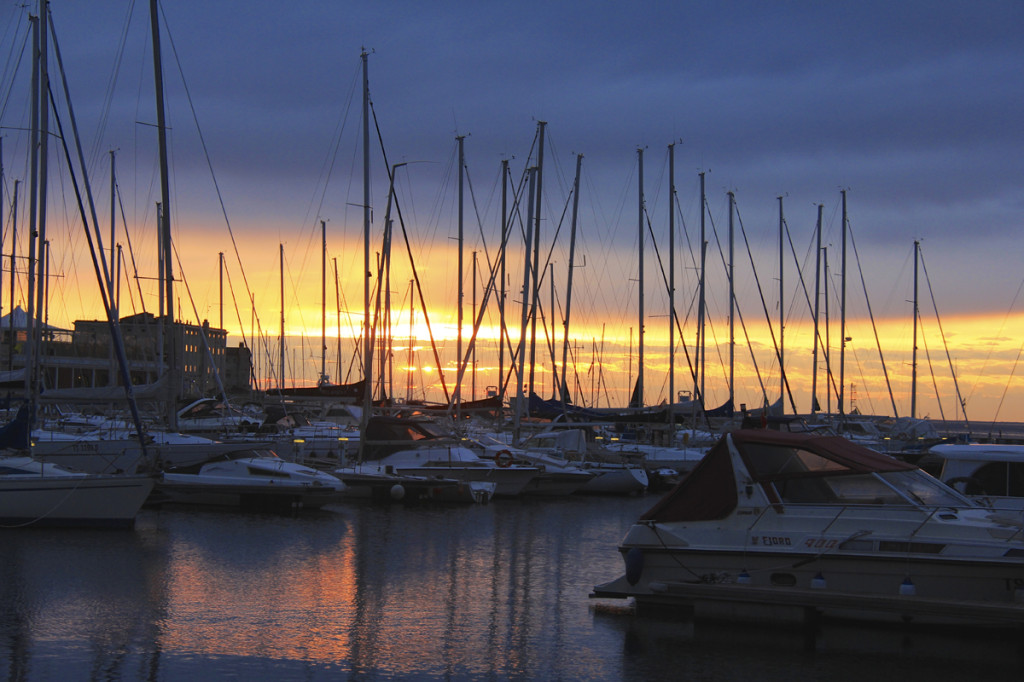
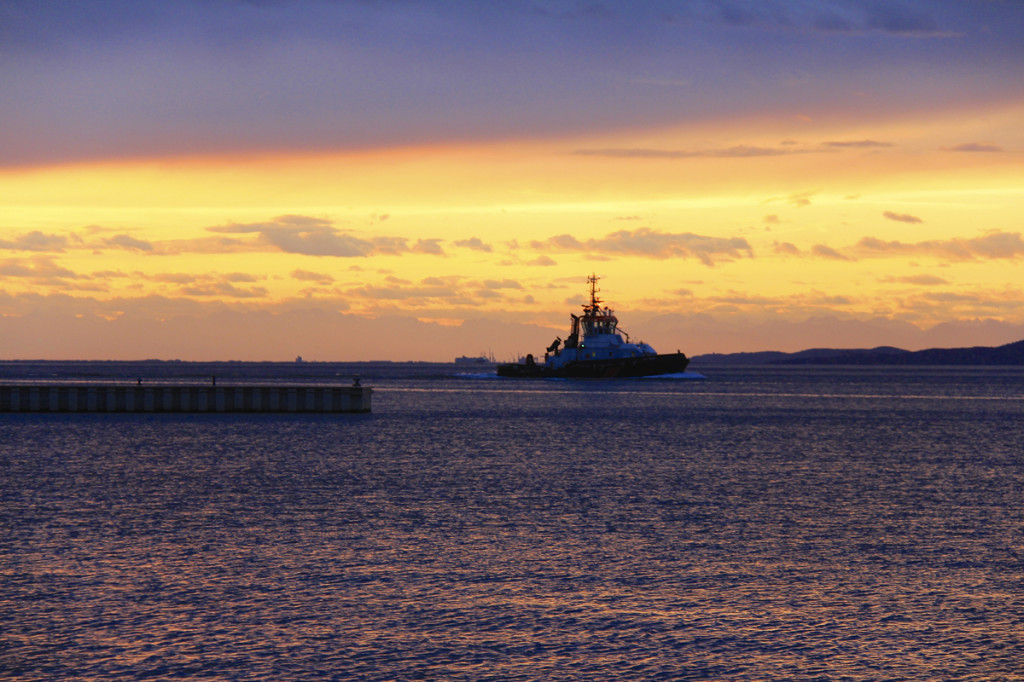
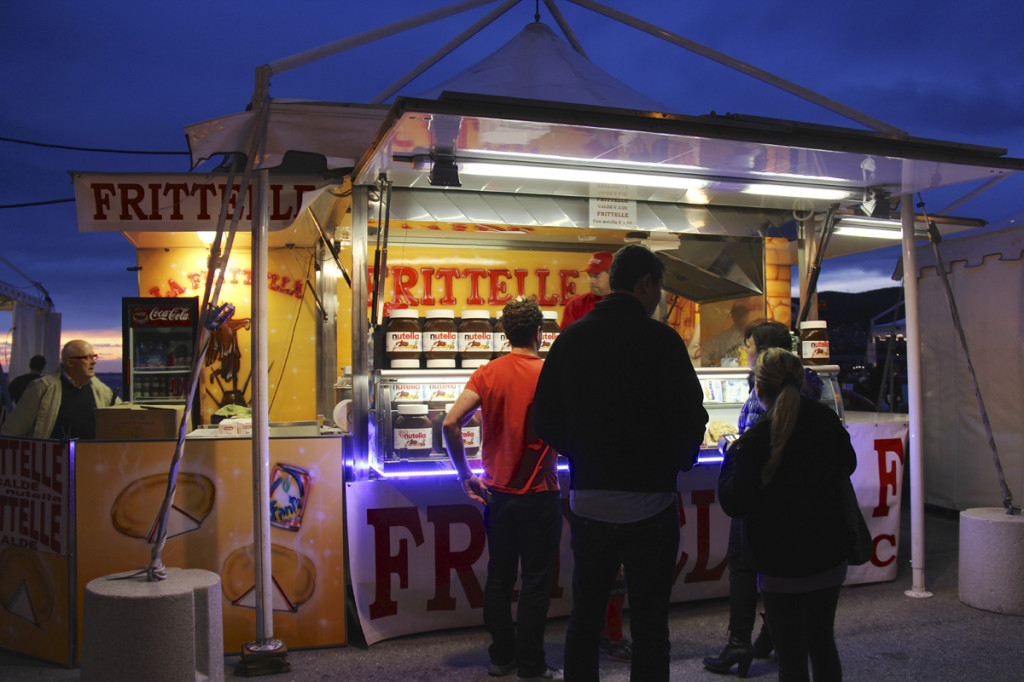
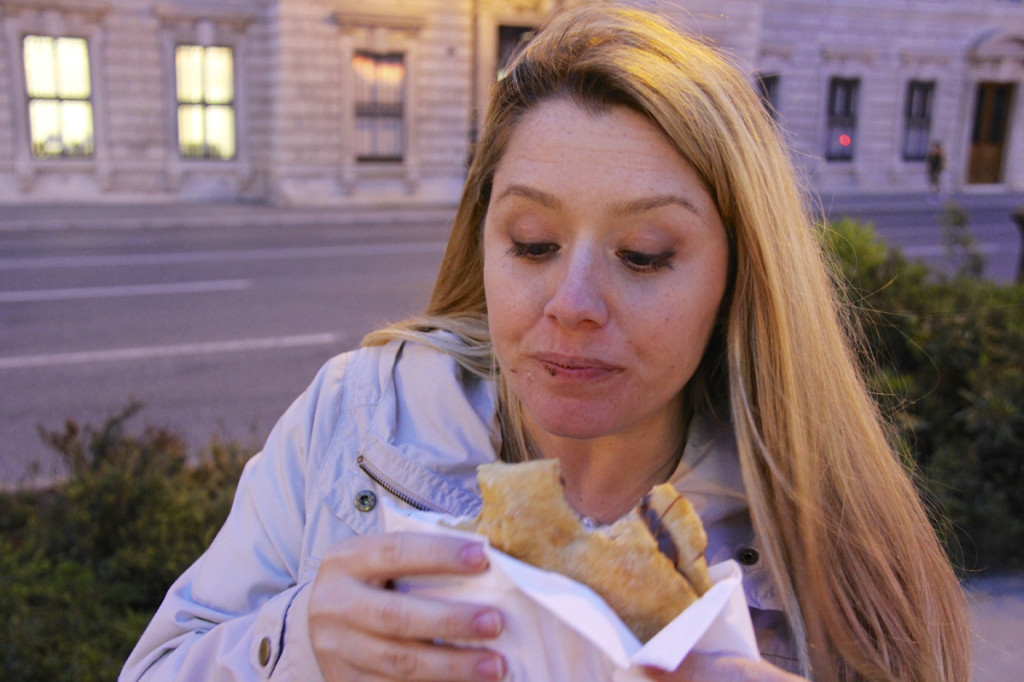
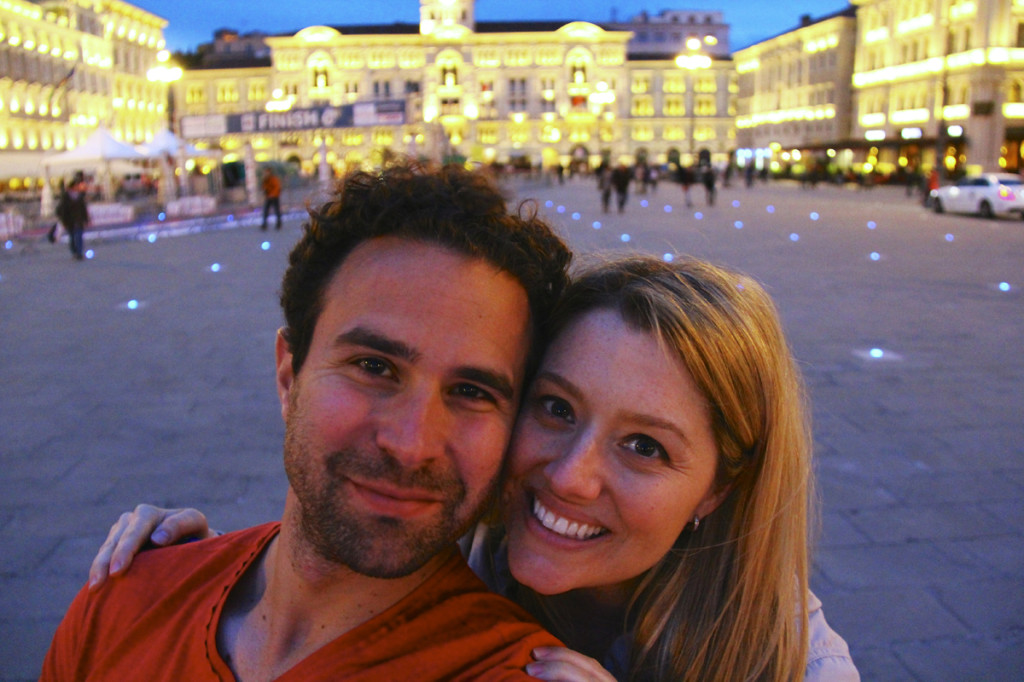
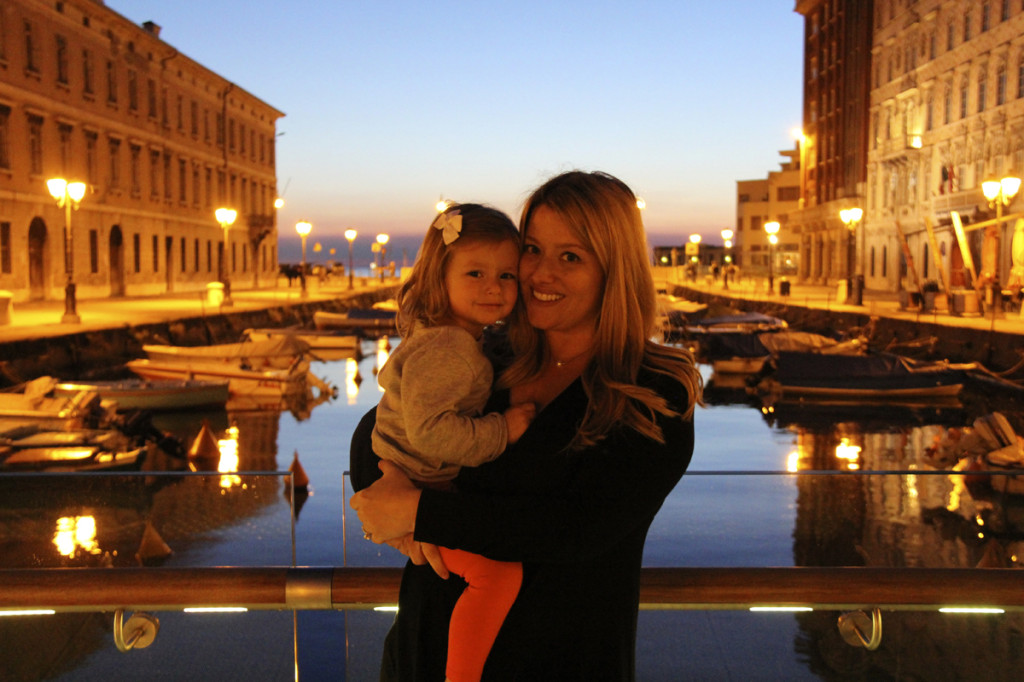
I get ready to take her on her first ferris wheelAway we go…Daddy/Julia selfieView from our car at the top of the ferris wheelThe sun set shortly after our ridePicture with momPicture with dadThe sunsets in Trieste were like nothing I’ve ever seenThe light play from the sky was this stunning both nights we were thereWe had to try some delicious frittelle with Nutella“Honey… you’ve got a little Nutella, riiiiight there”Walking through the piazza with daddyJulia loved playing with the glassesSelfie at dusk
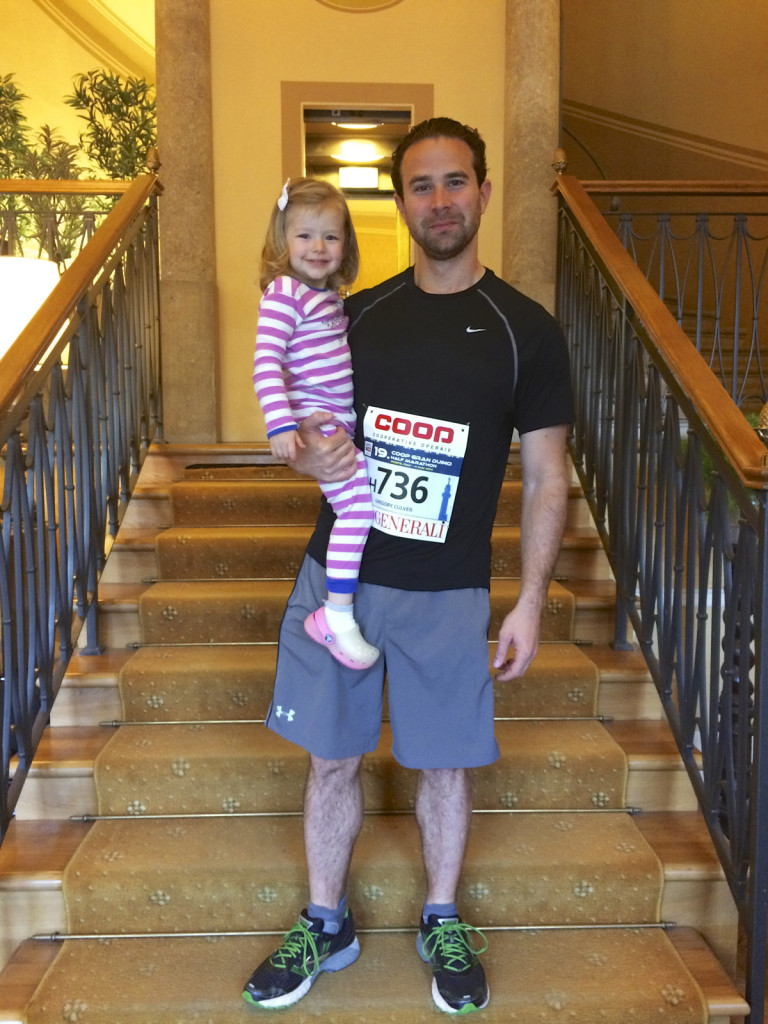
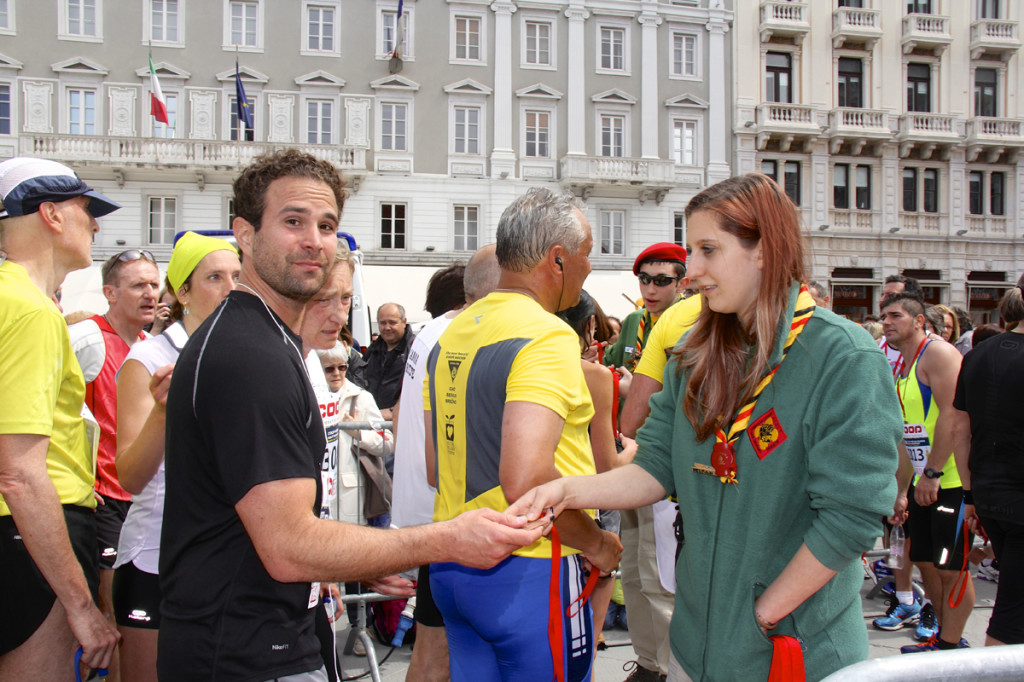
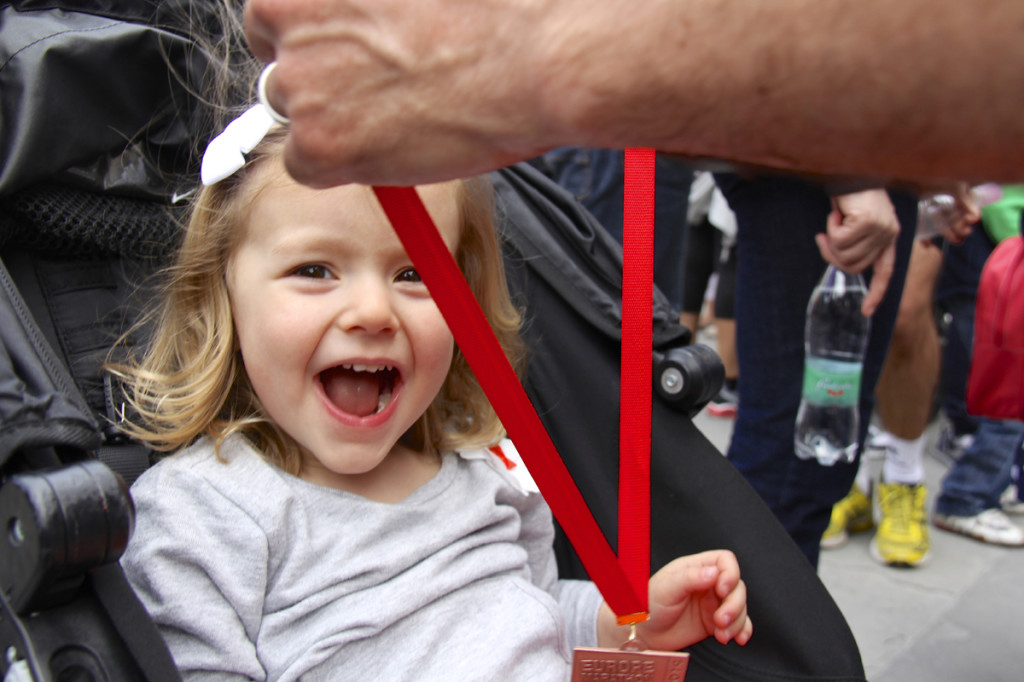
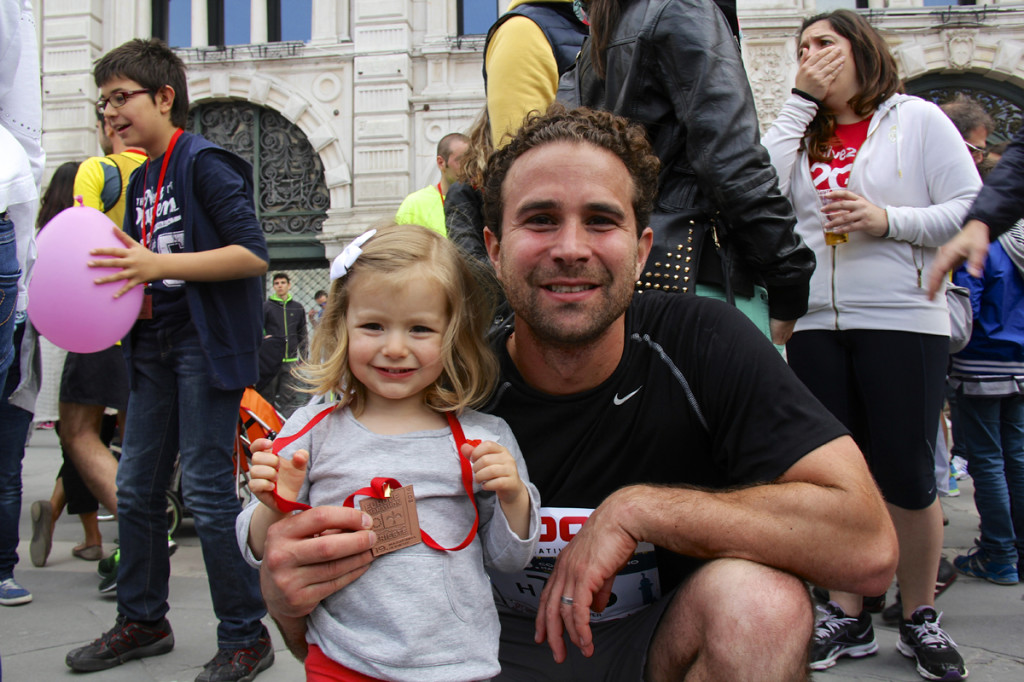
On race day, I was up and at ’em early – ready to beat my goal time (which I didn’t do). Of course, I forgot that I was in Italy and so the start of the race was a little later than I originally planned. I kept warm by jogging around the parking lot and taking in the crowds. I was tickled when I ran past the snack tents used for refueling depleted calories (usually covered by bananas and power bars) and found brioche and other Italian pastries. When I finished, I could not have been more pleased to be greeted by Jen and Julia; and to have Julia wear my medal.
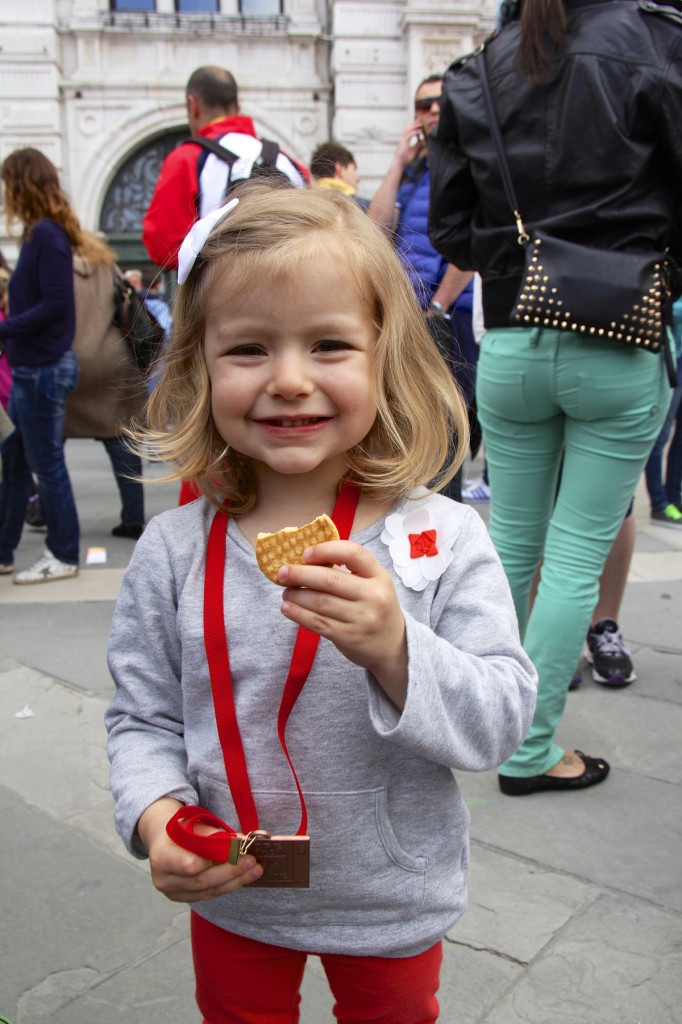
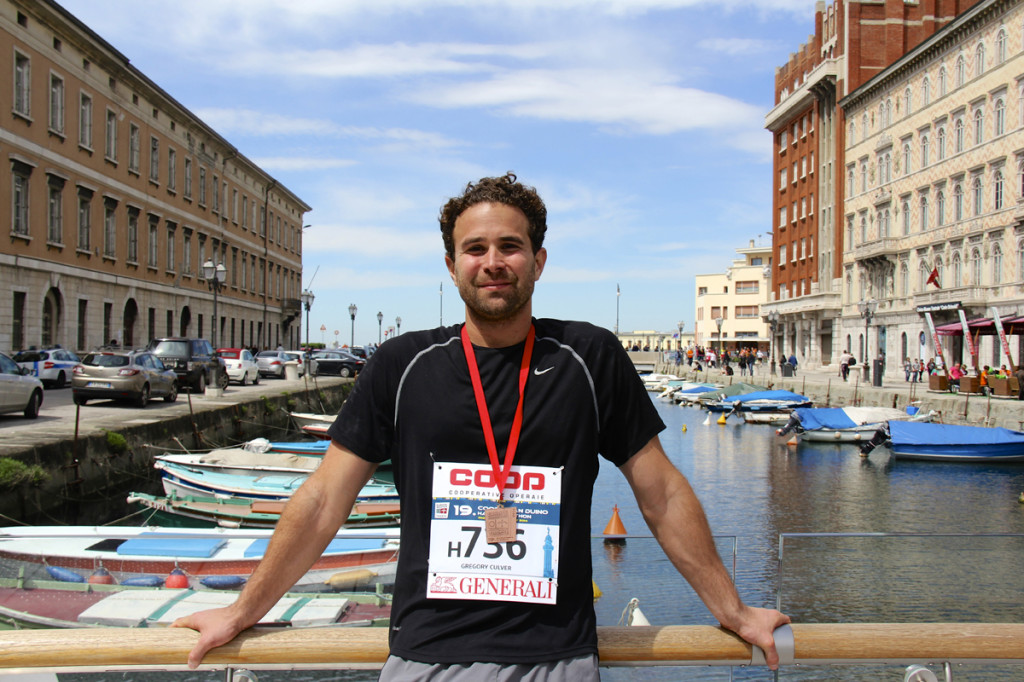
Julia got up early to see me offThere wasn’t much happening at the start line until after the race was supposed to beginAnd we’re off!I had the sea to my right for almost the entire half-marathonI felt (and looked) like death, but I crossed the finish lineBut I got my medal…Which I was happy to give to JuliaMy little peanut was proud of me… that was the best part of allJulia may have been more interested in the biscotti than the medalFamily picturePicture along the Canale Grande (Grand Canal) that runs through the city streets
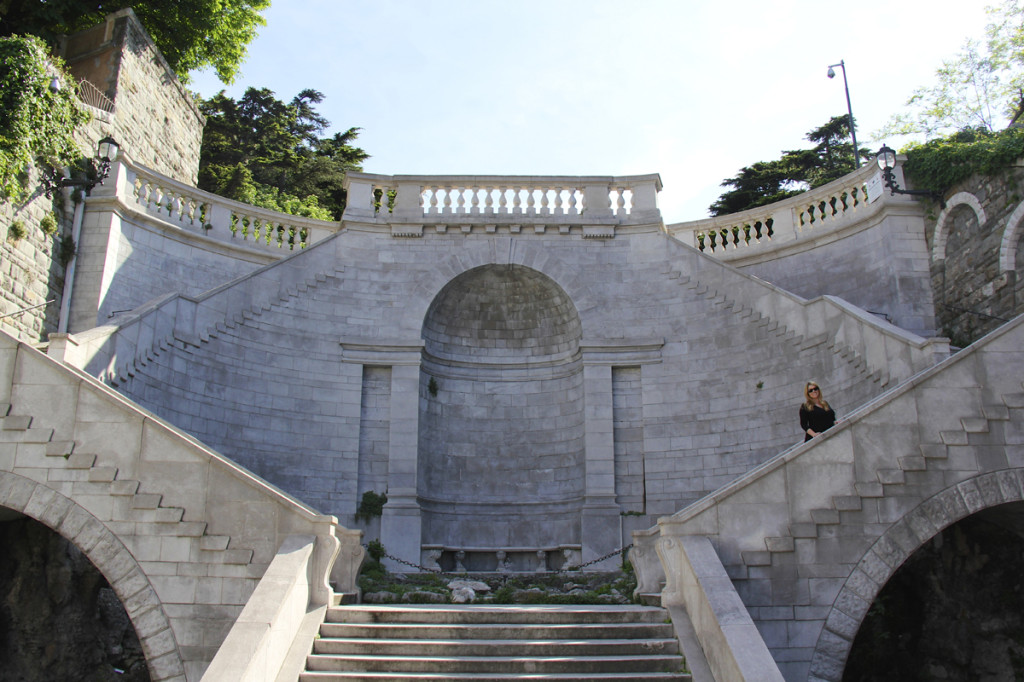
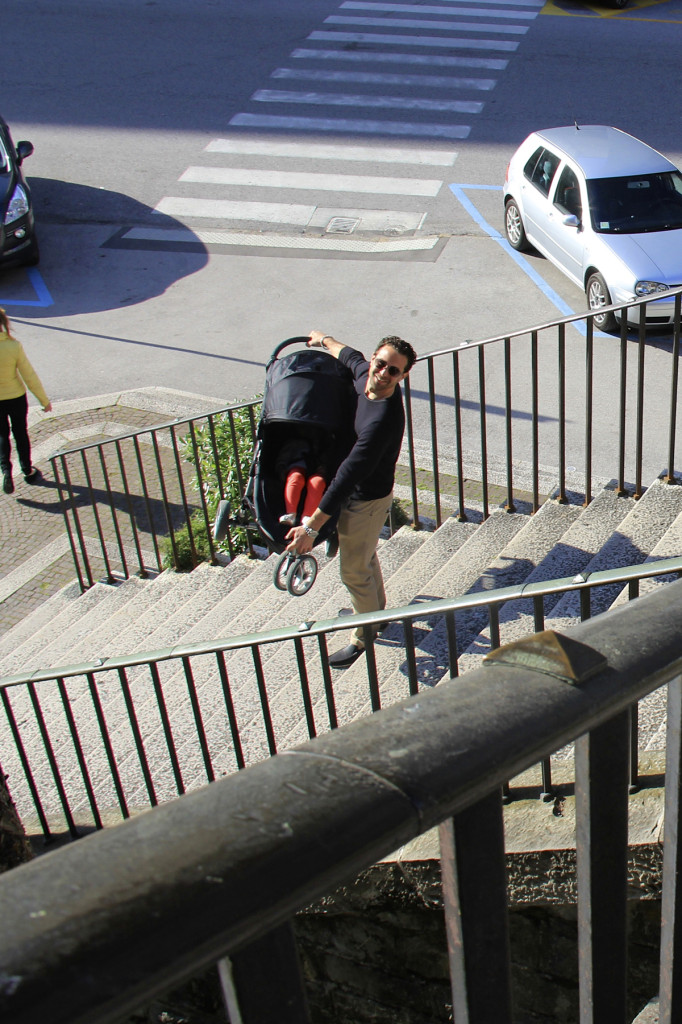
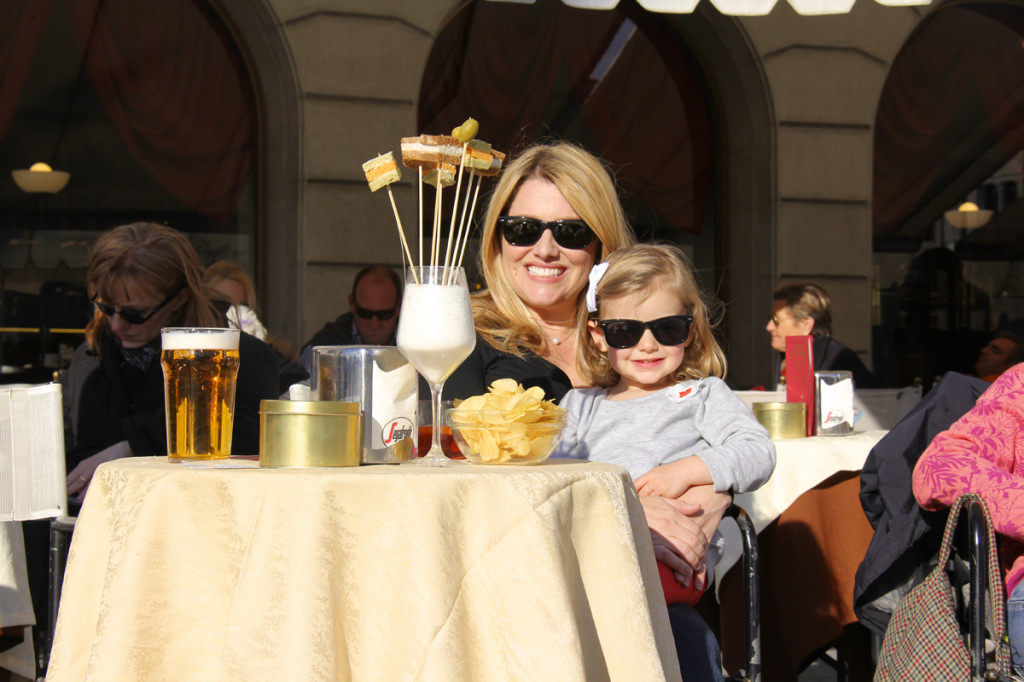
After the race, we stopped for a quick snack and beer (hey, I earned it) before going back to the hotel to change. Then, it was time to tour the city! Even though my marathon race was just a maratonina, I’m sure that we walked the remaining 13.1 miles as we wound through Trieste’s ancient streets. This was especially challenging, since the first part of the tour required me to carry Julia and her stroller up the Scala Giganti (Giant Steps). We capped it all off back in the Piazza Unità d’Italia for happy hour before a wonderful dinner.
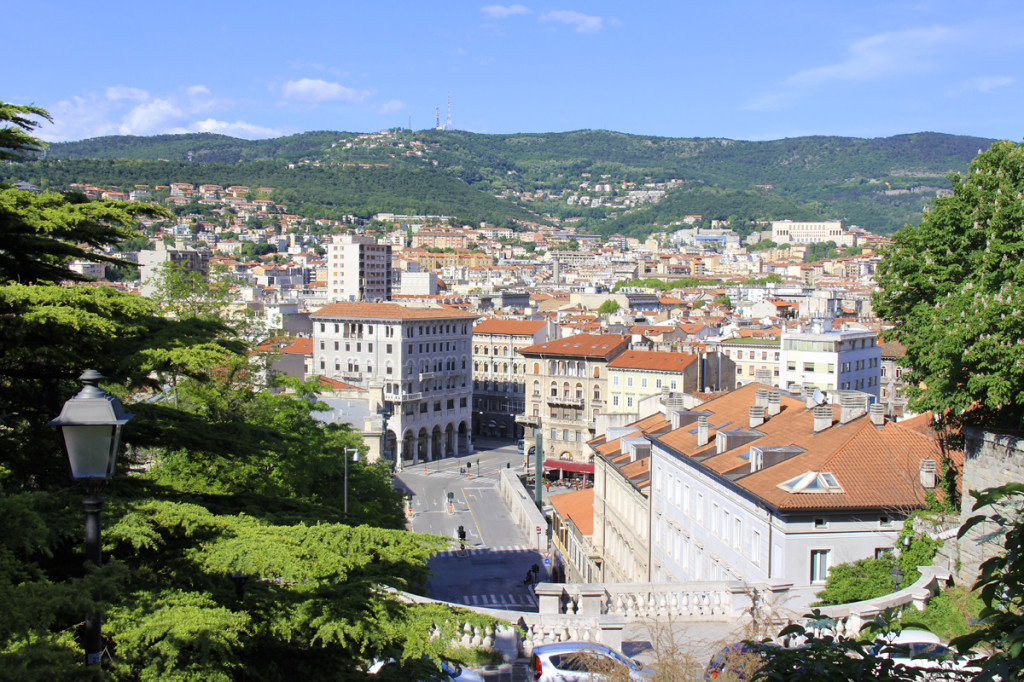
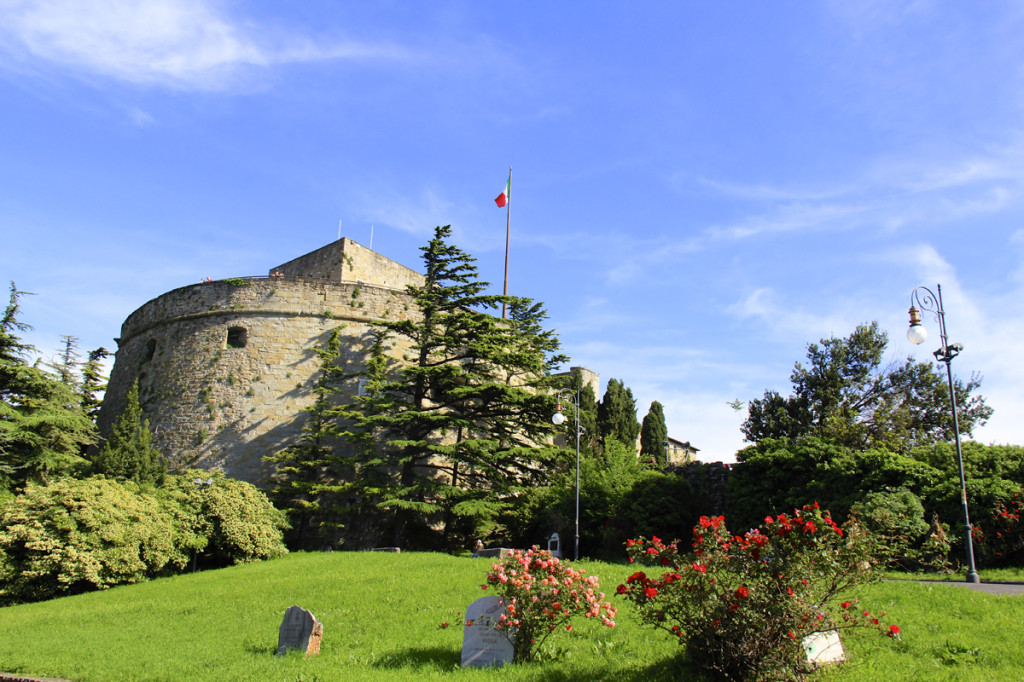
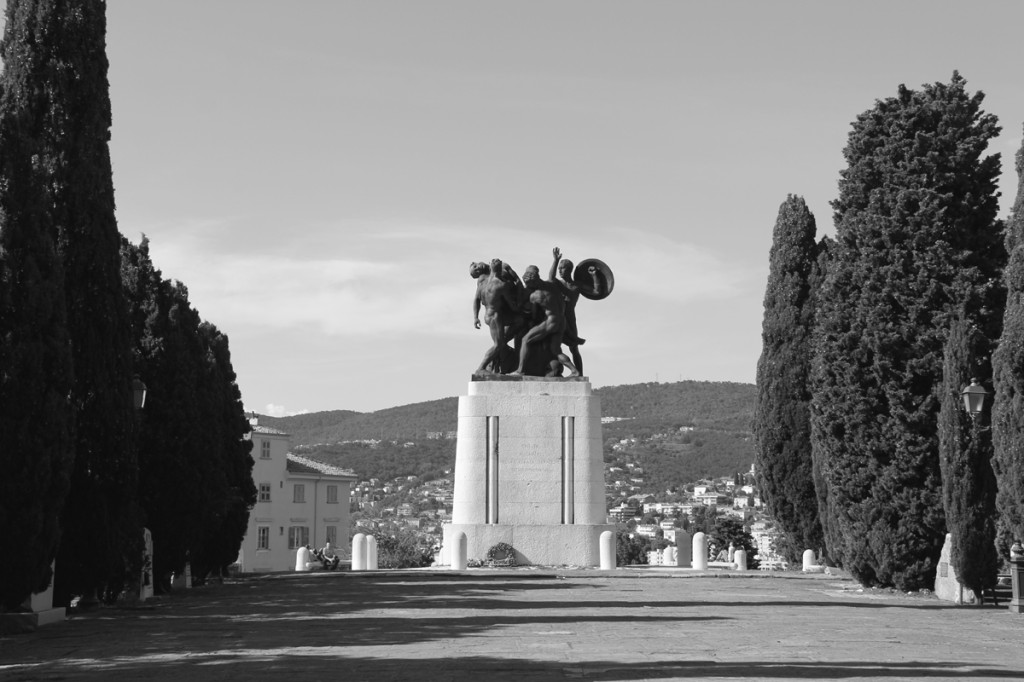
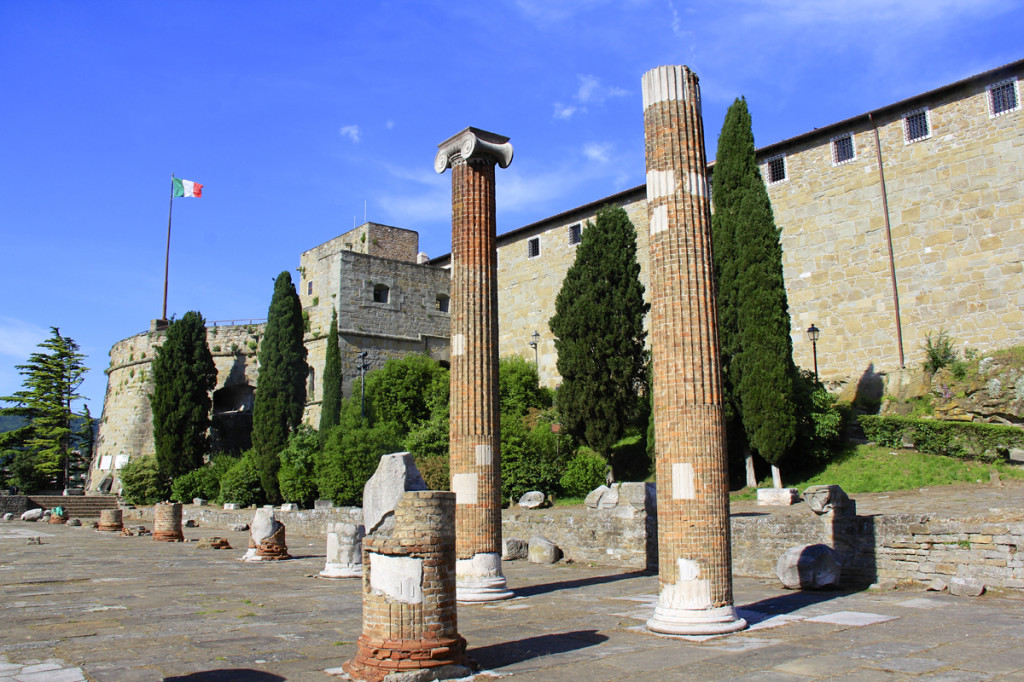
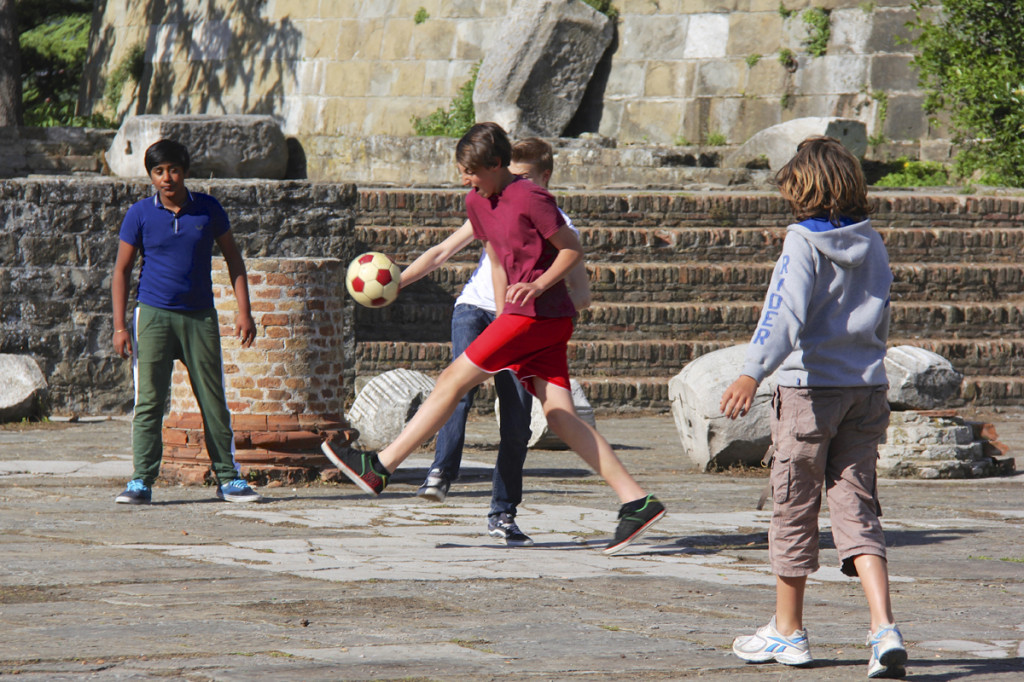
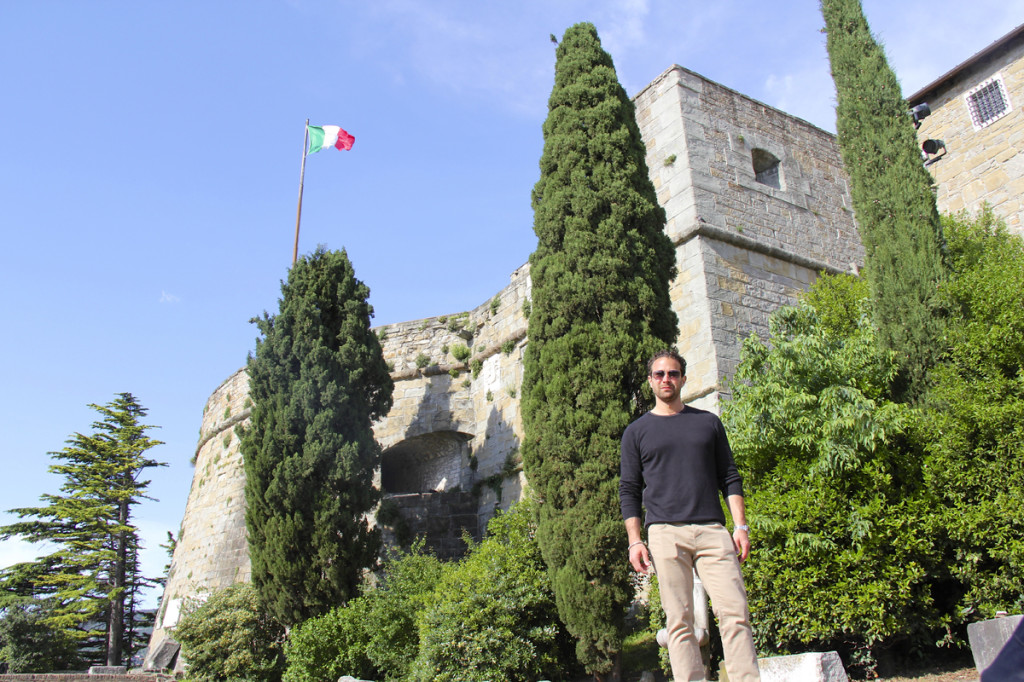
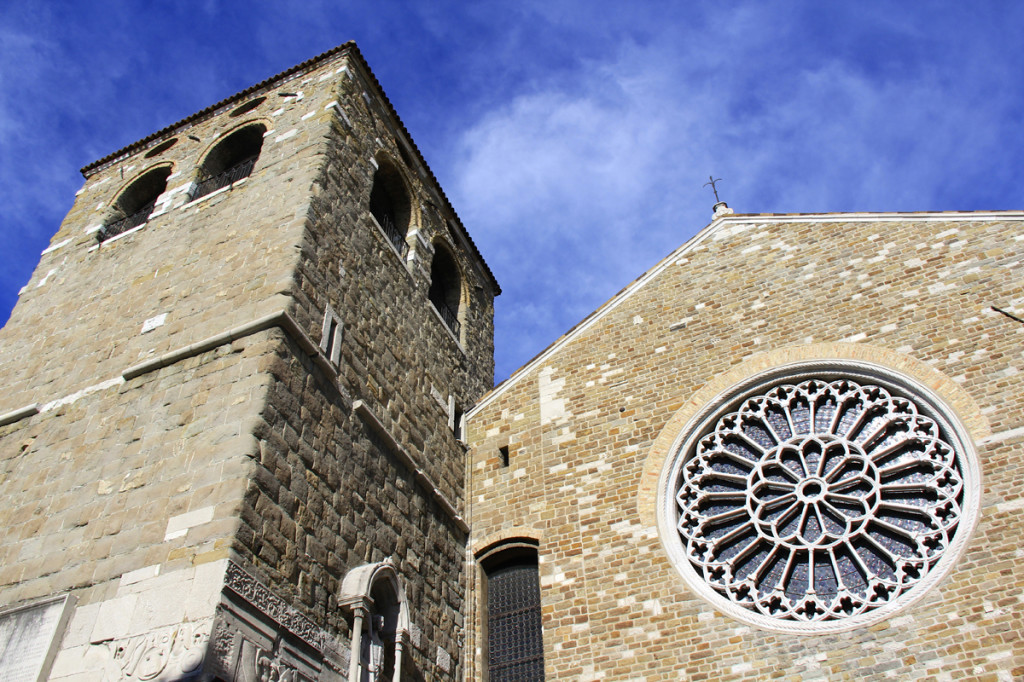
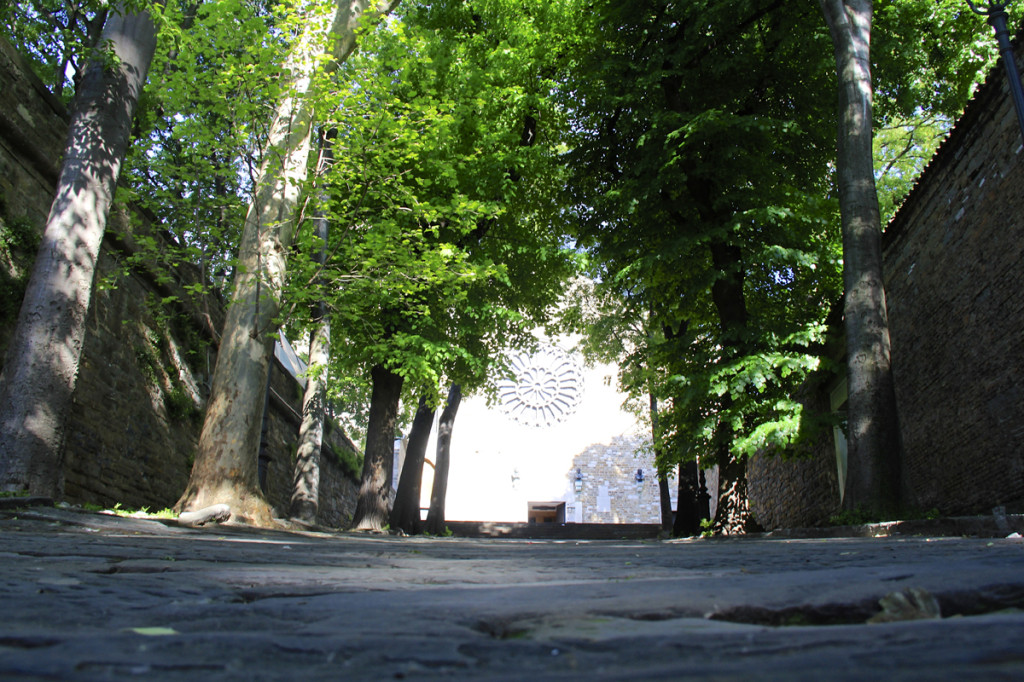
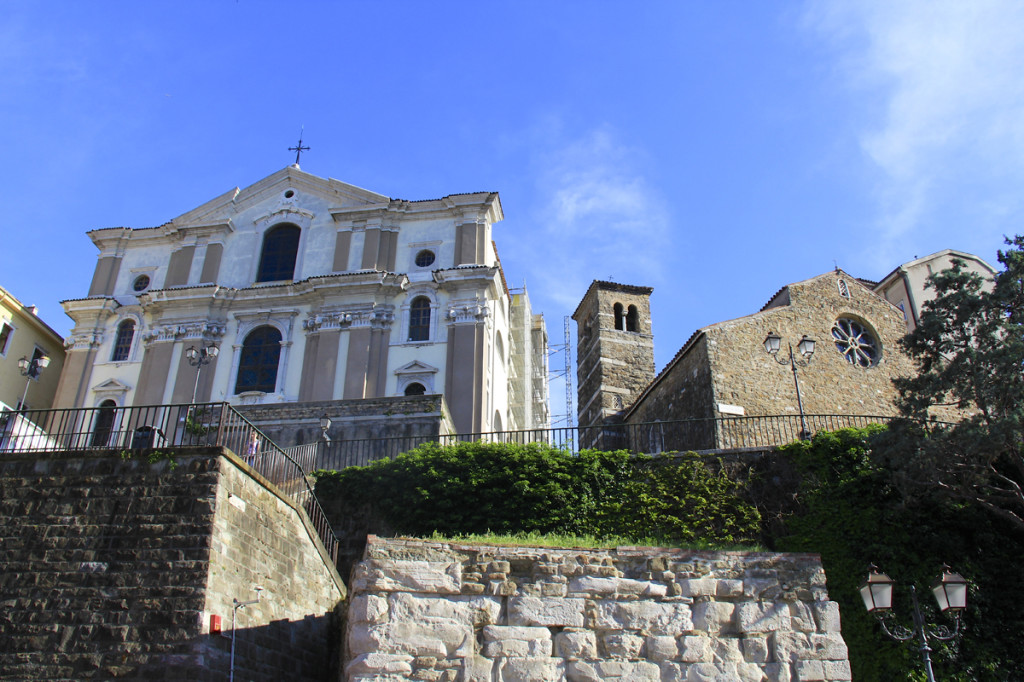
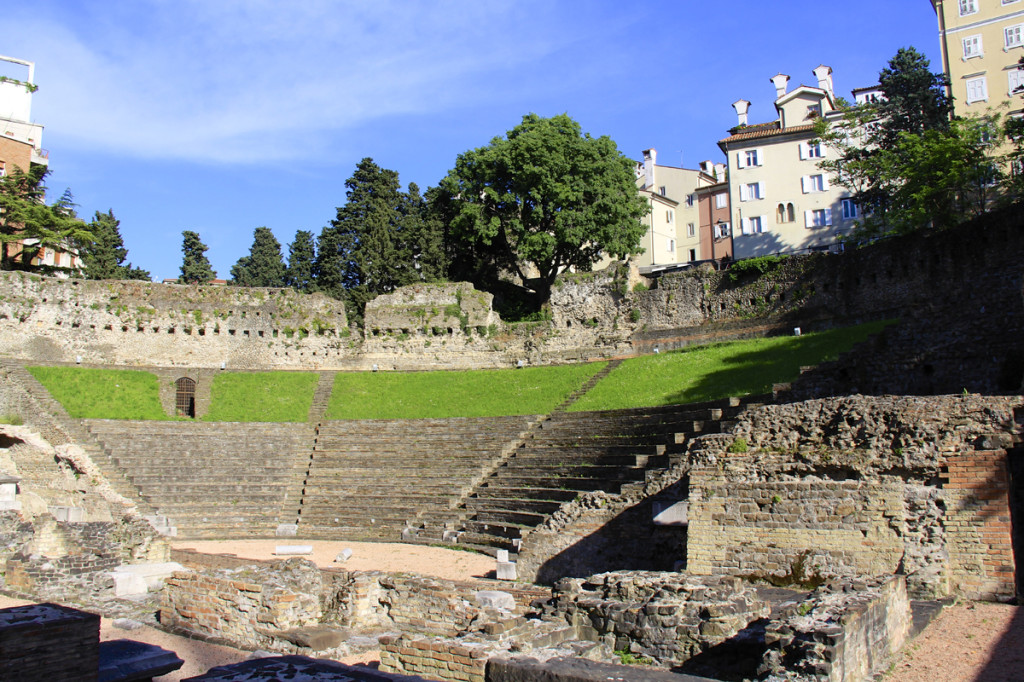
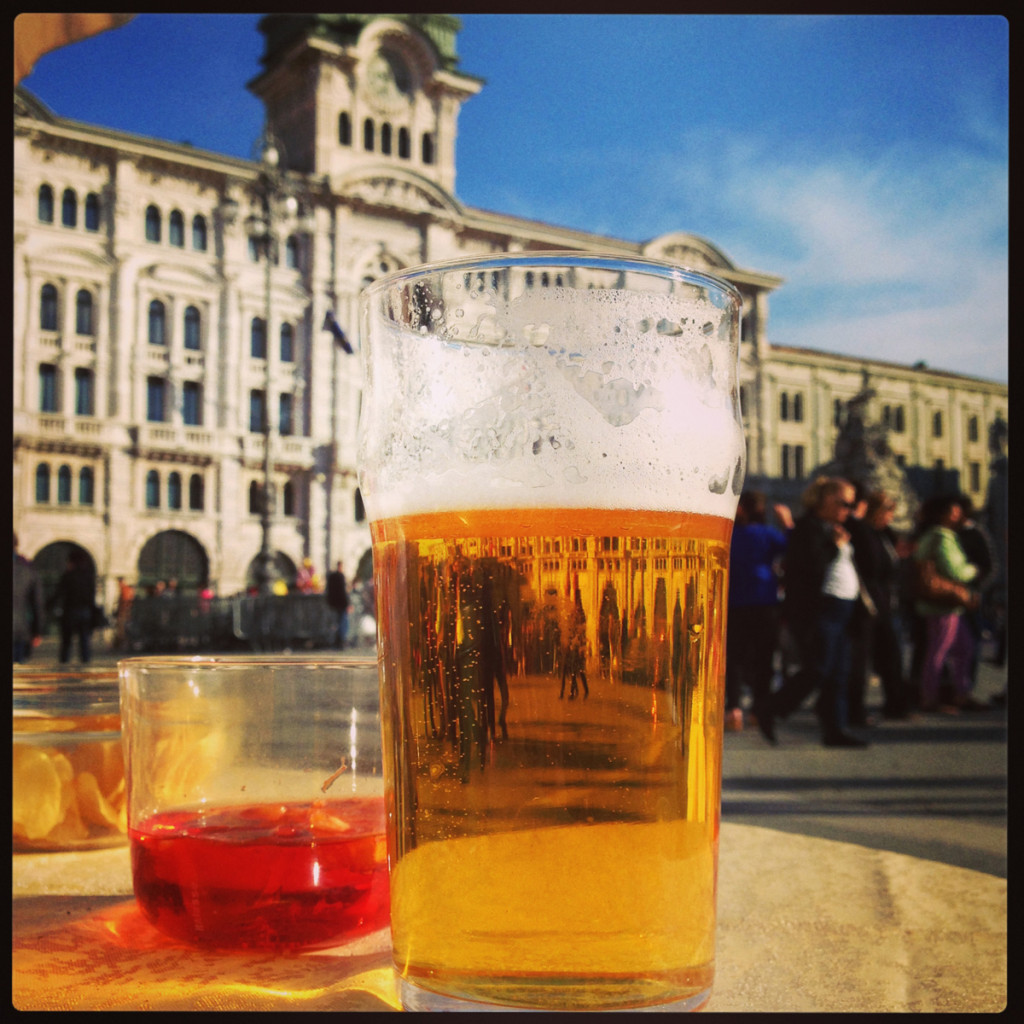
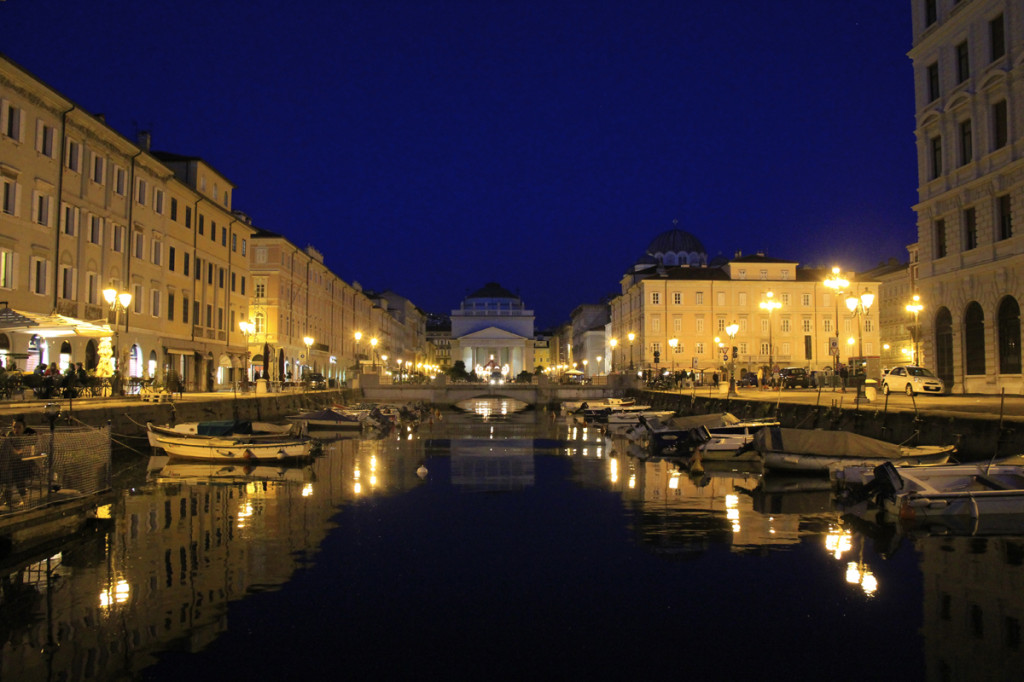
We stopped for a beer and light snack along the canalJulia rode a merry-go-roundThe touring began with the Scala dei Giganti (Giant Steps) – this is only about 25% of themAfter a long uphill climb, we got this panoramic of the cityWe arrived at the Castello di San GiustoStatue in front of the castle depicts maritime soldiers at warIn front of the castle were ancient Roman ruinsYoung soccer players compete where ancient Roman soldiers stood a thousand years beforeI can never catch Jen for a candid!Here I am in front of the Castello di San GiustoNearby is the Cattedrale di San Giusto – see if you can find the two cannon balls that have been lodged in the stone during a siege from the sea centuries beforeLovebirdsWonderful ancient streets – this is Viale XX SettembreHalf-Marathon or not… this kid had to get up and down these stairs somehowChiesa di San SilvestroTeatro Romano di Trieste – ancient Roman theatreWe stopped back in the piazza for happy hourMy happy hour Instagram shotJulia and I took a stroll around the piazzaChiesa di Sant’Antonio Nuovo at the end of the Canale Grande – well-lit at nightMy girls at night
If you ever find yourself in northeast Italy (I’m talking to YOU, when you plan that inevitable visit Venice) – do yourself a favor and carve out a couple of days to see Trieste. You’ll be glad you did!
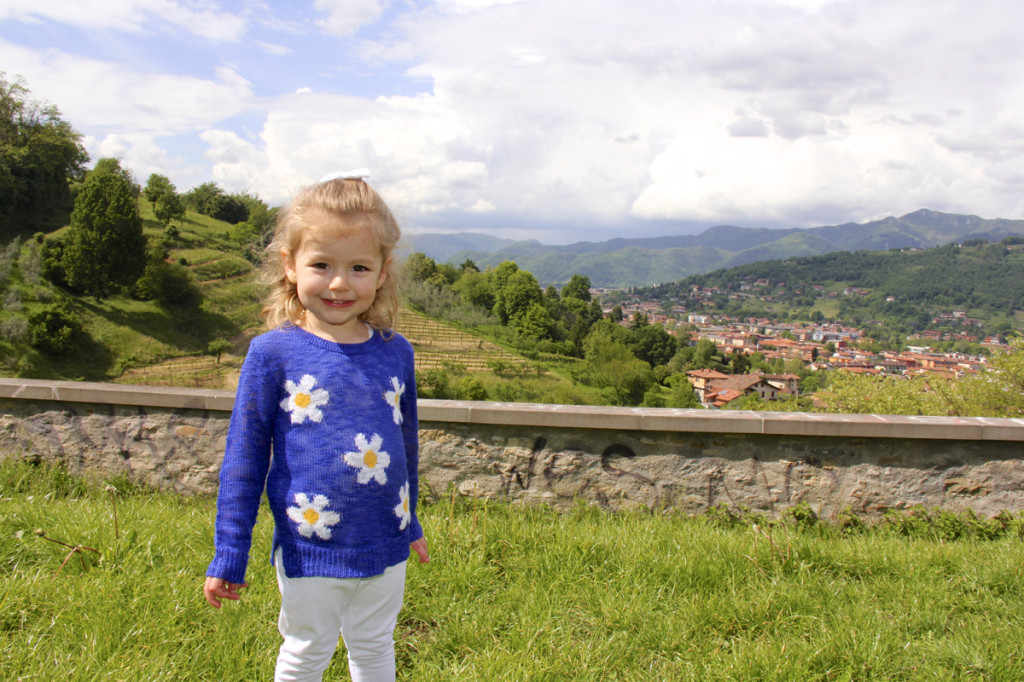
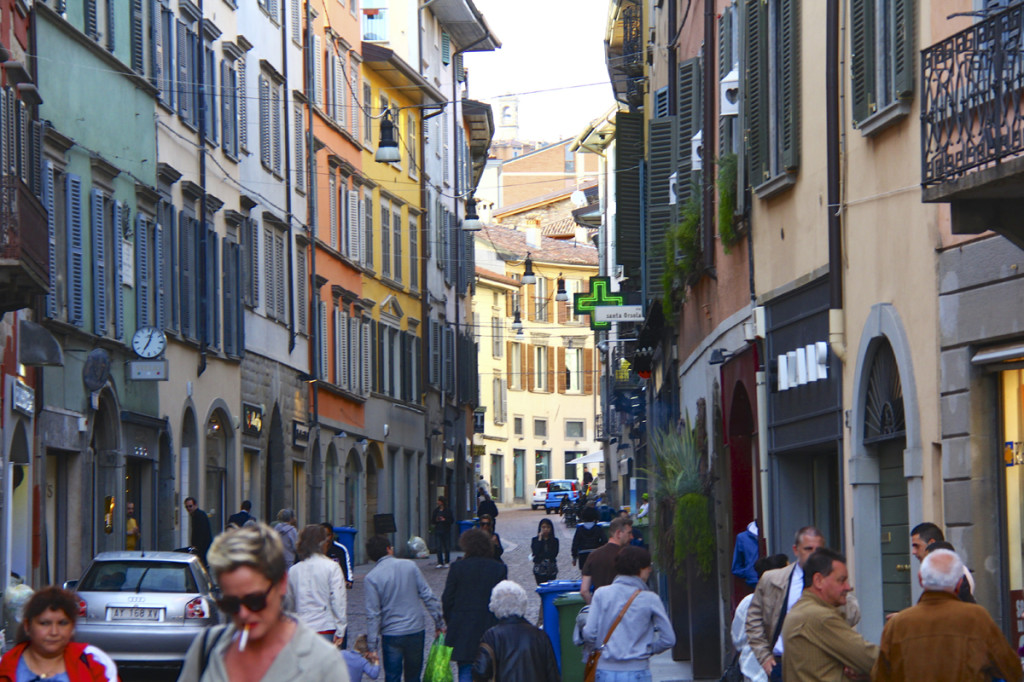
I played with various options for the title of this post, ranging from “Italy’s Most Hidden Treasure” to “Italy’s Best Kept Secret”. Really, any of those title would be apropos. Bergamo is all of those things and so much more. Ultimately, I went with “most underrated” because it seems that most people would rather bypass this northern Italian city for the sexier Venice, Florence or Rome. Heck, even neighboring Verona pulls more visitors than Bergamo. As a matter of fact, I had never even heard of Bergamo until I moved here and I had visited nearby Como plenty of times leading up to this adventure.
Città Bassa in Bergamo
Getting to know Bergamo was truly a blessing, because it is the type of place that we will continue to visit over and over. The distinguishing feature of Bergamo is that it is really two cities in one. There is the older, medieval city at the top of the hill (Città Alta) and the much more modern city (Città Bassa) below. Incidentally, I use the term “modern city” quite loosely… most notable development is still several hundred years old.
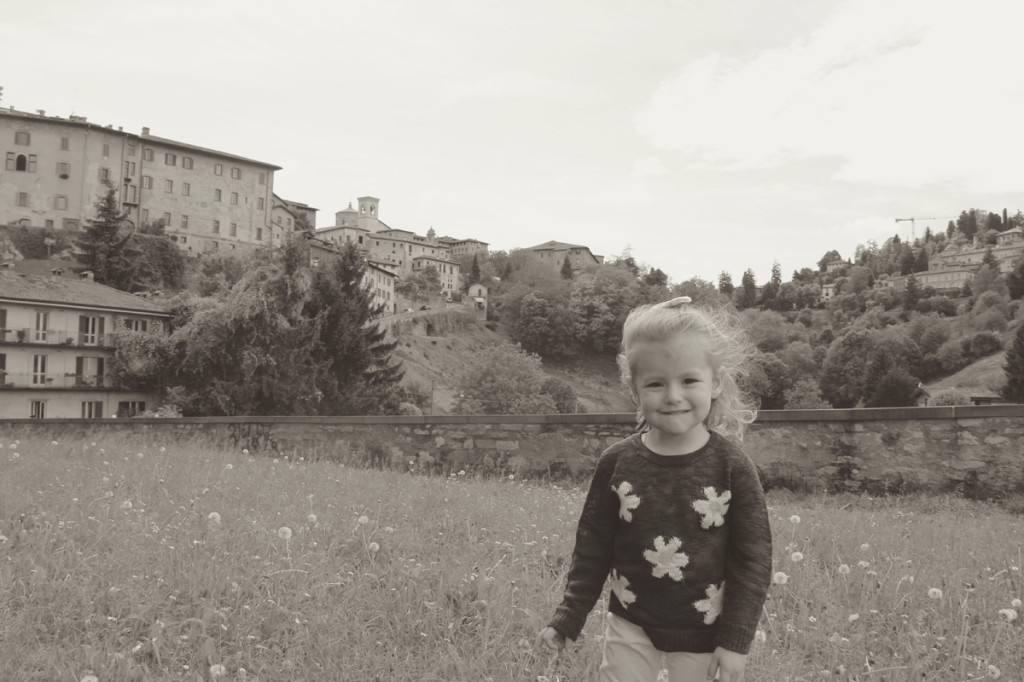
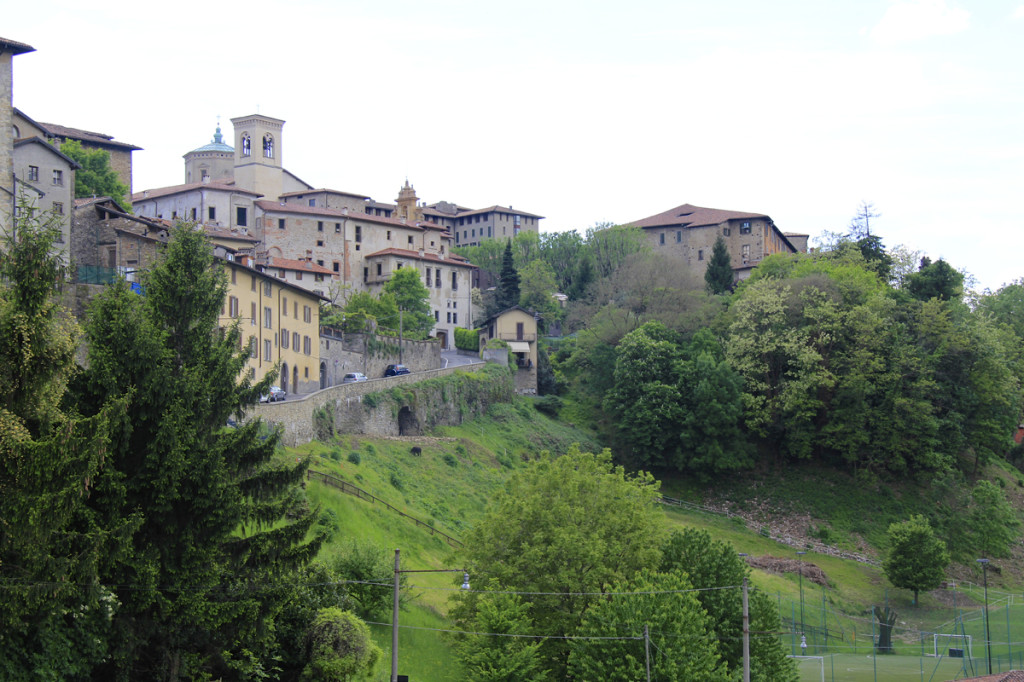
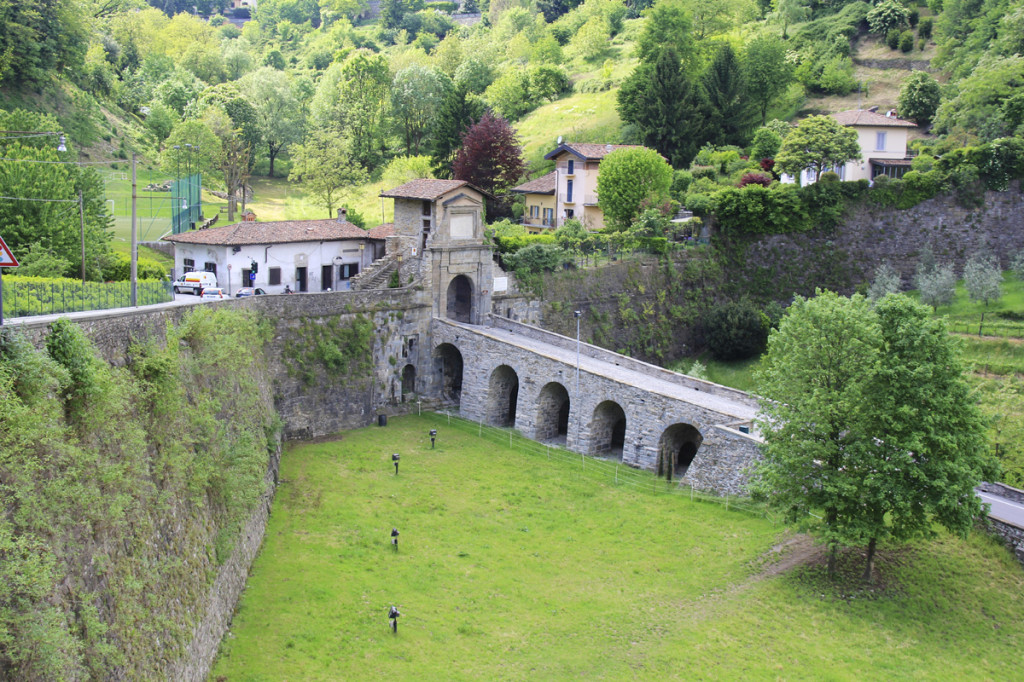
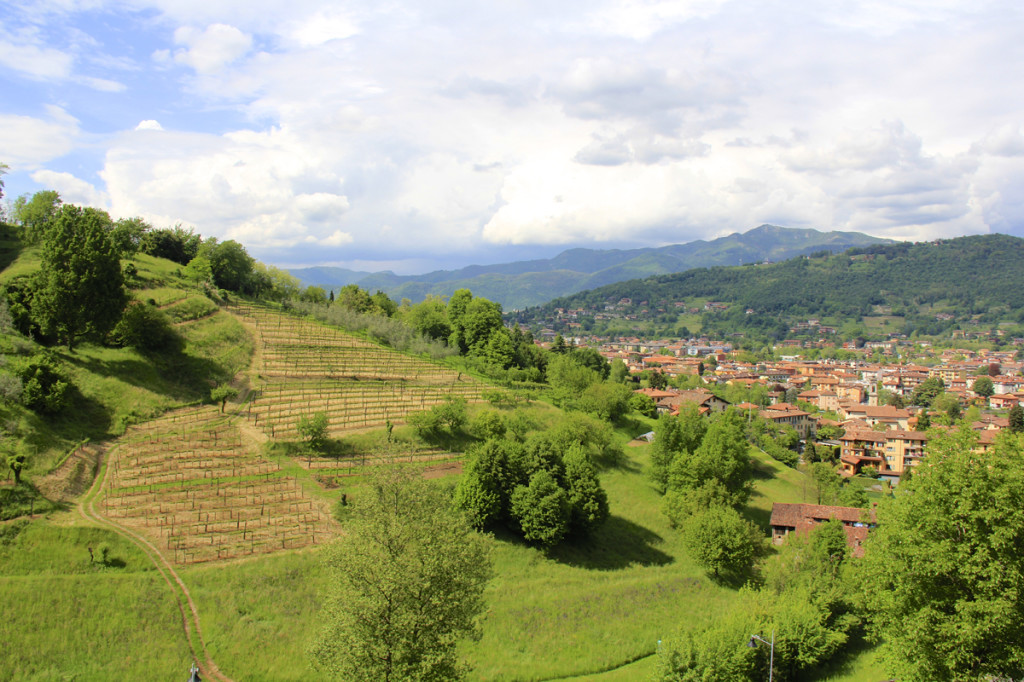
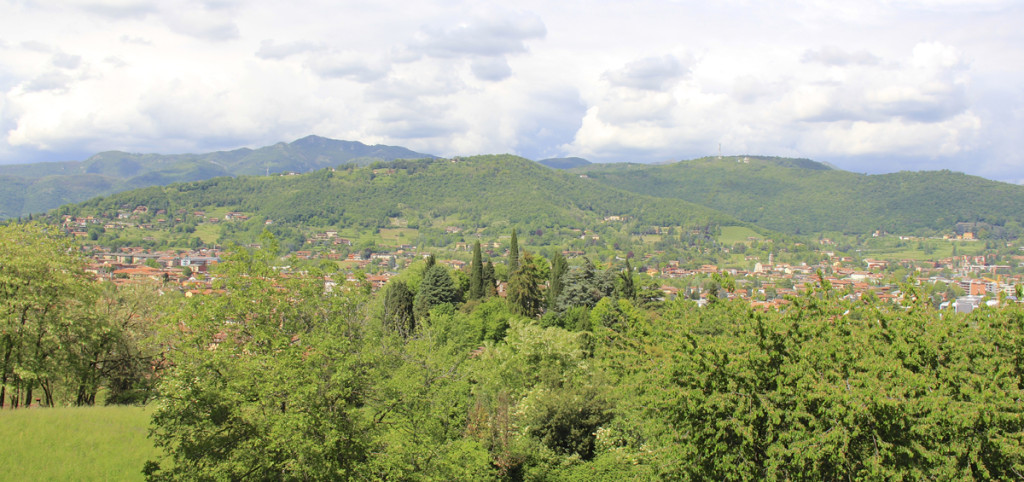
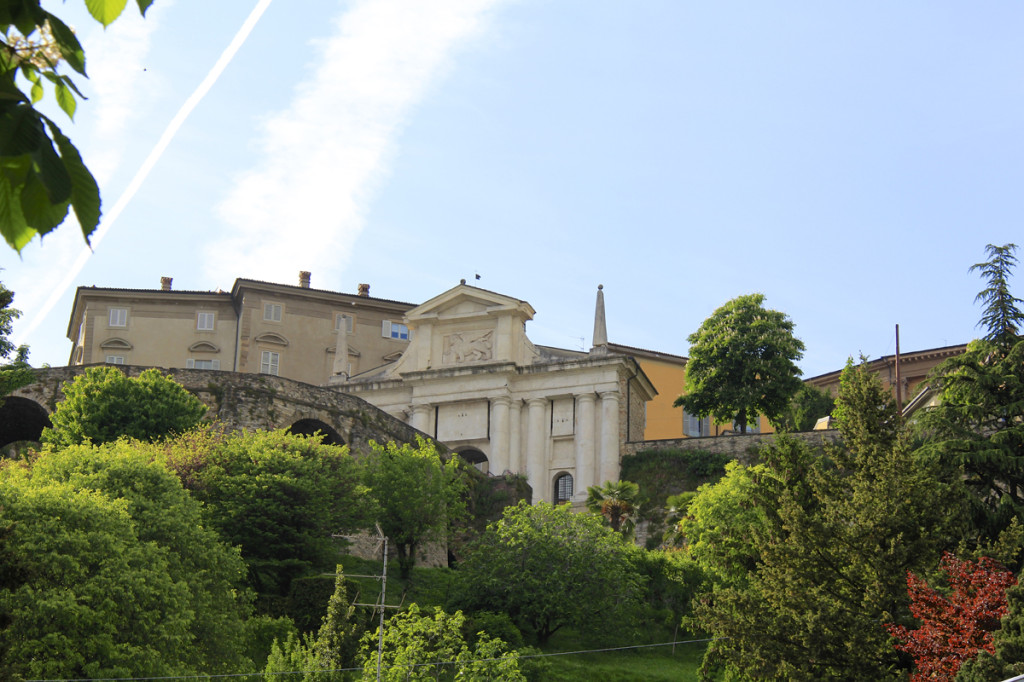
Julia enjoyed her day in BergamoThe older city at the top of the hillSecured roads allowed access into the ancient cityThe view from atop the hill extends for milesJulia enjoyed soaking it all inMore views…The main city gate, marked with the winged Venetian lion from the time Venetians ruled the city
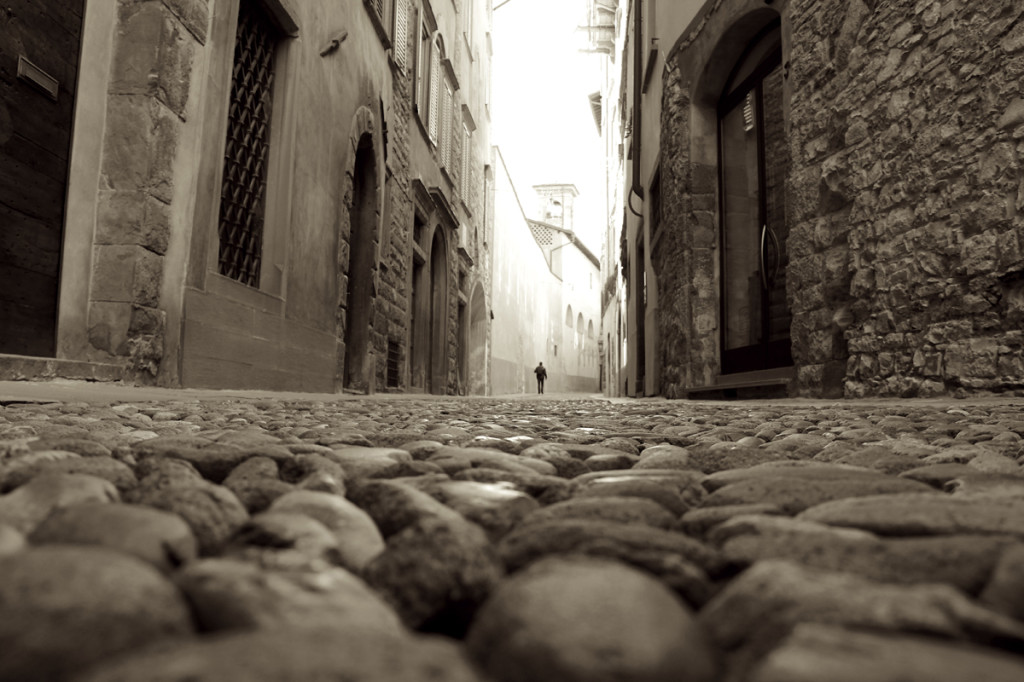
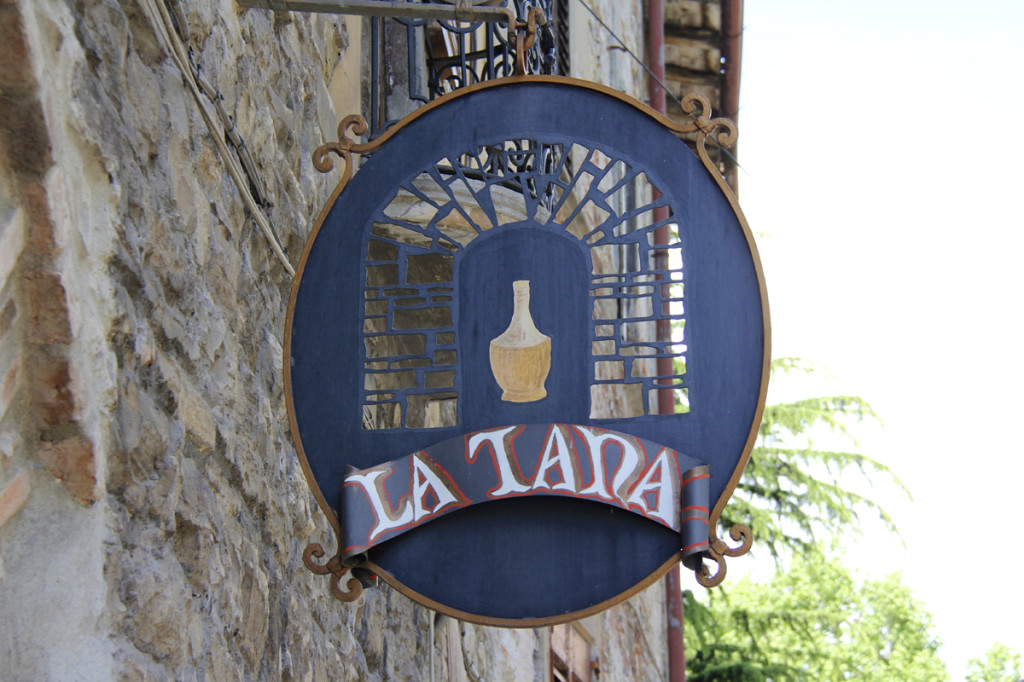
On our first visit well over a year ago, we were drawn toward Città Alta. We spent most of our day wandering the cobblestone streets, soaking up the magical views the high city extends before you. We had been dying to come back to Bergamo and finally got the opportunity when Jen’s sister came to visit with Matt (first post HERE). I thought the mixture of old and new would be something unique for them to see, and the hour(ish) car ride from our home would allow an easy day trip. We loaded our car and headed east toward the city. Our first step was to ascend the hill toward Città Alta (also known as Città Vecchio or Old City) by means of finiculare (cable car). We had researched a good lunch place and in no time, we found ourselves settled outside on the patio of La Tana. After lunch, we spent quite a bit of time wandering around the cobblestone streets and settled in among the other tourists and locals in the centro (center) of town.
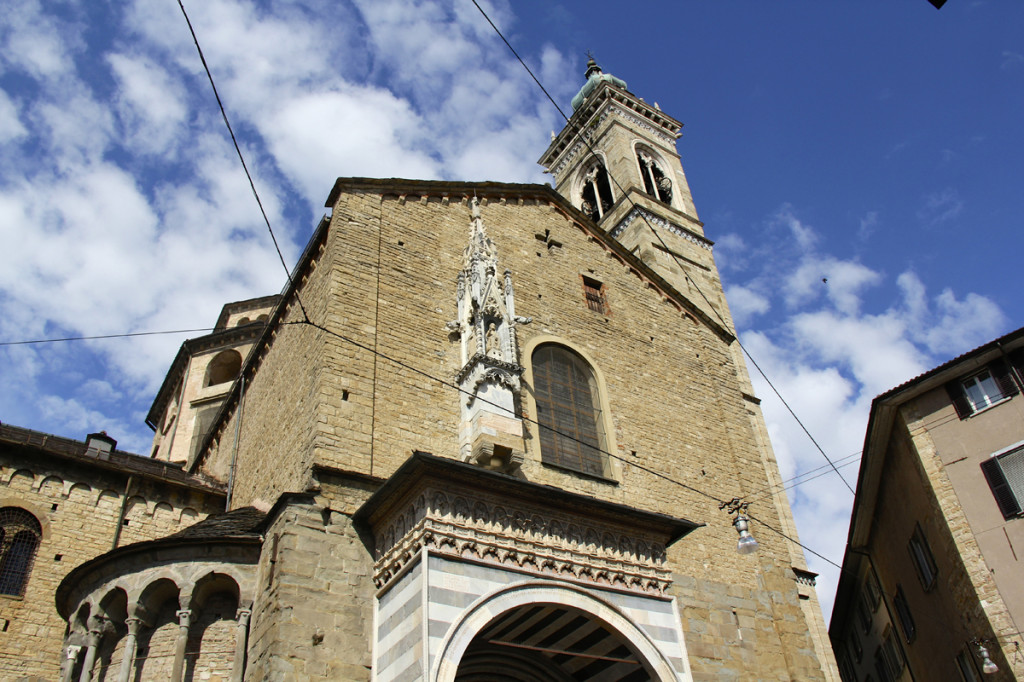
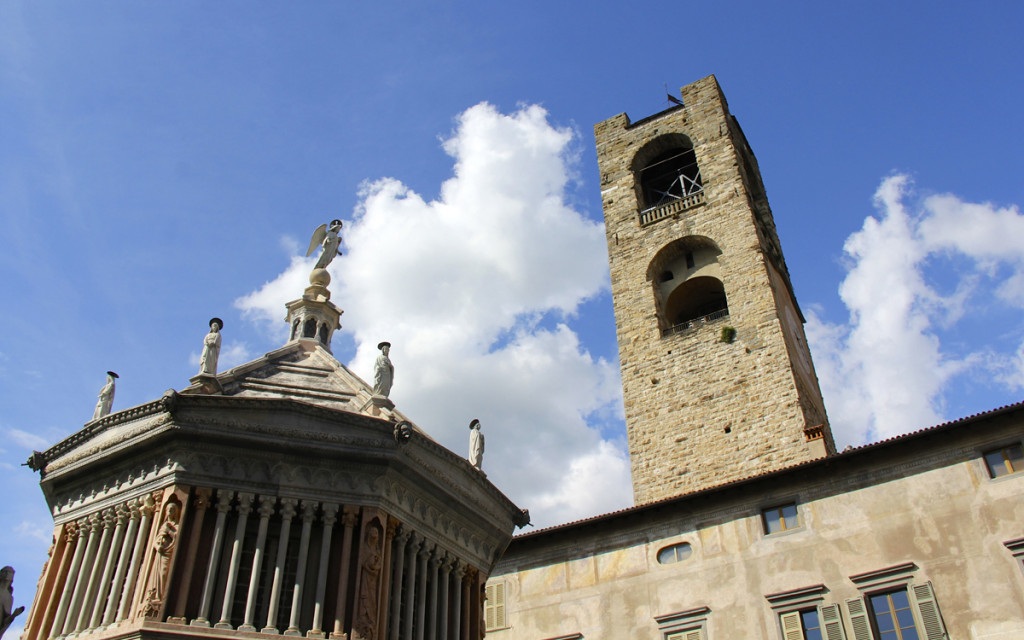
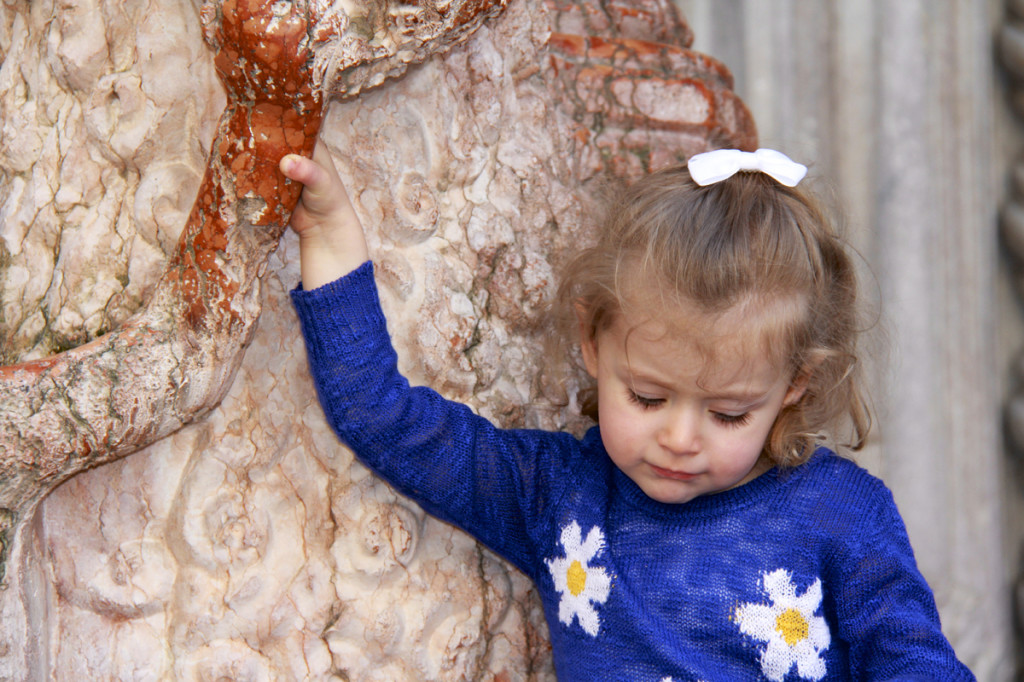
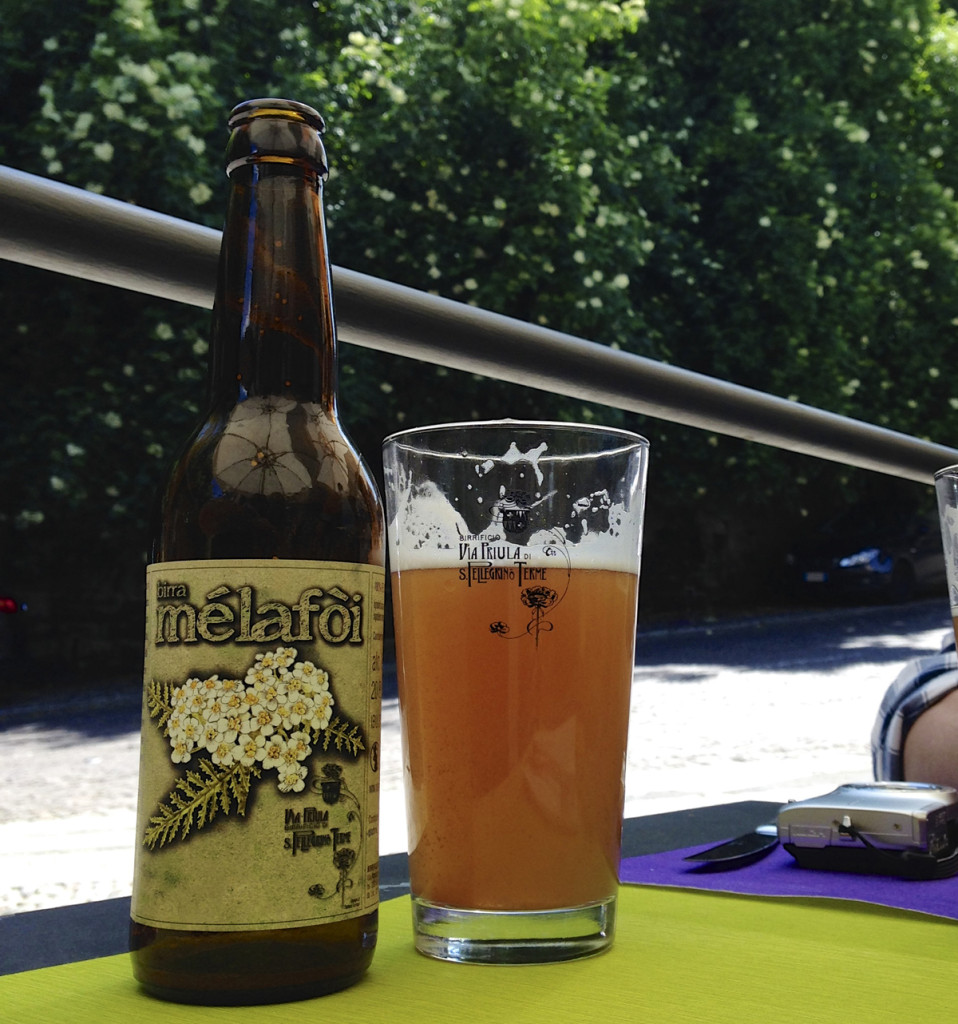
Streets centuries oldOne of the churches in the main piazzaJust outside the main piazzaJulia with a statue of a marble lionLa Tana – a fabulous restaurantJen’s sister, Jessica with JuliaThe waiter recommended a fabulous beer, produced locally. I’m still searching for where it’s sold
Eventually we descended to Città Bassa with plenty of daylight still above us. This gave us a perfect opportunity to enjoy an aperitivo (or two) in the sun. With our thirst quenched, we continued our tour of the lower city. This was the first time that Jen and I spent any notable amount of time down below and we were thrilled with what we discovered. The much more modern, lower city is just as special as the ancient city above.
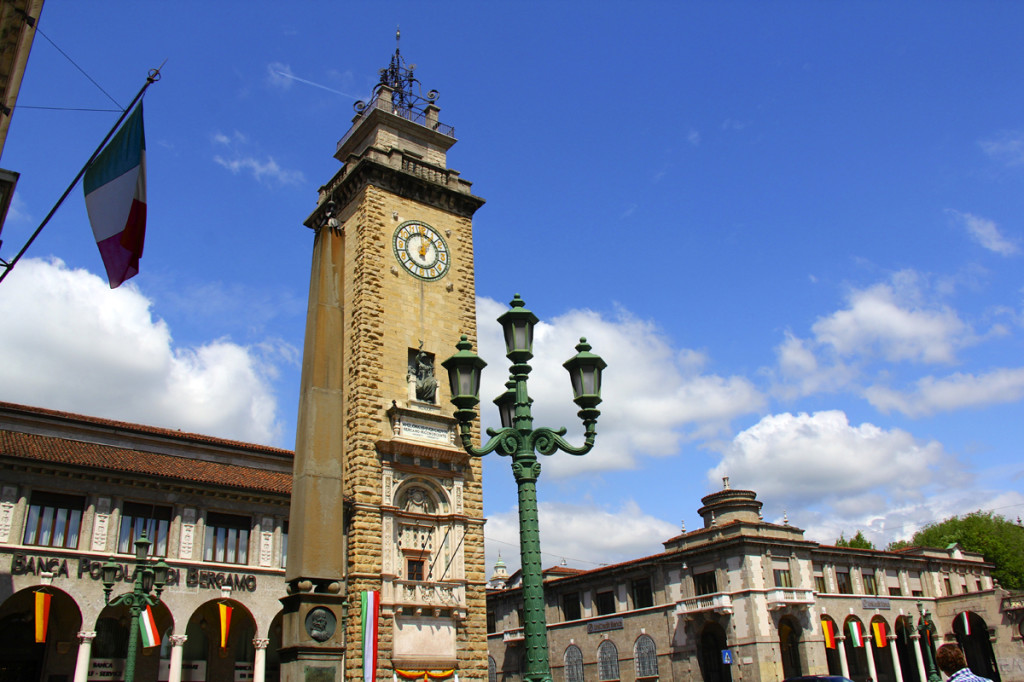
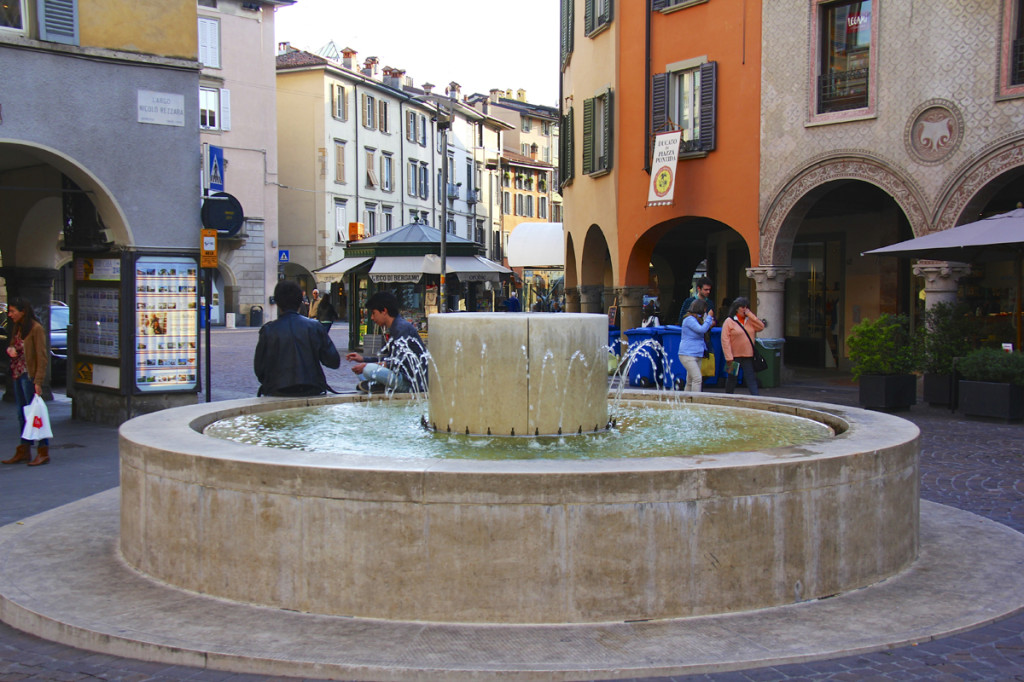
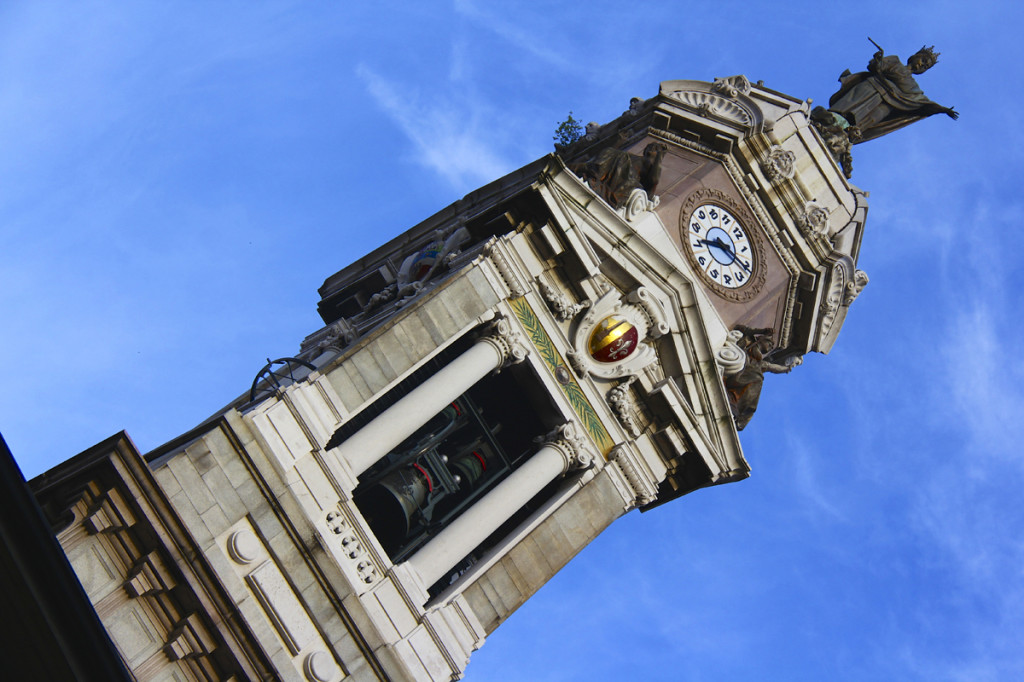
We stopped for happy hourThe lower city has a charm that rivals the higher cityThe streets are full of shops and caffèsChurch tower in Città Bassa
My only regret is that my photos don’t do this special city justice. I urge you to spend a full day exploring Bergamo and come discover for yourself why this is Italy’s “most underrated city”.
Sicilia (Sicily) was the birthplace of the original Godfather, Don Vito Corleone; its shoresharbored his son, Michael Corleone and recently the island hosted Don Greggorio and his small family. My only disappointment in visiting Sicily was that my wife, Jen wouldn’t let me wear a white suit and hat while walking around passing out fruit like I was Don Vito himself. Oh well, there’s always next time…
The sun rises over Catania. How can you be expected to walk around without a white suit?!
I was so excited to visit Sicily because I’ve wanted to see this unique part of the country for as long as I can remember. This region of Italy is so far south from where we live that I wasn’t sure if we would ever get the opportunity to explore the island while living here. Sicily boasts a plethora of interesting facts that I couldn’t begin to detail in a single post. However, perhaps the most interesting few points are that the island is the largest in the Mediterranean, archeological evidence dates human inhabitants are far back as 8,000 BC and the terrain has changed hands dozens of times (from Greek to Byzantine to Roman and all over again and again).
Coastline along SicilyÌsula Bedda is local dialect for Isola Bella, or Beautiful Island
While the capital city of Palermo is the largest and most populous on the island, Catania is another popular tourist destination and the port city that received us on our visit. The city also bore nostalgic significance – Catania was the birthplace and home of Jen’s bisnonna (great-grandmother), Rapisardi. Even though there is plenty to do in Catania, we decided to take the hour-long train ride up the coast to Taormina. We were not the first to make this journey – Taormina has been one of the most popular tourist destinations in Sicily since the early 19th century. However, we came at a particularly interesting time. The infamous Mount Etna had just erupted a couple of days before our arrival and evidence of the black soot was everywhere.
The black soot from the explosion of Mount Etna covered the entire areaThe beaches became black with sootJulia enjoyed walking on what became a black pathwayWe were all fascinated how far the soot traveled, literally blanketing the town
The rapid expansion of Taormina is believed to have begun around 345 BC. It originally started as part of the Greek empire before falling into the hands of the Romans. Today, the city remains high atop the ridges of the coastline, commanding a beautiful (and strategic) view of the sea. Before we could walk her ancient streets, we had to ascend the long and winding roads from the train station. We secured ourselves a cab and helped some other non-Italian speaking tourists get cabs of their own. Since there were more people than cabs, I offered to share our cab with a German couple. I arranged a pick-up time with the same cab driver at a discounted rate. Not only did we get to split the fare, but we got a discount by giving the same guy round-trip business. I’m always happy to find good travel deals!
Taormina has beautiful coastline and wonderful beachesThe city is nestled high atop the cliffsThe city is something truly wonderful to beholdWe enjoyed hiking aroundJulia took turns posing with her parentsWhat fun!Pretty gals and a pretty view“Momma… listen to me”Once again, Julia was a hit with the other tourists that wanted to hold her and take pictures
Upon arriving in Taormina, we spent some time walking around, soaking up the lovely street scenes. Eventually, we wound our way to the Teatro Antico di Taormina (Ancient Theatre of Taormina). The amphitheater is a fine example of Greek engineering that dates to the seventh century BC. What is most fascinating about this theatre (apart from its spectacular position overtop the Mediterranean) is that the use of brick in its composition hint at Roman construction (an era much later than the seventh century BC). But the design is that of ancient Greece. This architectural style in combination with other archeological elements has unfurled the prevailing theory that the Romans rebuilt the amphitheater overtop an existing Greek theatre. Today, the preservation of this ancient wonder is truly remarkable.
The view as an audience member in the amphitheaterThis ancient theatre dates all the way back to the seventh century BCThe design of the theatre is that of ancient GreeceThe views from the top of the theatre are remarkableJulia and I take a picture with the theatre and coastline behind usShe leans in for a hugI’m a lucky guy – Julia gives me a kissWe soak up the view together
After quite a bit of time exploring the amphitheater, we strolled through the city streets, marveling at the beauty behind each turn. However, we had more on our minds than just lollygagging. We were bound and determined to try arancini, which are essentially balls of fried rice. Of course, there is oh so much more to it than just that! This local Sicilian treat dates all the way back to the 10th century. The perfectly fried balls of heaven are often times stuffed with ragu, pancetta, cheese or other treats. We got a simple variation, just risotto fried lightly beneath breadcrumbs – we couldn’t be happier with our decision. I’ve included a link to a recipe HERE, although we haven’t tried to make them ourselves yet. We’ve since eaten arancini in other parts of Italy – but it’s never quite as good as it was that day in Sicily.
“Quick, dad – take my picture… photo-op!”Mandarini (mandarin oranges) were in seasonJulia found some pigeons that she became friends withJulia is no stranger to her winged friendsShe even made friends with a micino (little kitty)We loved the cityARANCINI! Amazing!!
We took our final walk through Taormina and back toward our departing ship. We had one last port to round out our time at sea – a day in the historic city of Naples.
W got one last look at the beautiful city streetsWe barely made it back to the ship before we set sail toward our final destination
If you read about our recent trip to Venice (HERE), then you’ll know that we finally unlocked the key to really enjoying Venice. In a nutshell, it involves beating the other tourists to the finish line. If the “finish line” is a guided tour in Palazzo Ducale (Doge’s Palace), then be the first person in line in the morning. If the finish line is grabbing a moment of solace in an empty Piazza San Marco, then you’d better be there as the sun rises (conversely, you can arrive well after the sun has set and listen to the beautiful music of the dueling bands). Or, more simply, you can do what we did; visit this magical city in the off-season and get to know the city of Venezia (Venice) without having to put up a fight.
San Marco Campanile and Doge’s Palace seen from the water
If you’re blessed with a couple of days in Venice, I would suggest that you go a bit deeper than the surface level attractions. Skip the gondola ride (it’s overpriced anyhow) and instead tour the neighboring islands. With 117 to chose from, you’ll have your pick. You can visit the Jewish Ghetto on the island of Cannaregio. Many of the beautiful parks and gardens on the island of Lido are free of charge to you botany lovers. Or, for the real adventurers, you could opt to wade into the marshes and cast nets with local fishermen near the island of Chioggia.
The Church of San Giorgio Maggiore Church on the island that shares the same name
We knew that we wanted to visit the island Murano and watch how the world-famous Venetian glass was blown. This would require a little preparation and so I enlisted the assistance of a guided tour. I discovered a wonderful website that offers local tours at very reasonable prices – Viator. Travel bugs, take note of that website! It is a great resource for sight-seeing tours in cities all over the world. We will definitely use them again; my only regret was not discovering the website sooner. When searching for a tour of Murano, we found a better option – a tour that also included the islands of Burano and Torcello. You can find the link to our specific tour HERE. I bought my tickets ($28 pp) and had the confirmation sent to my smart phone. I showed up at the designated area, presented the pass on my phone and received our tickets to the boat. Easy, breezy, lemon-squeezy.
Venetian workers were out in the early morningWorking on the water here is no different than working on a truck in another city
Before our tour departed the main island, we had enough time in the early morning to drop by Venice’s famous fish market. The Mercato di Rialto (Rialto Fish Market) is in the area affectionately known as Cuore della Città (heart of the city) behind the Rialto bridge. This area by the famous bridge was settled in the 9th century and becoming a booming marketplace by 1097. Today, the fish market still stands as a wonderful place to visit and buy fresh seafood.
We enter the market – the Winged Lion of San Marco warns not to touchThe ladies are excitedPESCE (FISH)!This guy looks tastyThe granchi (crabs)I wouldn’t want to get bit by this guyThe displays were beautifulThere was also wonderful looking produce – these are delicious peperonciniA butcher – this one specializes in horse meat, common to find in Italy
After viewing the market, we wound our way to the tour meeting-point next to San Marco Square. Our four-hour tour included a professional guide, a glass-blowing demonstration in Murano, a hand-crafted lace demonstration in Burano and round-trip transportation to all three islands via boat. I thought the price was very reasonable for all that was included, but truth be told – the price paid for little more than transportation. The guide was impossible to understand over the boat’s roaring engine. All in all, I’m still happy with the deal and it forced us to be back on our cruise ship in time for departure. Nothing like being stranded on a remote Venetian island and watching your cruise ship sail past to ruin your vacation!
Julia walks on the pier of Burano
Venetian glass, which is more commonly referred to as Murano glass today, is widely recognized as one of the most specialized and beautiful hand-crafted items the world over. Venice emerged as a prominent glass manufacturing center as early as the 8th century. The origins of glass making going back to the Roman Empire when molded glass was used to assist in the illumination of bathhouses. The island gained it’s notoriety when the Venetian glass blowers were all ordered to move their foundries to the island of Murano in 1291, for fear of fire on the main island. By the fourteenth century, the glassblowers were considered among the most elite of Venetian citizens. The closely guarded secrets developed on the island laid the foundation for a glassmaker monopoly on high quality glass that lasted for centuries. Our tour guide explained that even to this day the artisans of Murano are highly trained in this unique skill that is closely monitored by the Glassmakers Guild. Among other things, a Murano glassmaker must be the son of a tenured glassmaker and apprentice for twenty years before being allowed to make his own glass. A “young” glassmaker on the island would be someone who is in his mid forties.
We toured this factory, C&A GiserrieriThe artisan stands next to his furnaceHere he shapes or “marvers” the glass by rolling itNext, he “cuts in” to score the piece’s neckThis is where he is “trimming the lip” with shearsAnother example of design, he quickly molded a horseHe demonstrated the heat of the piece by simply laying a piece of paper on her neck, which immediately burst into flames
Next, we set sail for Burano, which is known mainly for its painted houses and the church of San Martino’s leaning campanile (bell tower). They also have an established reputation for their creations of lace.
As we sailed toward Burano, we could clearly see the leaning bell tower (in the background)A better shot of the bellower – it is leaning quite a bitThe painted houses were something to beholdThere were canals just like on the main islandThe vibrant colors were really something else!We loved strolling around and taking in all the beauty of the island
Lastly, we finished on the island of Torcello. We were surprised to learn that this was actually the first island to be settled by Venetians, and once held the largest population of the Republic of Venice. Today, you can hardly see evidence of this; the island is so sparsely inhabited that only a few structures remain and the inhabitants number fewer than a couple dozen. The main attraction nowadays is the Cattedrale di Santa Maria Assunta (Cathedral of Santa Maria Assunta) founded in 639 AD.
Torcello was very different from the other islands of Venice proving that each island offers it’s own unique beautyJulia and I walk along the ancient canal in TorcelloSince it was cold, we warmed up with a little vin bruléJulia and I take a stroll over this bridgeSanta Maria Assunta (left) and Santa Fosca (right)The historic Santa Fosca church – you can distinguish the Byzantine influence
If you are planning a trip to Venice anytime soon, I would definitely recommend a tour of the peripheral islands. If you discover any other fun places to visit, please drop me a line and let me know!
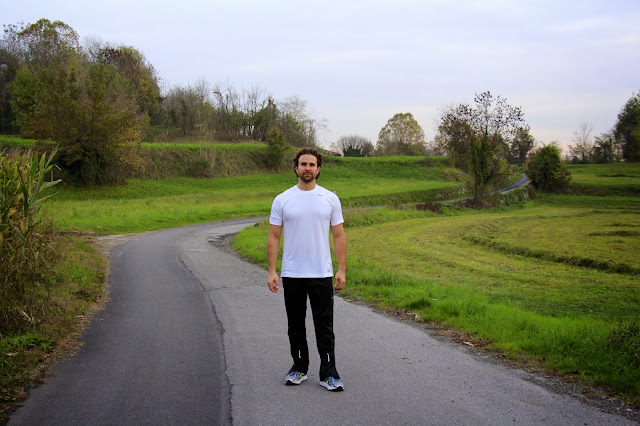
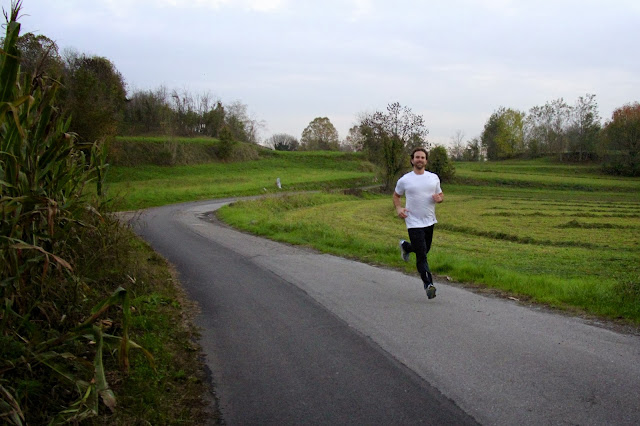
I have a love-hate relationship with running. I love the feeling of finishing a five or six mile run. I hate the agony I get in my calves the next day. I love pushing myself to run a distance further than I’ve ever run before. I hate pushing myself through that first mile after foolishly taking four months off during the winter. Currently, I’m learning to find a proper balance in my on-again off-again relationship with running. Since living abroad, I’ve discovered a renewed commitment to running. I am lucky enough to have some of the most amazing routes in my own backyard – a benefit that definitely keeps me on the trail a little longer.
“Please, come join me along my run”
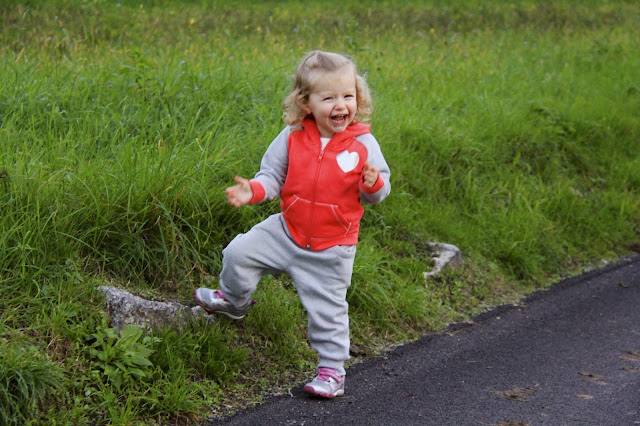
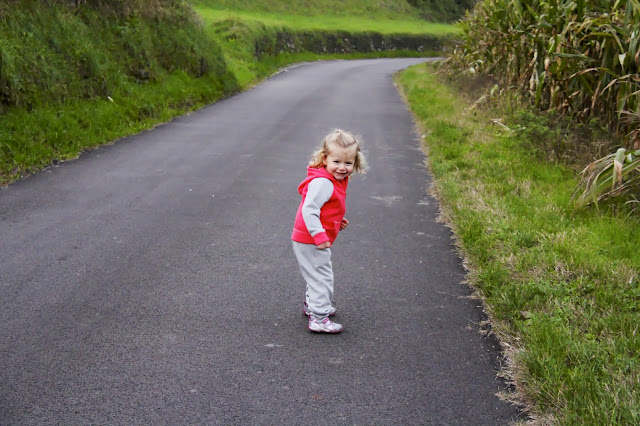
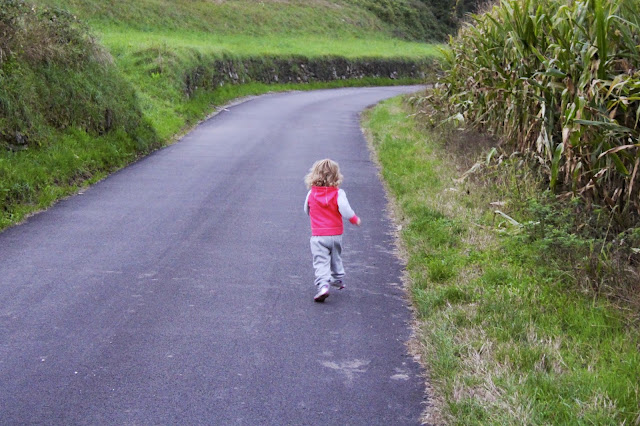
Julia loves to join me on an occasional run
We have been really lucky with some wonderful weather this fall. Just this morning, I went for a jog in shorts and a lightweight jacket. I understand it’s a lot colder at home, so I would like to invite you to “come for a run with me”. I have several routes that I take on a regular basis depending on how long, how far, or how much of a vertical climb I want. Or sometimes, I’ll just go out and try to find something new.
Running along the trail
“I want to go for a run with you guys!”
“Here I go!”
One of my favorite routes (and probably the one that I take most consistently) is a 5K loop (3.1 miles) around the neighborhood. I have taken many of the friends and family that have visited with me on this very same run. And now you can join me! I’ll map the distances, using mapmyrun so that you know how far we’ve gone.
Let’s get started…
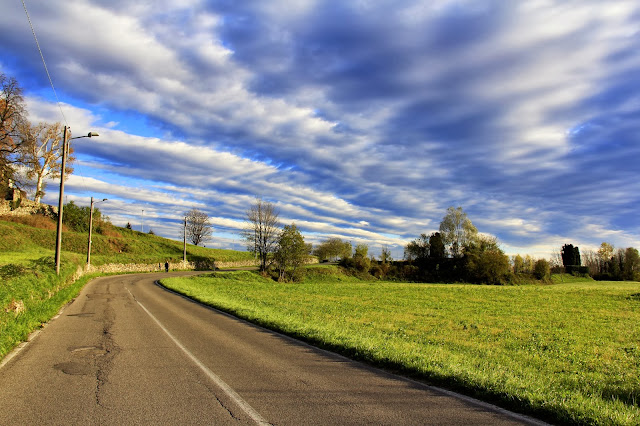
WE TURN RIGHT OUT OF THE NEIGHBORHOOD, HEADED DOWN STRADA PROVINCIALE – WATCH OUT FOR CARS DURING RUSH HOUR
.15 miles
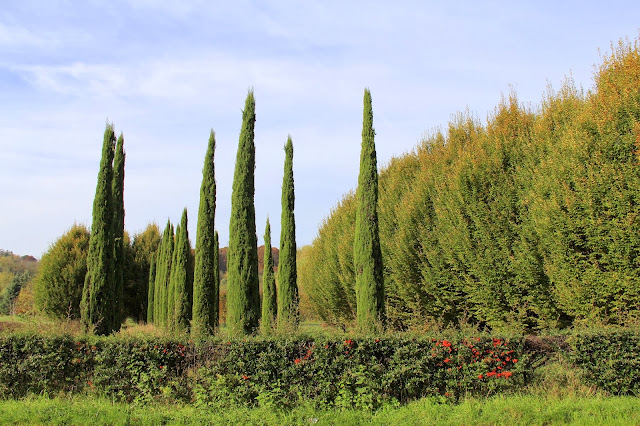
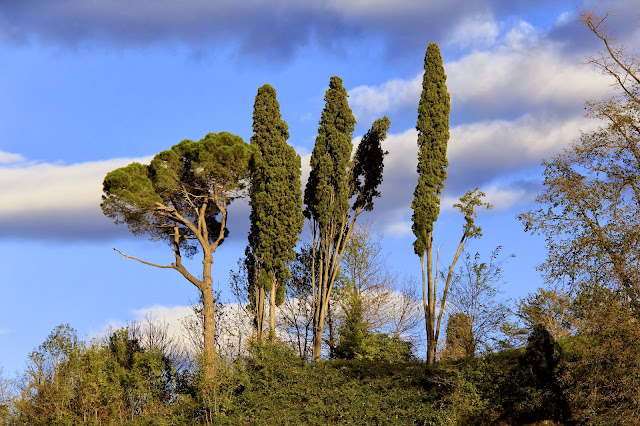
SOON WE’LL COME UPON A BEAUTIFUL COLLECTION OF ITALIAN CYPRUS TREES
.27 miles
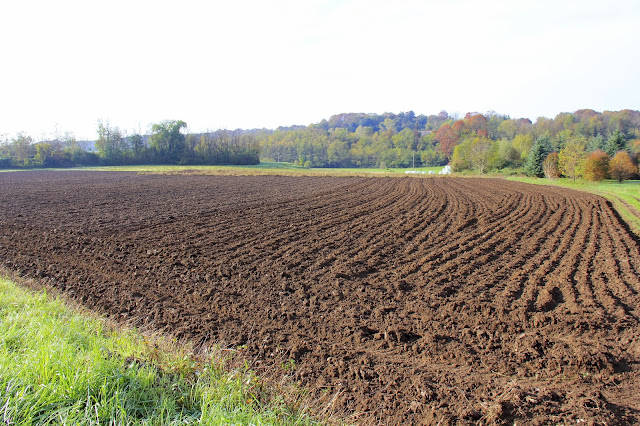
SUBSEQUENT TO THE TREES WE’LL SEE THIS FIELD, WHICH MEANS YOU WON’T HAVE A PLEASANT AROMA FOR THE NEXT 1/10 OF A MILE
.29 miles
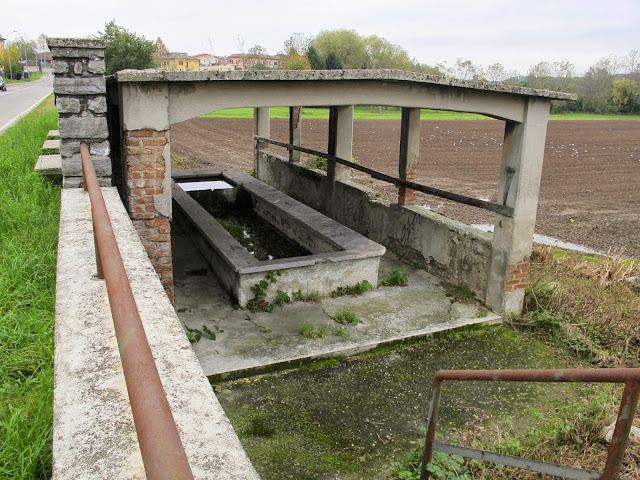
WE PASS A LAVATOIO (WASH BASIN) THAT IS AT LEAST 120 YEARS OLD – THIS WAS ONCE USED TO CLEAN THE CLOTHES OF THE PEOPLE NEARBY
.33 miles
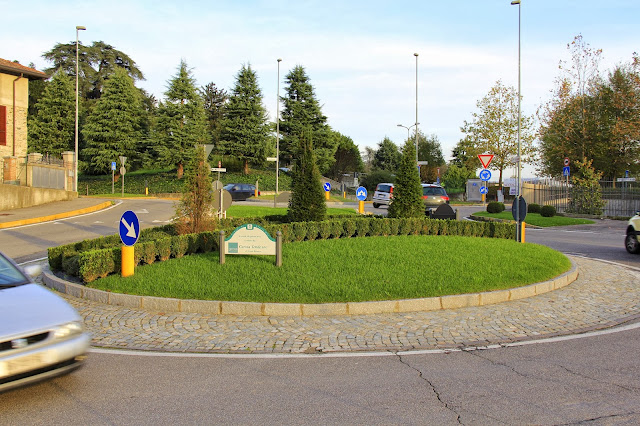
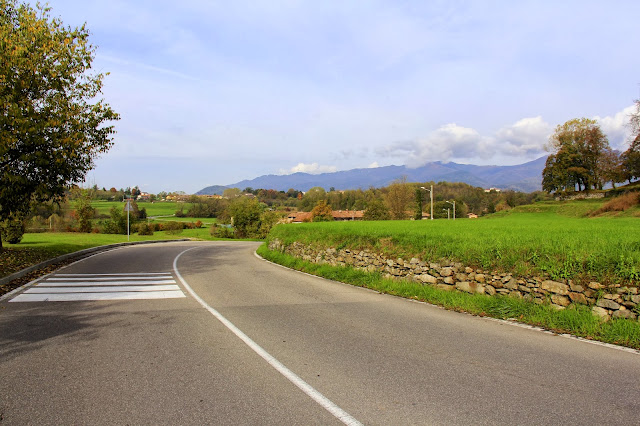
AT THE TOP OF THE HILL WE COME SMACK INTO THE DANGER ZONE! THE DOUBLE ROTONDA(ROUNDABOUT) – BE CAREFUL HERE!
.47 miles
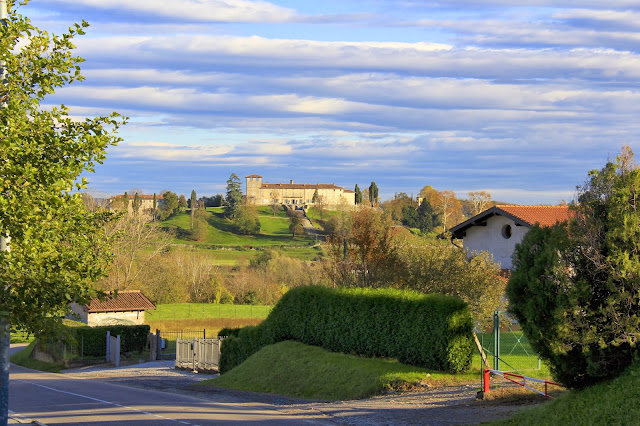
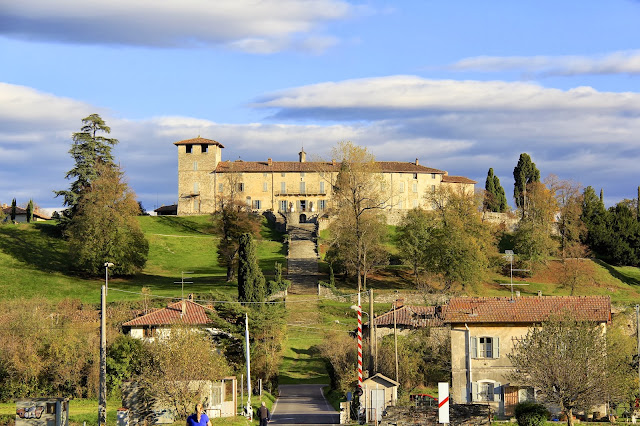
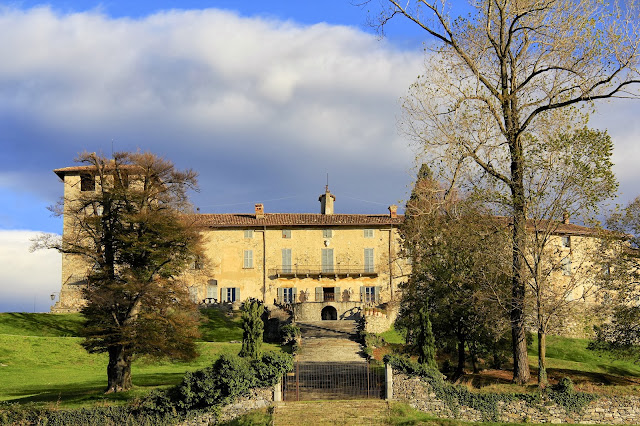
THIS IS ONE OF MY ABSOLUTE FAVORITE PARTS OF THE RUN, WHERE THE VIEW SPANS FOREVER AND AN ANCIENT VILLA REACHES FOR THE CLOUDS
.75 miles
WE START A MILD DESCENT
.84 miles
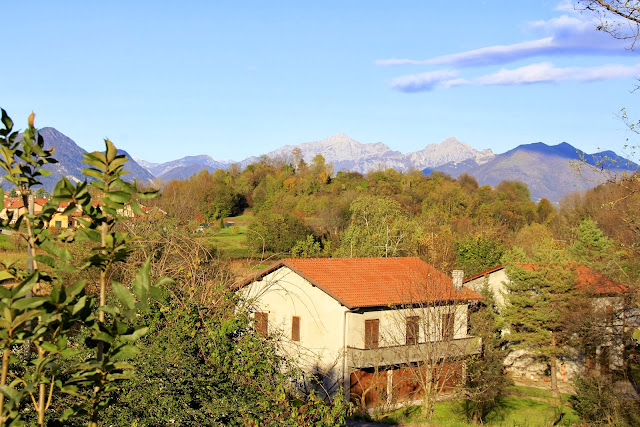
QUICK! LOOK LEFT – THERE IS A BRIEF OPENING WITH A STUNNING VIEW
.87 miles
.87 miles
.87 miles
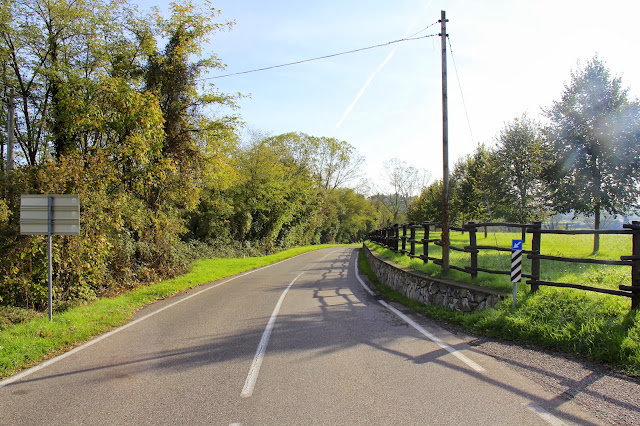
KEEP ON MOVING, BUT BE SURE TO HUG THE FENCE LINE TO YOUR RIGHT. CARS ARE LIABLE TO FLY BY
.90 miles
.91 miles
GET READY TO ROUND THE BEND – WATCH OUT FOR CARS AND BICYCLES
.93 miles
.99 miles
CONGRATULATIONS – WE JUST FINISHED OUR FIRST MILE! PEEK TO YOUR LEFT FOR A UNIQUE VIEW OF THE VILLA
1.02 miles
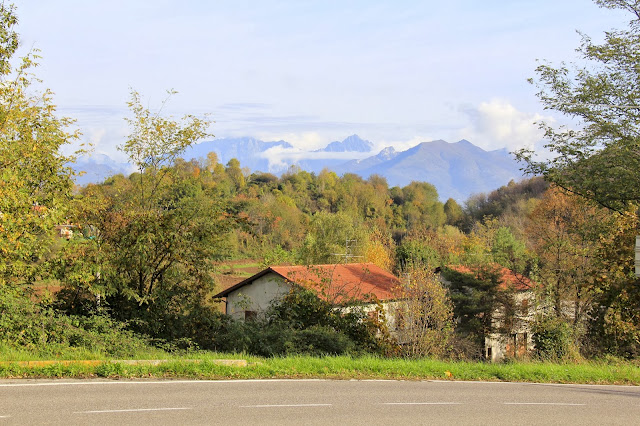
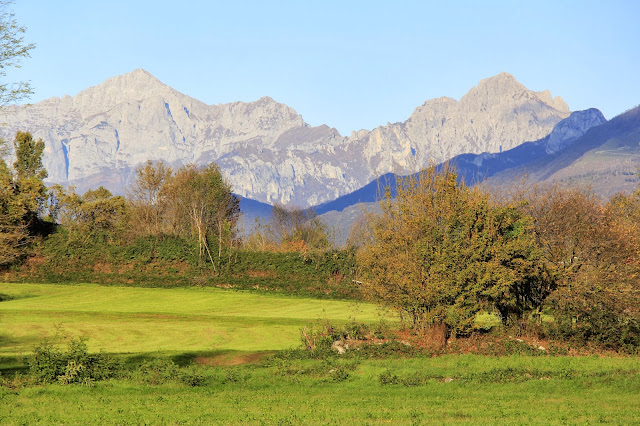
DON’T FORGET TO LOOK LEFT INTO THIS OPEN FIELD AND BEYOND TO THE MOUNTAINS…
1.13 miles
1.15 miles
1.15 miles
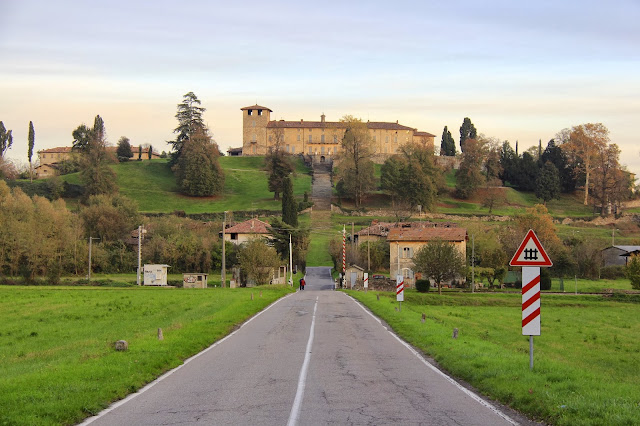
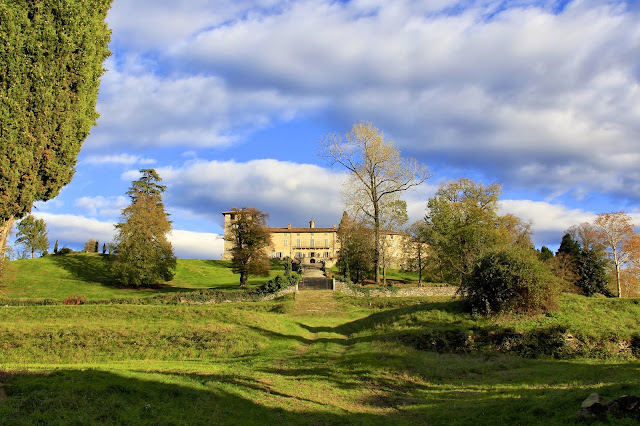
NEXT, LOOK AHEAD AS THE VILLA MATERIALIZES IN FRONT OF YOU
1.15 miles
1.16 miles
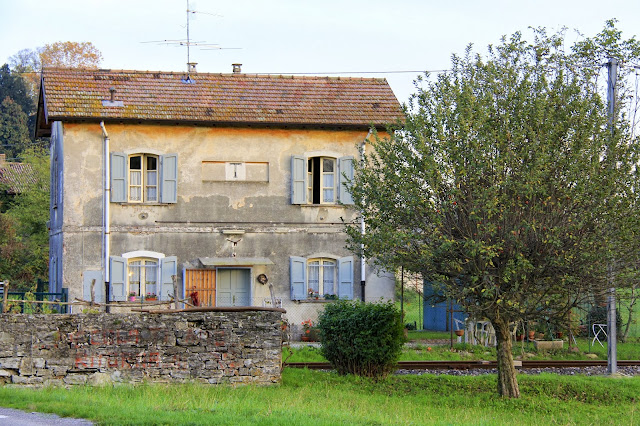
I OFTEN WONDER HOW MANY THOUSANDS OF TRAINS THIS LITTLE HOUSE HAS SEEN PASS BY
1.18 miles
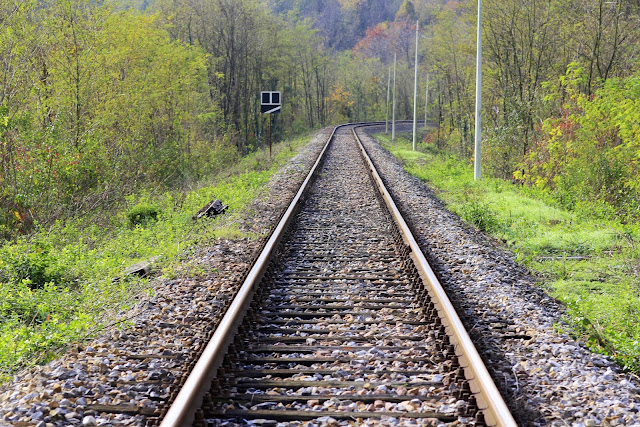
CROSSING OVER THE RAILROAD TRACKS – BE CAREFUL
1.19 miles
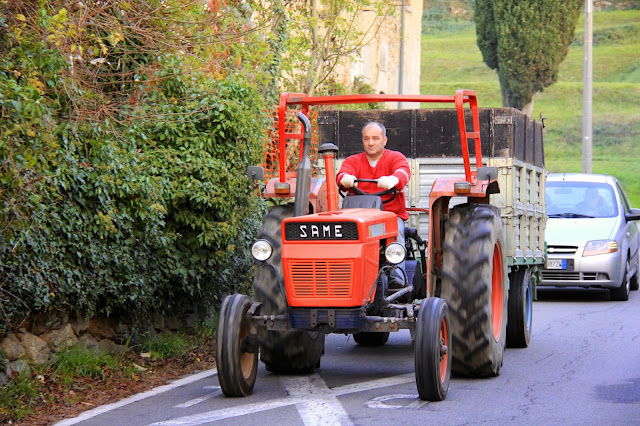
YOU’RE JUST AS LIKELY TO PASS A TRACTOR AS YOU WOULD BE TO PASS A CAR
1.25 miles
1.27 miles
1.27 miles
I LOVE THIS GROUP OF UNIQUE TREES ON THE PROPERTY
1.27 miles
NEXT, WE WILL START OUR ASCENT UP AN ANCIENT ROAD
1.32 miles
1.41 miles
A GLANCE BACK OVER OUR SHOULDER LETS US KNOW WHERE WE’VE RUN
1.44 miles
1.44 miles
1.44 miles
HERE, WE CAN CHECK OUT THE LOCAL EVENTS FOR OUR COMMUNITY
1.47 miles
LOOK TO YOUR LEFT TO SEE ONE OF THE MANY CHURCHES IN THE AREA
1.48 miles
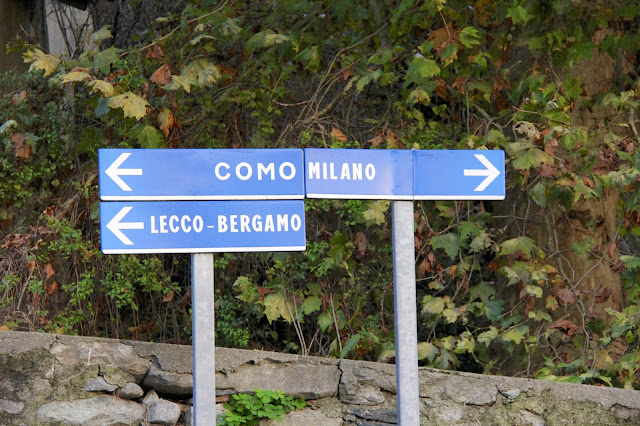
WE HAVE AN IMPORTANT DECISION TO MAKE HERE… I DON’T SUPPOSE MY LEGS WILL CARRY US THE 40 KM (24 MILES) TO MILANO, SO WE’D BETTER GO LEFT
1.58 miles
THE ROAD CROSSING IS A LITTLE DICEY HERE – LOTS OF BLIND SPOTS. I ALWAYS HUSSLE PAST THE CRYPT TO OUR RIGHT
1.61 miles
1.65 miles
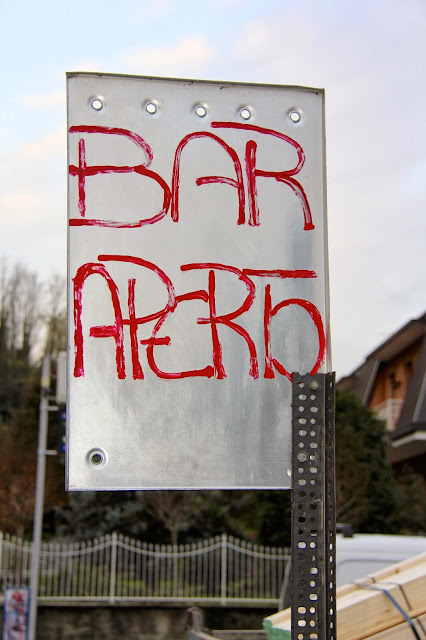
HERE, WE PASS A BAR THAT IS “ALWAYS” OPEN
1.65 miles
THE BAR – FEEL FREE TO STOP FOR AN ESPRESSO IF YOU FORGOT TO HAVE YOURS BEFORE OUR RUN
1.65 miles
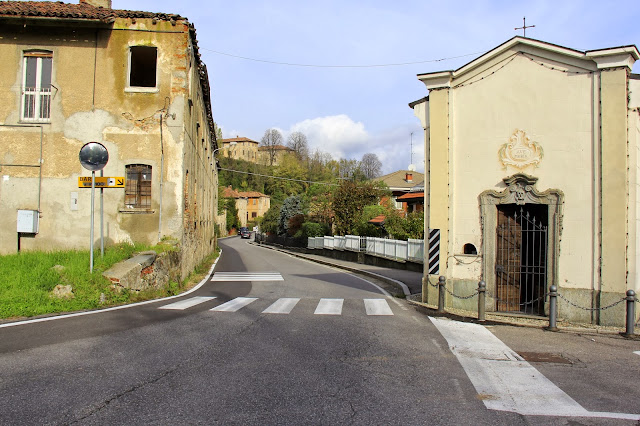
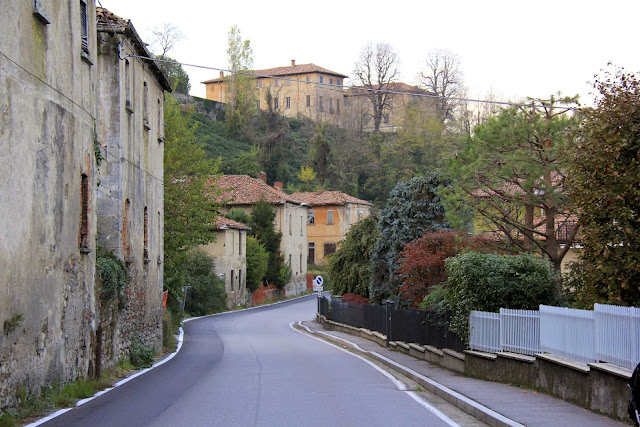
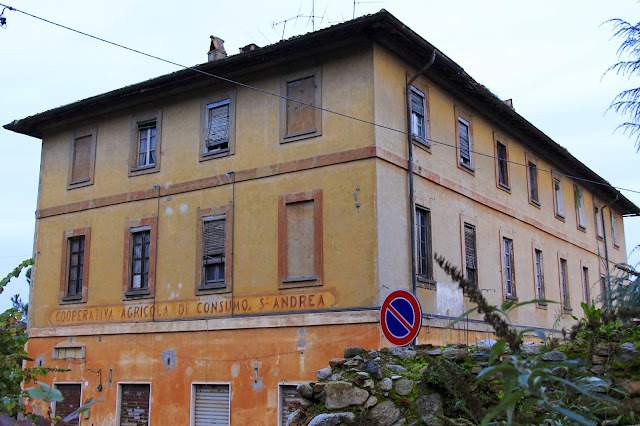
WE WILL NEXT PASS A SECTION OF TOWN THAT EXPERIENCED IT’S HEYDAY 50 YEARS AGO… 100 YEARS AGO… 200 YEARS AGO?!
1.75 miles
1.77 miles
1.78 miles
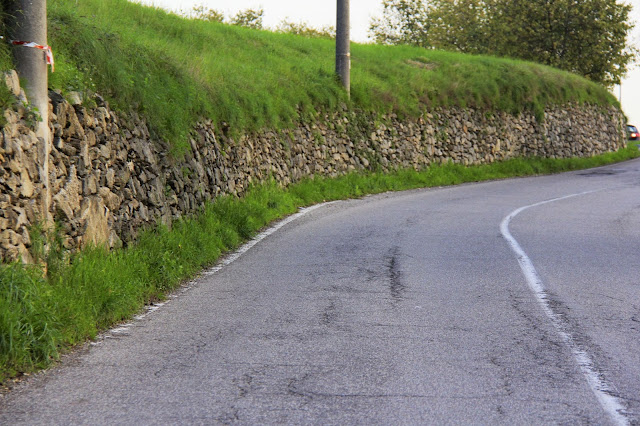
BE CAREFUL – THE ROAD IS VERY NARROW – TOO TIGHT FOR TWO CARS TO PASS AT ONCE. IT’S NOT UNCOMMON TO GET PINNED AGAINST THE RIGHT WALL
1.79 miles
LOOK TO YOUR RIGHT – QUITE A VIEW OF THE VALLEY. TO OUR PREVIOUS GUESTS… DO YOU RECOGNIZE THE BENNET (OUR GROCERY STORE)?
1.83 miles
WE HAVE TO MAKE A SHARP LEFT OFF THE MAIN ROAD AS WE APPROACH ANOTHER FAVORITE STRETCH OF THE RUN
1.90 miles
1.92 miles
THIS TWO LANE ROAD BECOMES EXTREMELY NARROW – I PREFERRED WHEN IT USED TO BE MUCH MORE RUGGED. THEY RECENTLY PAVED IT… WELL HALF OF IT
2.05 miles
2.08 miles
2.11 miles
2.11 miles
2.11 miles
CONTINUE ALONG THIS REMOTE ROAD
2.19 miles
WE PASS A CORNFIELD ON OUR RIGHT – THIS WAS JUST HARVESTED THREE DAYS AGO – I THINK THEY USE IT AS CATTLE FEED
2.25 miles
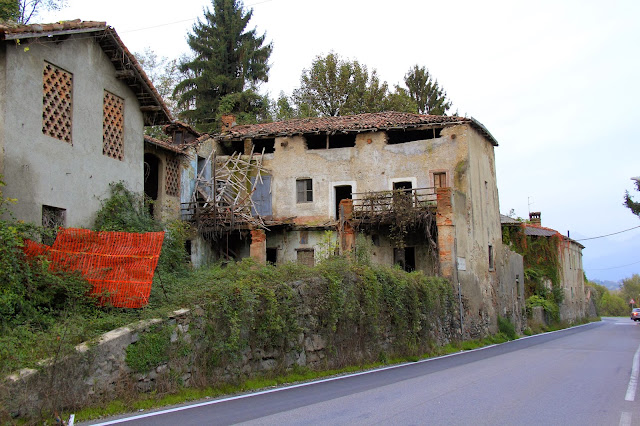
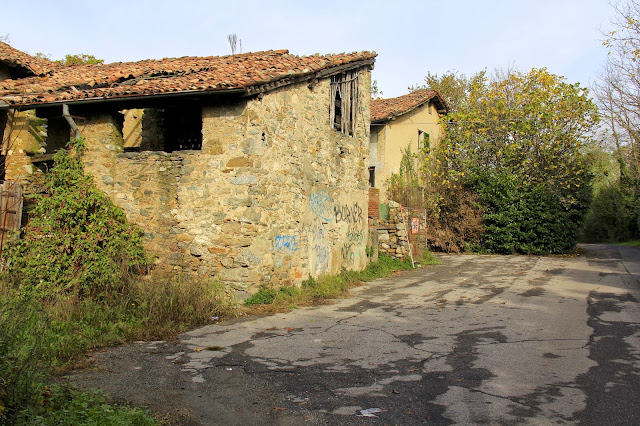
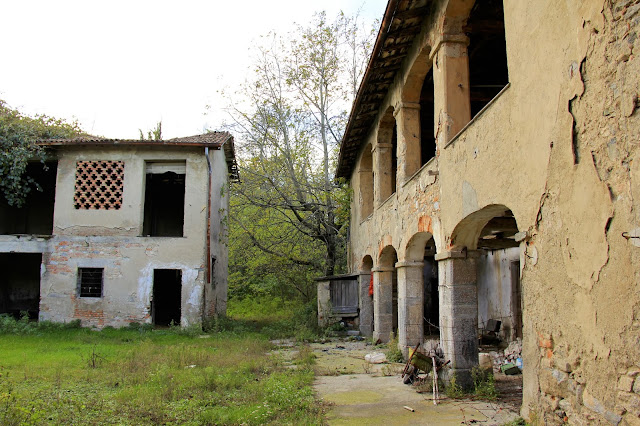
WE APPROACH AN INTERESTING PART OF THE RUN… ANOTHER SECTION OF HOUSING WHOSE HISTORY ENDED LONG AGO. I OFTEN WONDER WHEN A NEW STORY WILL BE WRITTEN FOR THESE ANCIENT PROPERTIES
2.38 miles
2.40 miles
2.41 miles
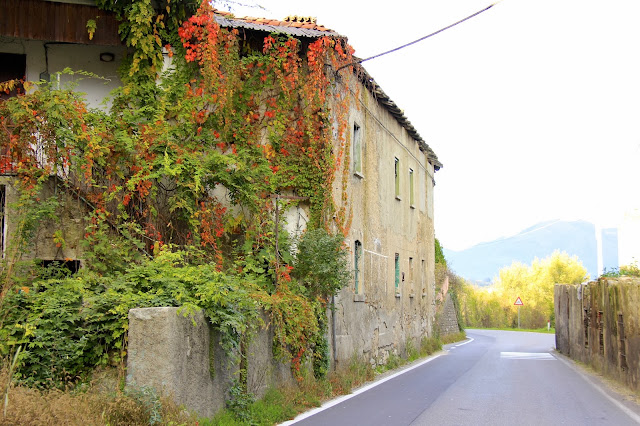
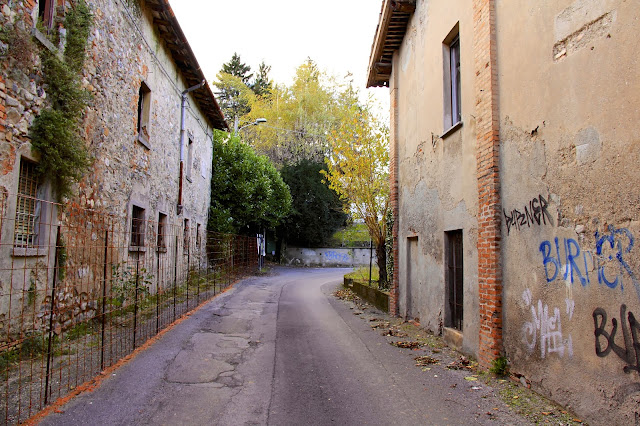
WE PASS THROUGH OUR FINAL STRETCH OF OLD, VACANT PROPERTIES
2.47 miles
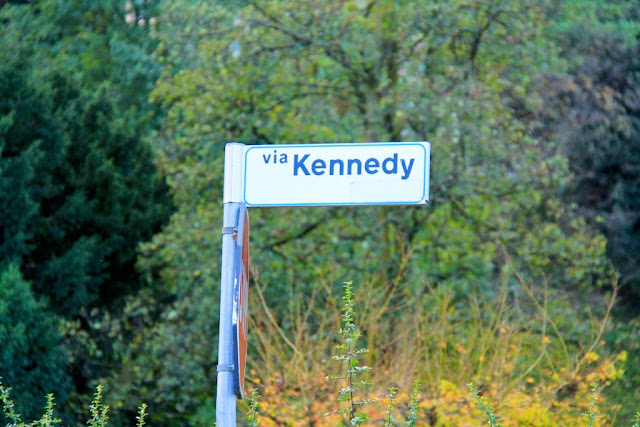
NOW WE WILL TURN ON TO VIA KENNEDY, WHICH ALWAYS CRACKS ME UP
2.53 miles
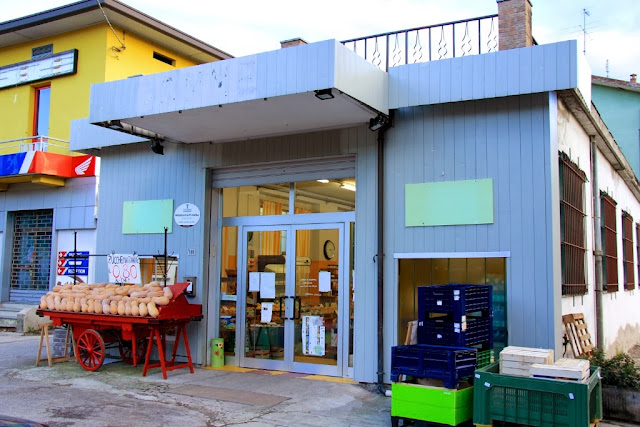
NOW THAT WE’RE BACK IN TOWN, IF YOU GLANCE OVER YOUR RIGHT SHOULDER, YOU WILL SEE OUR FAVORITE FRUIT STAND – YOU CAN SEE THAT ZUCCHE (SQUASH AND PUMPKINS) ARE THE SEASONAL VEGETABLE
2.70 miles
OK – DIG DEEP. WE’VE GOT AN UPHILL CLIMB, BUT WE’RE IN THE FINAL STRETCH. WE’RE GOING TO RUN RIGHT THROUGH THE CENTER OF TOWN
2.83 miles
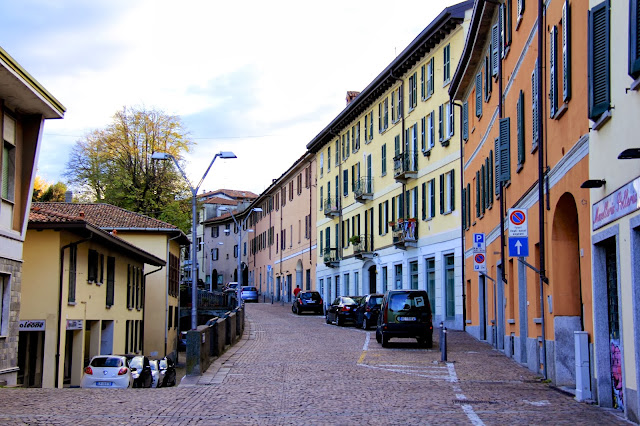
LOOKING LEFT, YOU’LL SEE MY FAVORITE STREET IN OUR TOWN OF ALZATE BRIANZA
2.89 miles
THIS IS IT… NEARLY HOME. A SLIGHT DOWNHILL DESCENT HELPS US – TIME TO PICK UP THE PACE… MY BROTHER-IN-LAW CALLED THIS MY FINAL “KICK”
2.91 miles
WE’VE ARRIVED AT THE ROTONDA BY OUR HOME – FULL SPRINT NOW WITH WHATEVER IS LEFT IN THE TANK
3.03 miles
TURN RIGHT DOWN OUR STREET…
3.05 miles
WE DID IT!! WE’VE ARRIVED HOME JUST IN TIME FOR LUNCH. PASTA IT IS – HEY WE EARNED IT!
3.10 miles – nicely done
IF YOU’D LIKE TO REWARD YOURSELF WITH A NICE DRINK LATER IN THE EVENING, HEAD BACK INTO TOWN TO THE AB CAFE
The best “happy hour” in town
Don’t forget, gang – there’s always time to stop and smell the roses
I hope you enjoyed coming with me on my run today! I certainly appreciated the company!
Jennifer, Julia and I had a wonderful time when my Uncle S and Aunt Deborah came to visit us this past March. That’s why we were thrilled when they mentioned that they would like to come back to Italy again this fall. They wanted to do a bit of traveling and invited us to join them on their adventures, using our condo in Como as a “home base”. They had sketched a rough itinerary and just wanted a little help filling in the blanks – assistance I was happy to give. They knew that they wanted to spend some time with us here in Como, some time in Piemonte and Emilia-Romagna (two regions adjacent to our region of Lombardia) as well as a quick jaunt down to the historically significant city of Pompeii and another to Venezia.
S and Deborah standing near the divide of Lake Como
Jen and I share the responsibility of planning our trips – researching restaurants, activities and hotels. But they’re usually in three or four day stints and one location at a time. This time, I had to navigate through a two week itinerary, complete with activities, restaurants, hotel stays and all at new locations each day. Putting the puzzle pieces of their trip together was a challenge not for the faint of heart. Jen and I dug in, and by the time S and Deb landed in Milan, we had an itinerary that we were both proud of. I think all of us agreed that it came together quite nicely. Of course, the key ingredient was the company, mixed with a little food and wine!
I manned the grill for a family feast on their second night. I’ll get Franco to smile for one of these pictures, yet…
S enjoys a little grappa after our meal
S gives us a thumbs up as he displays our first two days worth of “work”
We divided the trip into the three things that Italy is best known for. Part I was wine. Part II was food. And part III was history. Jen and I accompanied S and Deb for parts I and II (our personal favorites) and let them venture off on their own for part III. This clean break in adventures divided the trip quite nicely and will also allow me to easily organize these blog posts into two parts. Easy breezy, vino-squeezy. However, before we hit the open road, we spent a day here on Lake Como in one of our favorite towns – Bellagio (if you’ve been reading this blog for a little while, you’ve seen us here many times before). The unique beauty of the town is like nothing else on the world.
The weather was absolutely beautiful the day we drove to Bellagio
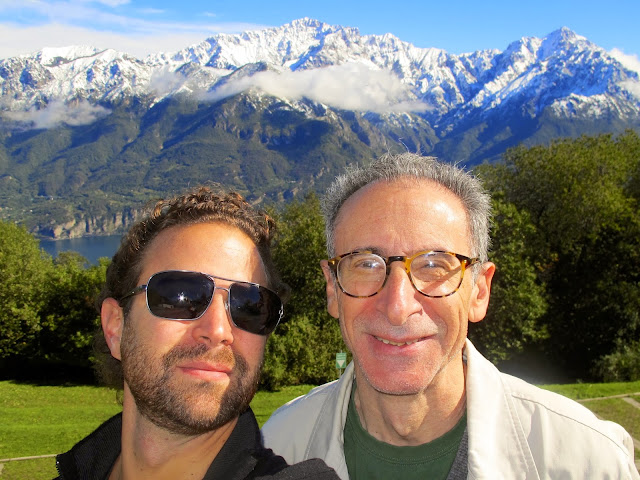
I teach my uncle how to take a “selfie” (after explaining what a “selfie” was)
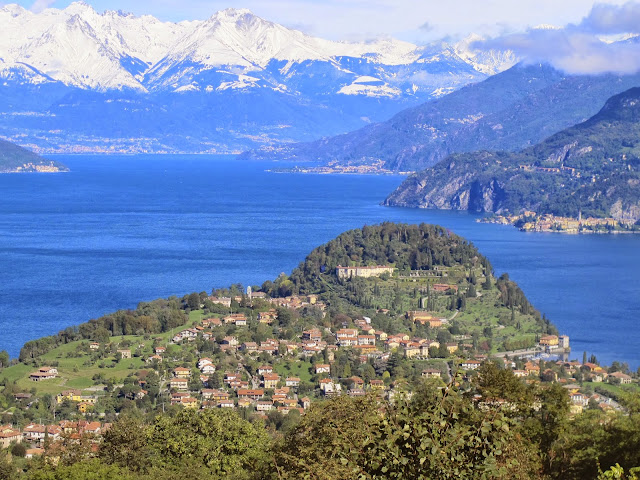
Bellagio from above – a unique vantage point. Bellagio divides Lake Como into the two “legs”
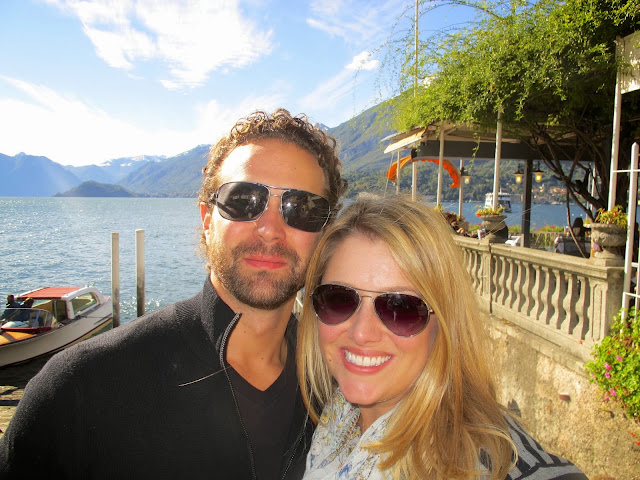
Jen and I pose for a picture
S and I take a picture together
My two girls
Bellagio is a beautiful town at the center of Lake Como
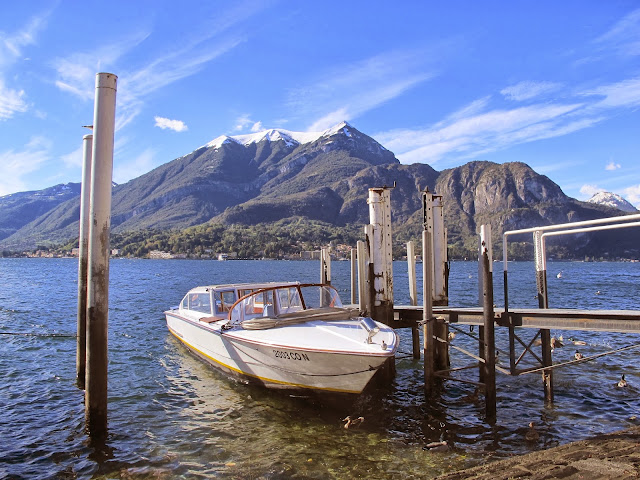
A boat rests after bringing passengers from another lake town
“Hey… I think I’ll make this my profile pic”
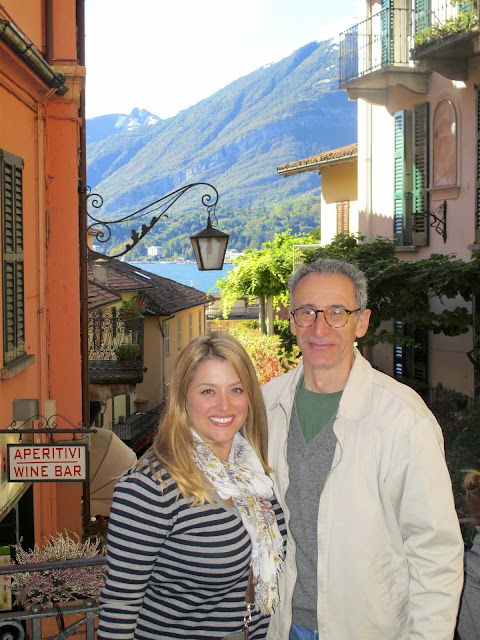
Jen and S stand near the wine bar where we had lunch
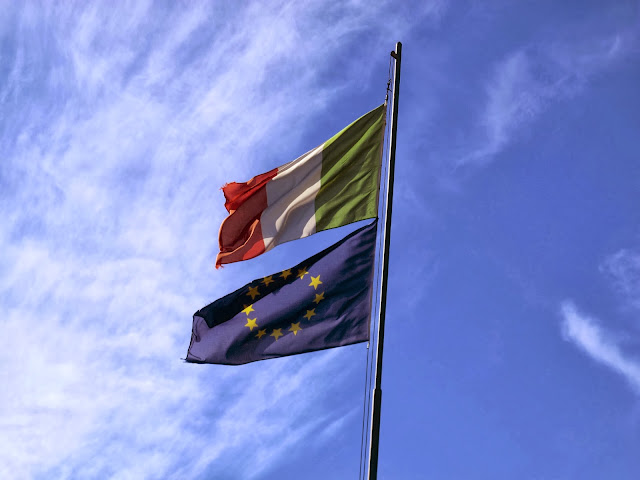
The Italian flag blows in the wind alongside the European flag
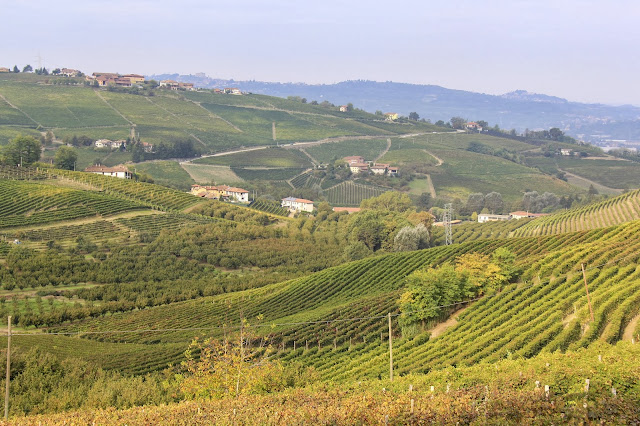
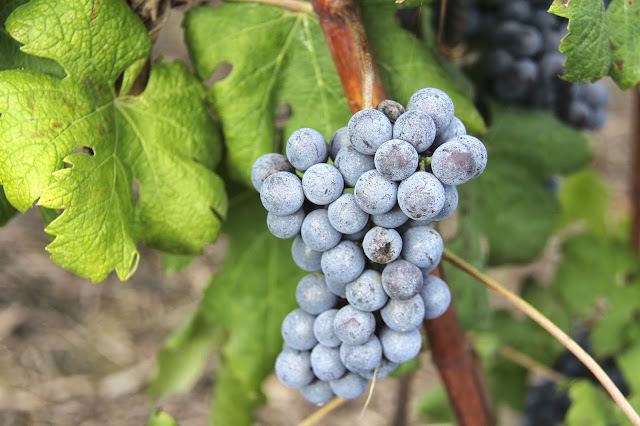
Piemonte (Piedmont) is a region in northwest Italy that borders France to the west and [our region of] Lombardia to the east. The capital city of Piemonte is Torino, which was once the capital of all of Italy and the springboard for the unification of the country. Of the twenty regions in Italy that each produce wine, Piemonte is probably the most well-renowned for their vintages. The rolling hills and mild climate result in some of the world’s best wine – the Barolos and Barbarescos produced here are often the prize jewels of wine cellars the world over. These wines, made primarily from the nebbiolo grape age very well, and in fact improve and develop richer and more powerful flavors as the decades pass. It was easy that to recognize that this portion of our trip was going to be entitled simply, Vino (wine).
The rolling hills of Piemonte are a perfect place to grow grapes
They look delicious now… just wait until they are turned into a Barolo or Barbaresco
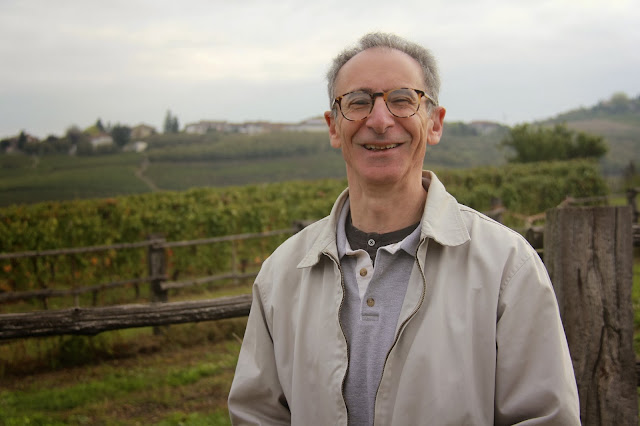
S stands in front of a field of grape vines early in the morning
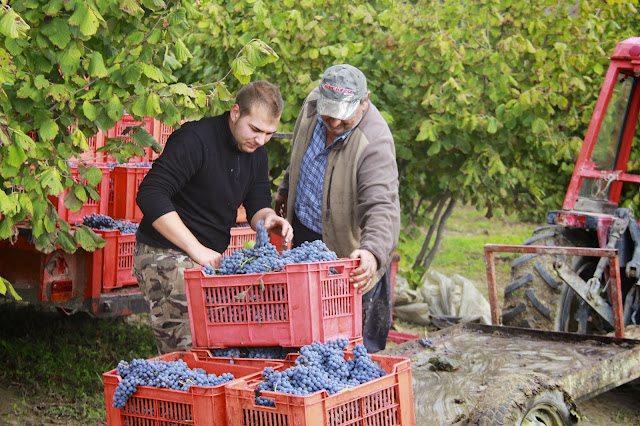
A father and his son load grapes onto a flatbed during their harvest
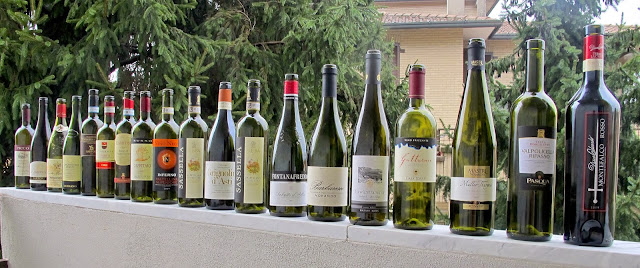
The finished product of our five nights together in the condo – wine was definitely a theme central to their visit
We spent the first day of our road trip in the small village of Barolo. During our drive to Barolo, S imparted some of his knowledge about the famous wine, which I’ll now share with you. Historically, Barolo wines were very rich on tannin and therefore could require as many as ten years to soften enough to drink. The long fermenting time and aging process in large, wooden barrels causes this complexity in the wine. The problem with this method is that it is very time-consuming and therefore expensive. A newer breed of producers have cut the fermenting time by as much as 2/3 and age the wine in smaller, French oak barrels. This allows the consumer to drink the wine much earlier and appeals more to the more modern, international palate (it creates a fruitier wine). As an aside, the more modern palates that prefer “big”, fruitier wines is often attributed to world-famous wine critic, Robert Parker (often referred to as the “Parkerization” of wine). The differing styles in Barolo has created a controversy between “old” and “new” – a conflict often referred to as the, Barolo Wars.
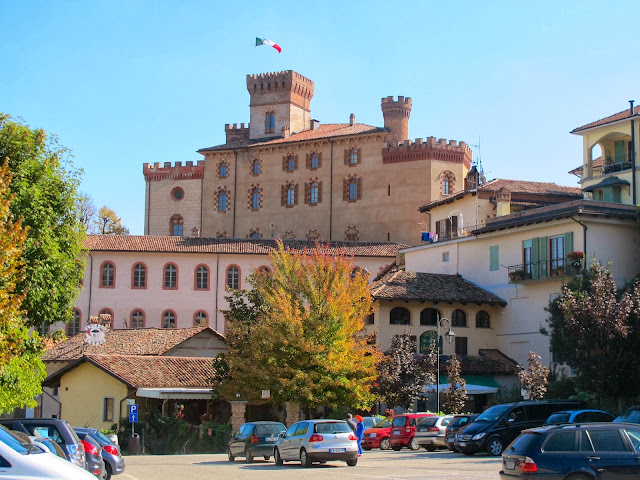
Castello di Barolo stands proudly overtop the town with the same name
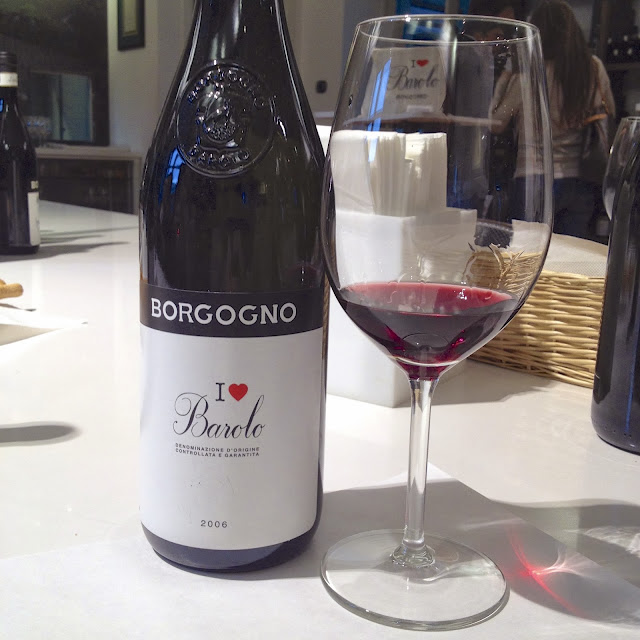
I ♥ Barolo!
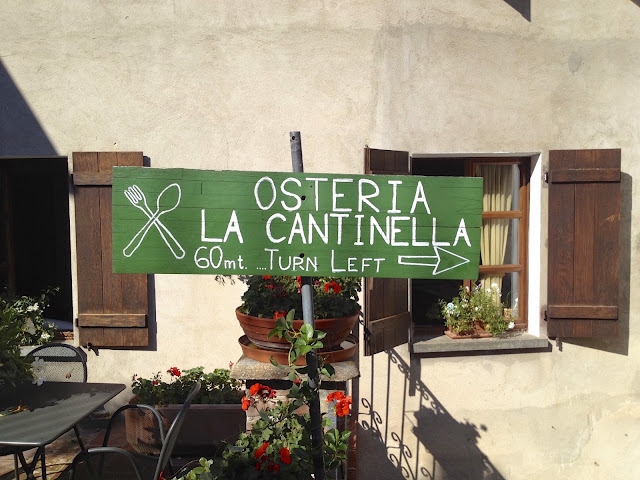
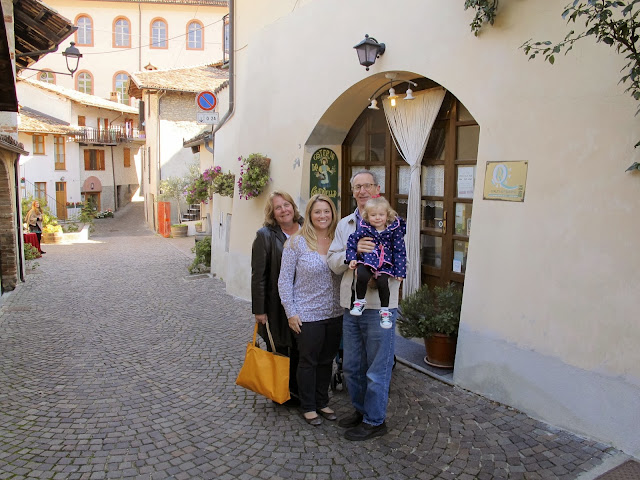
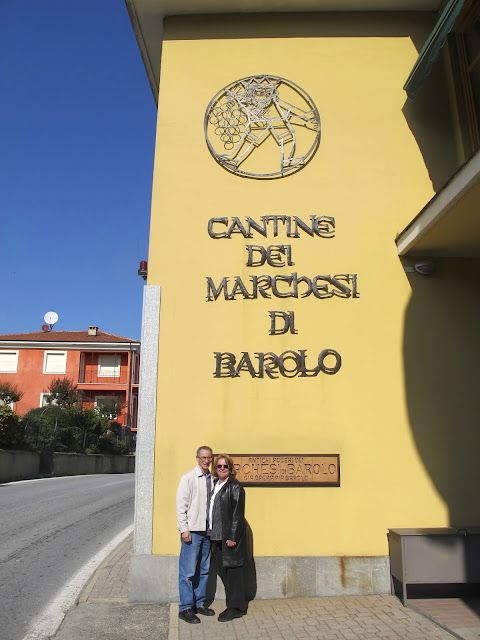
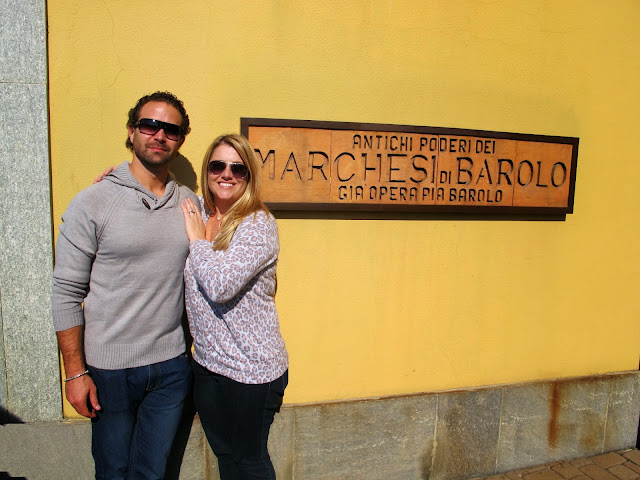
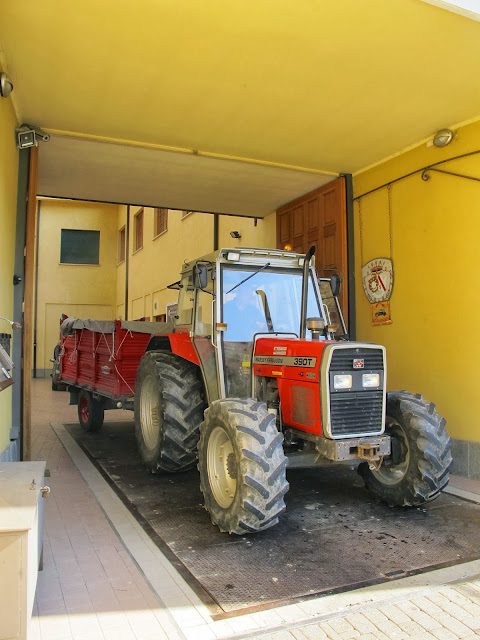
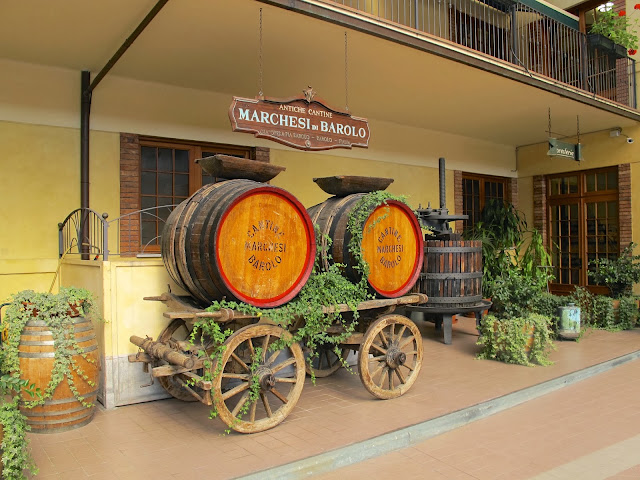
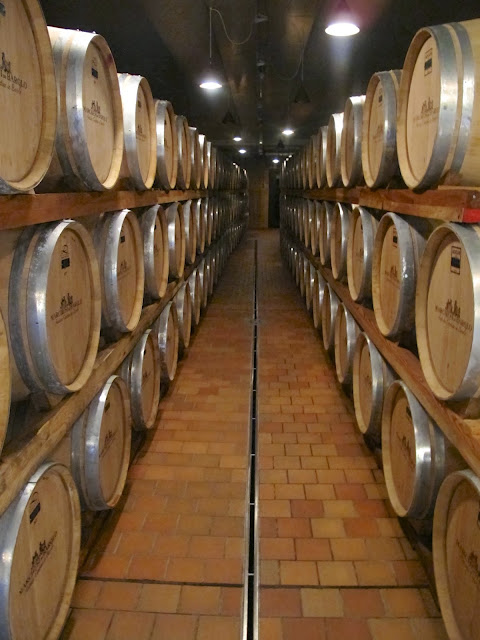
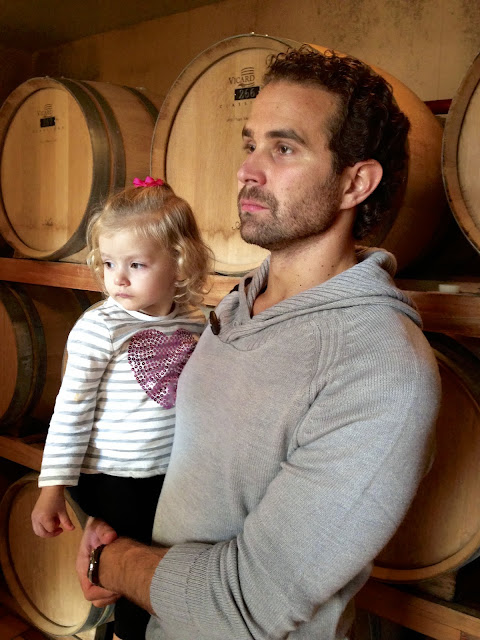
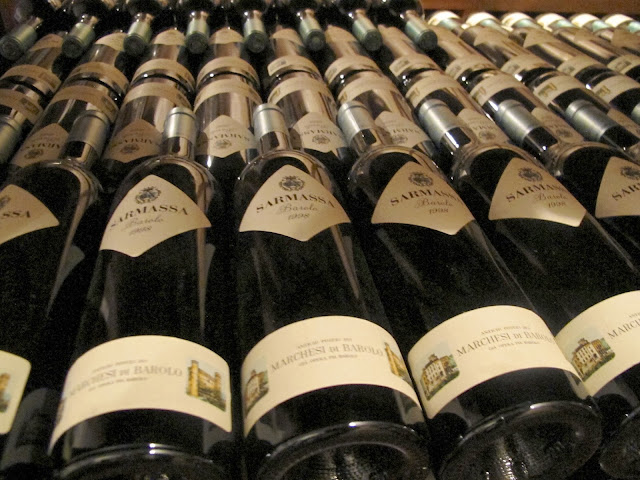
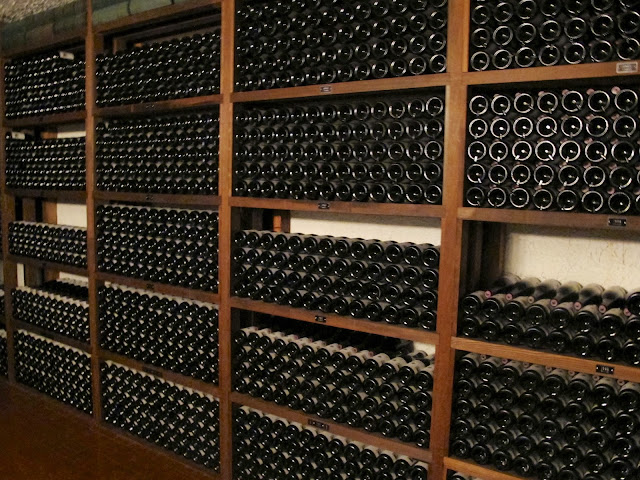
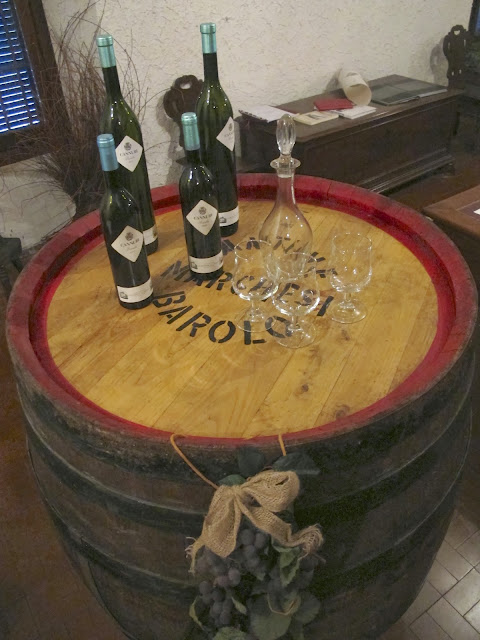
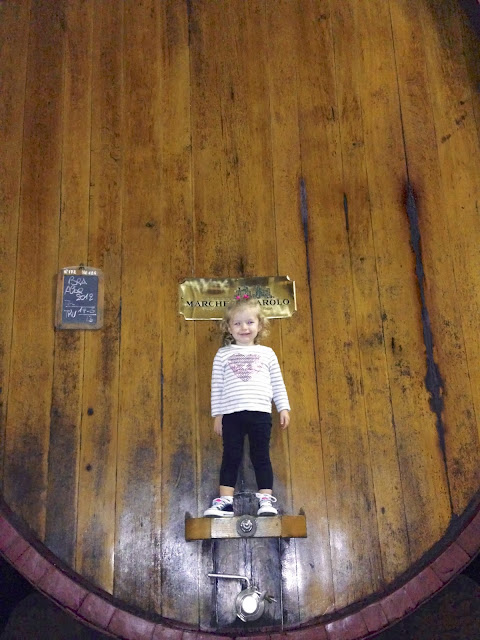
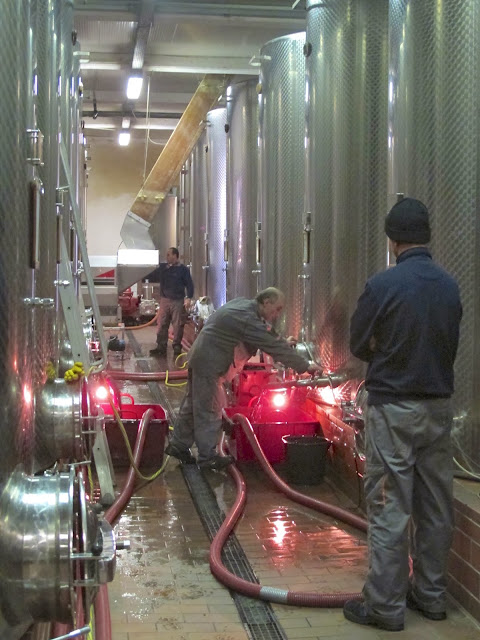
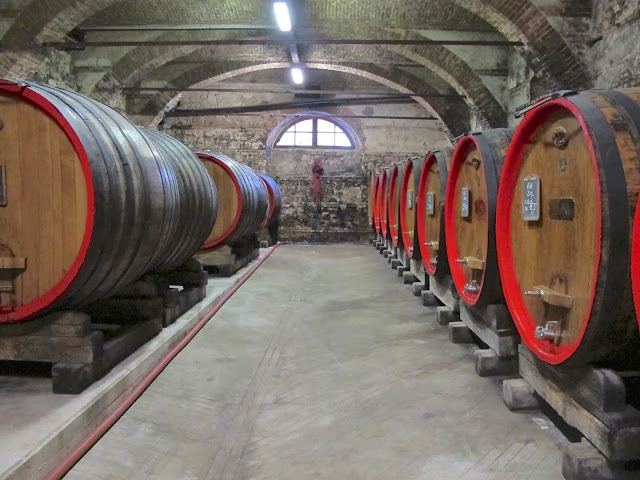
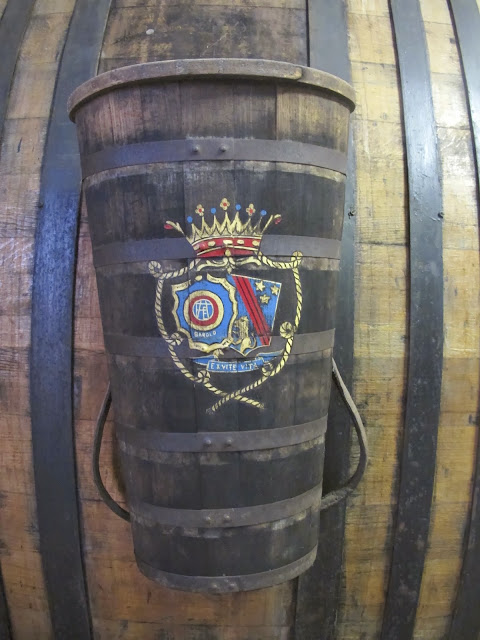
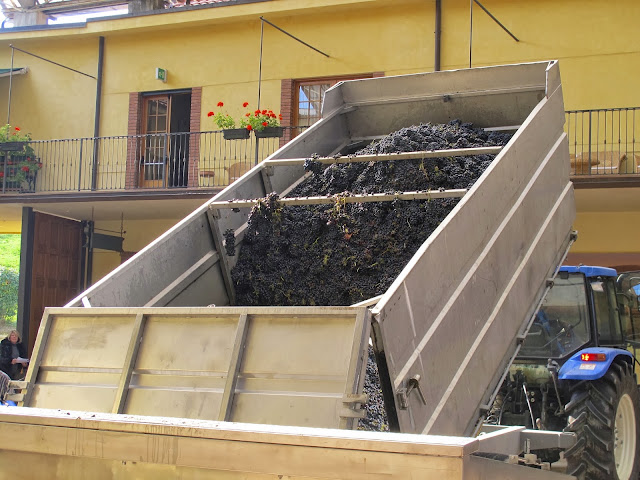
After a wonderful lunch at Osteria Cantinella, I had pre-arranged for a tour and wine-tasting at Marchesi di Barolo. This particular cantina boasts a very genuine and interesting history (I encourage you to click on the link and visit their website). It was explained to us that this particular winery was where Barolo itself was born – we even saw the original cask that was home the world’s first Barolo over 200 years ago. Our tour began in one of the cantina’s vast rooms where they were aging wine in botte di vino (wine casks). These barrels were made from oak from several countries. S and Deb saw some of the barrels were made by an American cooper (barrel maker) they know in Napa Valley. Small world! We next moved into the Marchesi’s private family cellar, where an impressive collection of wines rendered us all speechless. As we descended down into the heart of the cantina, we saw the juice of fresh “crush” flowing though long winding hoses, attached to the floor above where tractors were dumping the grape fresh from the “harvest”. This was exciting for all of us, knowing that we played a small part in the 2014 vintage (primarily by not tripping over the hoses and spilling the precious nectar on the floor). After the tour, we enjoyed a tasting of some of their finer wines – a wonderful way to casually spend the afternoon.
We merely had to follow the signs to reach our restaurant
Our group is eager to dine at Osteria Cantinella
S and Deborah stand just outside Cantine dei Marchesi di Barolo
Jen and I take a picture here as well
Tractors were coming in out along with us, bringing grapes fresh from harvest
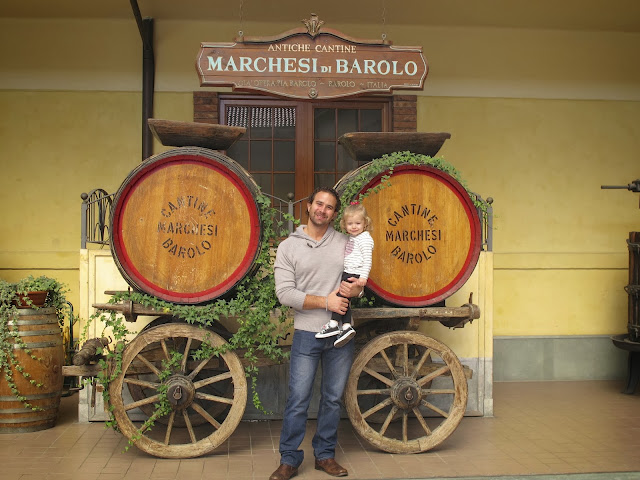
A display in the interior courtyard shows an old fashioned way to transport the wine from town to town
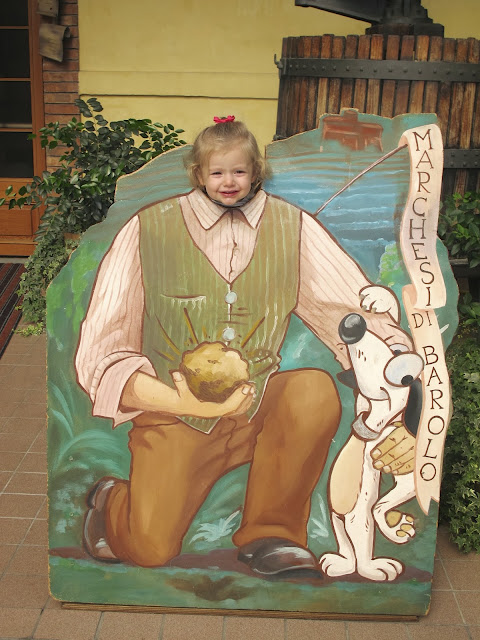
Julia also doubles as an expert Truffle Farmer
We smile in front of the old fashioned barrels and wagon
French oak botte in the first room we visited
Julia and I listen to our tour guide
Barolo can age in the bottle for many years, most Barolo shouldn’t even be opened for at least 10 years
Going into the personal cellar of the family… quite the collection
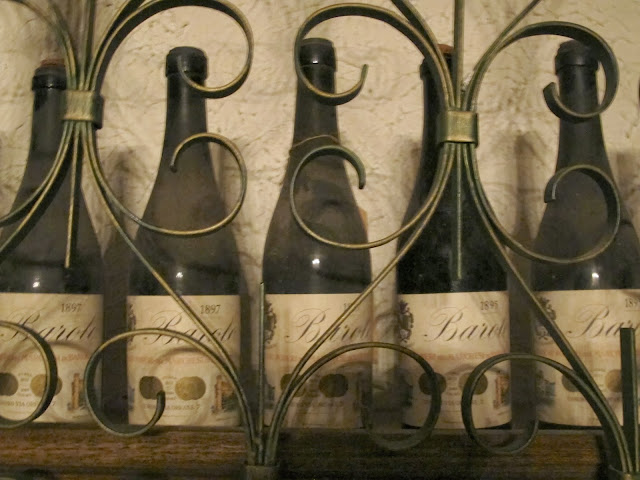
Some of the much older bottles are on display – these are no longer for drinking (hence the vertical position)
The oldest bottle in the cellar is from 1859 (not drinkable) and the oldest that is still drinkable is from 1938
A private tasting area
Some of these large barrels date back as far as the 1950’s
Downstairs the juice from the crush flow into these large steel vats through long hoses
These large barrels are made by hand and are very expensive
A basket that was once used for the harvest many years ago is now used as decoration
Tractors dump the grapes they collected at harvest into a machine that crushes them
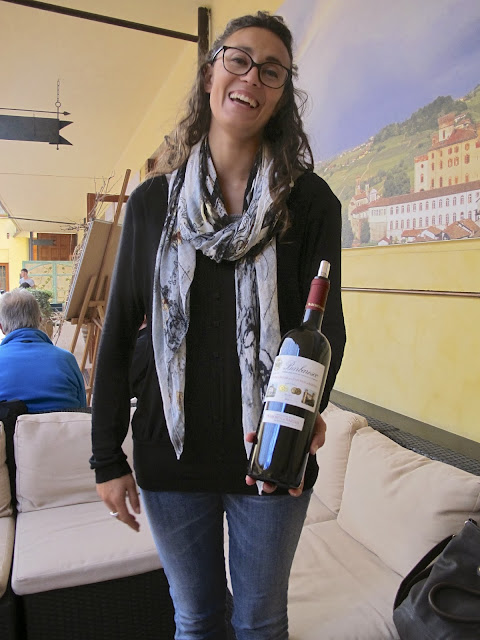
Our guide showcases one of the bottles that we would be tasting – this a Barbaresco
Deborah and Julia start a dance party
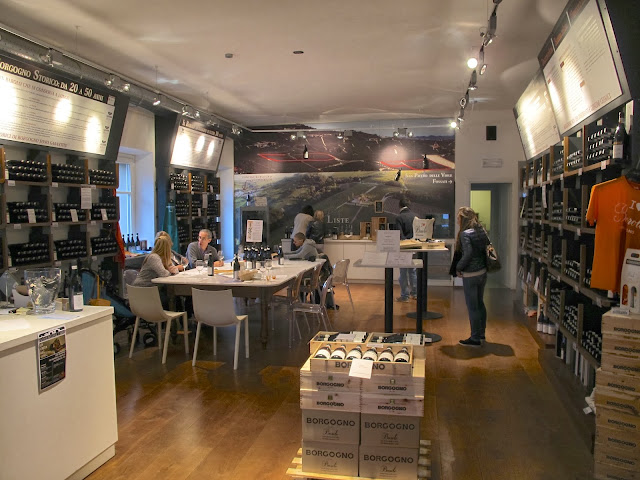
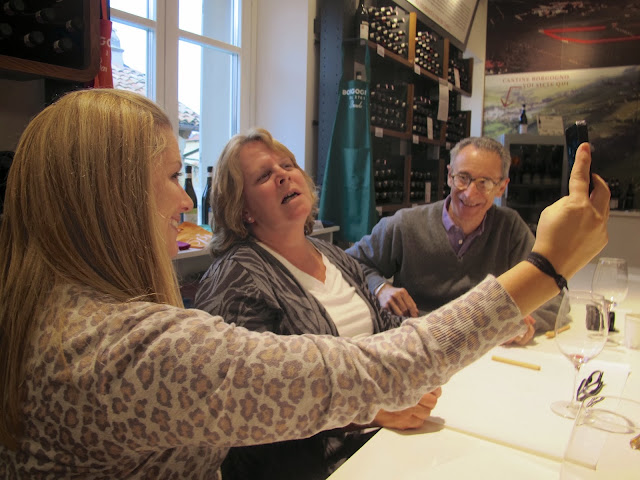
But we weren’t done – we still had another tasting on the books. We next went to Borgogno – a producer of fine wine since 1761. We opted for the more comprehensive vertical flight, consisting of six different wines. I cannot accurately describe to you the pure bliss one can discover whilst sipping on some of the worlds best wines, with fun people who’s company you really enjoy and basking in the glory of a napping baby. We tried our best to “play it cool” but I think perhaps got a little rowdier than we even realized. You have to give us a break, we had each had several glasses of wine at this point. Between me and S (mainly, S) – we bought so much wine that they included two of the four tastings and threw in canvas bags, custom wood cases and bottle openers. If you find yourself in Barolo – duplicate our exact schedule of eating and drinking – it was an amazing day.
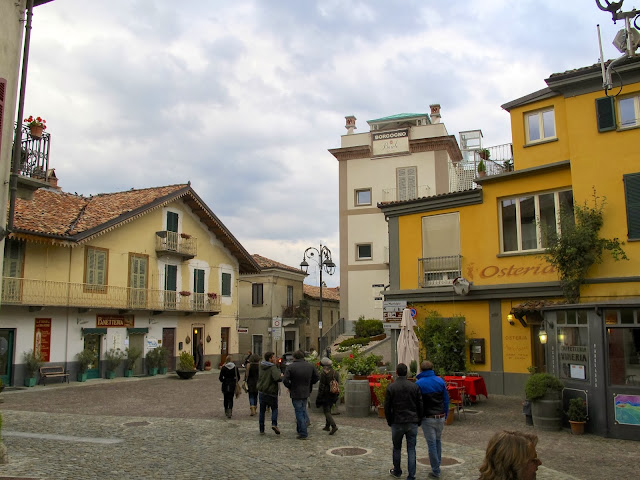
We walk through Barolo on our way to Borgogno (the tall white building)
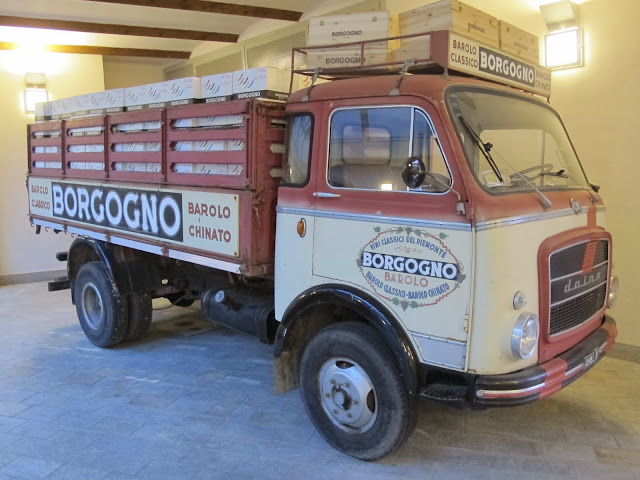
One of their old trucks now sits on display in the cantina
A wonderful place to taste wine, surrounded by all the amazing bottles that can be acquired with the simple swipe of a card
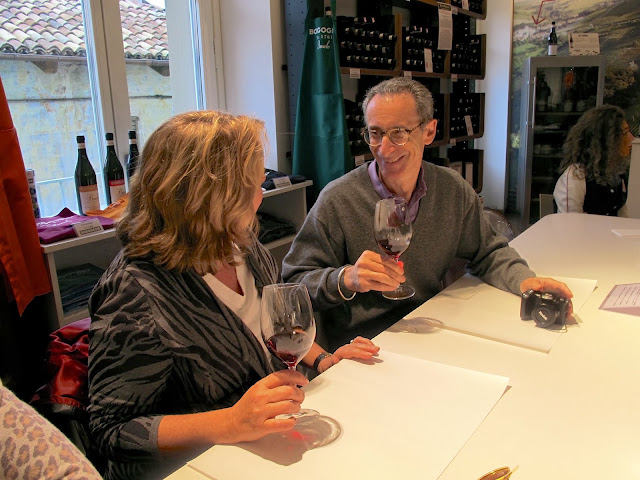
S and Deborah share a laugh
Jen explains what a “selfie” is and shows her how to do it
I wouldn’t call Deborah’s first attempt “successful”
“Here, let a pro show you how it’s done”
Deborah’s second attempt was much better – I think she’s nailed the “selfie”
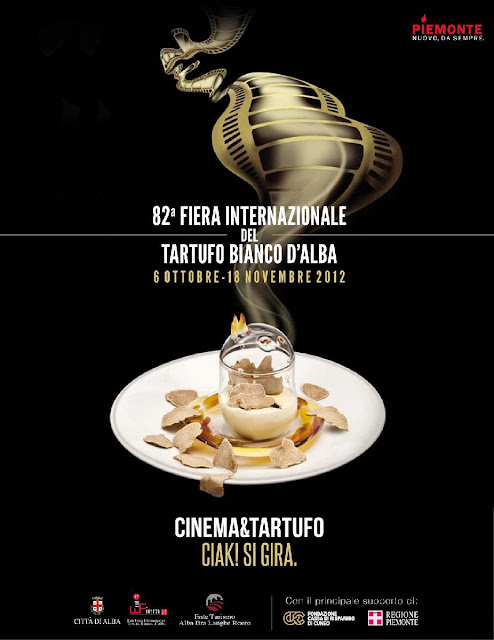
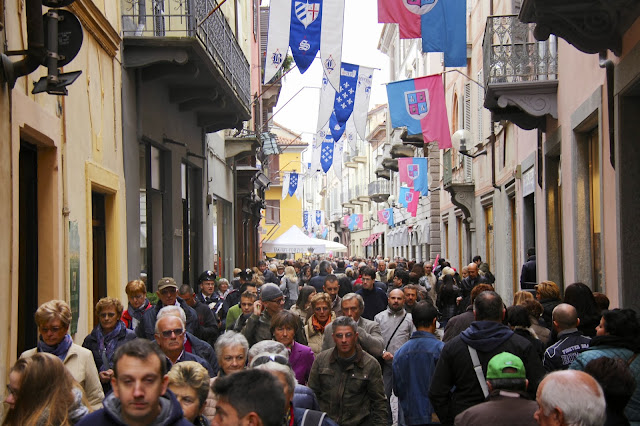
For 83 years, Alba has been host to the Fiera Internazionale del Tartuf Bianco d’Alba (International White Truffle Fair of Alba). This year, the festival is open for five weeks, from the 12th of October until the 17th of November, spanning across the entire city. There are hundreds of events (including a donkey race, music concerts and food & wine tastings), vendors set up in markets throughout the city, celebrity chefs dropping in all over town, cooking demonstrations and of course – thousands upon thousands of truffles. Admittedly, we were undertaking a “food” related activity in the “wine” portion of our trip – but we have learned that nothing pairs with the worlds most exquisite wine better than one of the world’s most elusive and desirable food items.
Last year’s poster for the event
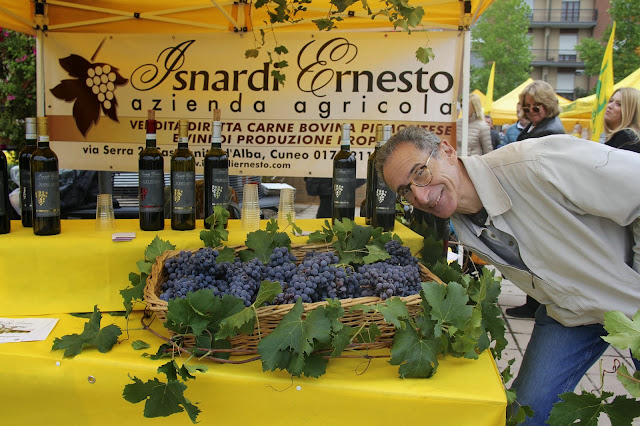
S gets close the grapes of a small producer selling his wine
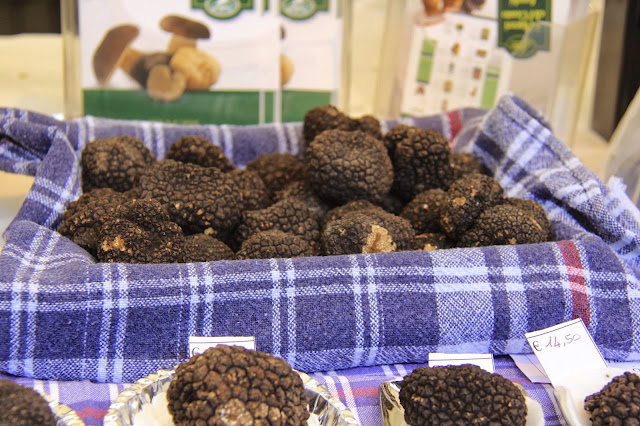
Some black truffles displayed for sale
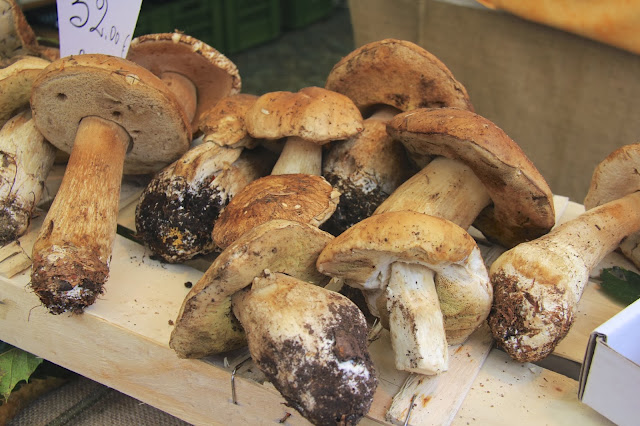
It is the season for truffles as well as mushrooms – there were some fine examples for sale
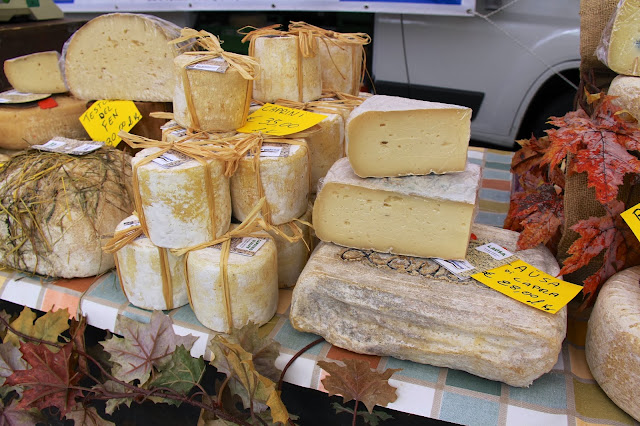
A cheese vendor showcases his various goat, cow and sheep cheese
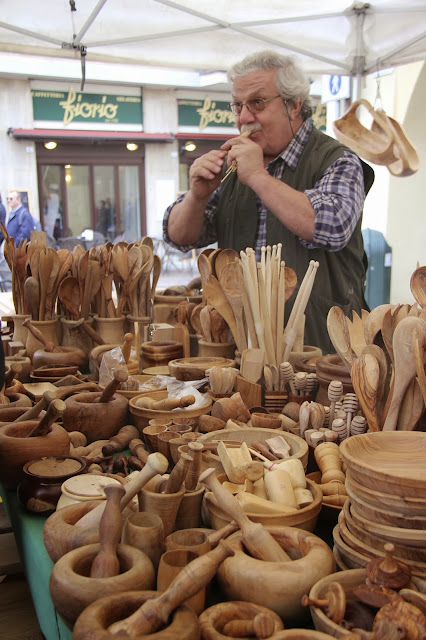
This artisan hand crafts items out of olive wood – Deborah got several spoons
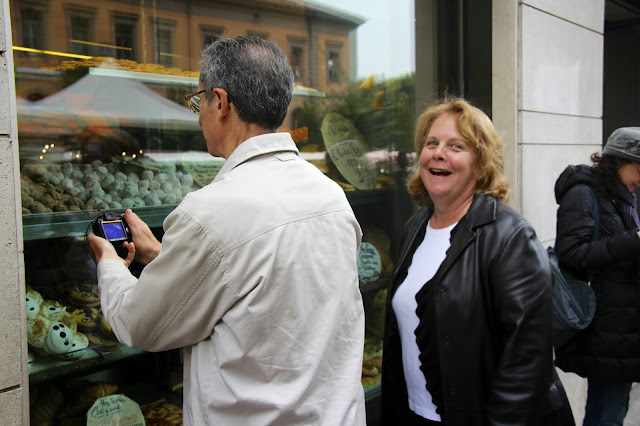
Deborah laughs as S takes a picture of the window display at a pasticceria (pastry shop)
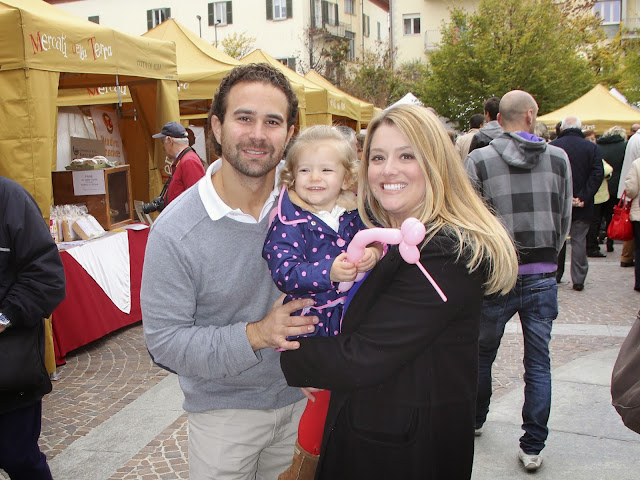
Family photo in one of the markets
The city is flooded with thousands of visitors each day during the month-long event
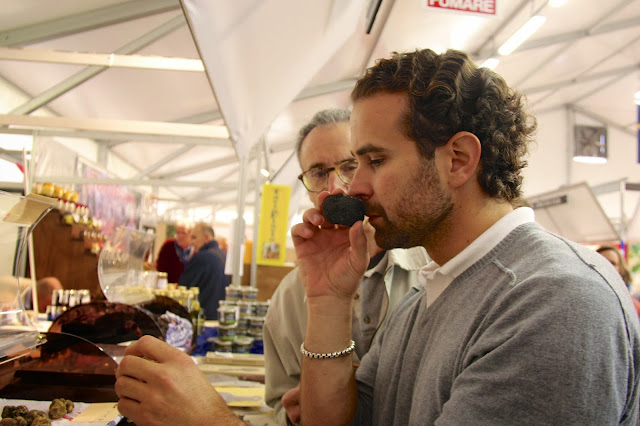
Like many of the world’s finer foods, a truffle may seem strange to many people (caviar = fish eggs, foie gras = goose liver, etc.). A truffle is in fact, a fungus – but nonetheless, affectionately referred to by many as the diamond of the kitchen. It is no wonder that this event is considered the Sundance Film Festival of the culinary world. The likes of Mario Batali, Joe Bastianich and dozens of other celebrity chefs make appearances each year. Lesser known restaurateurs can be seen in the main truffle tent, intently smelling every single truffle and purchasing thousands of euro’s worth of this little, spongy item. They will use the ingredient in various recipes (soups, stews, meat dishes and anything else their creative minds can concoct), but primarily – they will shave the truffles over pasta, table-side.
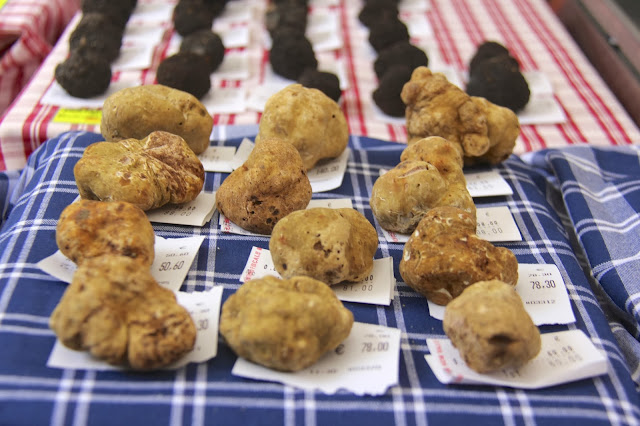
A collection of white truffles in the front – black truffles are in the background
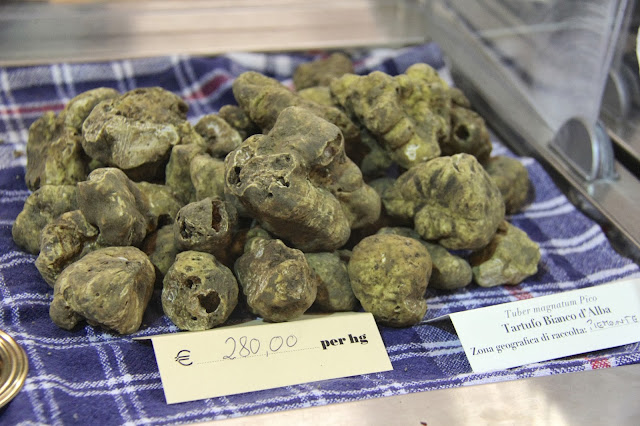
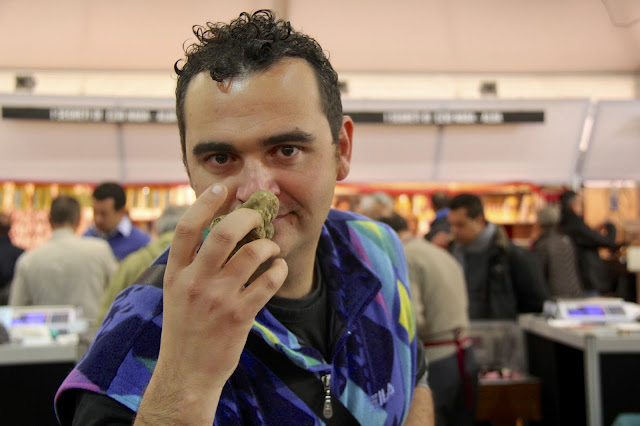
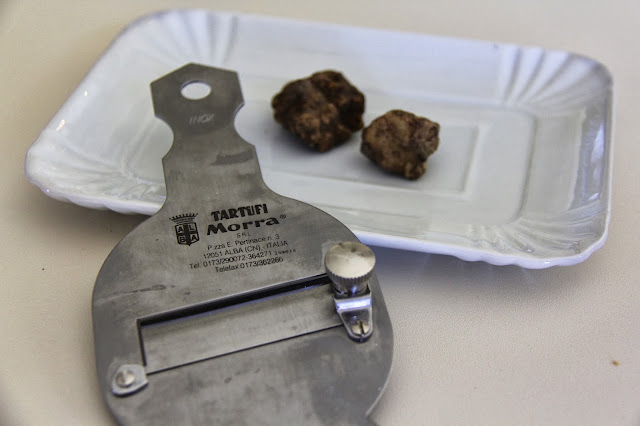
Truffles are small, hard to acquire and require the perfect soil conditions to achieve a proper balance. Italy is regarded as the foremost area for the natural cultivation of truffles (and the ultra-elusive “white truffle” grows in the Langhe area, specifically Alba as well as Tuscany and Abruzzo). As popularity and demand has increased, other countries have tried to cultivate white truffles (including Slovenia, Croatia and now even China). It is commonly accepted that these areas produce a lesser-quality truffle. One of the benefits of purchasing your truffles within the main enclosed tent at the festival is that you are guaranteed a certified, locally cultivated truffle. Many of the merchants selling their truffles were the actual farmers themselves. Today, farmers mainly use Truffle Dogs to sniff out the truffles. Historically, Truffle Pigs were used (because of their acute sense of smell and innate ability to find truffles) – but their love of the delectable treat often had them eating the merchandise before the farmers could snatch them from their snouts. The Truffle Dogs have to be trained to find the goods, but are much easier to control. We sniffed out some of our own truffles and plunked down €50 to acquire two small truffles and a truffle shaver.
White truffles for sale – they are not cheap!
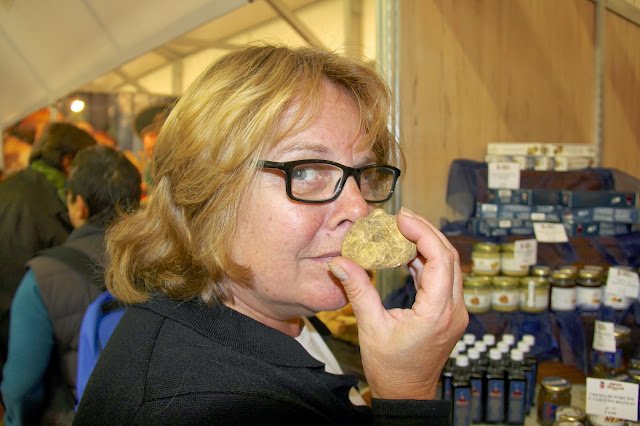
Deborah catches the scent of a beautiful specimen – that truffle probably cost around €300 ($400)
I give the truffle a smell as well
This guy really knows how to do it and shows us – it’s all in the wrist and perfectly timed nostril flare
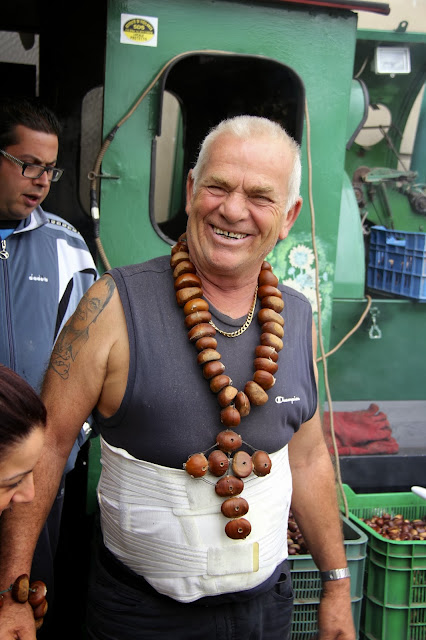
We found this guy selling roasted chestnuts outside
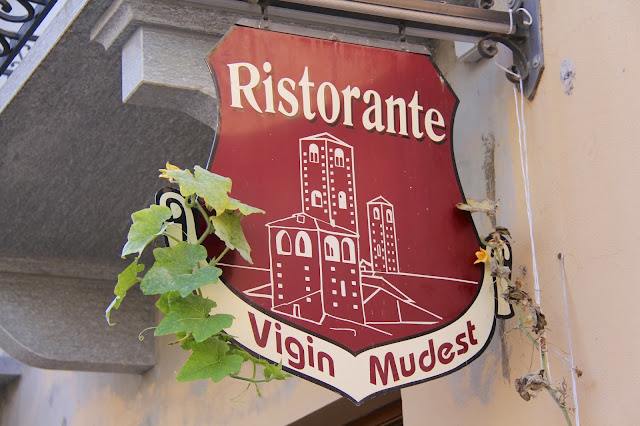
After touring the markets, we had lunch at Ristorante Vigin Mudest
Ever heard anyone say, “this sauce is so good I could drink it”? Well, when S says it – he really means it
I became the “garbage disposal” of the group, finishing everyone’s plates (3 plates and a bowl)
Julia hugs her great aunt and uncle after lunch
Before we left Alba, Julia insisted on ripping her shoes and socks off
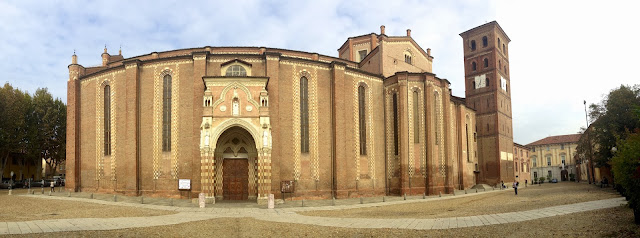
Our final stop in Piemonte was a visit to Asti, a city that has been occupied since the Neolithic Period and today boasts a population of about 75,000 inhabitants. Unfortunately, we caught the city on a Monday… during lunchtime. This meant that virtually every museum, shop and attraction was closed. We ate a makeshift lunch of pizza and flatbread on park benches before heading for home.
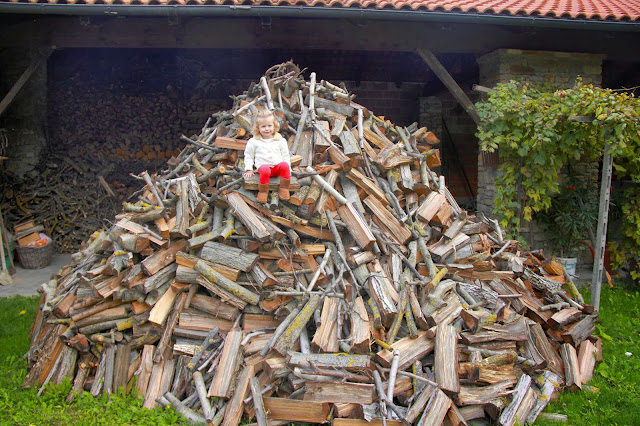
Julia built a throne of her own from some firewood at our agriturismo
Cattedrale di Asti (Cathedral of Asti) dates to 1309
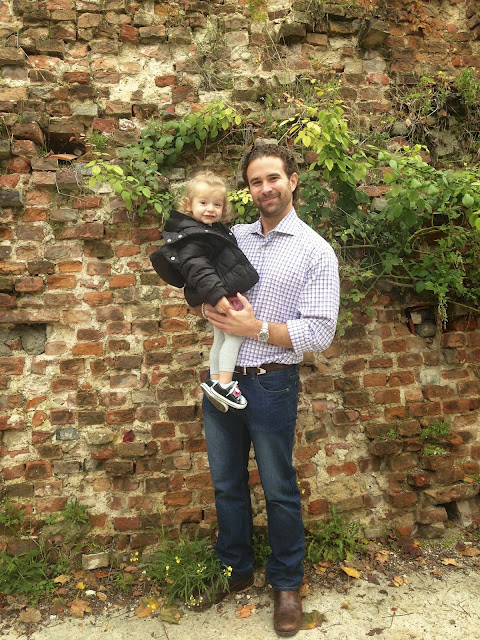
Ruins of an ancient tower that had been built into a more modern home
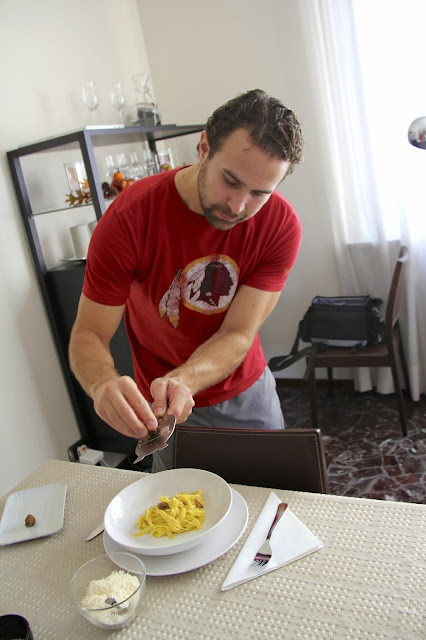
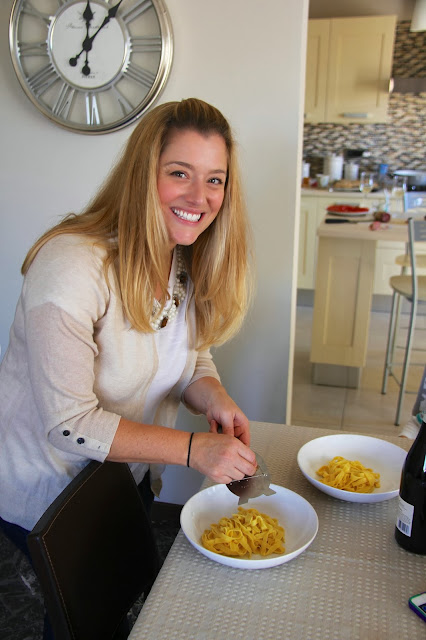
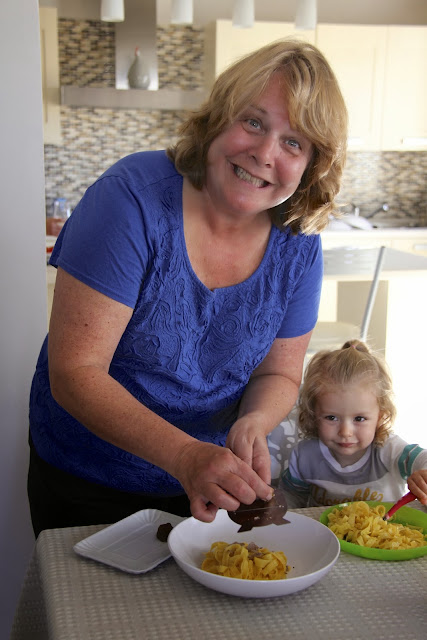
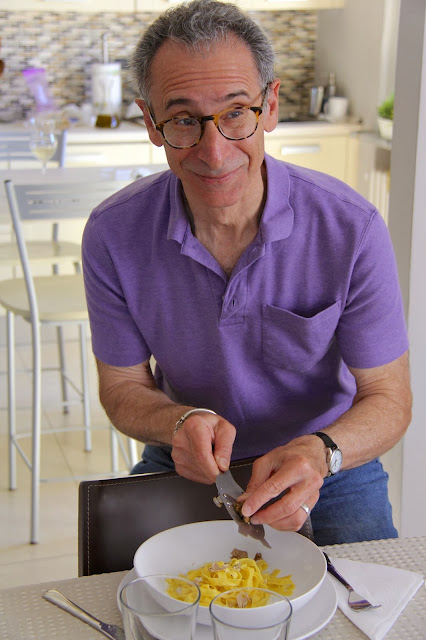
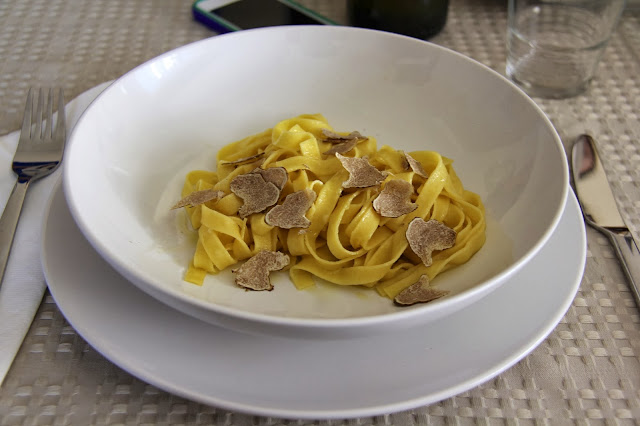
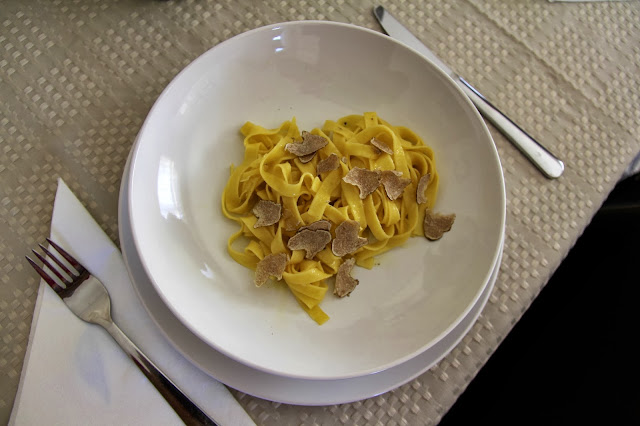
A couple days later, we took our prized truffles out of the refrigerator and cooked tagliatelle con olio with shaved truffle. It was a delicious lunch that nearly put us in a content, comatose state – a good way to tease our pallets for Part II of the trip. We would depart the next morning for Emilia-Romanga. If Part I was entitled Vino, then Part II of their trip would definitely be called Cibo (food).
This is what €50 ($68) worth of truffles looks like
I shave the white truffle on my pasta
Jen takes her turn
Deborah is happy to shave her truffles
S looks great when he’s shaving truffles
Now that looks great!
It tasted great too
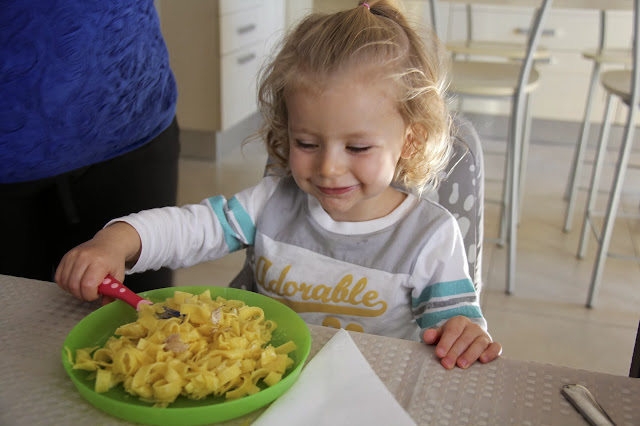
Even Julia got to try some truffles
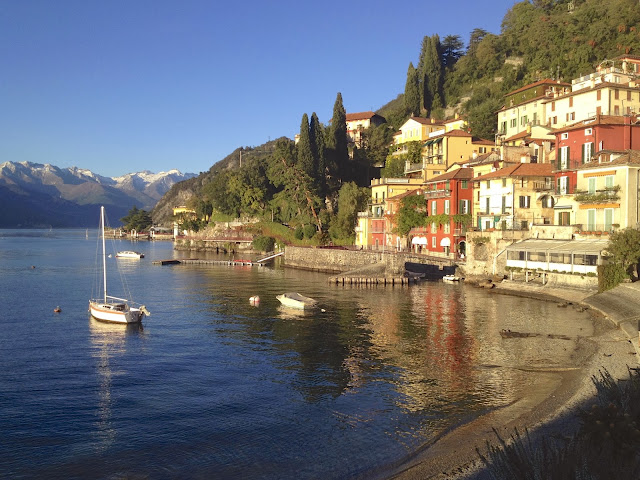
We visited Varenna after our truffle lunch
That night we all went to dinner at Ristorante Simposio to celebrate Claudia’s birthday – still can’t get Franco to smile
In my most recent blog post, we embarked on a cruise throughout the Mediterranean. I’d love for you to continue the adventure with us as we head to Istanbul, Turkey and the beautiful Greek island of, Lesbos. I’ll finalize our voyage in an upcoming post that will include the final ports of call and some more stories about our shipboard life.
“Oh, tell me… tell me all about it!”
When I last left you, we had visited Venice, Olympia and Athens. By this point in the cruise, we really hit our stride and had fully immersed ourselves in everything Holland America’sNieuw Amsterdam had to offer. We were overeating delicious food (and then trying to work some of it off in their state-of-the-art gym), spending time in the casino (maybe too much time… literally every casino worker knew me by name), taking in shows and making friends all over the ship. We found a couple of other families with small children, but for the most part – we were in the minority (not fitting into your typical “cruise-goer” demographic). I’ll tell you what… if you ever want affirmation about your kids cuteness – go on a cruise with thousands of grandparents missing their grandkids. They were all so happy to pay us compliments about Julia that it made us excited to take her anywhere on board.
Julia made friends wherever she went
She gained a large following of fans
That grew the longer we were on board
Midway through the cruise, we arrived in Istanbul, Turkey. This was to be the only port mid-voyage that had an overnight stay, allowing us two days to explore the massive city. To describe Istanbul as “massive” is underselling it. The city boasts a population of nearly 14 million people in the urban area alone and is ranked as the second largest city in the world ranked by population within city limits [source]. It is the only city in the world that stretches across two continents (Europe and Asia). Istanbul is home to over 3,000 mosques and welcomes nearly 12 million visitors each year. These are just a few of the fun facts about this amazing city, so yeah… massive really undersold it! If only there was some sort of book… kind of like a dictionary… that would give you alternate versions for specific words…
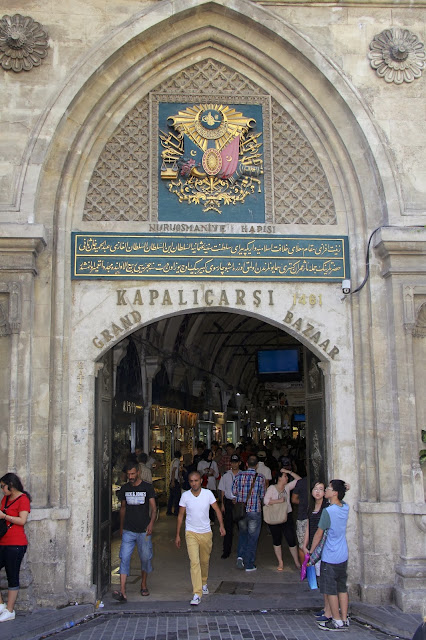
When we got off the ship on the first day, we took a bus directly to the Grand Bazaar. This location was ideal, because it would afford us the time we wanted to shop and then walk around that particular area of the city. We walked through the gates of the Grand Bazaar and our mouths dropped. I still remember the first time I went to a flea market. My great aunt Barbara took me to a market in New York when I was 8 years old. I was awestruck by all the amazing things that could be found with just a little looking. She bought me a brand new GIJoe Cobra Stun vehicle that I probably still have in a basement somewhere to this day. If I could reconstruct that image of my first market in my mind, with all my boyish enthusiasm and multiply it by a hundred – it couldn’t reach the level of awe I found myself in as a man standing in the Grand Bazaar. You can even factor in the fact that I had a wife repeatedly telling me, “I’m ready to shop – make sure you have plenty of Euro’s handy” weighing on my mind!
Main Gate of the Grand Bazaar
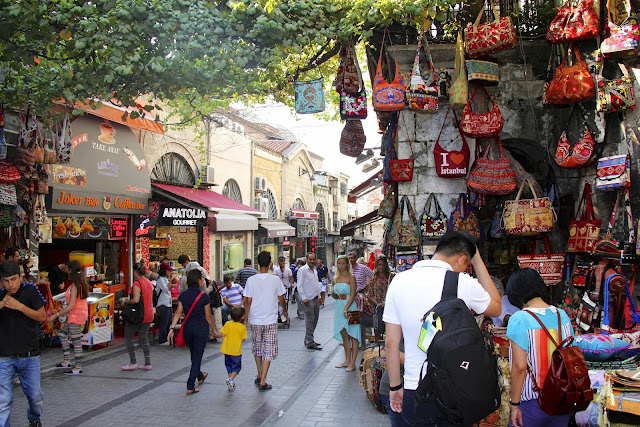
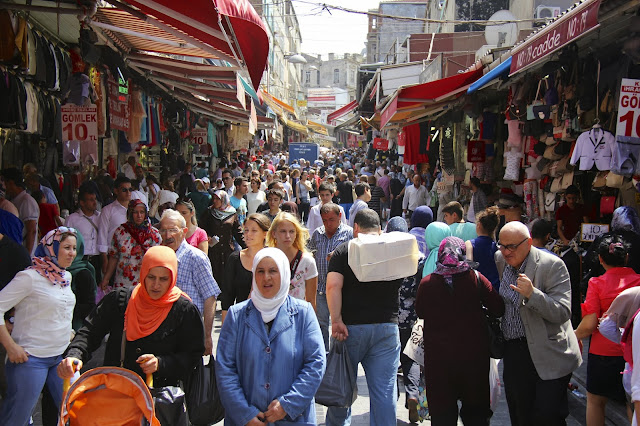
Shops extend around the outside of Grand Bazaar
The Grand Bazaar is like nothing we’ve ever seen. It is an enclosed market that ranks among the oldest in the world. 61 city streets house 3,000 shops that eagerly accept the money of up to 400,000 visitors every single day. This does not include the open air markets that have been built around the Bazaar and dominate many more city streets. Originally, each shopkeeper was allotted a 6′ or 8′ dolap (stall) in which to showcase their wares, the finest of which were kept hidden in drawers. The market was erected after the Ottoman Empire between 1455 and 1460. It reached it’s final form in the 17th century and not much has changed since. The main reason for the collective, enclosed space were to prevent against theft, fire and uprising. Even though the Turkish Lira is the currency of the country, merchants accept US dollars, Euros or Turkish Lira.
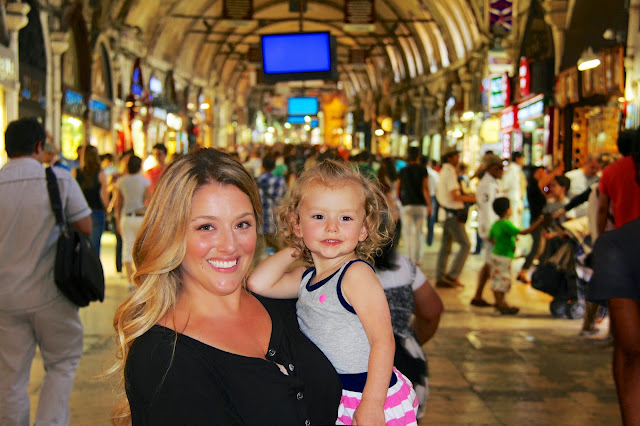
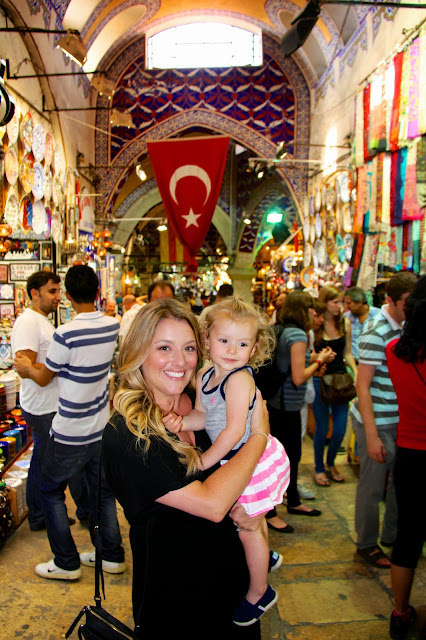
Jen and Julia enter the Grand Bazaar
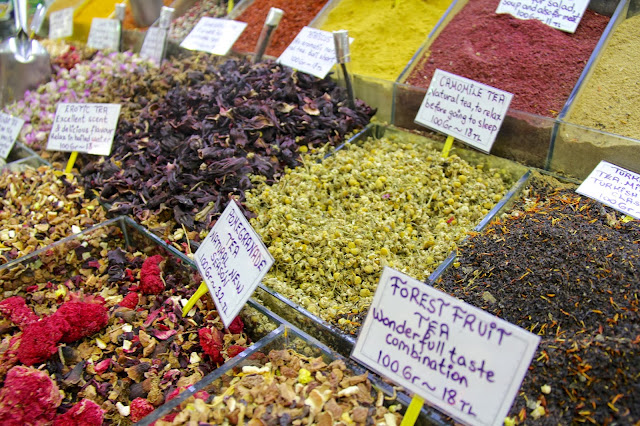
Some teas for sale
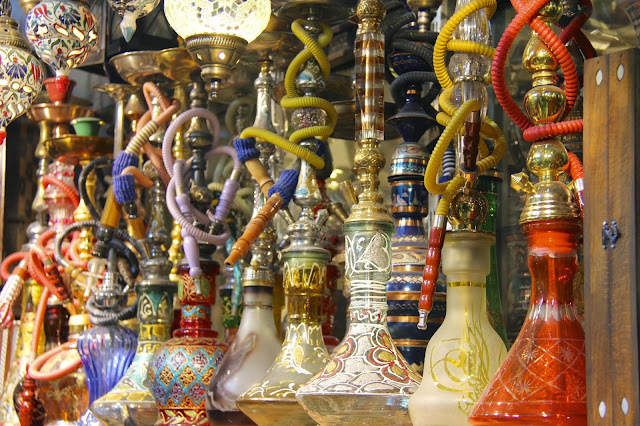
The Turkish nargile (hookah) became popular during the Ottoman Empire
Jen and Julia with a Turkish flag behind them
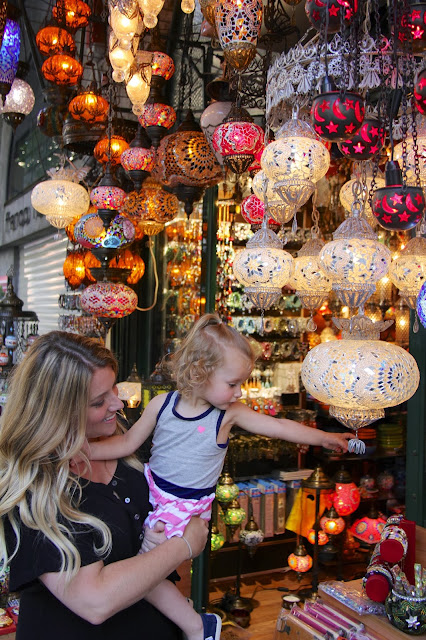
Julia was fascinated with the beautiful lamps
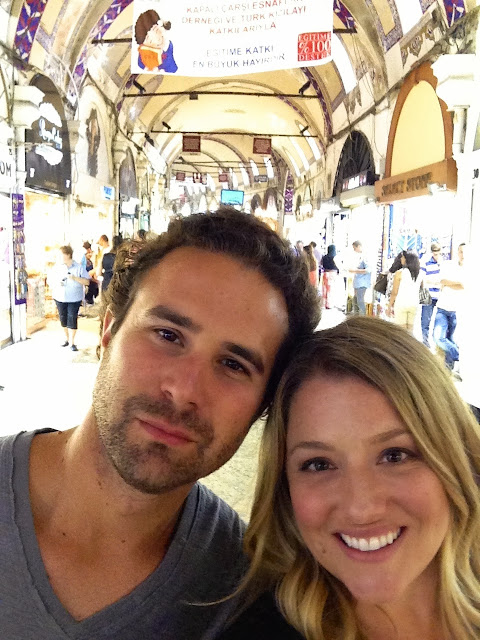
Jen and I pause for a picture in the market
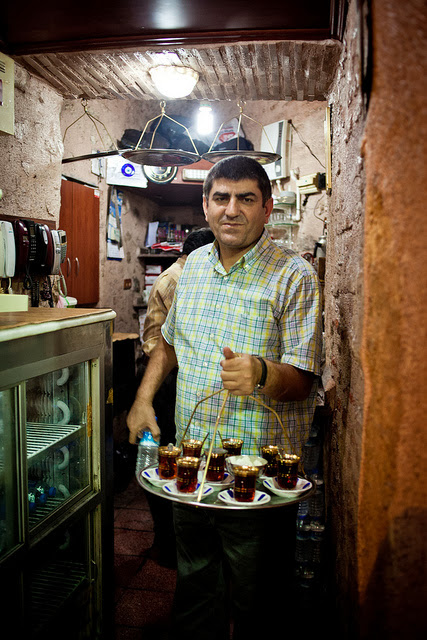
We didn’t notice any food vendors or restaurants inside the Bazaar – it turns out, the merchants have been bringing their lunches in boxes called sefertas for hundreds of years. However, they can get simple dishes like döner kebabs delivered right to their stalls (although, it’s more common for one of the merchants to bring back lunch for the entire shop). What I did notice quite a bit (and became somewhat fascinated with) was the bustling tea delivery business. Turkish tea is a huge part of the culture throughout the country. Tea is most often consumed in Turkish households – offering it to guests is a part of Turkish hospitality. It’s no different in the Bazaar; the custom of drinking tea blends the important tradition hospitality with the other main component for drinking the tea – the social congregation of men. Tea runners (as I was calling them) would skillfully whisk past the crowds and deliver un-spilled tea by balancing the cups on a tray with a long handle. What fascinated me the most was that I never saw any money exchanged for the tea. I imagined the tea runners marking how much tea a merchant drank and collecting on the tab at the end of the week. I have searched the internet to prove or disprove my theory of a “tab” system – but I could not find anything. Any Turkish merchants or Tea Salesmen reading this – please weigh in.
Guys like these would run all over the market, delivering tea
*photo credit – flickr: photographer unknown
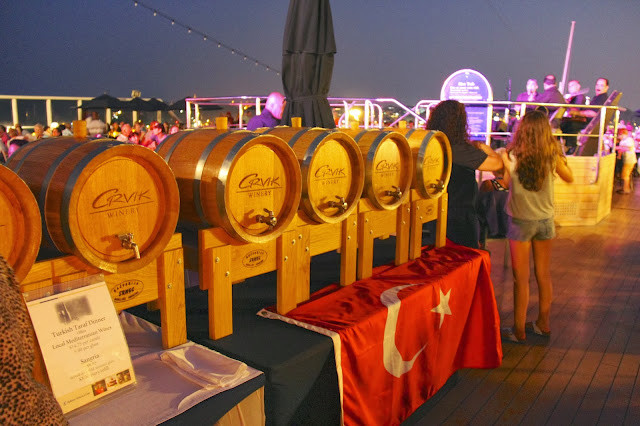
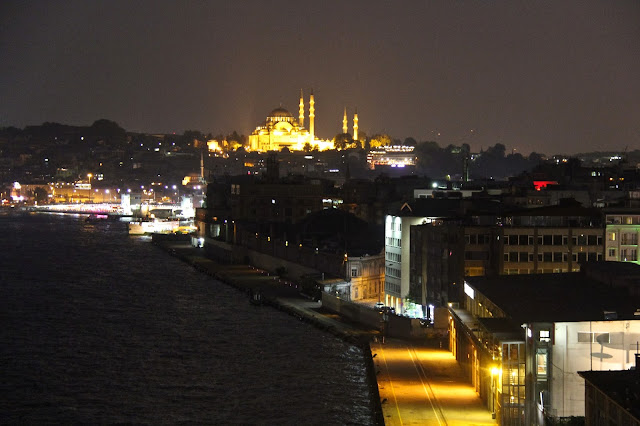
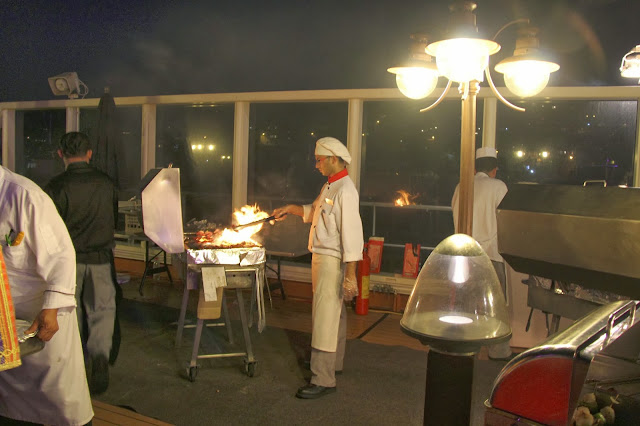
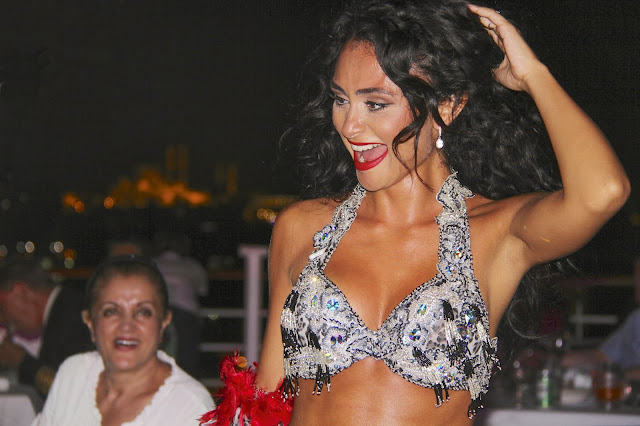
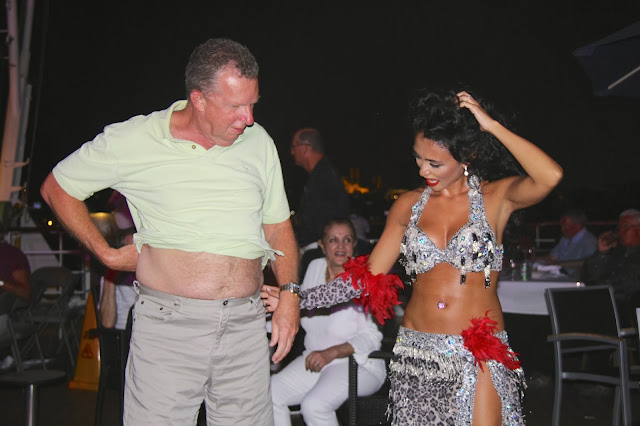
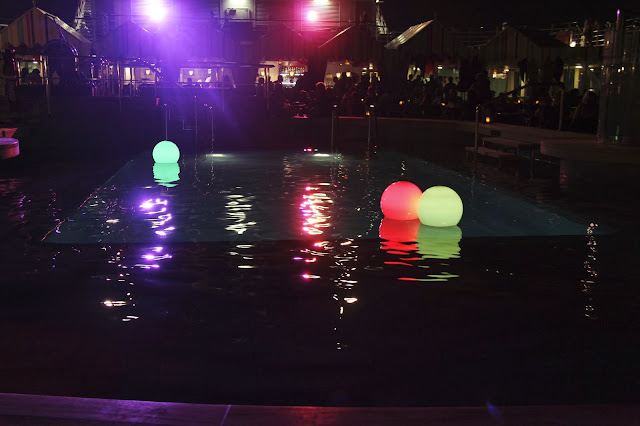
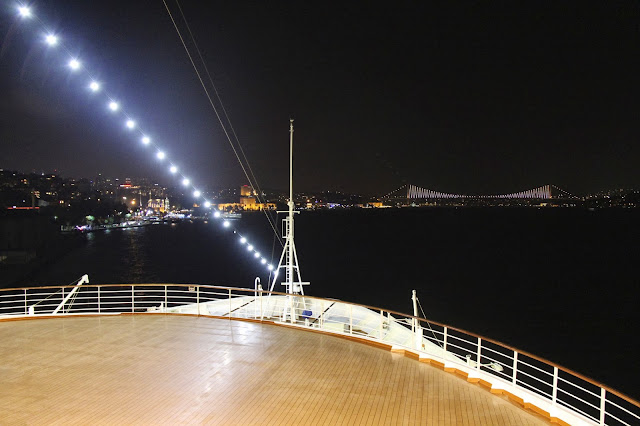
We spent hours navigating the maze that is the Grand Bazaar before we realized the sun was setting. Our intention was to walk the city around after we’d shopped. We had the flexibility to stay out as long as we liked because our ship wasn’t leaving until the next day; although we agreed that we were ready to head “home” for the night and set out early the next day. It turns out that it was a good thing we did! The ship was hosting a Turkish Taraf – a poolside party complete with live music, a Turkish belly-dancer, exotic drinks and spicy kebabs. An outdoor pool party is always a great thing, but if you have the shimmering city lights and uplight mosques of Istanbul framing the backdrop (and did I mention the belly-dancer), there is no greater party combination in the world (this is coming from the guy that was basically the President of Parties in college).
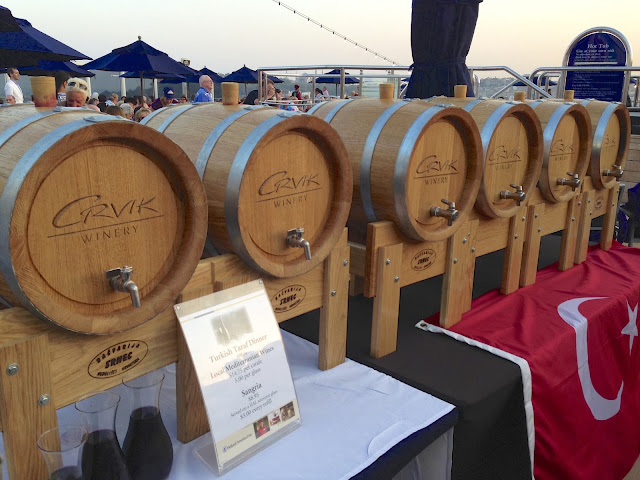
A variety of wine was served at the party – live band in the background
The Blue Mosque at night
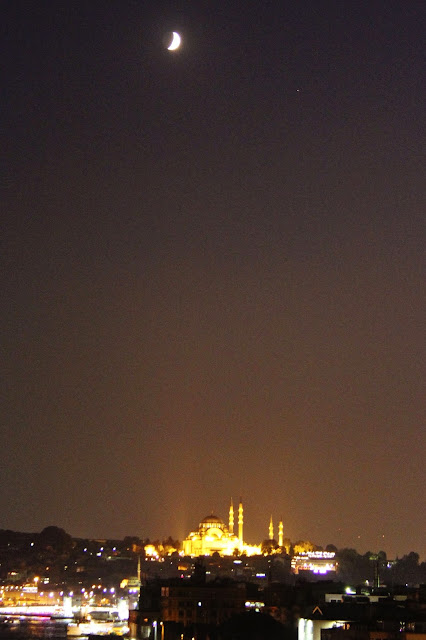
The quarter moon looked exactly like quarter moon on the Turkish flag
They were grilling authentic Turkish food
The belly dancer takes the stage
She recruited guests to help her move and move their own hips
The pool was decorated with lights
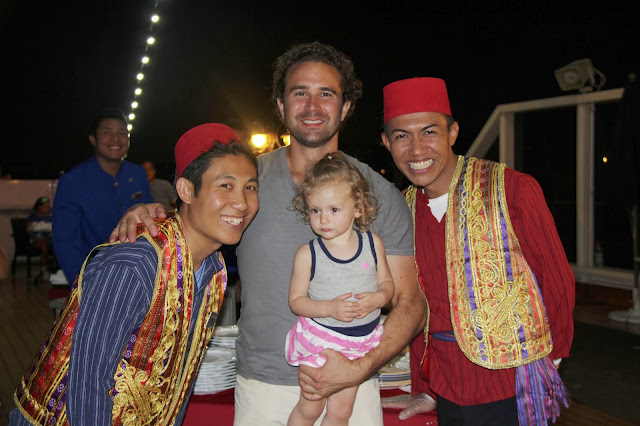
The crew dressed the part
The scenery was beautiful
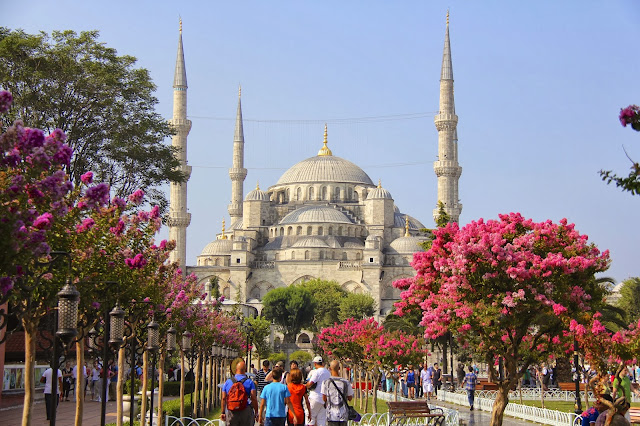
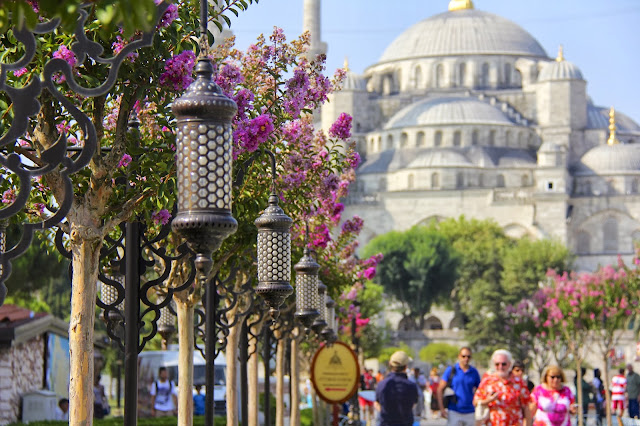
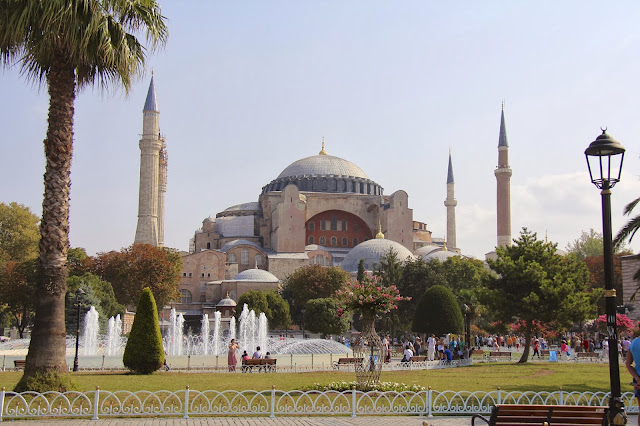
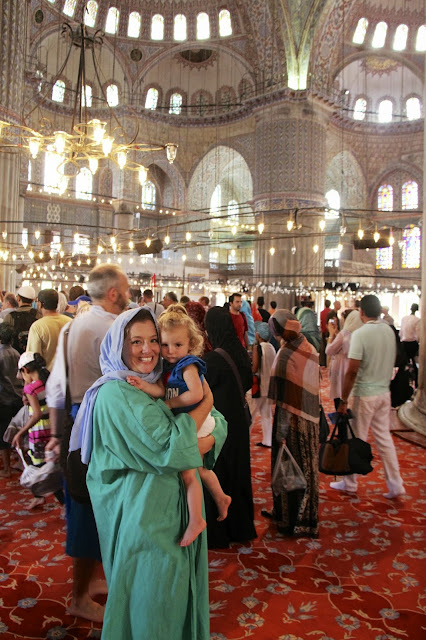
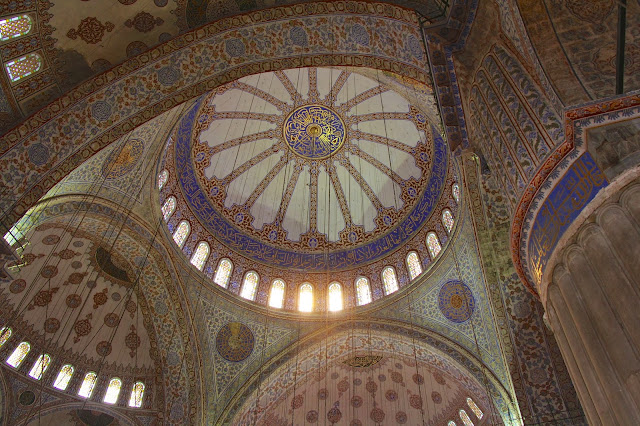
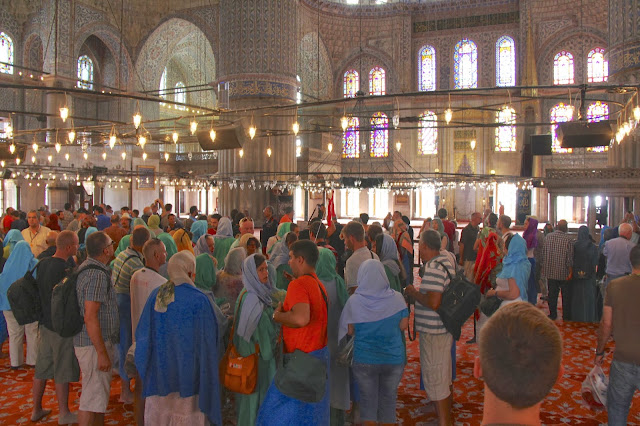
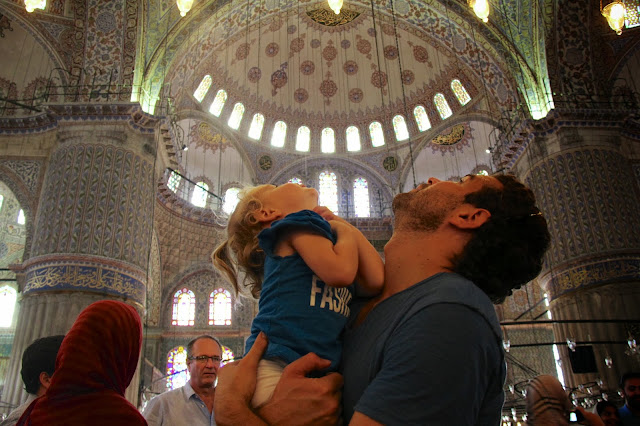
The next day we got an early start – with so much of the city left to take in, we wanted to get in as much as physically possible. We decided we would try to beat most of the crowds and start with the mosque’s. Specifically, the Hagia Sophia and the Blue Mosque – which sit opposite one another. We only ended up touring the Sultan Ahmed Mosque – or Blue Mosque, as it’s commonly called due to it’s blue tiles that adorn the inside walls. The mosque’s construction began in 1609 when it was commissioned by Sultan Ahmed I to not just rival the Hagia Sophia, but to surpass it. The mosque has an unprecedented six minarets (still the only mosque in Istanbul with six to this day), which garnished the wrath of the public. The display of six minarets was preserved for the Prophet’s mosque in Mecca – therefore the Sultan was criticized for incorrectly thinking that he was the man. The prevailing urban legend is that there was a miscommunication in which the Sultan told his architect he wanted gold minarets (altin minare) and the architect understood six minarets (alti minare). Seems fishy to me – sounds like he concocted a scapegoat to shift the heat off himself. Ultimately, he corrected the situation by shelling out the dough to build a seventh minaret on the Prophet’s mosque in Mecca. Whatever the correct history, it was fascinating to absorb in the first person.
We started our day before the city really woke up – just shop keepers setting up
Sulton Ahmed Mosque (the Blue Mosque)
Approaching the mosque
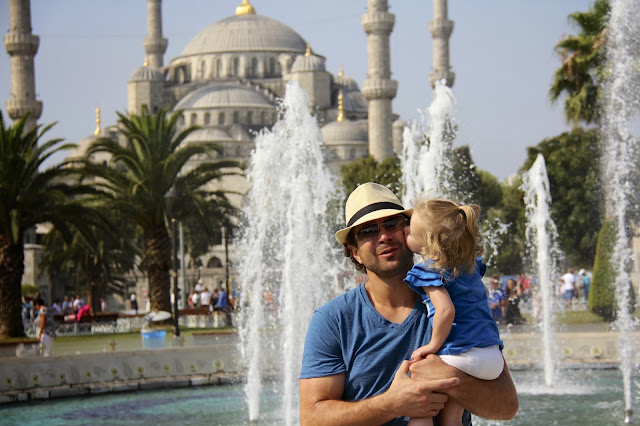
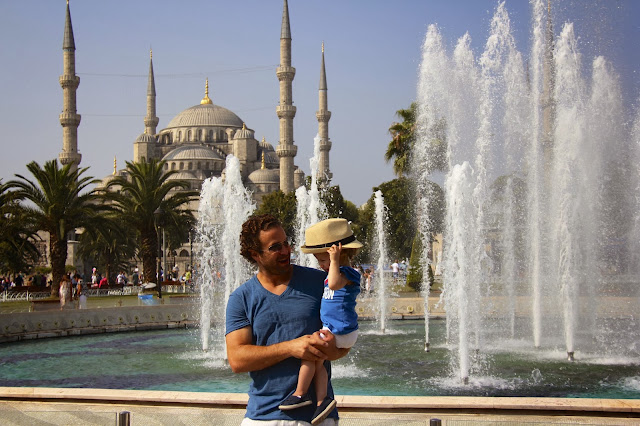
We had fun playing in front of a fountain
Julia steals my hat – I guess she wanted to block the sun
Hagia Sophia Mosque
All female visitors are required to wear proper garments
The ceiling and some of the blue tiles that are the reason for the nickname, Blue Mosque
The mosque sees a large number of visitors every day
It’s impossible not to gaze upward at the amazing display of over 20,000 handmade tiles
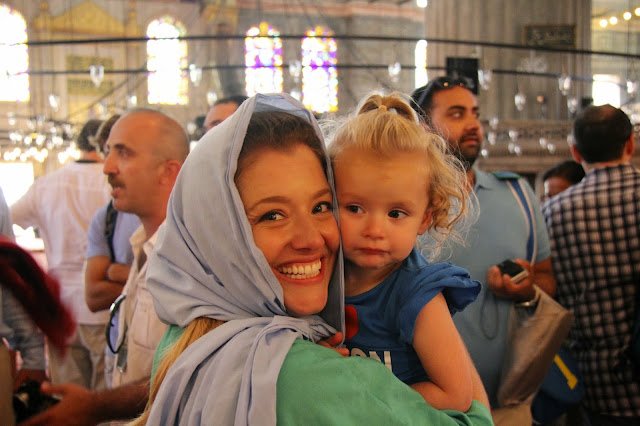
Jen and Julia in the mosque
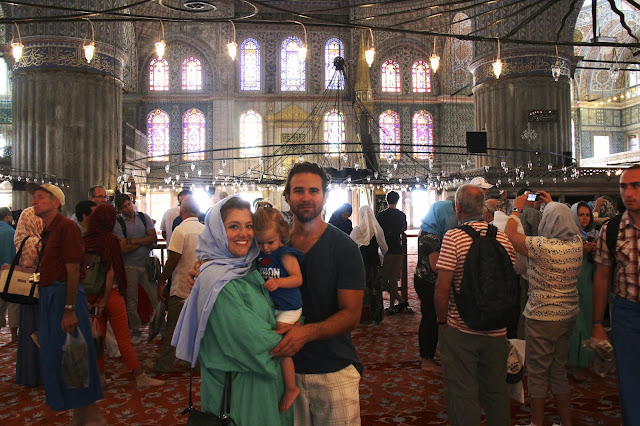
Family photo in the mosque
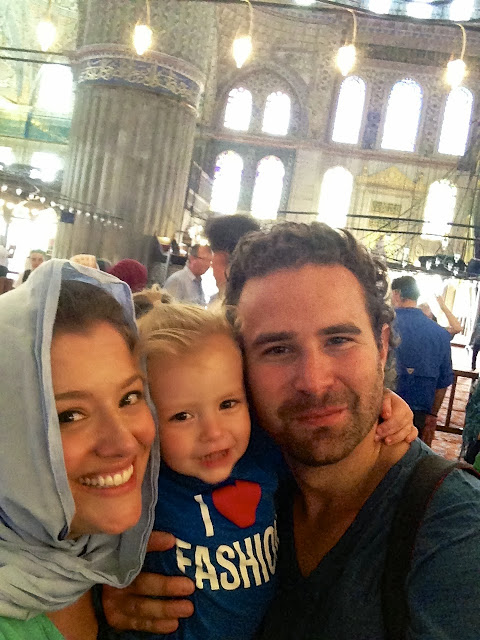
Another family photo
After the mosque tour, we headed northeast by foot to the Topkapi Palace. The palace was the primary residence of Ottoman Sultans for over 400 years. To this day, the residence consumes more land mass along the shoreline than any other single property and has been deemed by UNESCO as “the best example of ensembles of places of the Ottoman period.” We were very excited to see the palace, but unfortunately it was closed and so we had to settle for a stroll through the public gardens.
Inside the gardens of the Topkapi Palace
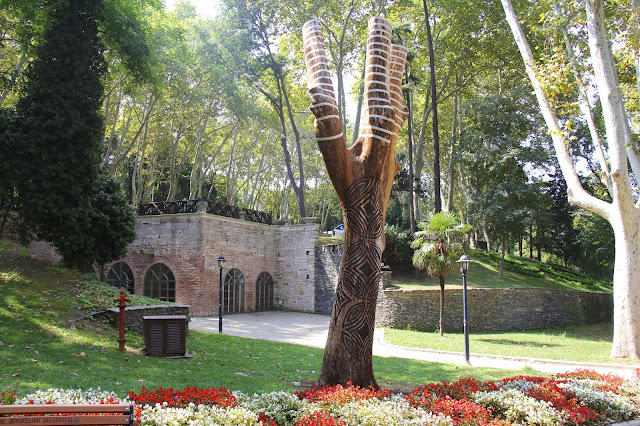
This unique tree appeared as if it had tattoos
After a long walk to our next destination, we first wanted to stop and have lunch. I had been dying for one thing since arriving in Turkey – a döner kebab. We found a restaurant that looked perfect and ducked inside for lunch. Just prior to walking in, we heard the adhan, called out by the muezzin from mosques across the city – amplified by loudspeakers. More commonly known in English as the call to prayer, this unique chant is called out five times a day, summoning Muslims for mandatory worship. After lunch we entered the famous Spice Bazaar – the center for spice trade in Istanbul. The market is the city’s second largest covered market behind the Grand Bazaar.
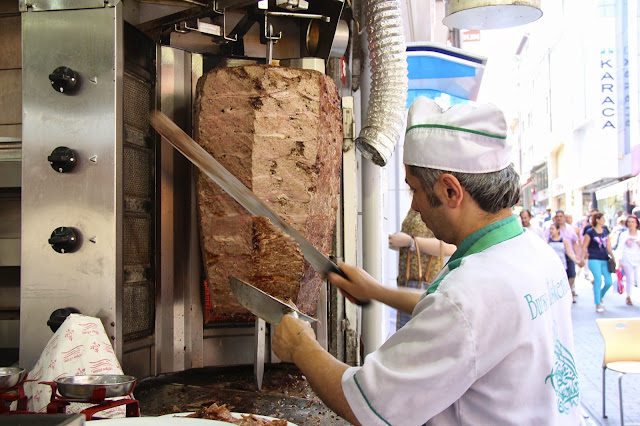
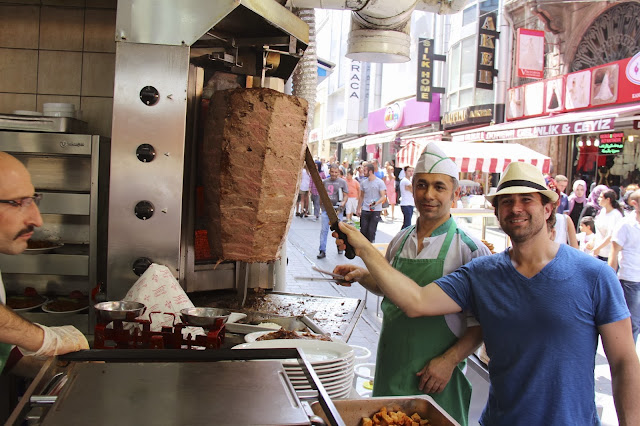
Döner kebab – a mixture of meat, usually veal and or beef with lamb and sometimes chicken
The only thing better than a freshly made döner kebab is one that you slice yourself!
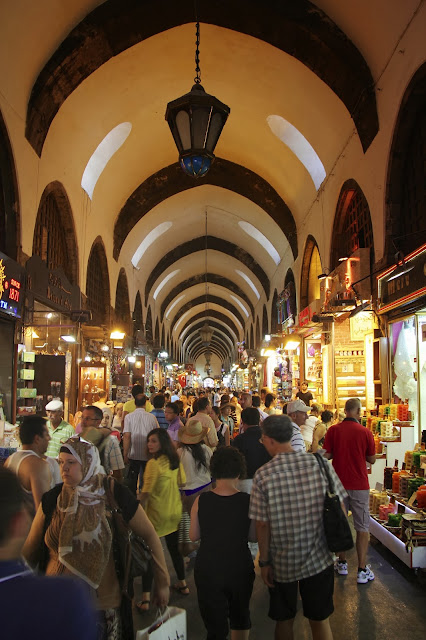
Entering the Spice Bazaar
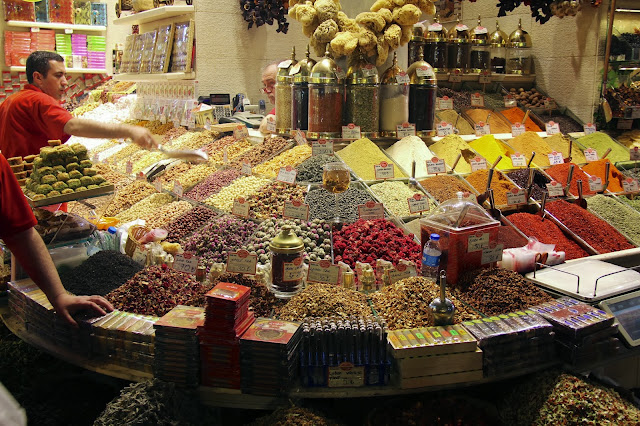
Merchants showcase their wares, including the ever-popular, Turkish Delight
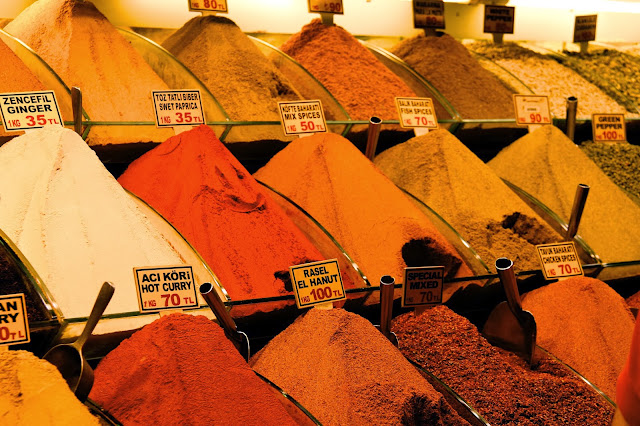
Here you can find most all spices, from hot curry to sweet paprika
The markets in Istanbul seemed endless – this is departing the Spice Bazaar
The ship hosted another party, this time a “sail away” party that included wonderful wine
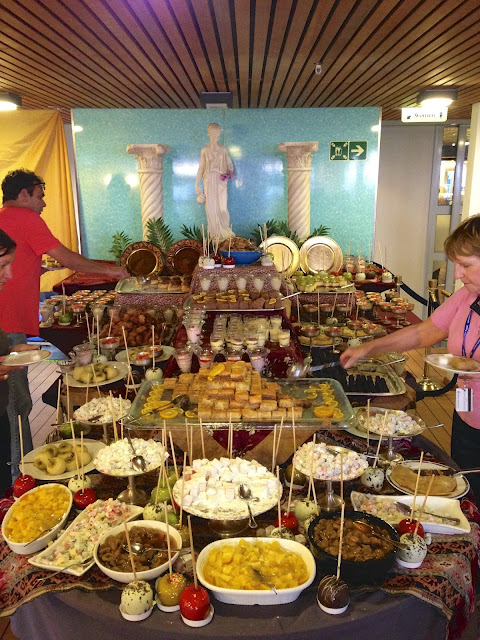
As well as delectable and authentic treats
After our trip to the bustling city of Istanbul, a little bit of unplugging was just what we needed. We easily accomplished this on the island of Lesbos, Greece. This Greek island in the northern part of the Aegean Sea is Greece’s third largest, with a bustling capital (Mytilene) and 200 miles of coast line). Some ports were too small for our monolithic cruise ship, and so we had to use the tender system. All large cruise ships are equipped with smaller boats that can transport passengers from the ship to land when arriving in smaller ports of call. Generally, you are assigned a group number (depending on how quickly you arrive to collect it) and then send ashore in that order. Surprisingly, we arrived fairly early and got to shore just in time to snatch up one of the few remaining tiki huts on the beach. After that, it was clear sailing – nothing but relaxing and sitting in the crystal clear water. Oh, and one more thing… skipping stones. The ocean was just full of perfect stone-skipping rocks. I could easily average six skips but got as high as fourteen skips – the crowing achievement of the day, only to be topped by making the final table at the Casino’s Blackjack Tournament later that night.
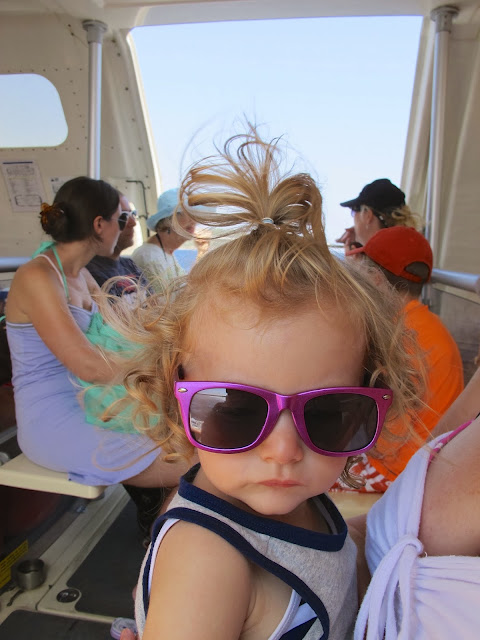
We rode in the tender to get to Lesbos
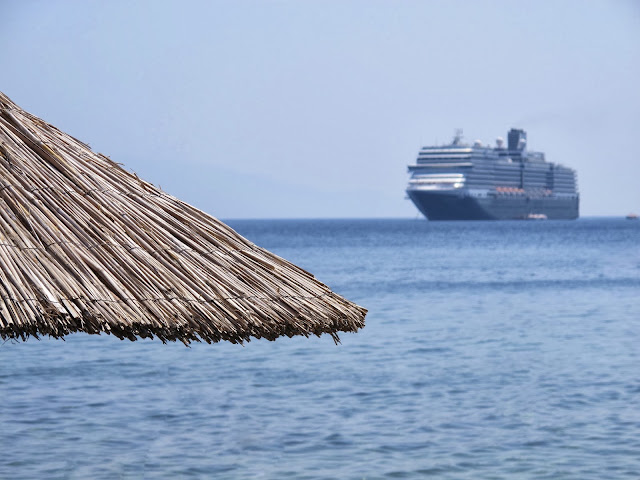
A view of our boat from the tranquil setting under our beach umbrella
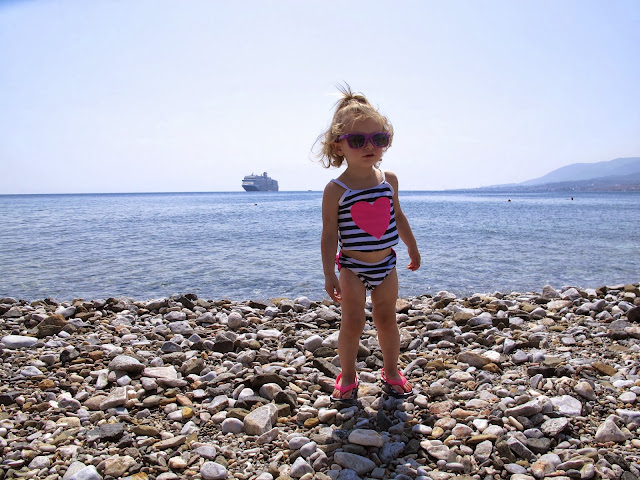
Julia poses for a picture
Skipping rocks with Daddy
Julia wanted to try on her now – she almost got the hang of it
The water was so clear it was fun to just soak
Family toesies
The sun wore Julia out – she was asleep on the ride back
Two beers and a cigar – oh man, oh man! Relaxing on the ship as we sail away
I’m posing for a picture with my girl, little did I know what she was up to under my hat!
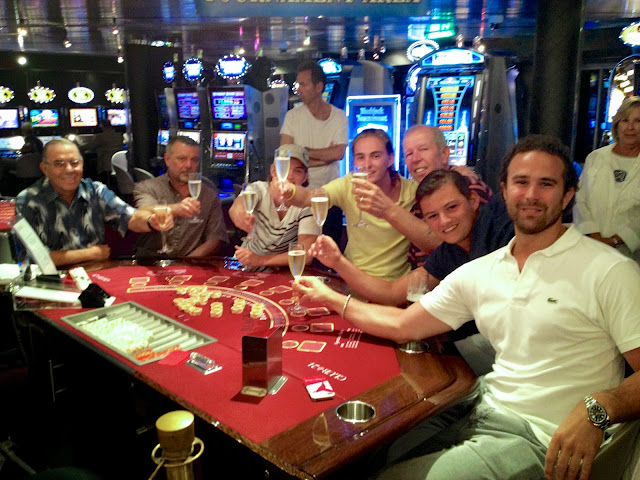
Blackjack tournament final table. Got knocked out doubling down on 10 against a dealer 6. It would have given me an unbeatable chip stack with three hands left. The winner had no idea what he was doing which put me on tilt
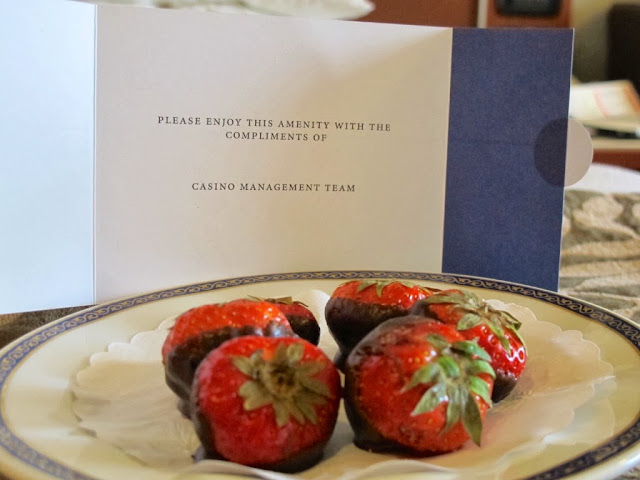
The casino would send up desserts and bottles of wine with their compliments. Perhaps I was too frequent of a visitor??
We still have plenty more adventure to come… please tune back in to the final section of our cruise in the next post.
Admit it… you sang the title in your head, complete with the voice raising on the “and-a I”…
I love to cruise. Jen loves to cruise. And now… Julia absolutely loves to cruise. We have very few experiences aboard cruise ships, but each time we’ve been on one of these massive floating hotels (or mini-floating city’s… I couldn’t choose between adjectives – you pick your favorite), we feel like royalty. We know that we will chose this method of vacation many more times in our lives. Cruising requires little planning and you are always rewarded with the very best customer service, the opportunity to see many more cities than you normally could in a given time period, endless activities aboard the ship, wonderful food, the benefit of unpacking only once and perhaps best of all – a very affordable vacation (you can get very good deals if you hawk the last-minute deal sites).
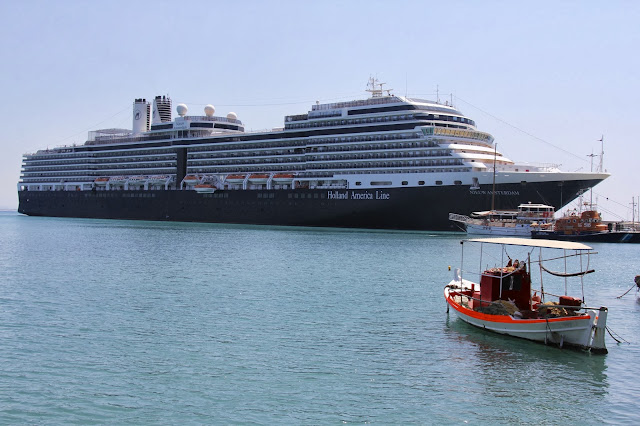
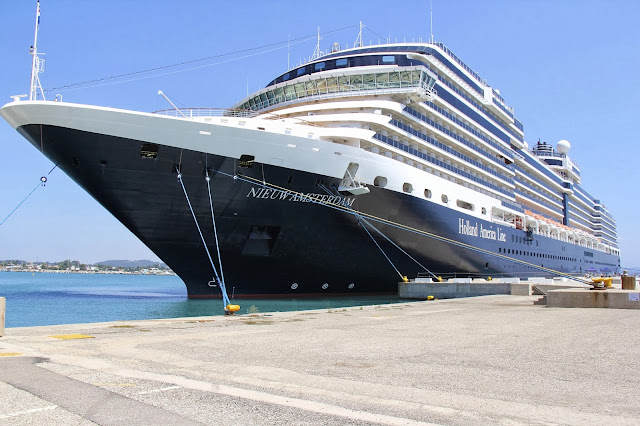
Our ship – Holland America’s MS Nieuw Amsterdam
The first time that Jen and I took a cruise was on our honeymoon. We spent three weeks sailing around South America (from Buenos Aires, Argentina all the way around Cape Horn and on to Santiago, Chile). I chose Norwegian Cruise Line (NCL) for our first cruise, primarily because the itinerary was perfect and I found it to be reasonably priced. I wasn’t nearly the internet-nerd I am today and so I did little research beyond that. We had a wonderful vacation, ate way too much food, enjoyed some lovely scenery (I have thousands of pictures to prove it) and had an absolute blast. However, I had no idea how amazing cruising could really be until we recently boarded Holland America’s, MS Nieuw Amsterdam (pronounced, n-e-w); one of the newer ships in their fleet.
Boarding the Nieuw Amsterdam
I had a few checklist items when we moved abroad – things I wanted to do and to see. Experiencing a cruising-adventure was definitely on that list. For the first time in our lives, we had the flexibility to really take advantage of a “last-minute” vacation, and so the plan was to use that to our full advantage. Unfortunately, we discovered that having a child prevents you from really getting those steep 70% off discounts you see flashing on the side of your favorite webpages. Some cruise lines require a child to pay a full fair. Others require that he or she have a special room or special bed. Either way, it seemed that the myth of really inexpensive cruising (at least with a child) was just that – a myth. Eventually, we searched for dates further into the future (ensuring the ability to book a room that could accommodate a small child) and narrowed our choice down to two cruises with two very different itineraries on two very different cruise lines.
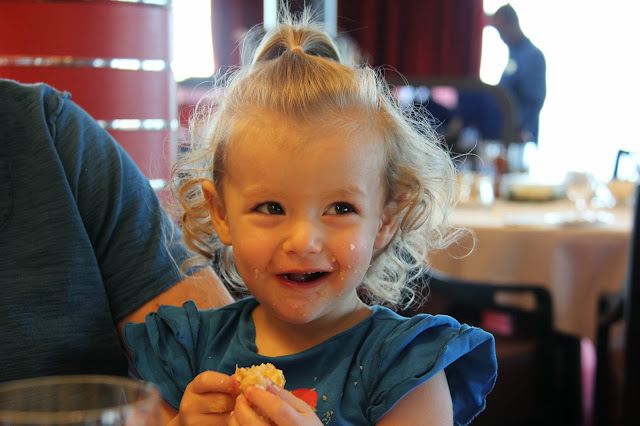
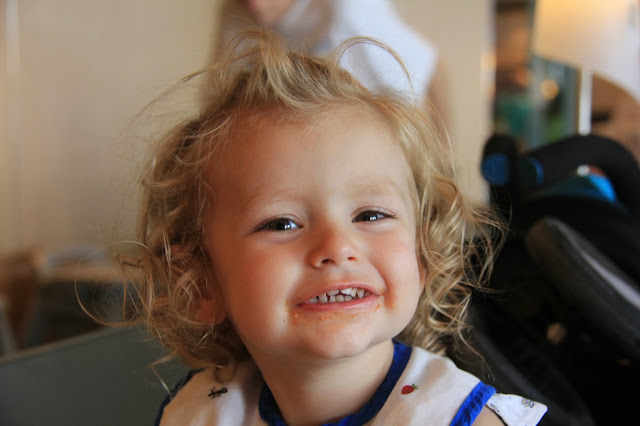
Could this little peanut (eating until her heart is content) actually prevent us from finding our perfect cruise?!
“Who me?! No way, Dad. Now, let’s EAT!”
World travelers and vacation aficionados – here’s where you need to pay attention. I am going to share two valuable resources I discovered throughout this process. First, I had been paying a fortune in cell phone bills, calling these various companies to get accurate information about their cruises. Then I stumbled across, gethuman.com – an internet based voiceover IP company that allows you to call most major companies from your computer – for free! I have spent this past year calling American Express, Visa, Wells Fargo and other companies at a cost of roughly €10 per call… just to get past the automated prompts! This site has revolutionized my ability to manage tasks at home while living abroad. Second, we discovered cruisecritic.com – the ultimate guide when selecting a cruise. Consider it the yelp or trip advisor of the sea. This site allows you to plug in any cruise line and read reviews – but more importantly it allows you to search specific cruise ships, ranking everything on that unique vessel from the food to the service – ultimately awarding the ship a nice, neat approval percentage number. It’s all very easy and streamlined. What I learned was that a cruise line can offer a vastly different experience aboard any number of their ships (for example, an older ship with lesser quality food may not be nearly as pleasant as one of their newer ships). Therefore, we learned that the ship itself is more important than the cruise operator. And we learned this lesson just in time. I was on the phone with Costa (the losing company), about to book our cruise. I had selected this particular cruise because of the funky itinerary. In addition to the “normal” places, we would have ventured into Ukraine, Romania and Bulgaria. I was moments away from giving my credit card number when Jen motioned at me frantically, having just discovered this particular ship only had a 54% approval rating. I got off the call as quickly as possible and called Holland America, booking aboard the Niew Amsterdam.
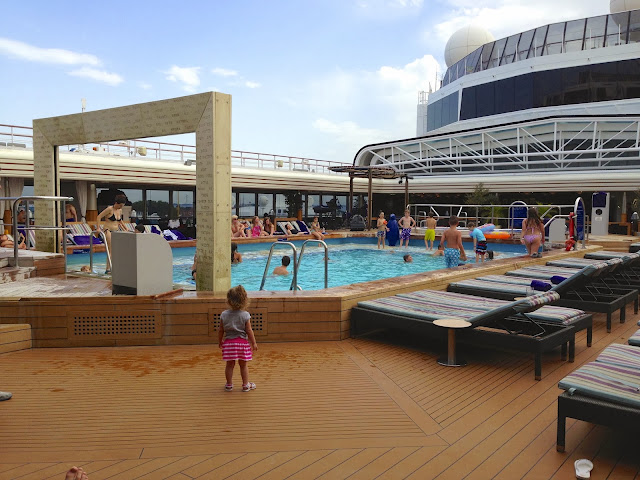
Julia evaluates one of the rooftop pools – this one was located midship
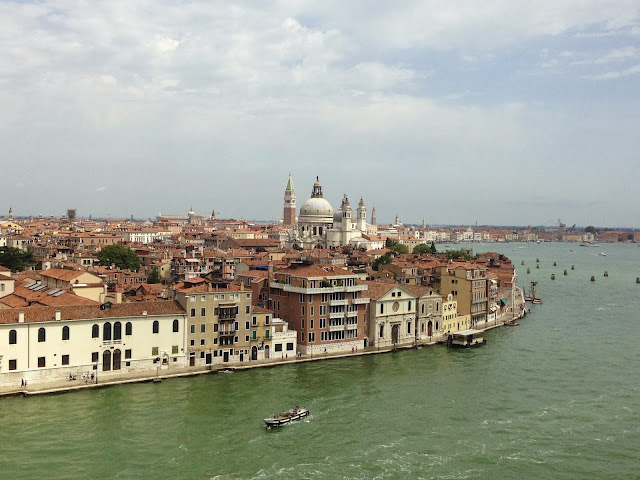
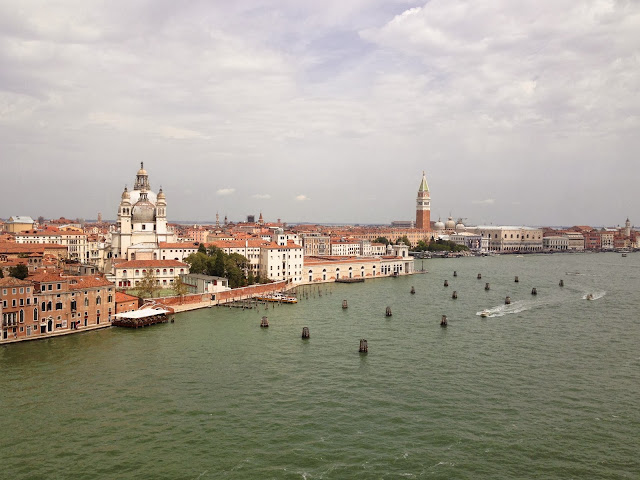
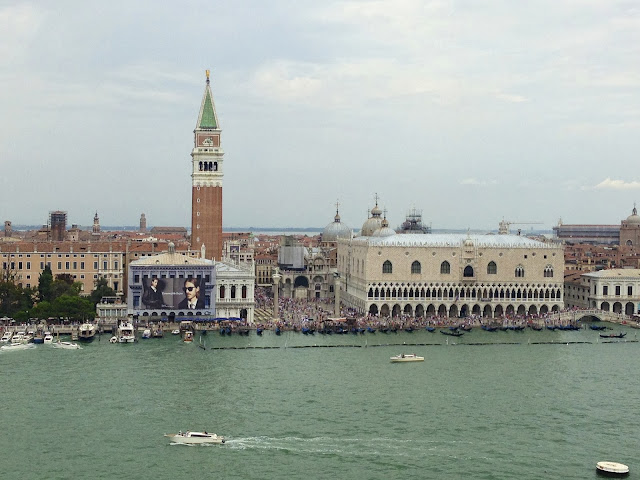
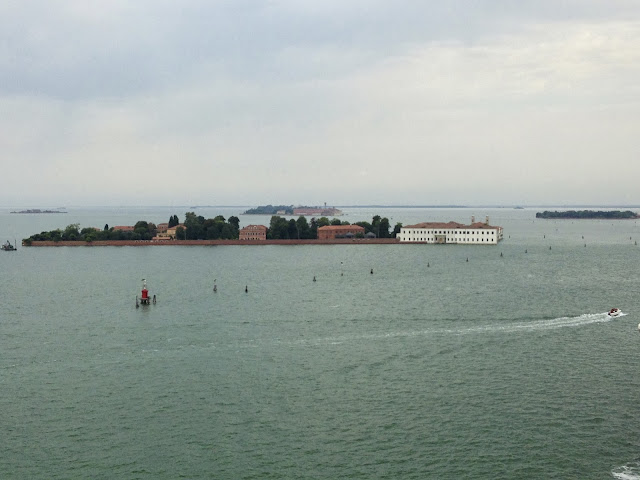
Our cruise departed from Venice, and so we took the three hour train from our home. We were in no rush to get into Venice early, having been there on previous occasions. We bypassed the throngs of tourists vying for photos of the canals and simply went right to the ship. We stayed in Venice’s port the first night, but set sail early in the morning. As we sailed through the Canale Della Giudecca in the middle of the city (I had no idea that it was deep enough to accommodate our massive ship), our fabulous Location Guide, Tom gave a memorable and insightful tour of everything that we were seeing. I apologize in advance for the pictures, I only had Jen’s cell phone with me – poor planning.
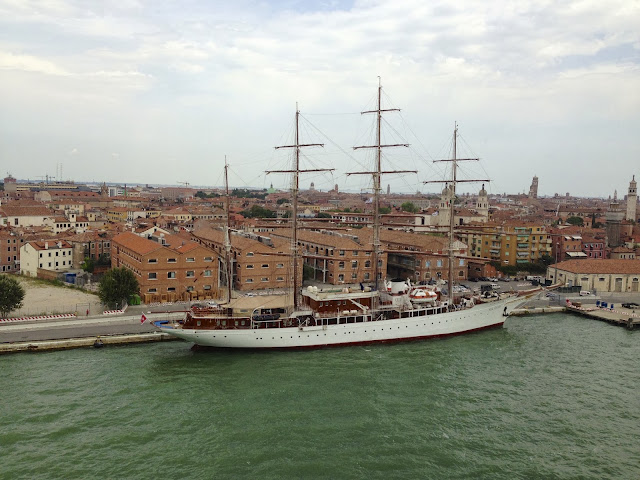
Sailing past another ship in the harbor
From high atop our cruise ship – we could see the entire city unfold before our eyes
A beautiful view of Santa Maria della Salute and the Campanile of Piazza San Marco
From this height we could actually look down and across Piazza Saint Marco – a very unique perspective
Here you can see many of the 118 different islands that make up Venice
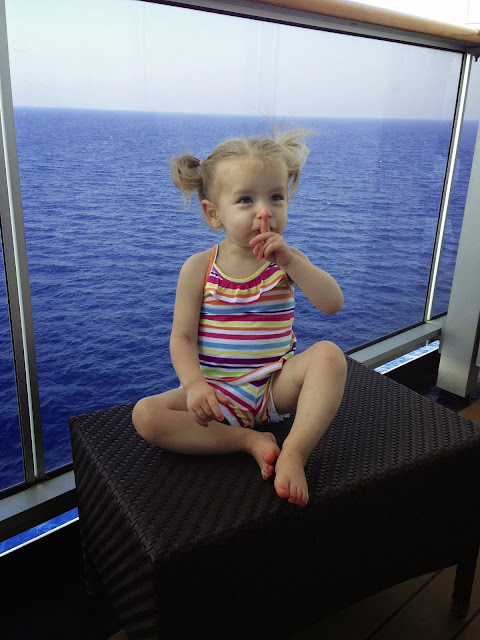
Our first full day aboard the ship was a Sea Day, which means exactly that – we were at sea all day. This is wonderful portion of the cruise for anyone that likes to eat, gamble, drink, workout, spa, play in the pool, attend cooking courses, read, mingle, do nothing, do everything…. you get the point. I think I hit about four or five of those things in the first three hours – eating and gambling at the top of the list.
We woke up early, eager to start the day – but Julia reminds us not to wake our neighbors
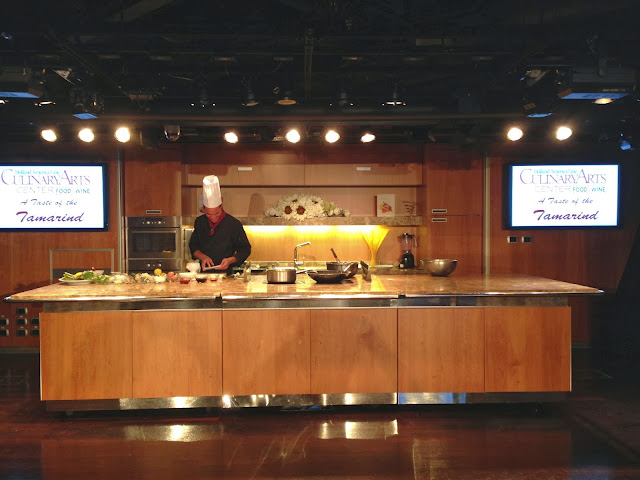
We enjoyed a cooking demonstration
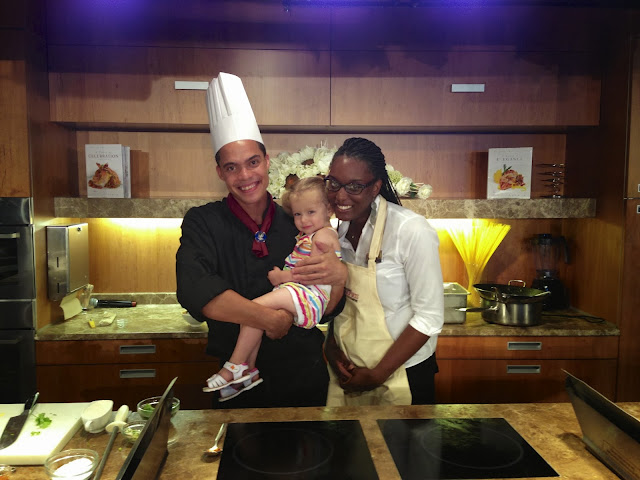
Posing with the Chef and Activities Coordinator
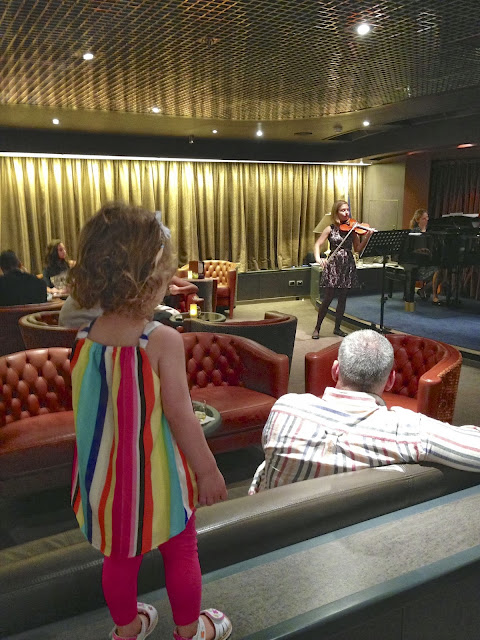
Julia would stop and watch this duo, Adagio perform each night after dinner
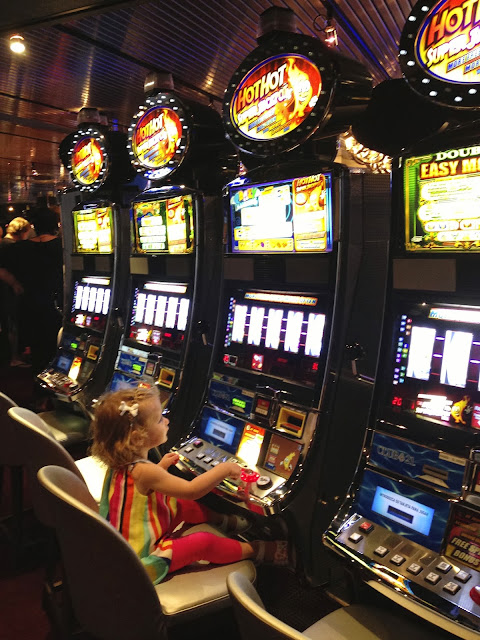
We hoped that lady luck would find Julia
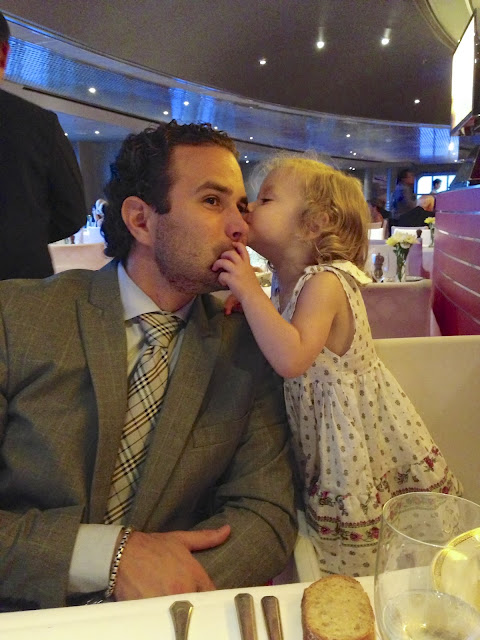
Julia treats me to a kiss during one of the “formal nights”
The following morning was a real treat – our first Port Day. We were at port in Katakolon, Greece, which was just a short bus ride away from something you may have heard of… Olympia, Greece. As in… the place the very first Olympic Games were ever held. As in, the place that contains the ruins of Zeus’ temple. And so I was a little geeked-up to see it all. I didn’t have to imagine standing in the very first olympic stadium – where the worlds best athletes competed since the 8th century BC; we actually got to do it. It was very awe-inspiring.
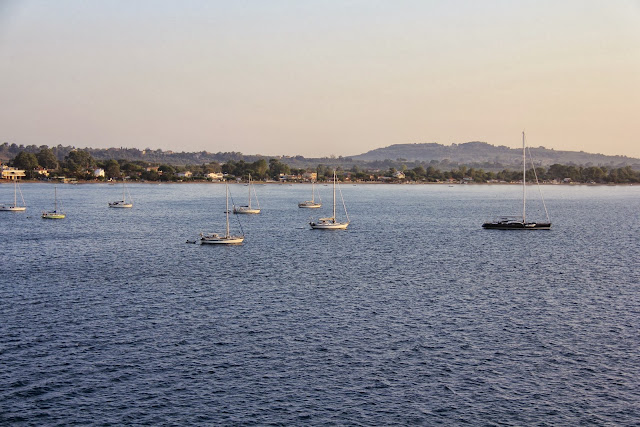
Our first sunrise at port
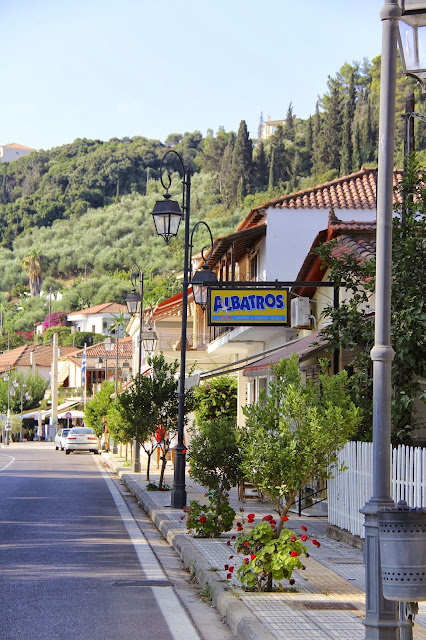
We strolled through Katakolon before our bus departed for Olympia
Travel-bugs… please allow me to give you another tip. If you are reading this post and thinking, “Greg is making a convincing argument for a cruise… I think I’ll give it a go”; don’t make the mistake many cruise-goers make. Do not book excursions through the cruise directly. Sure, it’s easier. Some may say safer. Others may tell you they’re better designed. That’s all true… but at an immense premium. Please allow me to state my case. Below is one of the excursion options at our first port (copied from Holland America’s site). Just skim it if you’d like… I’ll recap:
The small fishing village of Katákolon is your gateway to the mystical site of ancient Olympia, 25 miles to the east. The sanctuary of Olympia has the appearance of a park, and as you step back 2,000 years into the past, imagine the area crowded with athletes, orators, merchants and philosophers surrounding the Temple of Zeus with its forty-foot statue of the god, the ruins of which you will see today. It’s easy to imagine the roar of the spectators as the athletes took their marks on the marble starting blocks, and to picture the temples, treasuries, porticoes and statues as they were. After your visit to Olympia, you will continue to Mercouri Estate, known not only for its wines of supreme quality but also for its magnificent location. This is the area where the Refosco grape was first planted after being imported from Italy. In 1930, the Mercouris built a modern winery and distillery, updated again in 1990 with the latest technology. You are invited to experience the beauty and charm of the vineyards, to see the old and new wineries, and also to taste the locally produced wines.
OK – so you get a bus ride with 40 other schmoes to Olympia, gate access and a wine tasting. It’s very well written and this guy is singing a sweet sirens song – but he couldn’t lure me. Guess what it costs… $150 per person plus $60 for kids. OK – so we’d be all in for $360. Guess what we did? We got off the ship, walked over to the person selling bus tickets to Olympia (the same cushy travel bus with A/C and TV’s that the cruise people take) and bought both tickets for $20. Then another $20 at the gate and I’m all in for $40. A savings of $320. With that much left in my pocket, I had my choice of any number of Greek wines “known for their supreme quality” that we picked up at Duty Free on the way back to the ship.
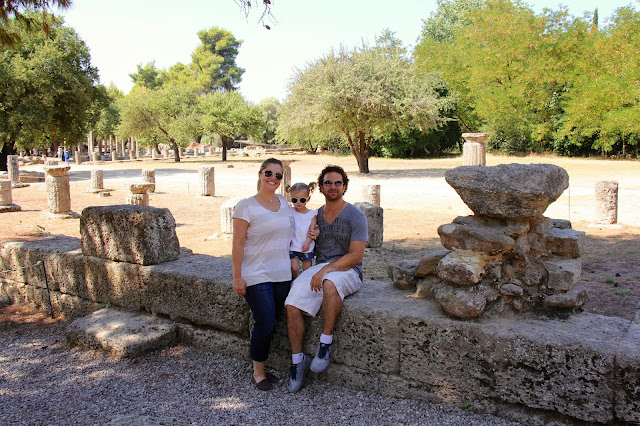
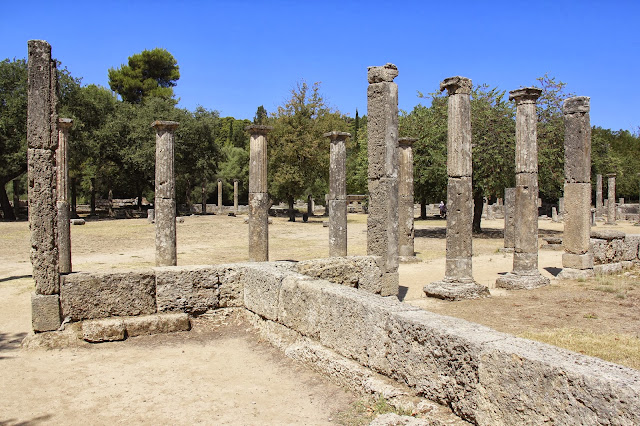
We stop for a family photo in front of the Palaestra
Julia does a little dance number
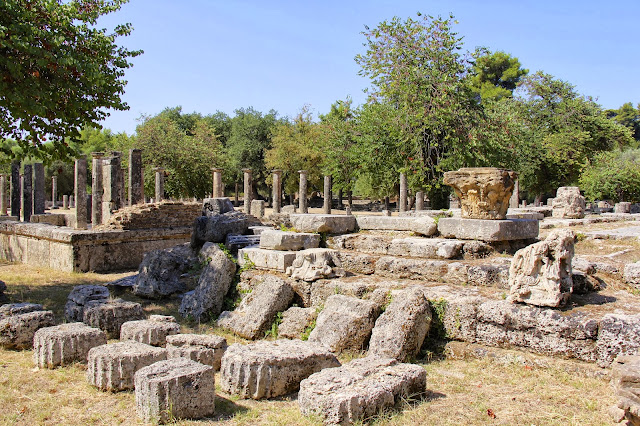
Ruins of the Theokoleon
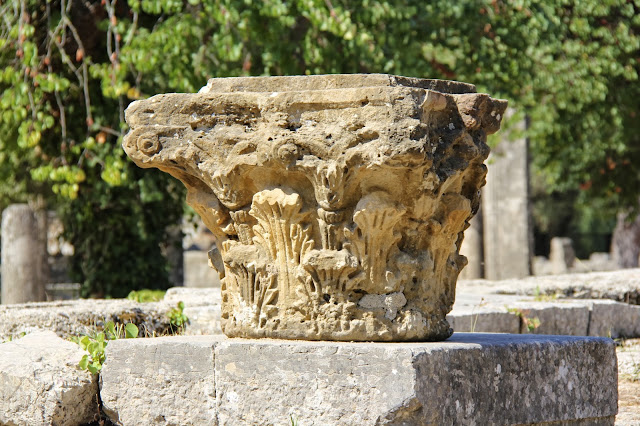
A lone column capital (top) remains… 1,000 years old? 2,000 years old? 2,500 years old??
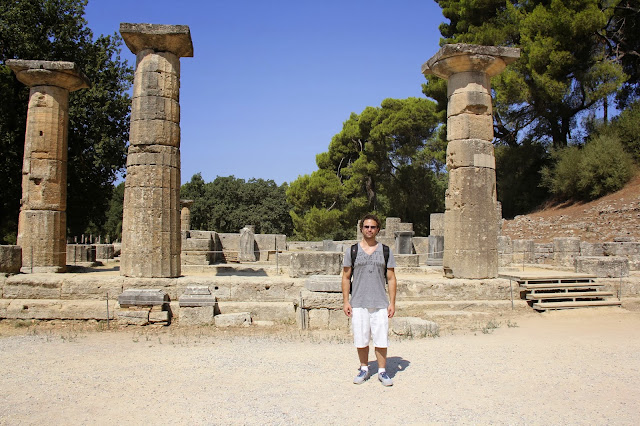
I stop to stand in front of the Temple of Hera
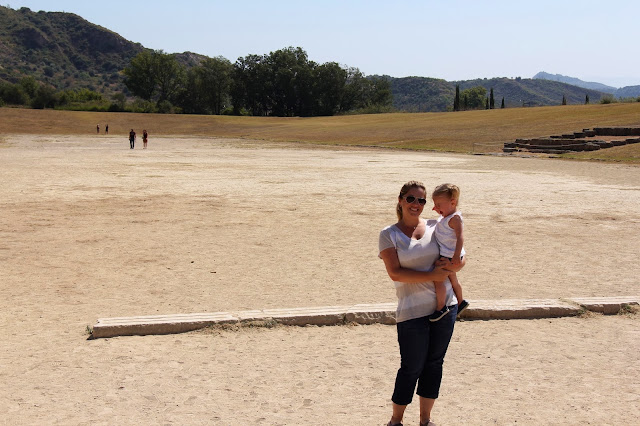
Jen and Julia challenge competitors on the Stadium ground
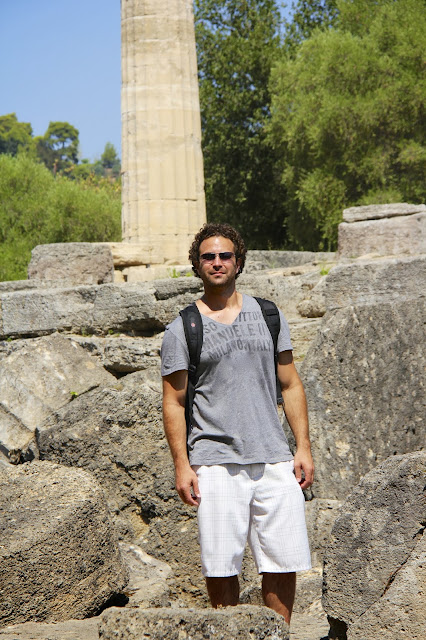
Lost amongst the rocks in front of the Temple of Zeus
Another view of the Theokoleon
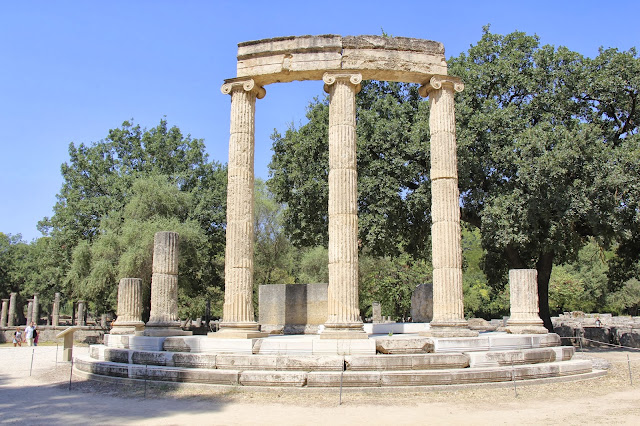
Impressive remains of the Philippeion
The next day we woke up in Piraeus, Greece – which is the port city outside Athens, Greece. Same thing as before – I bypassed the tempting, but expensive excursions and departed with Jen and Julia in tow. We walked around the corner and found that the Greek Gods were smiling on us that day. In addition to the regular cabs and buses to take us the 20 minutes into Athens, there were “Hop On-Hop Off” open-top tour buses. That meant we would get a ride, an audio tour and the ability to come and go as we pleased, all for $30.
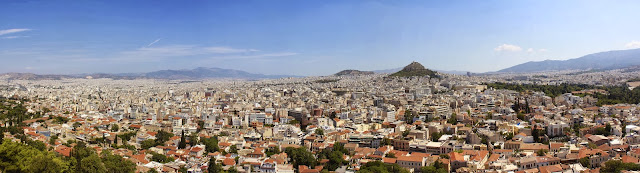
Athens is an amazing city with a recorded history spanning 3,400 years
We rode around Athens, enjoying our tour and chuckling to ourselves at the Greek music they kept playing over and over (imagine the soundtrack to “My Big Fat Greek Wedding” on repeat). My plan was to complete the loop and finish the audio tour before getting off, but when I saw the majesty of the Parthenon, I knew we needed to depart the bus immediately.
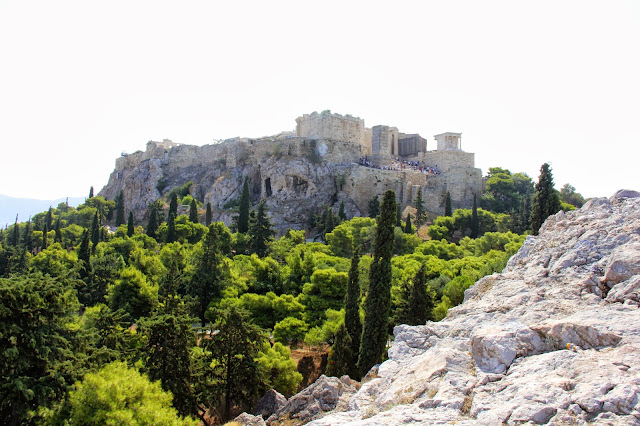
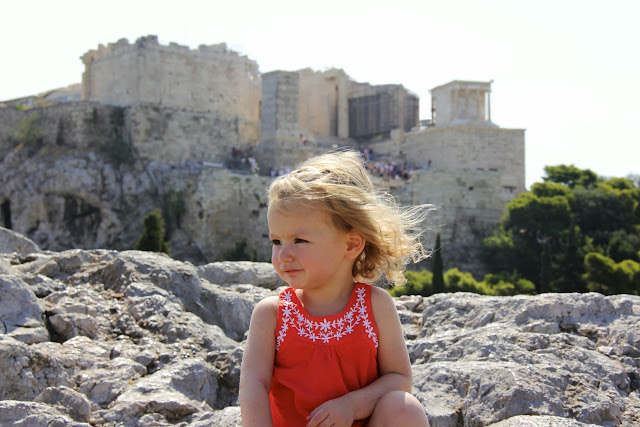
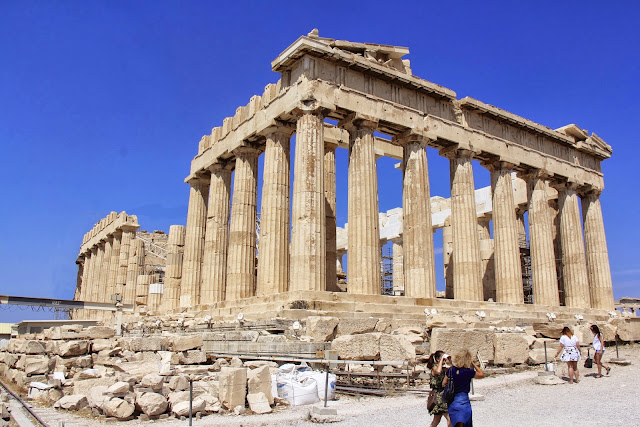
The Parthenon sits atop the Acropolis of Athena
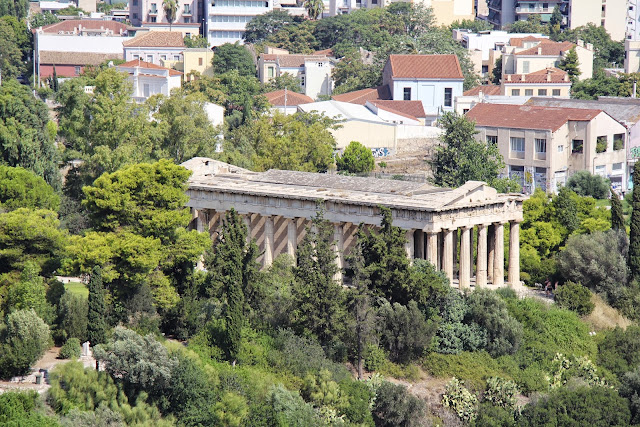
The Parthenon is the featured temple within the Acropolis of Athena; a temple built to honor the Goddess, Athena. Construction of the temple began in 447 BC and today it is widely considered the most important surviving building from Ancient Greece. In order to reach the temple, you must climb the imposing slate steps to reach the Acropolis of Athens, an ancient citadel set high atop a rocky outcrop far from today’s modern Greece. But before we climbed the steps of the Acropolis, we first climbed a neighboring cliff for a view of the magnificent ancient city and the more modern one below.
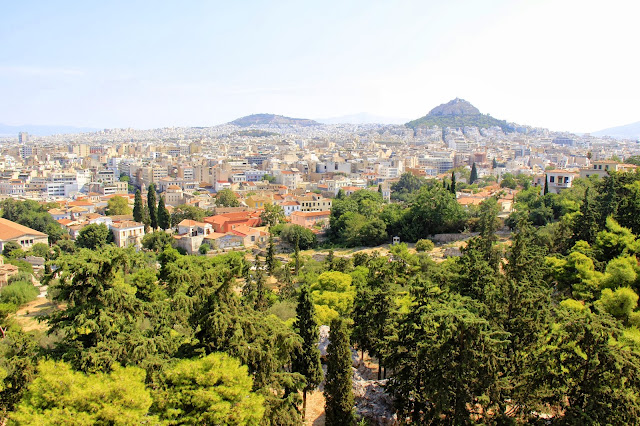
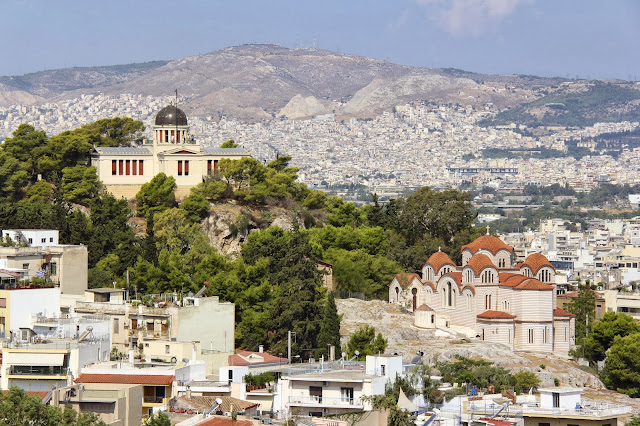
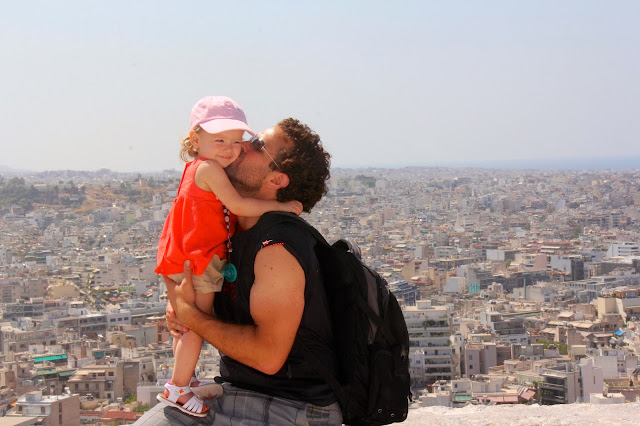
Athens has roughly 3.2 million inhabitants – Greece’s largest city by a wide margin
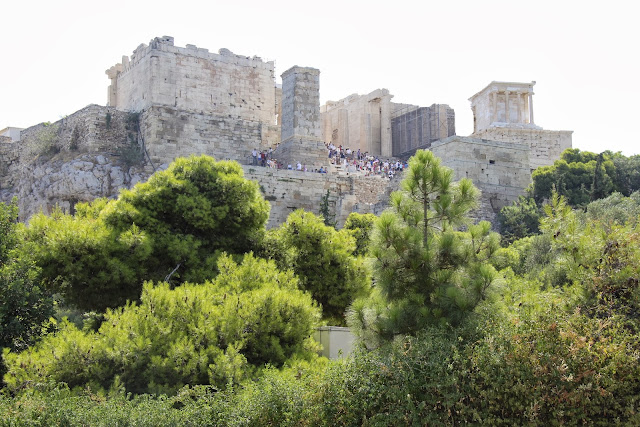
Hundreds of visitors passing through the gates of the Acropolis
Ancient ruins are a part of the city – even as modern urban sprawl is built around it
Some more “modern” temples perched atop their own cliffs
My girls begin their ascent
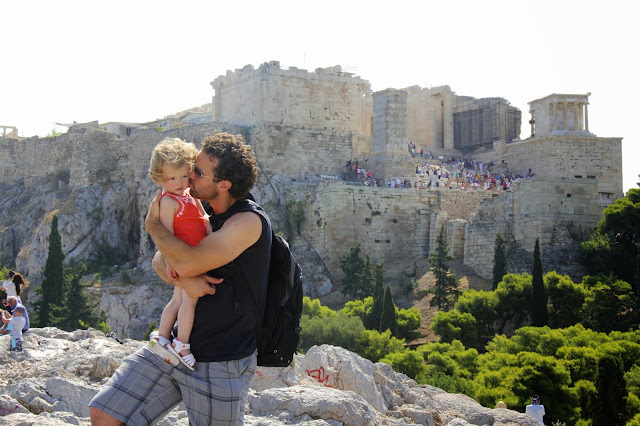
Julia fights the wind and I steal a kiss
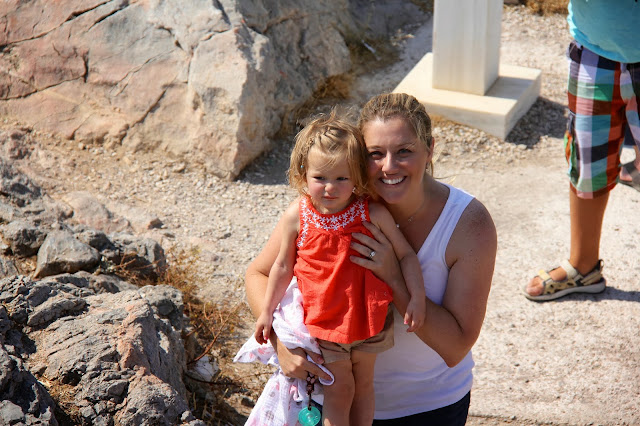
I think Athena herself would have been pleased to have this little guest in her temple
As we climbed the steep incline of the Acropolis toward the temples, we narrowly missed slipping and sliding back down to the bottom. The slate steps were slick even though they were bone dry – I couldn’t imagine making the climb if it had rained. There were many sights to see, including the amazing expanse of a remarkable city below. We marched through the ancient doorway leading into the city and stopped for a rest and some photos.
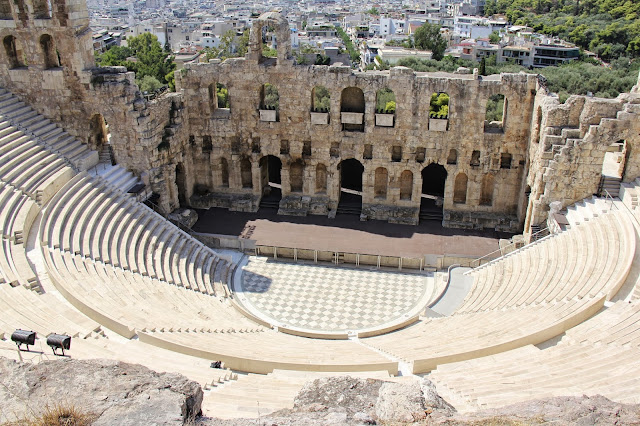
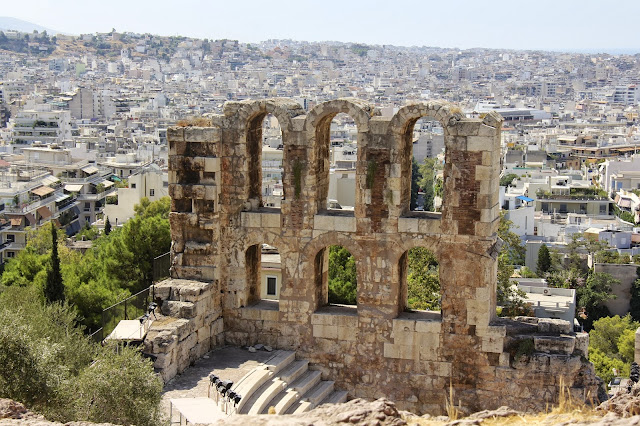
Odeon of Herodes Atticus – a steep sloped amphitheater built in 161 AD
The southern wall remains well intact
Julia lets me kiss her for all of Athens to see
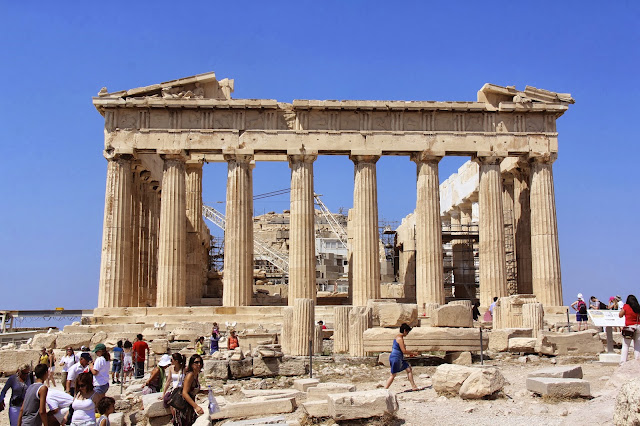
The Parthenon – Temple of Athena
It’s amazing how well the Parthenon has been preserved
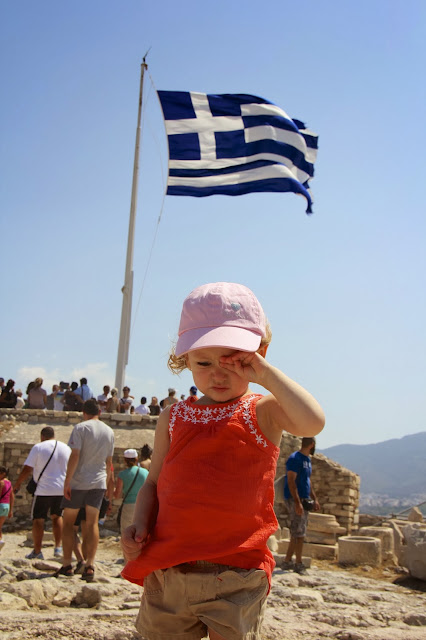
Julia pays her respects to the Greek flag
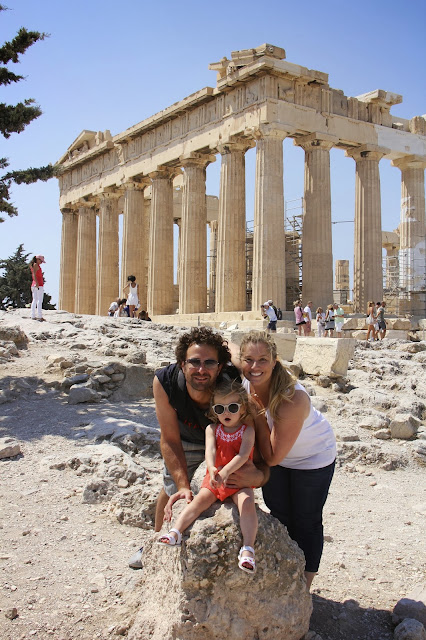
Family photo in front of the Parthenon
While the Parthenon is clearly the star of the show within the Acropolis, there are many other important ancient buildings and temples. The Greek word Acropolis (Ακρόπολη) is made up of two components – akron, meaning “edge” and polis, meaning “city”. While there are many other Acropolis’ within Greece, it is commonly accepted that the Acropolis of Athens is the Acropolis in all of Greece. From the moment we walked through the gateway into the city, I truly felt as if I was transported into an ancient, mythical world – where Gods and Goddesses ruled from on high. Perhaps I have seen too many movies, but I really did feel as though I was apart of something far bigger than I’ve ever known. I think I was even annoying Jen a bit with my enthusiasm and newfound feeling of power (as if I was somehow apart of the world of The Gods and could strike down any mere mortal…). It was probably good that I got out of there when I did, lest I try to actually smite someone.
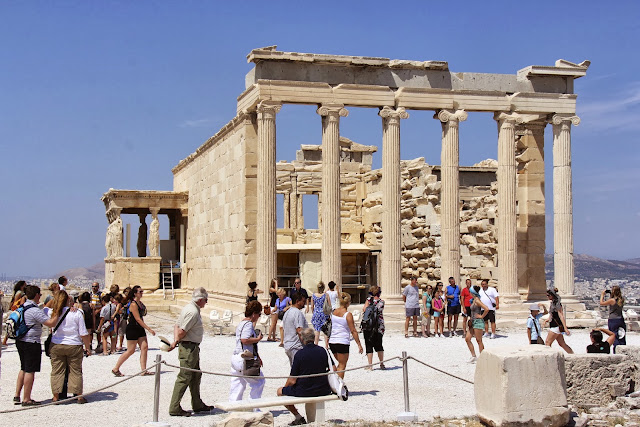
The Erechtheum – a Temple for both Athena and Poseidon built between 421 and 406 BC
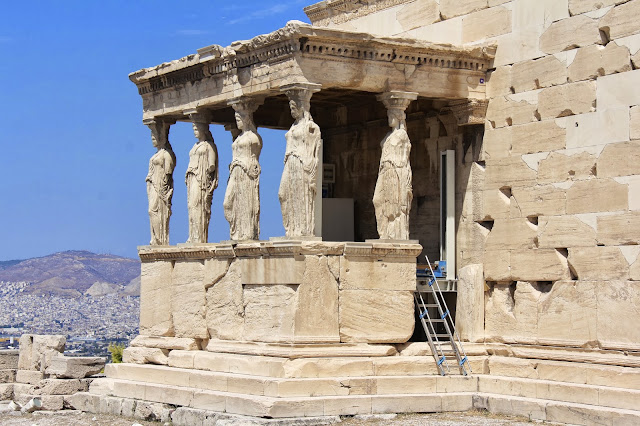
The Porch of the Caryatids (maidens) built to conceal a 15 foot support beam
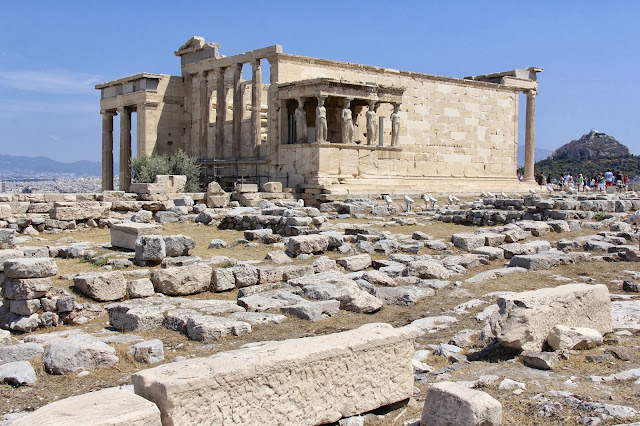
Another view of the Erechtheum from the south west
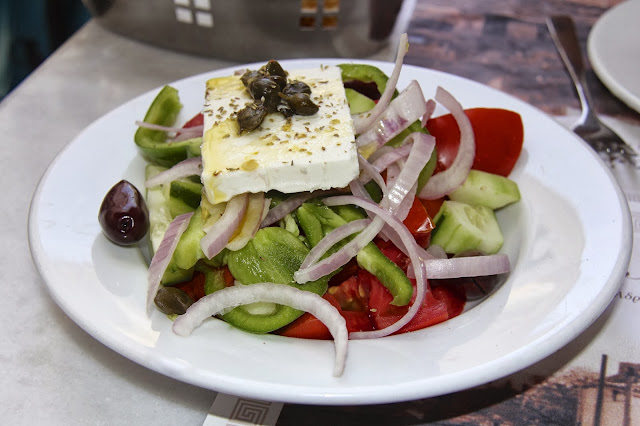
We had worked up quite the appetite touring the Acropolis and so we descended the ancient city toward a more modern part of town. We found a charming pedestrian area of the modern city and stopped for a lunch of what else… Greek salad! We drank a couple of refreshing Greek beers and then strolled through the ample markets.
Greek salad – the authentic way!
Finally, we boarded the ship and set sail for our next adventure… I hope you’ll hop back aboard for Part II (coming soon)!
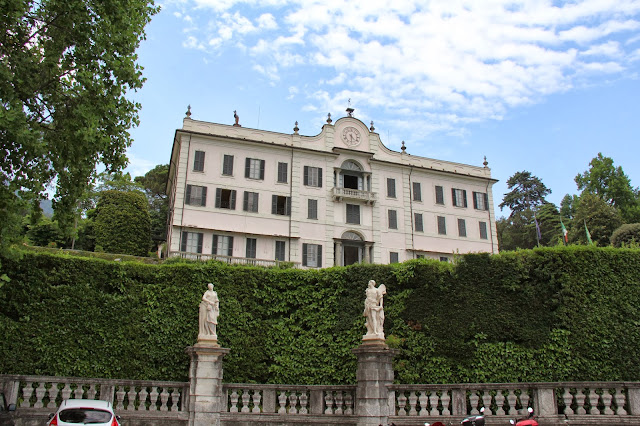
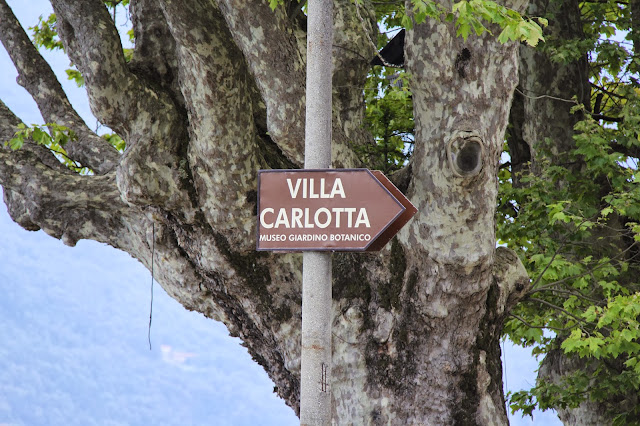
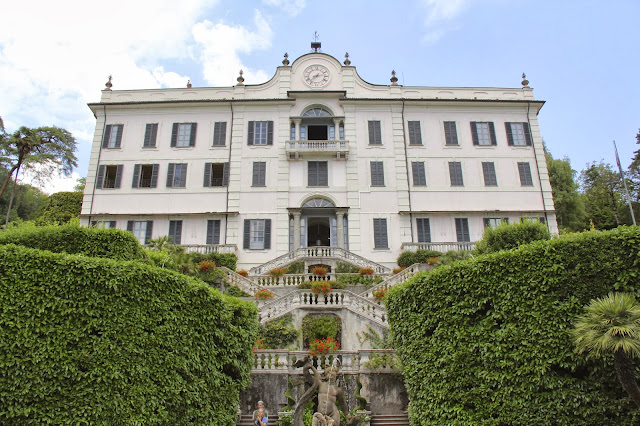
There is a wonderful town along Lake Como, called Tremezzo. Most people have heard of Bellagio, which sits on the exact shore opposite Tremezzo, but the lesser known town is a true gem with far fewer tourists crowding the streets. Tremezzo is home to a couple of our favorite restaurants and gelaterie (ice cream parlors). It is also home to Villa Carlotta, a 17th century treasure that has been beautifully restored and maintained.
Villa Carlotta
Jen and I have been wanting to visit Villa Carlotta since we moved to Como. The beauty of the villa and the gardens are well known in this area and attract thousands of visitors each year. We had planned on going in March when my aunt and uncle were visiting, but the villa is not open to the public until the 15th (just a few short days after they departed). Since the gardens are the main attraction, the preservation society wants to ensure all the flowers are in full bloom. Jen and I decided that since my mom is a big fan of gardens, we would visit while they were here (read about the first part of their trip HERE).
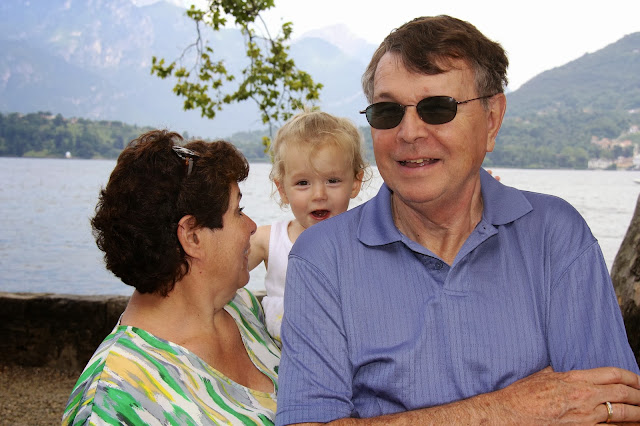
Julia peeks out from behind her Grandma and Pop-Pop
We had planned a drive along the lake to arrive in Tremezzo just in time for lunch. We took my parents to one of our favorite restaurants, La Fagurida that we had discovered some time ago (blog post HERE). Their specialty is rabbit – and once again, we were not disappointed with the food.
Jen and Sonny outside of La Fagurida
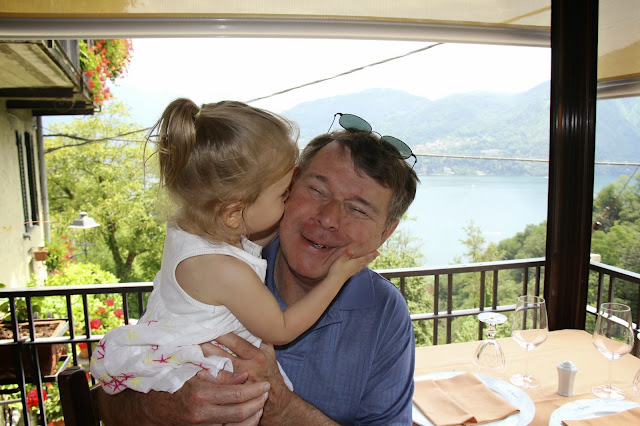
Julia was all kisses after lunch
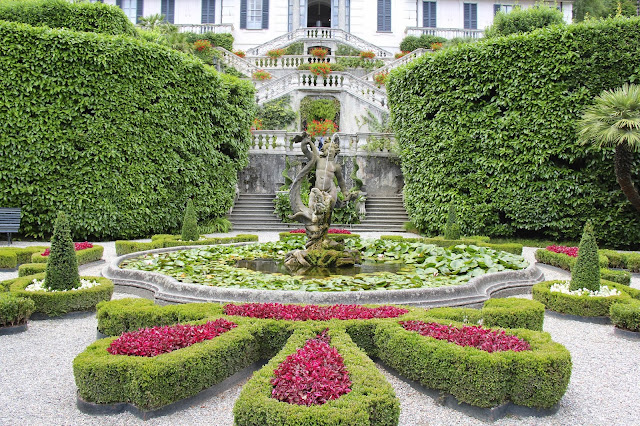
After lunch, we drove back down the long and windy mountain road toward the center of town. We parked and got our admission tickets to the villa. We spent some time walking through the villa, but the real beauty was in walking through the elaborate and seemingly endless gardens.
Villa Carlotta, Museum and Botanical Garden
Impressive stairway leading to an impressive facade
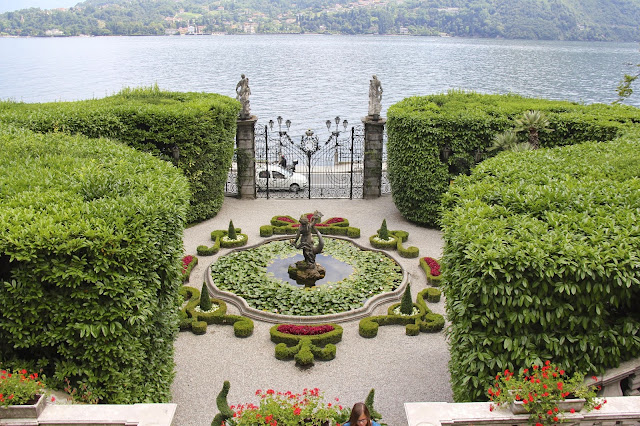
The ornate gardens begin the moment you enter the grounds
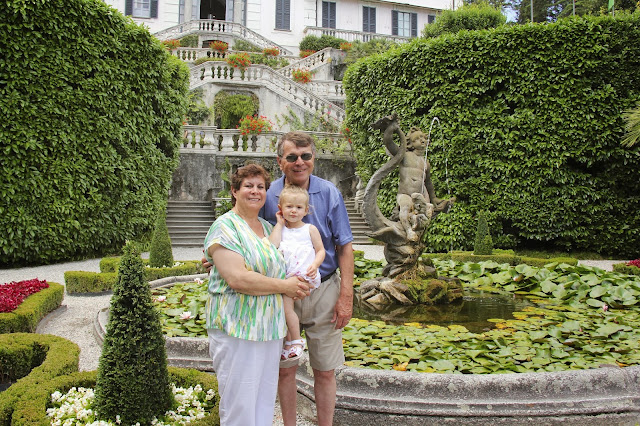
Julia stops for a photo with her grandparents, Stefani and Sonny
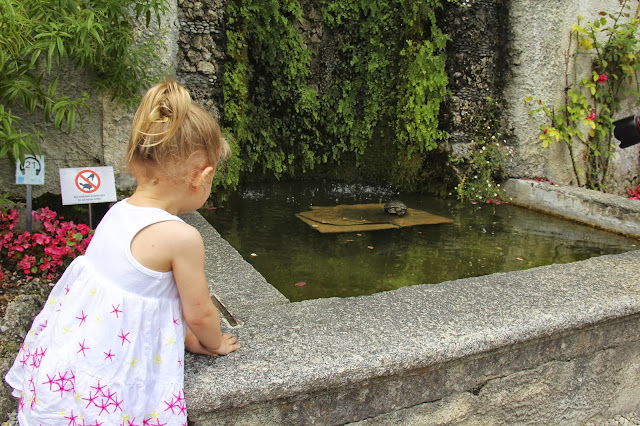
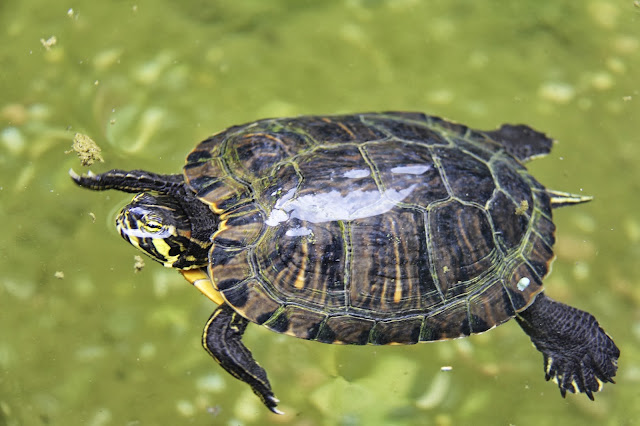
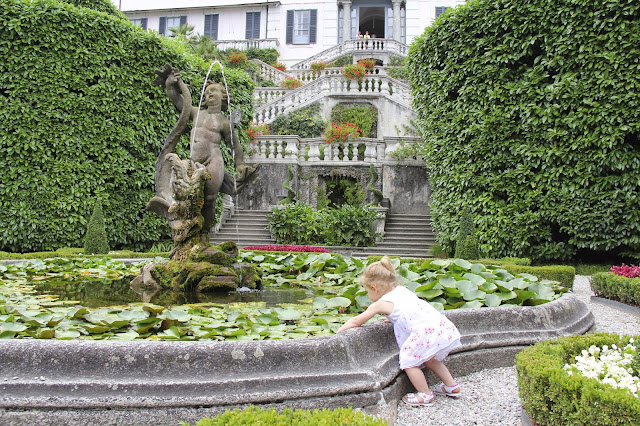
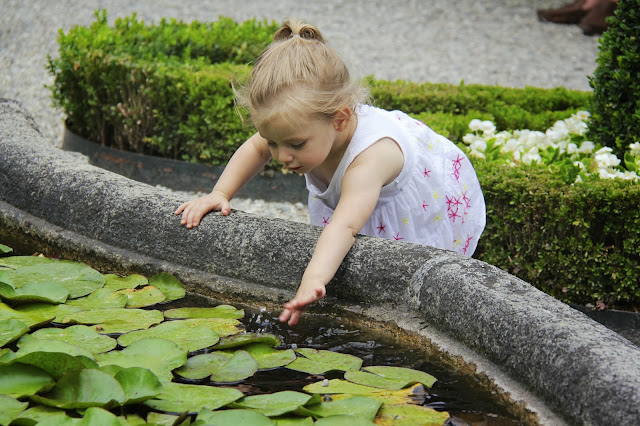
She was amazed by the turtle pond
There were half a dozen of these little guys
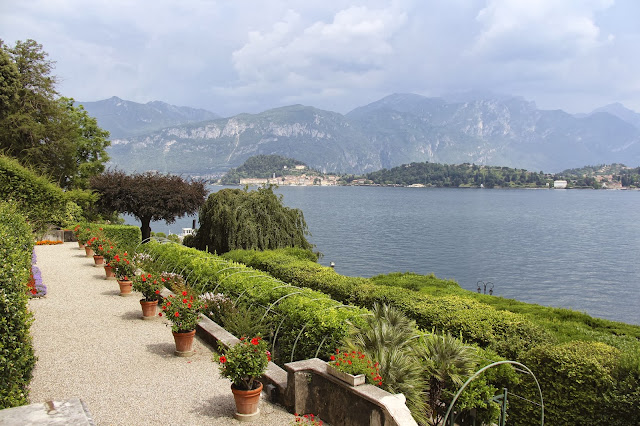
View from the front of the villa’s terrace overlooking Lake Como
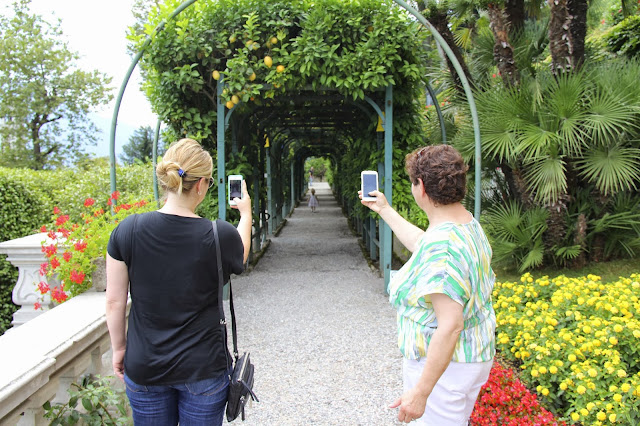
A mom and a grandma snap pictures of our little Julia
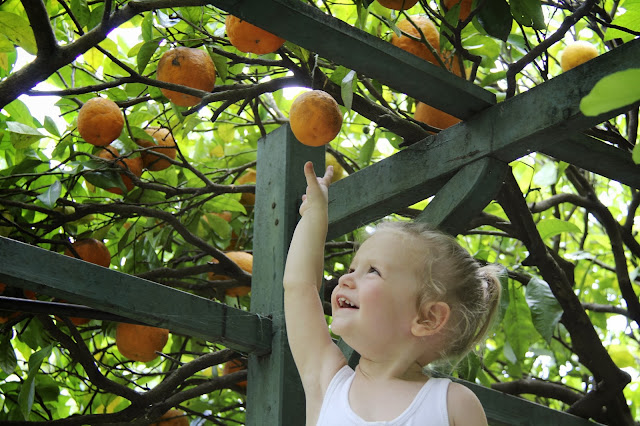
They had oranges growing in the trellis that Julia wanted to pluck
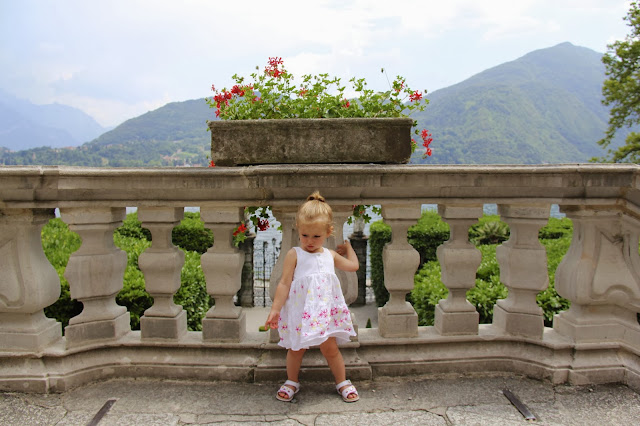
Julia strikes a fashionable pose on the terrace
The villa was positioned to overlook the town of Bellagio, across Lake Como
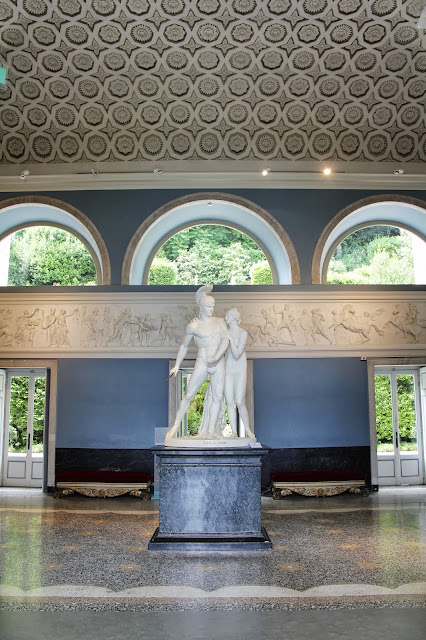
Priceless works of art adorn each room in the villa
Jen and Julia stop for a picture in the villa
I have copied a brief description of Villa Carlotta directly from the brochure, if you are interested in a bit of it’s unique history:
Villa Carlotta is a place of rare beauty, where masterpieces of nature and art live together in perfect harmony in over 70,000 square meters (17 acres) of garden and museum. The beautiful villa was built at the end of the 17th century in a natural basin between lake and mountains, facing the dolomitic Grignas and the peninsula of Bellagio. The architect created for the Clericis – a noble and powerful Milanese family – an important but somber building, with an Italian garden decorated with sculptures, stairs and fountains. In 1801 Gian Battista Sommariva, famous politician, businessman and patron of arts, bought the villa. Thanks to him, the villa attained the summit of its splendor and became one of the most important halting-place of the Grand Tour with its collection of art (masterpieces of Canova, Thorvaldsen and Hayez) and its fascinating romantic garden. In the second half of the century Princess Marianne of Nassau bought the villa and gave it as a present to her daughter Carlotta in occasion of her wedding with Georg II of Saxe-Meiningen. Georg was passionate about botany and made a lot of improvements and new additions to the park that became more and more famous for its botanical richness and the rhododendrons’ and azaleas’ spring flowering.
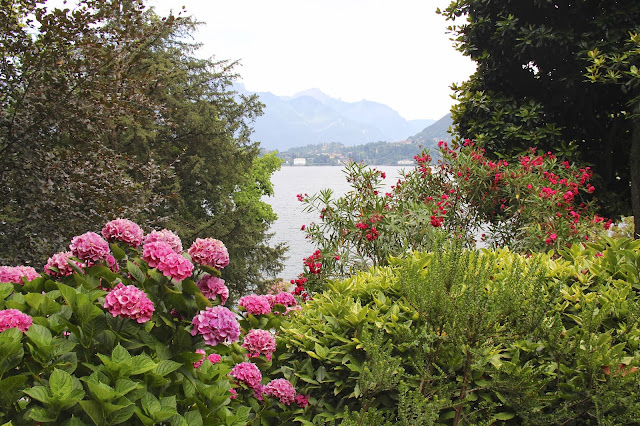
The beauty of the gardens did not disappoint, we all enjoyed each moment of the self-guided tour.
Overlooking Como and Bellagio
Julia couldn’t get enough of the rhododendrons
We had to stop and smell almost every flower
One of my favorite pictures of Julia
Always the lady… or flirt?!
Giving Pop-Pop as kiss as thanks for the ride
Climbing the stairs in La valle delle felci (the valley of ferns)
Walking through Il giardino dei bambù (the gardens of bamboo)
Still in the Bamboo Garden
Julia runs quickly across a stone table
Calocedrus decurrens
Views from all angles
Julia had to play with the fountains one last time
She insisted on making a little splash
Villa Carlotta, more specifically – the gardens of Villa Carlotta are simply stunning to behold. I would strongly recommend copying our itinerary and enjoying pranzo (lunch) at La Fagurida before spending countless hours getting lost in the gardens of Villa Carlotta.
Jen and I recently went to Scotland with her family (HERE) and had a fabulous time exploring the Scottish Highlands. We saw Aberdeen and quite a bit of the Scottish countryside. Next on the agenda was a trip to the country’s capital, Edinburgh. The original plan was to make it a day-trip, but we felt that there was too much to see and do in just one day (not to mention a two hour drive each way), so we planned an overnight stay.
Country road in Ballater
These dry stone walls have been used as field boundaries for well over a thousand years in Scotland
We set out early in the morning from our cottage in the charming town of Ballater, and headed south (still on the wrong side of the road) toward Edinburgh. I was simply amazed to see how the landscape could change so quickly from one part of the country to the another (the colors went from a lush, fertile green to a more rustic, almost coarse landscape – beautiful in it’s own right).
A hilltop basking in the sun, near Ballater – in the Scottish Highlands
A sheep sits down for a rest
Booming commercial center near Ballater
There was a long and desolate stretch of road as the hills flattened and changed their colors
We paused at a scenic overlook to drink up the new landscape
Jen and her sister, Jessica are naturals in front of the camera
Since we opted for an overnight to Edinburgh, we weren’t as rushed to get there, freeing up time to see another glorious castle. Based on local feedback, countless websites and geographic convenience along our route, we chose to visit, Glamis Castle– often dubbed, “Scotland’s most beautiful castle”. The current home of the Earl and Countess of Strathmore and Kinghorne (yes, they really do live there; we could still smell the pleasant aroma of red cedar in the fireplace from the night before) began in the 11th century with much more humble beginnings. Set far in the woods within the town of Glamis, the current castle was once merely a hunting lodge nearly a thousand years ago. But changes in Royal titles, transfer of property, the ego of a few as well as some sordid stories of murders and love affairs transformed a simple hunting lodge into the massive castle it is today. There are legends of a ghost playing cards with the devil until dawn and myths of a monster strolling through the long corridors at night. The castle plays a prominent role in Shakespeare’s MacBeth when Duncan is murdered by MacBeth in Glamis Castle. And what proper castle would be without it’s Royal ties? Glamis Castle has boasted a direct link to the Royal Family in many ways, since 1372 (most recently, the childhood home of the Queen Mother).
Glamis Castle
Welcome to Glamis Castle
Julia went right up to knock on the front door
“Well, if no one is home… I’ll just use this as a back scratcher”
The lion’s are a symbol of the castle and appear in some form in every single room (except the chapel)
Interior photographs were strictly prohibited. Obviously, I couldn’t resist.
Billiards room
Someone’s bedroom – I was hanging back too far to listen so that I could get this shot. In retrospect, I see how dumb that was. I’ll just call it… the “guest bedroom”.
My favorite room – the trophy room where Earl Beardie plays cards with the devil each night (behind the wall to the left)
After the tour (I’ll have you know, I only got scolded for using my camera about four times), we were free to walk about the museums and gardens. First, we viewed a toy soldier exhibit and read more about the Royal history with the castle. Then we strolled around the castle, along the nature trail and into the Italian gardens.
Impressive toy soldier exhibit
Private gardens adjacent to the castle
More lions
Castle from the side – the lion protects this side
Jen’s parents, Dominic and Diane snuggling up
And smooching a bit
Julia felt right at home in the Italian gardens
One of the garden’s intricate gazebos
A beautiful hedge wall enclosed the magnificent gardens
A path covered by a canopy of trees interweaving their branches
View from the garden looking back toward the castle
A similar view with Julia (who would barely stand still long enough to take one quick shot)
A second gazebo framing the garden
A guardhouse stands alone from the castle
View from the road as we departed such a magical place
After we left the castle, we pushed the rest of the way toward Edinburgh, pausing only long enough to capture a few wonderful scenic photos. We arrived late in the afternoon and strolled around town. We stopped for souvenirs and found a perfect kilt for Julia. Jen’s father, Dominic suggested that it had been too long since our last whisky and so he purchased a few miniatures for us to enjoy as we took in the sights. I didn’t hesitate to jump on board – that’s why he’s the best father in law around!
We would pass fields that glowed almost a bright, neon yellow
This guy was sitting on the job
I regretted this photo-op. I think the booth was more commonly used as a toilet than a phone
Gothic tower surrounds the statue of Sir Walter Scott, completed in 1846
Bank of Scotland, Head Offices
Allan Ramsay statue stands in front of Edinburgh Castle
Who can resist images created from flowers?!
Edinburgh Castle overlooks the older and newer parts of the city
Part of the castle
Every city has pricey real estate – you’re looking at some of Edinburgh’s most expensive private residences
And again from a slightly different angle – the old city frames the backdrop
This looks like a good place for a “selfie” LOL, #lovescotland
And this looks like a good place for a serious sip of whisky
Jess took a little sip of her own
The Anderson Clan
After walking for a couple hours, we bent the tour towards the George Street – a pedestrian friendly street full of pubs and restaurants. We found one with tasty looking food, a good atmosphere and appeared to be baby-friendly. We picked correctly and had a wonderful meal. However, the best part was when we ordered the haggis. Julia simply could not get enough. She would scream for the waiter to leave her plate each time he tried to clear it, until she got every last morsel (for those that don’t know what haggis is… just google it).
Haggis and potatoes for the table to share and try (even Diane tried it… and liked it)!
Julia nearly finished the entire plate herself
The next day, we encountered a typical Scottish drizzle (perhaps a bit heavier than a drizzle). With only indoor options appealing to us, but still a lot of city to cover – we found ourselves at a crossroads. We discovered the perfect solution aboard one of the city’s “hop on-hop off” tour buses. We were covered and warm, but still got to see all the highlights of the city, explained to us by a charming tour guide (through a thick Scottish accent).
Scotland is a city divided essentially in two. There is the Old Town, composed of wonderfully narrow and intricately wound streets that exude more charm than you could imagine. The west side of the Old Town is dominated by the large and imposing Edinburgh Castle. Over time, as the city became more and more populated, Edinburgh became one of the world’s first cities to develop “high rises” with 11 and 12 story buildings built as early as the 16th century. At one point in the 18th century, the city decided to assess property taxes based on number of windows in a building, so many building owners bricked over most of their tenant’s windows. You can still see these tax-evading buildings as you drive through the city. As population reached an all-time high in the Old Town, trash became a problem. During the night, people would dump their trash and toilet refuse from their windows onto the streets below. It became well known which streets to avoid after a night drinking in the pubs, lest you wanted a shower of the worst kind.
When the population reached an unmanageable amount, city planners developed the New Town on the northern end of the city. A young, relatively unknown 27 year old, James Craig became the lucky architect for the new city. He did a wonderful job establishing a well-laid city that stood in stark contrast of the chaotic city just south. Edinburgh became divided by Princes Street. Take note, that it is Princes (one “s”) and not Princess Street as many people mistake. The King had two sons and named this important street after his two male heirs (plural for prince). When the New Town became developed in the 18th century, the city planners hoped and envisioned that the cities elite would immediately move to newer section. But no one did – no one wanted to move to what was essentially “the boonies”. So the city built some of the most elaborate and beautiful homes and actually paid the cities upper crust to move into the New Town.*
Below are some shots I snapped on our tour as the bus rolled at a rapid pace through this fascinating city.
*The interesting little tidbits I sprinkled in above, were all given to me from the tour director.
Royal Scottish Academy, featuring a magnificent collection of works by Scottish artists
A street scene in the old city
A closer view as we drove beneath part of Edinburgh Castle
After experiencing a wonderful tour and benefiting from a clearing sky, we elected to exercise the “hop-off” feature of our tour and headed around a bit by foot. We did a little shopping, a little walking and a little eating. Diane got a plaque with her Clan’s tartan for her new home in Maryland.
Julia plays with her nonno
Striking church door
Julia turned out to be a pretty decent make-shift hat during a drizzle
Edinburgh is a port town – you can se the water along the horizon
We wrapped up an amazing couple days in Edinburgh and set our courses back to Ballater. We travelled along a new route and got to experience even more of this wonderful country. A few of my favorite images from the drive are below.
This was absolutely stunning in person
Why did the sheep cross the road? So I could stop in wonderment that this was actually happening
He let me get about 10 feet away before he started telling me to back off
Our wonderful trip to Scotland had come to an end. So too had Jen’s family’s visit with us in Italy – sadly, we bid them arrivederci, cheerio, adeus and a good trip home.